
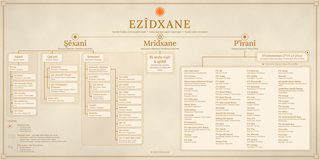

The Ezidi people is divided into 3 castes (in Ezidi a caste is called qebîl). These are Şêx, Pîr, Mirîd.
Pîr and Şêx are representatives of the clergy. Mirîd are laypeople; for the most part it is precisely the Mirîd who become «Aghas and Begs», i.e. rulers of their «e'şîr» (e'şîr are tribes or tribal unions that include all representatives of the Ezidi people, all 3 castes).
As already mentioned above, in the religion ŞerfeDîn all numerical values have their own reason of origin. Let us consider the division of the people into «three» castes – or rather, where does the number «three» come from? First of all, a stanza from the prayer Qewlê Şîxadî Şêxê Siyara needs to be analysed:
Dîn û Îmana me ji wane – Dîn (religion) and our Îman are from them – the first stanza unites everything spiritual of the Ezidi people in the form of two comprehensive concepts, Dîn (religion) and Îman; we have already considered these concepts in the chapter «Mthaira, E'debî, Êzdî», but note that the most important principle of the spiritual is missing here – faith. The concept «Bawerî – faith» is missing because here it is already about the «people». As we know, the concept of «faith» is higher than the concepts «Dîn» and «Îman»; consequently there is a concept that stands higher than «people», and that is human being. We must first and foremost remain «human beings» and maintain our «humanity». Everyone can have his own religion, represent his own nationality, but all of us are connected by the concept of the human being and by the spiritual concept that unites all people – faith. So when it is about a specific people, the spiritual is considered in this case on an «individual basis»: earlier it was only «Îman»; afterwards, because of differing interpretations and the emergence of other religions in the world, the concept «Îman» was supplemented by an independent concept, «Dîn». Now we understand why the concept «Bawerî – faith» is missing here, and we get literally: «Our Dîn and Îman are from them».
Heqîqeta ta me ji grîvane – Our true knowledge comes from «grivane» – as for heqîqet, it has already been written in the book that these are servants of religion, or rather the true service of one's religion. The Ezidis draw their knowledge of the religion ŞerfeDîn from the «Ulim – prayers» (we will discuss these in another chapter). So these «Ulim – prayers» all come from «grîvan». Grîvan means, as it were, knowledge, and this «grîvan» is ultimately sent down by the archangel FerxeDîn; one says: «our true religious service rests on knowledge that comes from the "grivana Melek FerxeDîn"».
Zanibin Tawusî Melek, Sultan Şîxadî, Sultan Êzîd ji sur'a XWADÊNE – You know, archangel Tawus, Sultan Şîxadî, Sultan Êzîd come from the power (the radiance) of GOD – this line supplements what we explained before; we now see the names of three archangels, and all three – Tawusî Melek, Sultan Shikhad, Sultan Êzîd – are created and revealed from «sur'», that is, from the power (the radiance) of GOD. Here a connection can already be seen between the three castes and the three names of archangels; more precisely, the particularities of the three castes are named «in honour» (note: in honour, no more and no less) of three archangels.
What happens next probably becomes the turning point in the Ezidi caste structure and means equality of rights for all castes
Çi qendîleke mezine – This great «foundation stone» – in the translation you have already noticed that the words «foundation stone» and «strive» are put in quotation marks, because it is often difficult to choose a word that fully conveys the meaning when translating into a foreign language... That is why, as you see, stanzas are explained twice: first comes the bare (literal) translation, then a translation according to the meaning. The word «qendîl» means a foundation stone or, let us say, a source, a beginning, where someone or something is hidden. And the second word, «momn», means that for which there is a need, or that for which you strive. Finally, the first two lines, «Çi qendileke mezne, P'îranî le buya momne», mean that there is a certain foundation stone for which the Pîr «strive». If we finally connect «qendîl» and the name «Pîr», we get «qebila Pira – the caste Pîr». The third line answers the question in whose honour the caste Pîr was created.
Xerqe hatye bona Melekê Melekane – Xerqe was sent down for the archangel of all archangels – Xerqe (the first sanctuary, the first relic revealed in the universe), and the most important prerogative, i.e. the most important function, of Xerqe is its role as «testimony» of everything created by GOD. So Xerqe was sent down to the angel of all archangels, and the archangel of all archangels is, as already mentioned above, one of the 1001 names (attributes) of the archangel Tawus. From this stanza we see, by and large, that there is a certain foundation stone for which the Pîr strive; this foundation stone and the name «Pîr» produced the «caste Pîr», and this was attested by means of Xerqe; moreover, the whole is connected with the name of the archangel Melekî Tawus. Finally, this connection between the caste «Pîr» and the name of the archangel Tawus leads to the caste «Pîr» being created in honour of Melekî Tawus. This rule, as we will notice later, will with regard to the two castes Şêx and Mirîd be connected with Xerqe and, above all, be attested by it.
Çi qendîleke nurîne – This radiant «foundation stone», Şêx le bune bangîne – «turn» to it» – The meaning of these lines is practically identical to what was written about the Pîr; again there is a certain radiant (nurin) «foundation stone» to which the Şêx turn (bangîn).
Xerqe buye nîşana Şixadîyê Sltuane – Sultan Şîxadî became the guardian spirit of Xerqe – The most important thing here is the word used, «nîşan», which literally means «sign», i.e. «symbol». Please note that we say «Xerqe nişana Sultan Şixadiye» only with regard to Sultan Şîxadî, i.e. Şîxadî is a guardian spirit of Xerqe (that is why all Ezidis say Xerqe Şîxadî). Having understood the meaning of this stanza as a whole, we now see that there is a certain «foundation stone» (qendîl) to which the Şêx «turn», and the name Sultan Şîxadî; all this led to the emergence and creation of the caste «Şêx» in honour of Sultan Şîxadî.
We qendile jide – Lay this «foundation stone» – It is time to lay this «foundation stone» once and for all and to find a place for it.
Xerqe buye nîşanga Sultan Êzîdê – Xerqe became the sign of Sultan Êzîd – The main thing here is to pay attention to the word «nîşange», because there is a difference between «nîşan» and «nîşange». In Ezidi a sanctuary or a relic is called «nîşan»; this means that this sanctuary is a symbol and belongs to an archangel or angel: Xerqe nishana Shikhadie – Sultan Şîxadî is the guardian spirit of Xerqe, and at the same time it is his sign. But when the word «nîşange» is used, this means that it is only his symbol for a «certain time» or «in a certain place», but this archangel (angel) does not become its guardian spirit. That is why with regard to Sultan Êzîd one uses the phrase Xerqe nishanga Sultan Ezide. This is explained by the fact that Xerqe became the «sign» (nishanga) of Sultan Êzîd «on earth» for a certain time.
E'debya hildaya nave bave Mrîde – The E'debî took the name of the «father Mirîd» – After Xerqe had become the symbol of Sultan Êzîd on earth, the «foundation stone» that was to complete the formation of the Ezidi people was named in honour of his name; this caste was called Mirîd. The E'debî took the name of the «father Mirîd» – why are the words «father Mirîd» used here?
When we consider the clergy, we must specify that Şêx and Pîr are servants of religion of the hierarchy of archangels and angels on earth: there is, for example, the lineage of Şêx on earth called Şêxê Şemsa, and they are servants of religion of the archangel ŞemseDîn on earth. To avoid «sacrilege», the servants of religion of the hierarchy of archangels and angels on earth are called «micewr», which means servants. Above all, one must understand that the Şêxê Şemsa do not descend from the lineage of Melek ŞemseDîn himself and are not his «descendants»; they are merely «micewr – servants» of the archangel ŞemseDîn. Almost every archangel or angel (with the exception of some Upper Archangels) has his servants of religion on earth.
This exception is formed by two archangels: Melekî Tawus and Sultan Şîxadî – among the Ezidi people there is no lineage P'îre Melekî Tawus or Şêxê Şîxadî. They are absent because in that case the equality of the castes in the Ezidi people would be lost, i.e. all Şêx and Pîr would serve only these two lineages. Their absence led to an «enormous» equality of rights for the whole Ezidi people; consequently every Şêx and Pîr had his own Şêx and Pîr. As a result, there is no lineage of Şêx and Pîr that does not have its own Şêx and Pîr. Subsequently Şêx and Pîr were described as «du navi – with two names», and the Mirîd are called «yek navi – with one name». Şêx and Pîr are called «du navi» because from the point of view of the castes they are either Şêx or Pîr, but with regard to their own Şêx and Pîr they are Mirîd. Finally, dear readers, we get an answer as to why the line of the prayer says «E'debya hildaya nave bave Mrîde – the Adabya took the name of the "father Mirîd"». First, the name of the father Mirîd – or rather the very word «father» – is connected with the fact that all three castes without exception that make up the Ezidi people are «Mirîd» with regard to their own Şêx and Pîr (i.e. all of us, and all those who lived before or will live after us, our fathers and forefathers as well as our descendants, are «Mirîd» with regard to their own Şêx and Pîr). Since the meaning of the name «Mirîd» had come to encompass all the castes (and we know that the third caste, «Mirîd», was created in honour of Sultan Êzîd), the actual name of the archangel Ezid also came to encompass the whole people E'debî; that is why all Ezidis always say: «K'ê ne mirîde, ne êzidîye». As we all know, Ezidis today are called either the «Ezidi people» or «the people Êzdî». This people, Êzdî, sees the way of GOD and lives according to His laws. In addition, the Ezidis bear the name of the archangel Sultan Êzîd, who was revealed by GOD and is a «holy king» of all Ezidis.
After a brief acquaintance with the castes – which was named in whose honour and what they have in common – let us consider the internal structure of the caste system, briefly, with regard to Şêx and Pîr.
The caste Şêx is divided into three great houses:
Zer'zanî – mjewri, «servants of religion» of the hierarchies of the archangels ŞemseDîn, FerxeDîn, SicaDîn, NasirDîn.
Qat'anî – mjewri, «servants of religion» of the hierarchy of the archangel Şêxûbekir.
Adanî – mjewri, «servants of religion» of the hierarchy of the archangel Şîxsin.
The Pîr were originally divided into 90 lineages; later their number decreased to 40 lineages. At the head of all 40 (forty) lineages stands the lineage P'îre Hesmemane. Here are some names of the lineages of the caste Pîr:
P'îre H'esmemana, P'îre Omerxala, P'îre Îsîbya, P'îre Liblana, P'îre Xacialiya, P'îre Merqebesa, P'îre Mamer'eşana, Pire Qedibilbana....
Finally, on the basis of these «three» castes, «three» holy postulates were revealed for an «Ezidi», or, as the people call them, «Sê (3) H’erf».