
After the death of Şêx Adî, members of his family took over the leadership of the community that had formed around his tomb in Lalîş. Arab chroniclers call them Adawiya (“the followers of Adî”) after him. In the 13th century it came into conflict with the rulers of Mosul, while a branch of the family lived in Syria and Egypt under the protection of the Mamluks. This account follows John S. Guest, who evaluates above all Arabic sources.
The first successors in Lalîş
| Person | Details in Guest |
|---|---|
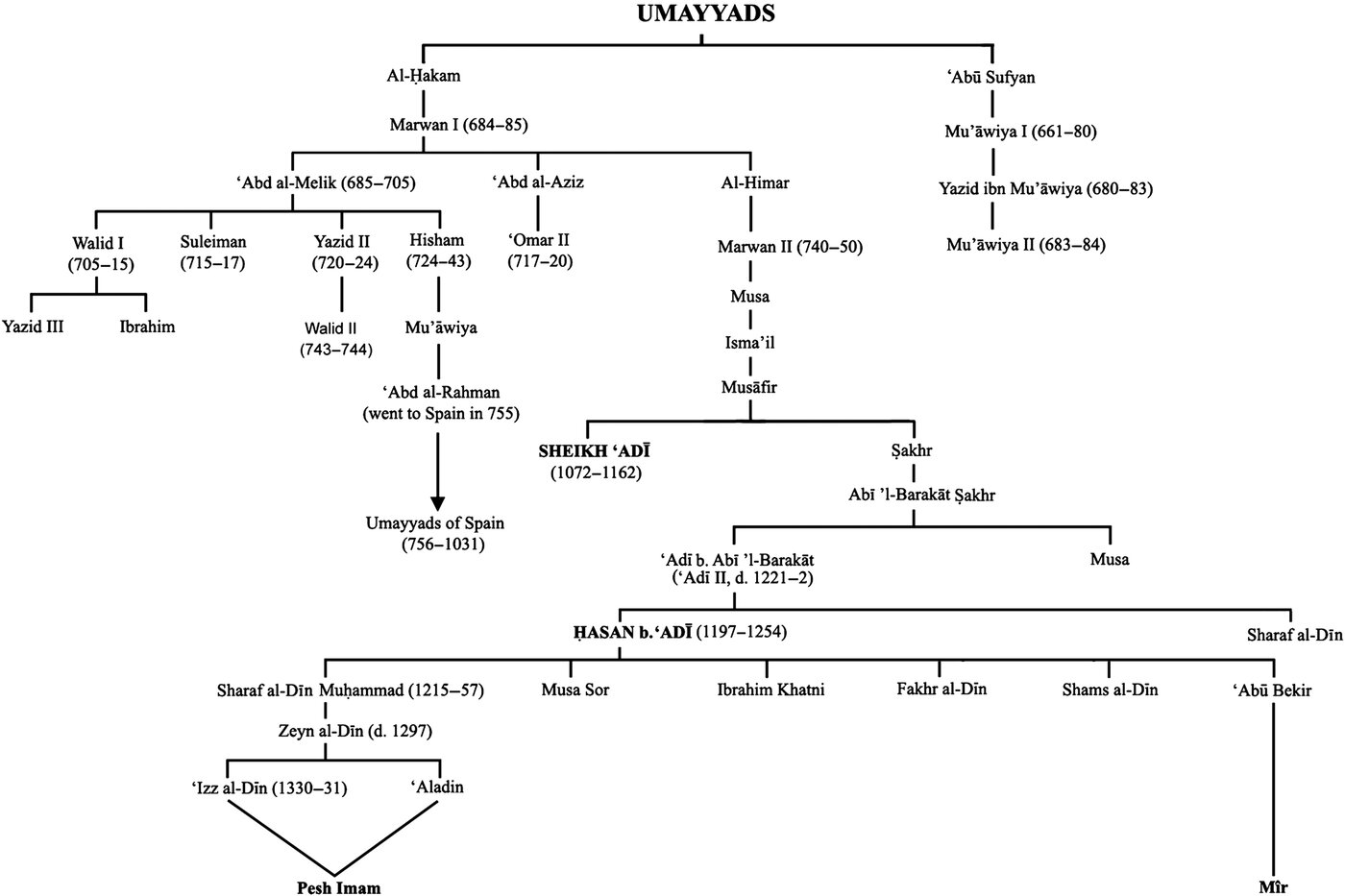
| Ebû l-Berekat (Abu l-Barakat b. Sakhr) | Nephew of Şêx Adî from his home village of Beit Far in Lebanon; first successor. He was buried near the tomb of Şêx Adî. |
| Adî b. Ebî l-Berekat | Son of the former, called “father of goodness”; the first Şêx of the family born in the Hakkari mountains. |
| Şêx Hesen (Hasan b. Adî, b. 1195) | Lived six years in solitude and wrote a work now lost. He demanded strict veneration of Şêx Adî and absolute obedience. Tradition attributes the “Black Book” (Meshefa Reş) to him. Executed in Mosul in 1246. |
| Şerfedîn Mihemed | Son of Şêx Hesen. In 1257, on behalf of the Seljuk sultan Izz ad-Din Kaikaus II, he held the fortress of Harput and fell in the battle at the Kemah gorge below Erzincan against the Mongols. In Şengal he is regarded as patron saint. |
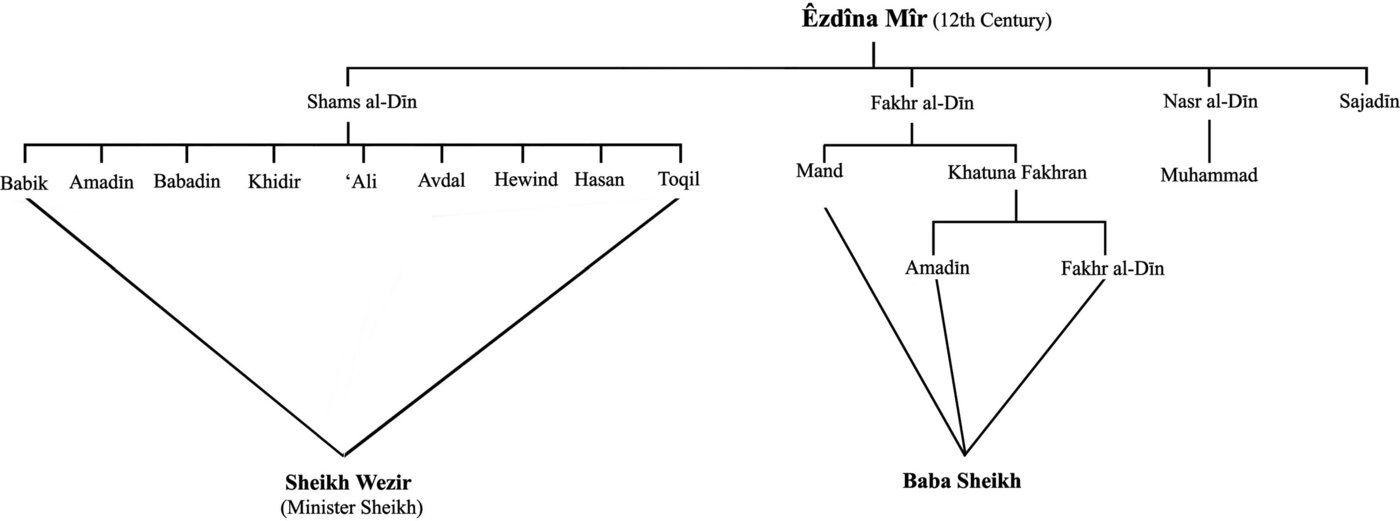
The Şêx line of the Şêxsin later emerged from the family of Şêx Hesen.
Conflict with Mosul
The ruler of Mosul, Badr ad-Din Lulu, had Şêx Hesen strangled in 1246 and in 1254 sent a punitive expedition during which the bones of Şêx Adî were burned – see Ferman in the Middle Ages.
According to the Syriac chronicler Bar Hebraeus, in 1275 two brothers of the family of Şêx Adî quarreled because the younger had married a Mongol woman. The elder moved to Syria with 400 followers together with horses, sheep and cattle; the younger fled to Egypt with his wife in 1276. In 1281 the elder returned, asked the Mongol Ilkhan for mercy and was executed. With this the contemporary reports about Lalîş end for a long time.
The Adawiya in Syria and Egypt
Under the Mamluks, the veneration of Şêx Adî flourished in Syria. At the end of the 13th century the scholar ash-Shattanaufi compiled a life of Şêx Adî with accounts of miracles.
- Zeynedîn Yûsif, a son of Şerfedîn, lived in Damascus and in Beit Far. Thanks to the gifts of his followers his hermitage was rich. He founded a community in Cairo and died there in 1297. His mausoleum (damaged by fire in 1907, restored) is regarded as an important monument of Cairo.
- Izz ad-Din, son of Zeynedîn, was head of the Syrian Adawiya in 1330/31. The sultan of Egypt suspected his followers of planning an uprising; Izz ad-Din died in prison.
- Descendants of his brother lived for at least five generations in Jebel Seman (Çiyayê Lêlûn) west of Aleppo, where Ezidi villages exist to this day.
Muslim theologians viewed the community critically. In the early 14th century Ibn Taymiyya wrote an epistle to the Adawiya in which he censured the veneration of Şêx Adî and Şêx Hesen. Another theologian named the Adawiya in the same breath as the venerators of the caliph Yazid; according to him Şêx Hesen had sent preachers as far as Hit on the Euphrates.
The travelers Ibn Battuta (1327 in Mosul, Cizre and Beled Sinjar) and al-Umari (1338) do not mention Lalîş.
Spread in the 14th and 15th centuries
In the 14th and early 15th centuries the community spread rapidly. According to Guest, whole tribes joined it; there are no sources on the nature of this spread. Around 1415 the Kurds called the followers of Şêx Adî “Sohbetiye” (“the companions”). In the 16th century the Sheref-name (1597) counted seven large tribes of the region as wholly or partly belonging to the Ezidi religion – see Ezidis under Mongols, Turkmens and Ottomans.
Interpretations
How the community around Şêx Adî became the Ezidi people with its religion is disputed:
- Some researchers suspect that in the turmoil of the 13th and 14th centuries a new religion arose from elements of various teachings. This is a thesis; no tradition names a founder.
- Many Ezidis – and also the position of this site – regard the religion as very old. According to this view, its followers at times outwardly professed other religions but preserved the old faith; Şêx Adî renewed it, he did not found it. Guest also reproduces this view.
Sources
- Birgül Açıkyıldız: The Yezidis. The History of a Community, Culture and Religion. London 2010, p. appendix II (ill.)
- John S. Guest: The Yezidis. A Study in Survival. London/New York 1987, p. 36–47, 61
Found a mistake?
Is something wrong – a fact, a spelling, a source, an image? Let us know: we check every report and correct the article.
Other spellings: Sheikh Hesen · Scheich Hesen · Sex Hesen · Sexsin · Schechsin · Shekhsin · Zeynedin Yusif · Sheikh Adi · Scheich Adi · Shaikh Adi · Şêxadî · Shikhadi · Lalish · Lalisch · Lalesh · Mossul · Mûsil · Sheikh · Scheich · Shex