
For the Ezidis there is one central holy place: Lalîş in the district of Şêxan in northern Iraq, with the tomb of Şêx Adî (Omarkhali 2023, p. 21). Besides it there are hundreds of smaller sanctuaries: tomb buildings of saints, places of light, caves, springs, trees and stones. Kreyenbroek calls the village sanctuaries usually the center of village life (pp. 13–14).
A holy place and the visit there are both called ziyaret (Omarkhali 2023, pp. 45, 133).
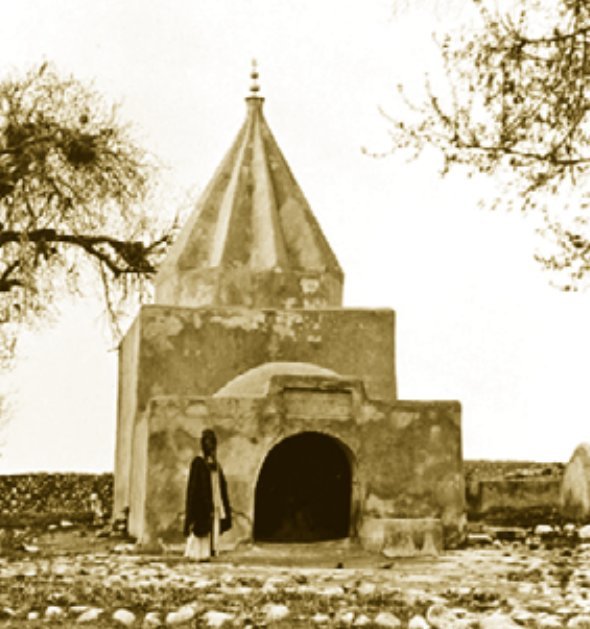
Lalîş – the center
According to tradition, Lalîş is the first solid place on earth; God sent it down from heaven (Omarkhali 2023, pp. 103–110 according to the hymns; Kreyenbroek, p. 21). Every tree and every stone there has its holiness (Lalişa Nûranî, pp. 20/23). According to Şêx Mak’sîm, every Ezidi should visit Lalîş at least once in his life and be consecrated with the water of the Kaniya Sipî (Şêx Mak’sîm, p. 175). Everything about the sanctuary is in the category Lalîş.
Whoever has made the pilgrimage to Lalîş may call himself Hecî (Pirbari, glossary p. 258).
Where one turns in prayer
The Ezidis pray toward the sun (Kreyenbroek, p. 14); every morning at daybreak they turn to the east and greet the light of God (Lalişa Nûranî, pp. 6–7). The Pirbari glossary names Qublet-Lîdor as the "Qible" of the Ezidis, the holy place toward which one turns one's face in prayer (p. 251); elsewhere it calls the Kaniya Sipî the Qible (p. 78). Besides Lalîş, according to Pirbari, Jerusalem and the Kaaba as the "old house of Birahîm" are also venerated (p. 16). Kreyenbroek mentions heavenly counterparts of Jerusalem, Mecca and Medina in the hymns (p. 21).
Kinds of holy places
| Kind | What it is | More |
|---|---|---|
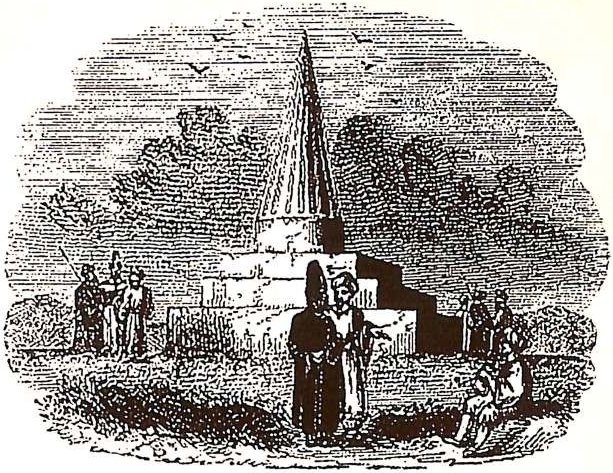
| Qub, Mezar | tomb building or memorial building of a saint, often with a white, ribbed conical dome | Mezar, Qub and Nîşan |
| Nîşan, Nîşangeh | small, whitewashed site with a niche for an oil light, dedicated to a holy being | Mezar, Qub and Nîşan |
| Şikeft (cave) | place of devotion or of hermits, often with a light niche | Lalîş |
| Kanî (spring) | holy water for consecration and healing | Lalîş |
| Dar (tree) and Ber (stone) | places for wishes and vows; people tie ribbons to them | Ziyaret – visit and rules |
| Stêr | the holy place in the house where holy objects lie | Holy signs and objects |
According to the faith, many sanctuaries heal particular illnesses and have their own rituals for this (Kreyenbroek, pp. 13–14). The graves of great experts in the religious tradition also become places of pilgrimage, for example the grave of P’îr Memed in Pamp in Armenia (Omarkhali 2023, p. 133).
Who guards the sanctuaries
Every sanctuary has a guardian, the Micêwir. He is usually a Şêx or P’îr, sometimes a Feqîr, and is regarded as the "local priest": he looks after the sanctuary, takes part in burials and organizes the annual festival (Kreyenbroek, p. 11). According to Lalişa Nûranî, he lives from donations and helps to settle disputes (p. 205). Highly respected is the Micêwir of the Kaniya Sipî in Lalîş (Kreyenbroek, p. 11).
The festival of the sanctuary
Every village sanctuary has its feast day: in Şêxan the Tiwaf, in Şengal the Cema. The festivals fall on fixed days from April to the end of June (Omarkhali 2023, p. 25; Kreyenbroek, p. 15). See Other festivals.
Where the sanctuaries stand
- Şêxan and Şengal in northern Iraq have the most sanctuaries: Sanctuaries in Şêxan and Şengal.
- In the Caucasus and in the diaspora, holy places arose in nature as well as new buildings: Sanctuaries in the Caucasus.
- A list of all recorded buildings in northern Iraq with building form and dating is offered in the section People & Culture: Sanctuaries and mausoleums in northern Iraq and Sanctuaries in Armenia, Turkey and Syria.
Destruction
In 2014 and 2015 IS destroyed many holy places in Şengal, Başîqe and Behzanê (Omarkhali 2023, p. 21). See Şengal 2007 and 2014.
Sources
- Philip G. Kreyenbroek, Khalil Jindy Rashow: God and Sheikh Adi Are Perfect. Sacred Poems and Religious Narratives from the Yezidi Tradition. Wiesbaden: Harrassowitz 2005, p. pp. 11, 13–15, 21, 38
- S. A. Grigoriev, L. V. Ivasko, D. V. Pirbari (P’îr Dîma): Lalişa Nûranî / Святой Лалыш / Holy Lalish. Yekaterinburg: Basko 2008, p. pp. 6–7, 18, 20, 23, 166, 205
- Khanna Omarkhali: The religious textual tradition of the Ezidis – from the oral to the written. Saint Petersburg 2023 (Russian translation of the English original, Wiesbaden 2017), p. pp. 21, 25, 45, 103–110, 133
- Dimitri Pirbari (P’îr Dîma), A. Ščedrovickij: Тайна жемчужины (The secret of the pearl). Moscow/Tbilisi 2016, p. pp. 16, 78 (text and ill.), 251, 258
- Şêx Mak’sîm (Maksim Ezdi): Grundpfeiler der Religion ScherfeDin, 2017 (on EZDIKI.COM in the Religion section and in the library), p. p. 175
Found a mistake?
Is something wrong – a fact, a spelling, a source, an image? Let us know: we check every report and correct the article.
Other spellings: Nisan · Nischan · Nishan · Nisangeh · Nischangeh · Nishangeh · Lalish · Lalisch · Lalesh · Shekhan · Scheichan · Shaikhan · Sheikh Adi · Scheich Adi · Shaikh Adi · Şêxadî · Shikhadi · Sinjar · Sindschar · Shingal