
The sun – in Ezidi Şems, in everyday speech also roj – is, besides the peacock, the most important emblem of the Ezidis. It appears on all three present-day Ezidi flags, on sanctuaries and monuments. Ezidis pray facing the sun and swear by it. For them, however, the sun itself is not a god: it is a sign of God and of his angel.
Şems and Şêşims
- According to tradition, the sun is connected with the angel and saint Şêşims (Şêx Şems, Şemsedîn); an expression runs Şêşims nûr e – “Şêşims is light” (Omarkhali).
- According to a tradition reproduced by Perminov, Melek Şems breathed the soul into the first human being; for this reason and because he is the angel of the sun, prayers and customs are to be performed toward the sun.
- In Ezidi tradition the sun is male, the moon female (Omarkhali).
- The Şêx families of the Şemsanî trace themselves back to Şêx Şems (see Caste system).
Prayer toward the sun
- One prays standing, facing the sun, the right hand on the left. The direction of prayer toward the sun is called Qubleta bi dor (Omarkhali).
- The morning prayer is said at sunrise, the evening prayer before sunset; in the evening one turns to the west (Omarkhali, Polatov).
- In 1936 Lescot described prayers in Şengal and Syria at dawn and dusk and at the rising and setting of the moon, standing turned toward the heavenly body, arms crossed in front of the chest.
- The prayers themselves belong to the section Religion.
Not “sun worshippers”
Neighbors and travelers sometimes called the Ezidis “sun worshippers”. Perminov, who wrote his book together with Ezidi Şêx and P’îr, calls this a gross error: sun worshippers consider the sun a god; for the Ezidis the Highest is the one God, and they only pray in the direction of the sunlight. The comparison is obvious: whoever prays toward the east or toward a sanctuary does not worship the cardinal direction.
Oaths by the sun
Among the gravest oaths Omarkhali counts the oath by Şems, the double oath Xwedê-Şems (“by God and the sun”), the oath by the direction of prayer Qubleta bi dor, and the exclamation “Wê rojê!” – “by this day / this sun”.
The sun on sanctuaries
- Orientation: The buildings in Lalîş lie east-west, according to Açıkyıldız because of prayer toward the rising and setting sun.
- Şêx Şems in Lalîş: According to Ezidi belief, the first rays of the sun fall on the fluted conical roof of the mausoleum of Şêx Şems; that is why it stands at this spot. Layard heard the same already in 1846: the sanctuary was built so that the first rays of the rising sun fall on it (nineveh1 p. 288).
- Conical roofs: Ezidis regard the ribs of the fluted conical roofs as rays of the sun, the cone as a sun sign directed toward heaven (Açıkyıldız; see Sacred architecture). According to Edmonds, a fluted tower is carved into the stone above the entrance of the tomb of Şêx Şems; inside, a small flame was burning in 1944.
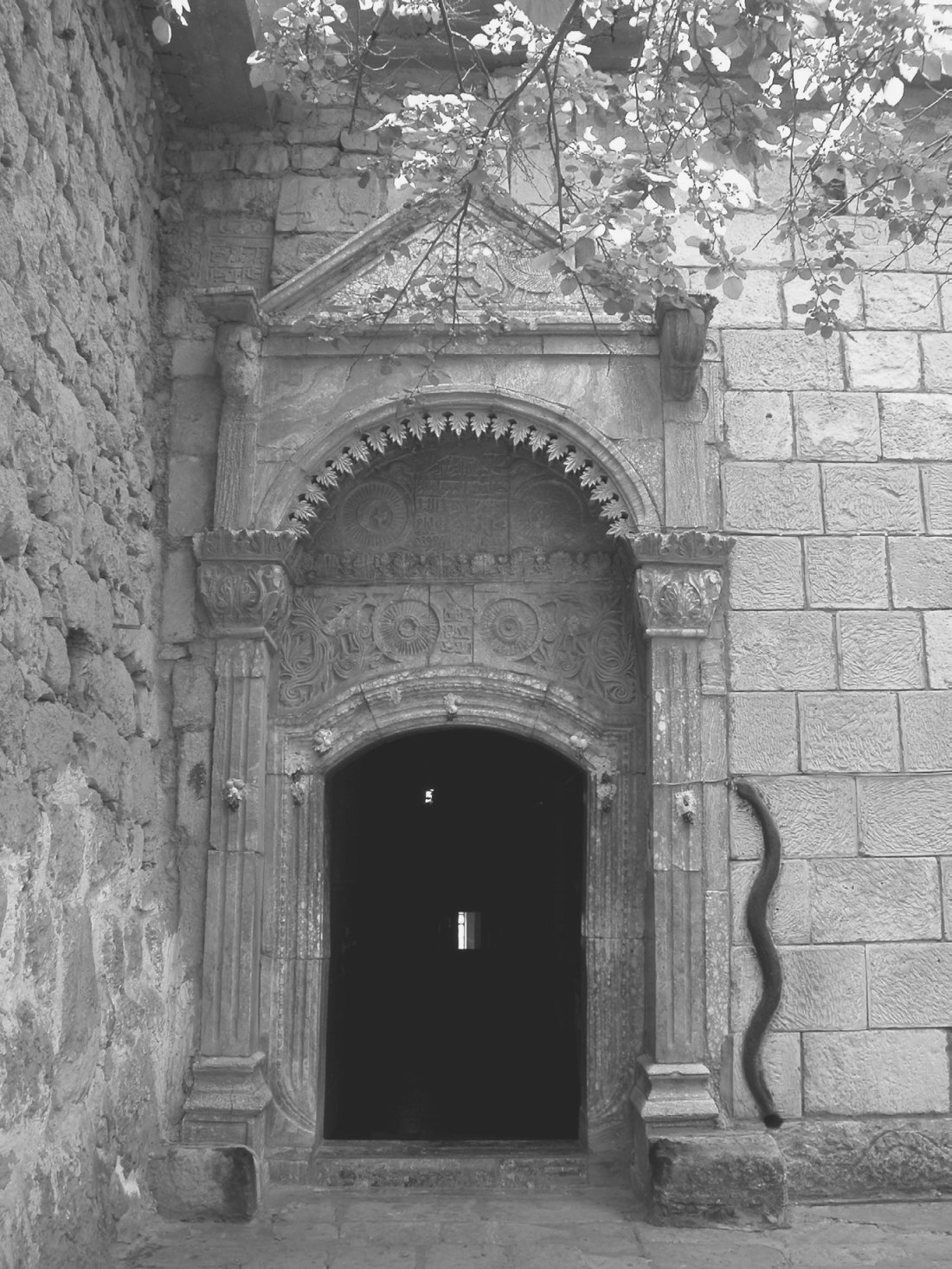
- Gate Derîyê Kapî: In the tympanum there are two radiant sun disks to the left and right of an Arabic inscription with the year 695 of the Hijra (1295/96); the gate itself was renewed at the beginning of the 20th century.
- Reliefs: On the wall beside the portal, in 1944 Edmonds saw, beside the snake, a relief with sun, moon and stars in a circle.
The sun in custom
- Autumn festival: The climax of the autumn festival Cejna Cimayê is the sacrifice of a white bull at the sanctuary of Şêx Şems in Lalîş (see Qebax).
- Sun festival: For Şengal and Syria in 1936, Lescot names an Îda Roja (“sun festival”) on December 1 with three fast days (see Festivals and fast days).
- Burial: The dead person is laid with the head toward the east, toward the rising sun. According to Perminov, a small fire is lit on the grave for three days, as a “sign of the people of the sun” (see Burial and mourning).
- Four-wicked lamp: At the Sersal festival of 1940 in Başîqa, the Koçek lit a lamp with four wicks in the sanctuary of Şêx Mihemed; according to the host Reşîd, the four flames stand for the four quarters of the world and the path of the sun (peacock p. 116, 120; see Sersal in Başîqa 1940).
- Dance: The round dance Govend is danced in a circle in the direction of the sun’s course (see Instruments and dance).
Sun customs in Armenia according to the grade 8 school textbook
The Ezidi grade 8 school textbook (T’amoyan et al., 2011) describes customs of the Ezidis of Armenia:
- Morning: One rose before sunrise, washed head and face, turned to the east, placed the right hand on the face and said “Ya Şems, tu k’omekê bidî me” (“O Şems, help us”). The childless asked the sun for offspring, the poor for a livelihood, the sick for health.
- Greeting, oath, curse: One greets with “R’oja te bi xêr”, swears with “Ez vî şemsîkim …” and curses with “Şems belakê ter’a bîne” (see Greetings and rules of conduct). A frequent greeting in remembrance of the deceased runs “R’e’ma Şems li r’uh’ê dû bavê teve”; according to belief, the souls of the dead also need the grace of Şems.
- Solar eclipse: Children were then not allowed out of the house and, if they were outside, not allowed to look at the sun. An eclipse was regarded as a portent of war.
- Graves: Graves are dug from east to west, the dead person laid with the face toward the east; likewise in Şengal.
- Şêxê Şemsa: Some of the Şêx in Armenia are called Şêxê Şemsa; they went through the villages every year and collected the offering for Şems. For healing, a Şêx struck the sick person on the head with a staff and asked Şems for help.
- Names: According to the book, the clan Şemska in P’ampa (Axbaran district) came from the Euphrates via Entab and, after the war of 1877–78, to Eastern Armenia. The Ezidis also call themselves Miletê Şems (“people of the sun”).
The sun as a sign of the people
- The first primer for Êzdîkî (1921) was called “Şems” (see Schools and alphabets in Soviet Armenia).
- S. M. Polatov called his book on the Ezidis (2011) “Children of the Sun”.
- At the sanctuary in Aknalich (Armenia), the monument “Friendship and Brotherhood” shows the Ezidi sun beside the Armenian cross (Sloyan).
- On the flags, the sun appears with 23 or 24 rays (see The flags of the Ezidis).
Theses of origin
Some authors derive the Ezidis from an ancient sun cult, for example Polatov (from yazata, an Iranian deity) or Perminov (via Sumer and Egypt). These are theses of the authors that are not documented (see Traditions of origin).
Sources
- E’zîzê E’mer, H’esenê Şêx-Me’mûdê: E’debyet û zimanê êzdîkî, grade 8. Yerevan: Spîka 2011, p. p-036–039
- Khanna Omarkhali (Ханна Омархали): Йезидизм. Из глубины тысячелетий (From the depths of the millennia). Saint Petersburg 2005, p. p. 43–44, 72–73, 128–129, 149–151
- A. V. Perminov: Езиды – древний народ Адаби (The Ezidis – the ancient people Adabi). Sharya 2016, p. p. 85, 90, 92, 105, 110
- Roger Lescot: Enquête sur les Yezidis de Syrie et du Djebel Sindjār (Study of the Ezidis of Syria and of the Şengal mountains). Beirut 1938, p. p. 69–70, 71
- S. M. Polatov: Дети Солнца (Children of the Sun). Rybinsk 2011, p. p. 17–18, 47
- Birgül Açıkyıldız: The Yezidis. The History of a Community, Culture and Religion. London 2010, p. p. 115, 130, 145, 166, 177, 253 (n. 318)
- C. J. Edmonds: A Pilgrimage to Lalish. London (Royal Asiatic Society) 1967, p. p-025, p-031–032
- Mirza Sloyan (Mirzoyê Çolo Siloyan): Дорога, ведущая в храм. Три года спустя (The road leading to the temple. Three years later). Yerevan 2015, p. p-087–088, p-167
- Austen Henry Layard: Nineveh and Its Remains, Vol. 1. London 1849, p. p. 288
- E. S. Drower: Peacock Angel. Being some Account of Votaries of a Secret Cult and their Sanctuaries. London 1941, p. p. 116, 120
Found a mistake?
Is something wrong – a fact, a spelling, a source, an image? Let us know: we check every report and correct the article.
Other spellings: Sems · Schems · Shems · Sesims · Scheschims · Sheshims · Sex Sems · Sheikh Sems · Scheich Sems · Sex Schems · Sheikh · Scheich · Shex · caste system · Sinjar · Sindschar · Shingal · Shengal · Singal · Pîr