
An Ezidi festival is called Ayd. Before the great festivals there are three days of fasting; the fast days are called Rojî.
The rule
All periods of fasting begin on a Tuesday and last until Thursday. On the following Friday the Ayd is celebrated. The dates are calculated according to the prayer Dirozge and the Qewlê Cime’a Milet.
The festivals
According to tradition there are 13 Ayd in the course of the year. Among the Ezidis in the Caucasus and in Russia two above all are celebrated today:
- Ayda Êzîd – in December. It commemorates the coming of Sultan Êzîd, who according to tradition saved the people; under his rule the people is said to have experienced its heyday.
- Ayda Xidir Nebî – in February. Xidir Nebî is regarded as Mirazbexş, the bringer of fortune to the family.
Perminov attributes the fact that many festivals have fallen into oblivion to centuries of persecution, assimilation and the adoption of festivals of other peoples.
The exact dates of all festivals are in the Ezidi calendar.
The festivals according to Polatov
In “Children of the Sun” (2011) S. M. Polatov describes the festivals as the Ezidis in Armenia and Russia observe them:
- Ayda Êzîd – mid-December, one of the main festivals, also the “day of reconciliation”. Before it there are three days (Tuesday to Thursday) of strict fasting: until sunset neither eating nor drinking nor smoking. On Thursday evening one visits families who have recently lost a relative. On Friday all families lay their tables early, people go from house to house and offer congratulations until late in the evening.
- Ayda Xidir Nebî and Xidir Ilyas – on the third Friday in February, after three days of fasting; according to Polatov the second most important and one of the most popular festivals. Xidir Nebî is regarded as the patron of lovers, who fulfills wishes, Xidir Ilyas as the protector of the sick, travelers and prisoners. On the feast day young people eat salted flatbreads in order to see their future spouse in a dream.
- New Year (Serê Salê) – on the Wednesday of the first week of April according to the eastern calendar. According to tradition God sends an angel every year who adorns the earth with flowers and greenery; April (Nîsan) is called the “bride of the year”. The housewife puts eggs dyed red, yellow and green on the table; farmers scatter the colored shells on the fields. The New Year cake Kiloça Serê Salê is baked.
- Çilê Zivistanê – in January at the end of the 40-day winter fast.
- Çilê Havînê – in July after the 40-day summer fast; according to Polatov celebrated above all in Lalîş and in Iraq, not observed by the Ezidis of the CIS.
- Ayda Cemayê – the particularly solemn festival in honor of Şêx Adî.
For Ayda Êzîd and Xidir Nebî the information agrees with the rule in Perminov (three days of fasting, festival on Friday). For the New Year the sources differ: Polatov names the first Wednesday in April according to the eastern calendar, Perminov the equinox on March 20 or 21. Also, according to Polatov, pearls are baked into the New Year cake and it is distributed on Thursday morning; according to Perminov a coin.
Remembrance of the dead
At New Year and at Xidir Nebî, according to M. B. Rudenko, the dead are also remembered and food is distributed as xêra miriya, “gift for the dead”. At these festivals, too, the mourning after a death is often solemnly ended (see Days of remembrance for the dead).
Spring festivals in the Kars region
Among the Sîpkî in the Kars region people celebrated in spring with zurna and drum; families invited each other over several days. The festival Barodan was observed when the livestock was driven up to the summer pastures, when the lambs came back to the ewes. In summer the young went out into the open on holidays, for instance to Mount Gülheyran (see Tree of fortune).
In the diaspora
In Yaroslavl the Ezidi community celebrates the festival of Xidir Nebî with a concert; at the city festival of 2000 it presented its New Year celebration with folk dances (see Ezidis in Russia).
Festival dates compared across the sources
The sources give the festival dates differently. Part of the differences is explained by the calendar: many Ezidis reckon the festivals according to the “eastern” calendar or the old style (Julian calendar), which today lags 13 days behind the generally used calendar. The statement “after February 13” in T’amoyan thus probably corresponds to the “first Friday in February old style” in Omarkhali.
| Festival | Omarkhali (2005) | T’amoyan (memorial volume) | Polatov (2011) |
|---|---|---|---|
| New Year (Kiloça Serê Salê) | first Wednesday in March (eastern calendar), among the Ezidis in Armenia, Georgia and Russia | a Wednesday in April (“Çarşema serê salê”), at the same time the festival of Tawûsî Melek | Wednesday of the first week of April (eastern calendar) |
| Çarşema Sor (“Red Wednesday”) | first Wednesday in April (eastern calendar), above all in Iraq and Syria | – | – |
| Xidir Nebî and Xidir Elyas | first Friday in February (old style), after three days of fasting | Friday of the first week after February 13, after three days of fasting | third Friday in February |
| Rojiyên Êzîd / Eyda Êzîd | festival on the first Friday in December (eastern calendar), preceded by three days of fasting from Tuesday | in December, after three days of fasting | mid-December |
| Çilê Zivistanê | end of the 40-day winter fast (December 13 to January 21, eastern calendar) | – | January |
| Çilê Havînê | July, end of the 40-day summer fast | – | July |
| Eyda Cemayê | seven days from September 23 to October 1 (eastern calendar / old style) | – | no date |
For the New Year the statements contradict each other most clearly: Omarkhali names March, T’amoyan and Polatov April, Perminov the equinox on March 20 or 21. Omarkhali supposes that in the 19th century New Year and Çarşema Sor were not yet separate but formed a single New Year festival.
Which festivals are celebrated where
According to Omarkhali there are clear differences between the communities, because the Ezidis of the former Soviet Union long had no contact with those in Iraq and Syria:
- Celebrated in Armenia, Georgia and Russia: New Year (Kiloça Serê Salê), Xidir Nebî and Xidir Elyas, Eyda Êzîd.
- Celebrated above all in Iraq and Syria: Çarşema Sor, Eyda Çilê Havînê (especially in Lalîş), Eyda Cemayê (the seven-day pilgrimage festival in Lalîş, also Cejna Hecîyan, “festival of the pilgrims”) and Eyda Bêlindê (from bilind, “high”), a winter festival in December or January with fires over which people jump.
- Çilê Zivistanê is kept only by volunteers, above all the Feqîr (ascetics).
- Eyda Qurbaniyê, the festival of sacrifice in memory of Birahîm Xelîl (Abraham), has no fixed date.
Omarkhali also names festivals of the patron saints of livestock Mamê Şivan (sheep) and Gavanê Zerzan (cattle), the festival Beran berdan (“releasing the rams”) in October or November and the festival Sada pez in the middle of winter. Before a festival there are usually three days of fasting (rojî): between sunrise and sunset nothing is eaten or drunk; the breaking of the fast is called fitar. A separate three-day fast in December is devoted to the household patron saint Xudanê Malê. For “festival” the Ezidis use the words eyd (ayd) and cejn.
Customs at New Year and Xidir Nebî according to Omarkhali
New Year

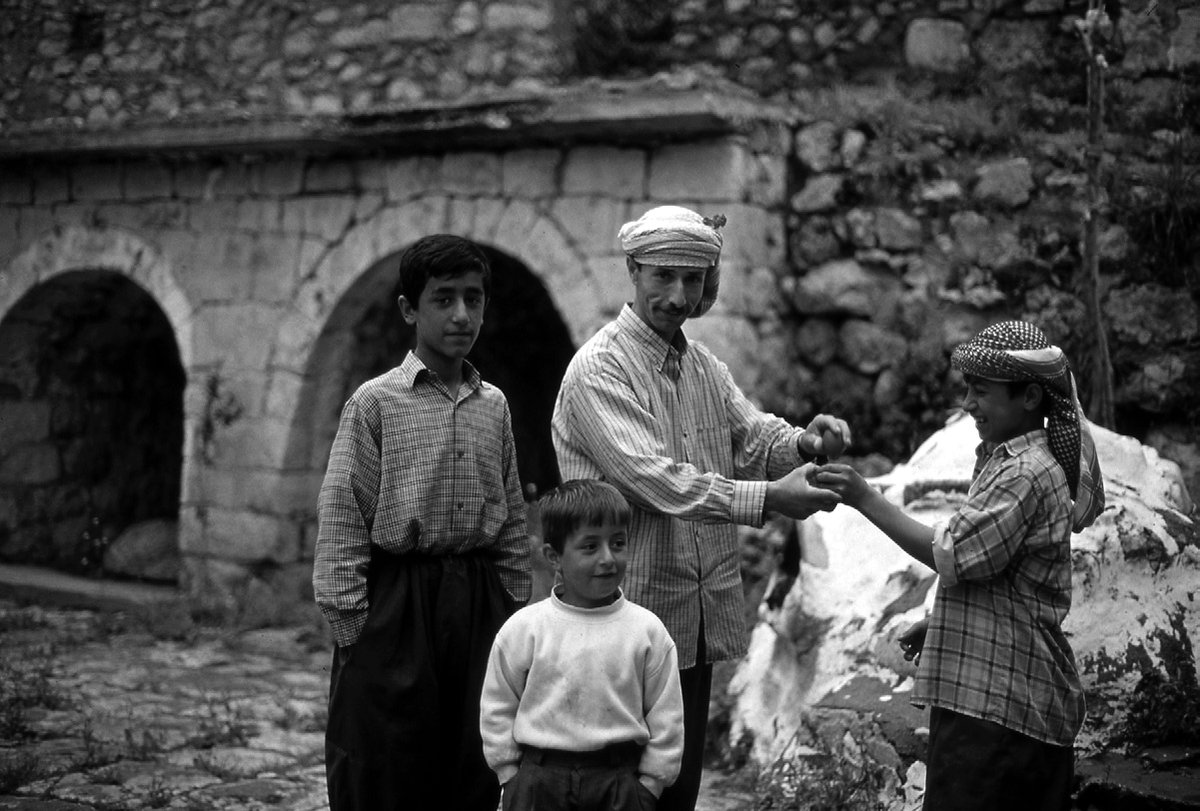
- In every house the New Year cake Kiloç is baked, with a pearl or small coin inside. Only the head of the family cuts it; one half is divided into pieces for patron saints, the other for the members of the family. Beforehand he breaks the cake on the back of the youngest son – this is supposed to give the boy strength.
- Eggs are dyed, above all red and yellow, knocked against each other, offered to guests and given as presents.
- A fire is lit and people jump over it – for purification from everything bad.
Xidir Nebî and Xidir Elyas
- In the night before the festival the villagers paint figures of animals and people with flour on the walls of the room with the clay oven (tendûr) and in the sheepfold (gom) and stable (tewle) – for plentiful offspring of the livestock and the blessing of children.
- In the night from Thursday to Friday one first visits families who have lost a relative in the current year and offers condolences (serxweşî), then relatives and neighbors. The men gather in the house of a respected P’îr or Şêx and listen to hymns and prayers.
- After the fast, young people eat a salty flatbread (totka şor) before going to sleep and drink nothing afterwards: in a dream their future spouse is supposed to appear and hand them a bowl of water.
- Formerly children on the eve let down a colorfully patterned woolen sock (dolîdang) on a string through the roof hatch (kulek) into the houses; the inhabitants filled it with sweets.
- At the door of the room a bowl of flour or p’oxîn (finely ground roasted wheat) is placed. If in the morning the hoofprint of the horse of Xidir Nebî is found in it, this promises good fortune.
Xidir Nebî is regarded as the patron of lovers and fulfiller of wishes, Xidir Elyas as the protector of the sick, travelers and prisoners – this agrees with Polatov.
Festivals as a support of the people
E’zîz T’amoyan writes in his memorial volume that the Ezidis observe their festivals with great reverence; they are a guarantee of the survival of the people. On the remembrance of the victims of the genocides see Roja Xezebê.
New Year celebration with the Sencaq in Aknalich (2015)
On April 15, 2015 the Ezidi New Year was celebrated for the first time at the sanctuary of Aknalich. According to Mirza Sloyan's book, the date followed from the rule that the New Year falls on the first Wednesday after April 13 – which corresponds to the first Wednesday in April according to the eastern calendar (see above).
For the celebration the Sencaq (peacock standard), which is kept in Armenia in the family of Şêx Aziz Ozmanyan in the village of Jrarat (Armavir province), was brought to Aknalich. After a festive meal in the Şêx's house a motorcade drove to the sanctuary, where the Sencaq remained for the day. Otherwise it is only rarely brought out of the house. President Serzh Sargsyan sent a message of greeting. At the celebration the newly endowed medals “Cangîr Axa” and “Ûsiv Beg” were also awarded for the first time.
Festival dates according to Omarkhali (2023)
In her later book on the oral tradition (Russian 2023), Khanna Omarkhali gives the festival dates again, now separated by community. All dates are according to the eastern (Julian) calendar (see Ezidi calendar).
| Festival | Date | Where |
|---|---|---|
| E’yda Êzîd | first Friday in December | all communities |
| E’yda Xidir Nebî û Xidir Eylas | in Iraq first Thursday (Xidir Eylas) and first Friday (Xidir Nebî) in February; in Armenia and Georgia only the Friday | all communities |
| Kloça Serê Salê (New Year) | first Friday in March | Caucasus |
| Serê Salê (New Year) | first Wednesday in April | Iraq |
| Tiwaf and Cema (local festivals) | on fixed days from April to the end of June | Şêxan and Şengal |
| Visit to the sanctuary of Şêx Adî in Lalîş | July 18–21 and September 23–30 | Iraq |
| Cejna Cimayê (“festival of the assembly”) | September 23 to October 1 | Iraq |
| Tawûs gêran (tour of the Qewal) | in summer and autumn | Iraq |
| Cejna Bêlêndê | December 25 | Iraq |
According to Omarkhali, the New Year in Lalîş is also called Cejna Serê Salê or Cejna Tawûsî Melek.
Discrepancies
- New Year in the Caucasus: In 2023 Omarkhali names the first Friday in March, in her book of 2005, by contrast, the first Wednesday in March (see table above). Polatov and T’amoyan place the New Year in April. The sources remain contradictory here.
- Bêlênda: In 2005 Omarkhali writes “in December or January”, in 2023 she names December 25.
- Xidir Eylas: Only the book of 2023 names for Iraq a separate Thursday for Xidir Eylas before the Friday for Xidir Nebî.
Tiwaf and Cema – the local festivals
In Şêxan and Şengal every village celebrates the festival of its sanctuary on a fixed day. In Şêxan these festivals are called Tiwaf, in Şengal Cema. They are devoted to saints and patrons (babçak, xas, mêr). According to Omarkhali, the series of Tiwaf begins every year in Başîqa and Bahzanê.

| Village (Şêxan) | Tiwaf in honor of |
|---|---|
| Cerahî | Pîr Mend |
| Ba’dre | Hecî Elî |
| Êsiyan | Memê Êsiyan |
| Bêristek | Hecî Receb |
| E’yn Sifni | Şêx Mend |
| Cerwan | Pîr Cerwan |
| Sîna | Kerecal |
| Bêban | Şahsiwar |
| Mehet | Êzî and Pîra Fat |
| Xetara | Hecî Fêris |
| Duxata (also Başîqa and Bahzanê) | Şêx Mihemed |
| Mem Şivan | Mem Şivan |
In Şengal Omarkhali names among others the Cema Şerfedîn, the Cema Şebil Qasim in Kolka and Simê Hêstir and the Cema Şêşims in Cefriyê, Bara and Xana Sor.
After the attacks of 2007 the festivals of 2008, 2009 and the following years were reduced or canceled for security reasons (see Şengal 2007 and 2014). Omarkhali considers it possible that after the expulsion of 2014 Tiwaf and Cema will live on in new forms or fall into oblivion; that is her assessment.
Further festival customs according to Omarkhali (2023)
- Pilgrimage day in Armenia: The Ezidis of Armenia observe a roja ziyaretê, a pilgrimage day to the newly built sanctuary in Şamiram.
- Eve of the great festivals: On the eves of E’yda Êzîd and Xidir Nebî people gather; in Engeserk (Armenia) Şêx and P’îr told stories all night on the eve of Xidir Nebî.
- Çilê Havînê: The “forty days of summer” are observed in Iraq in Lalîş with recitations. According to Pirbari, they begin a 40-day fast of the dervishes, at the end of which there is a festival.
Festivals in Şengal and Syria according to Lescot (1936)
In 1936 Roger Lescot recorded the festivals of the Ezidis of Şengal and of the Afrîn area in Syria.
How people celebrated
- A festival consisted above all of the visit of the Mirîd to their Şêx, of family celebrations and of processions around the local sanctuaries (ziyaret). In Şengal people also went ritually around the house of the Şêx, which was regarded as a sanctuary.
- The Şêx announced the festival dates; the fast was broken with a symbolic meal at his house.
- Wednesday was regarded as the day of rest; in Syria some kept Friday because of the Muslim neighbors.
- In Syria in 1936 the festivals were celebrated as inconspicuously as possible; people also took part in the festivals of their neighbors.
The festivals
| Festival | Date according to Lescot | Customs |
|---|---|---|
| Îda Roja (sun festival) | December 1 | three days of fasting |
| Îda Êzî (festival of Sultan Êzî) | directly after Îda Roja | great feast |
| Îda Xidir Elyas | February 18 | three days of fasting beforehand |
| Îda Sersalê (New Year) | first Wednesday in April | animal sacrifices (sheep, goats, chickens); every house is decorated with wild flowers; bonfires at night |
| Îda Dalîyê (festival of the dead) | moves through the year | gifts on the graves (see Burial and mourning) |
| Îda Remezan | two days before the end of the Muslim month of fasting | – |
| Îda Hecîya / Îda Qurban | two days before the Muslim festival of sacrifice | – |
| Îda Îsa | around Easter | – |
In spring the dairy products of the herds were consecrated to Şêx Adî for two days, on the third day to the dead.
Festivals of the sanctuaries
In the Djebel Sim'ân the festivals of the local saints all fell in spring; the largest was the festival at the cave of Çêl Xanê, to which Ezidis and Muslims of the surroundings came with sacrificial animals. In Şengal they were spread over the year: Şê Şims in Cefrîya was celebrated in midsummer, Şerfedîn near Eldîna – according to Lescot the most popular sanctuary of Şengal – after the fig harvest, Şê Bilqasim in the valley of Çerse and Amadîn near Mîhîrkan at the end of autumn. This corresponds to the local festivals (Cema) described by Omarkhali (see above).
Discrepancies
- Xidir Elyas: Lescot names a fixed date, February 18; the other sources a Friday in February (the first old style or the third).
- Ayda Êzîd: In Lescot the festival of Sultan Êzî follows the sun festival on December 1; the other sources name a Friday in December.
- New Year: The first Wednesday in April agrees with the information for Iraq.
- Only Lescot names Îda Remezan, Îda Hecîya and Îda Îsa; he describes them for Şengal and Syria in the 1930s.
Festivals according to Tagay and Ortaç (2016)
Şefik Tagay and Serhat Ortaç emphasize that the festivals differ from region to region (p. 84). They describe especially the festivals of the Ezidis from Turkey.
| Festival | Date according to Tagay/Ortaç | Special feature |
|---|---|---|
| Çarşema Sor (“Red Wednesday”) | first Wednesday in April according to the Julian calendar | New Year; expressly to be distinguished from the Newroz festival on March 21 (p. 84–86) |
| Cimaʽiya Şêx Adî (“festival of the assembly”) | October 6–13 in Lalîş | for the Ezidis from Iraq the most important festival; participation obligatory for all who can (p. 87) |
| Îda Êzî | from the first week of December, three weeks | for the Ezidis from Turkey the most important festival (p. 87–88) |
| Batizmî | end of the year / beginning of January, eight days | almost only among the Ezidis from the Tur Abdin; similar festivals: Mel Melav (Şengal), Belinda Pîra (Şêxan) (p. 88–89) |
| Xidir Ilyas | first Thursday in February (Julian), after three days of fasting | especially popular among the Ezidis from Armenia and Georgia (p. 89) |
Customs at Çarşema Sor
According to Tagay and Ortaç these include (p. 86): meat dishes blessed by the P’îr; visits to the cemeteries; house cleaning, flowers at the entrances and colorfully painted eggs at the windows; ribbons in red, yellow, white and green, worn as a bracelet or hair ribbon (basimbar); festive clothing, dance and song. In Lalîş the valley is illuminated at night with candles and little sesame oil lamps.
In the same section the authors also name the dish simat (meat with wheat), gatherings with the returned Qewal and a bull sacrifice on the fifth day. According to the other sources these customs belong rather to the festival of the assembly in autumn (see Qebax – the bull sacrifice); the book probably mixes the two festivals here.
Îda Êzî among the Ezidis from Turkey
Among the Ezidis from Turkey Îda Êzî comprises three weeks, each with three days of fasting from Tuesday to Thursday; the fast is broken each time on Friday (p. 87–88):
- Friday – in honor of Şêşims,
- Friday – in honor of the Xudan (household patron saints),
- Friday – in honor of Êzî.
The other sources name for Ayda Êzîd only one three-day fast with the festival on Friday; Omarkhali also knows a separate three-day fast in December for the household patron saint Xudanê Malê (see above). The three-week form is described only by Tagay and Ortaç, for the Ezidis from Turkey.
Fasting
- The especially devout fast twice for 40 days: in summer (June–July) and in winter (January–February).
- In addition there are the 3 × 3 days of fasting in December and three days of fasting before Xidir Ilyas.
- Fasting is from sunrise to sunset. Children should not fast; for women fasting is not obligatory (p. 89).
Discrepancies
- Xidir Ilyas: Tagay and Ortaç name the first Thursday in February (Julian); Omarkhali (2005) the first Friday, Polatov the third Friday, Lescot February 18. Omarkhali (2023) names for Iraq the first Thursday for Xidir Eylas – this corresponds to the statement of Tagay and Ortaç.
- Festival of the assembly: The dates October 6–13 (Tagay/Ortaç) correspond roughly to September 23 to October 1 old style in Omarkhali, since the old calendar lags 13 days behind today's.
- Winter fast: Tagay and Ortaç place the 40-day winter fast in January and February, Omarkhali (2005) from December 13 to January 21 (eastern calendar).
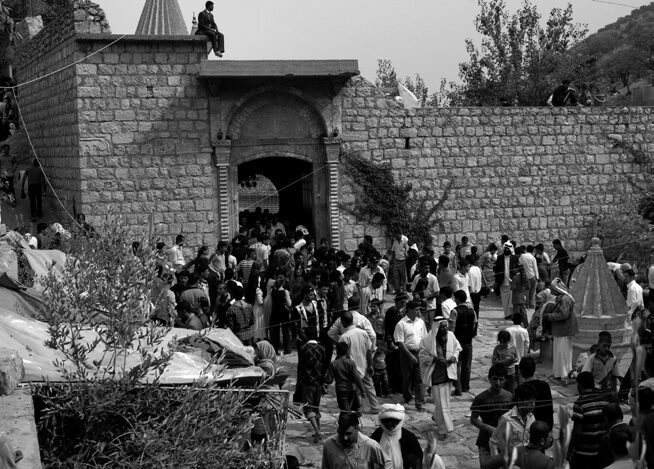
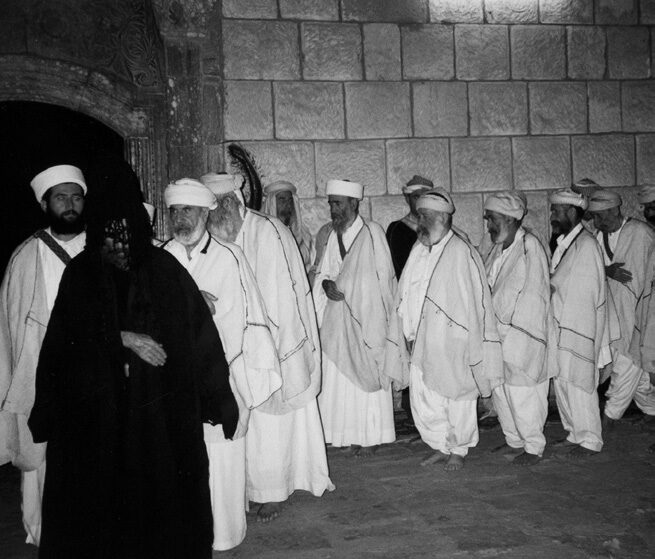
Festivals and fasting in the Erivan Governorate according to Yeghiazarov (1884)
S. A. Yeghiazarov names for the Ezidis of the Erivan Governorate around 1884 two annual festivals, each after a fast (p. 191):
- The first and more solemn festival follows a three-day fast in honor of God and Şêx Adî, which begins 20 days before the beginning of winter. In time and fasting this corresponds to the fast and festival in December (Rojiyên Êzîd / Ayda Êzîd) of the other sources; Yeghiazarov, however, names it after God and Şêx Adî.
- The second follows the three-day fast in honor of Xidir Nebî. According to Yeghiazarov it lies between the Christmas fast and the Great Lent of the Christians and coincides with the Armenian fast Arajavor, which is devoted to Saint Sergius (Sarkis); the Ezidis identified Sergius with Xidir Nebî (p. 190).
According to the report of the district chief of Alexandropol, every year two weeks before Great Lent, during the fast of Xidir Nebî, the Mîr sent out Qewal with a metal peacock image; it was received solemnly with music (p. 230; see Sencaq and Tawûs geran).
Food rules: Pork was forbidden, strong drinks allowed (p. 191). According to the report from Etchmiadzin, the Ezidis drank wine and took care not to let a single drop fall on the ground (p. 228–229).
Help in need: If someone fell into need, everyone contributed – one gave a ram, one a sheep, one a cow (p. 190).
Discrepancies
- Number of festivals: Yeghiazarov knows only two annual festivals for the Erivan Governorate; he does not name the New Year. The other sources name at least three for the Caucasus (New Year, Xidir Nebî, Ayda Êzîd).
- Time of the winter fast: “20 days before the beginning of winter” is not converted into a calendar date by Yeghiazarov; the other sources name December.
Additions according to Layard (1846) and Drower (1940)
Layard (1846)
- According to Layard's informants, the year begins as among the Eastern Christians; the months bear the same names. Some fast three days at the beginning of the year.
- Wednesday is regarded as a holy day, but is not a day of rest.
- As their own year number Şêx Nasir gave Layard in 1846 the year 1550; Layard does not say what it refers to.
- On the assembly festival in Lalîş see The festival in Lalîş 1846.
Drower (1940)
- According to Feqîr Reşo, the servant of the sanctuary of Lalîş in 1940, the Ezidis fast three days at the beginning of Kanûn I (December) and then celebrate the Cejna Rojî, which he equated with the Cejna Êzî.
- According to him, they celebrate the Cejna Qurbanê (festival of sacrifice) one day before the Muslims, for four days, also called Cejna Hecîyê.
- He called Sersal (New Year) the second most important festival and at the same time the “festival of the dead”. The course in Başîqa is described in Sersal in Başîqa 1940; in Başîqa the festival dance was called Tewafî (cf. Tiwaf above).
- Drower calls the autumn festival in Lalîş Cejna Cimayê (see The festival in Lalîş 1944).
- Rain custom: In times of drought a boy and a girl danced from house to house and were doused with water.
Festivals in Armenia according to T’amoyan's textbooks
The Ezidi school textbooks of Armenia (T’amoyan et al., 2013–2014) describe the festivals as they are supposed to be observed there. The dates are each reckoned from the 13th of a month (old calendar, see Ezidi calendar).
| Festival | Fasting | Feast day | Textbook |
|---|---|---|---|
| Xidir Nebî (Xidir Nevî, Xidir Eylas) | after 13 Sivat (February): Monday sacrifice and fasting for those who died during the year, then Tuesday to Thursday | Friday; Saturday e’refat (cemetery visit with Şêx and P’îr), Sunday şerefat | gr. 5 (gr. 11: fasting Tue–Thu, without Monday) |
| New Year (E’yda Tawisî Melek, Çarşema serê salê) | Tuesday after 13 Nîsan | Wednesday; cemetery visit | gr. 5, gr. 11 |
| Festival of the Unity of the Ezidis | – | May 1 | gr. 11 |
| E’yda Êzîd (Êzdîd) | after 13 K’anûna pêşin (December): Monday for the dead, Tuesday to Thursday “for Êzdîd” | Friday; Saturday e’refat | gr. 5, gr. 11 |
| E’yda Şêşims (“E’yda dur’ê”) | Thursday, one week after E’yda Êzîd | Friday | gr. 5, gr. 11 |
Details according to the 5th-grade textbook:
- Fasting rules: Get up in the night around 4–5 o'clock and eat (without cabbage and without forbidden meat), then again from nightfall. During the day no eating, drinking, smoking or chewing gum, no washing of clothes or hair and no shaving. Children and the sick are exempt.
- Xidir Nebî: On the first day a sheep is slaughtered and food is brought on trays to the needy (xêra Xidirnevî); on Thursday there is the bread of the dead (nanê mirîya), on three nights the meal paşîva Bapîr. With flour, signs are made on the wall and chest, “signs of Xidirnevî”. On the fast days people go to the cemetery with a Şêx or P’îr and on Thursday evening to the houses of the Şêx and P’îr to bring gifts (xêr) before the Ocax.
- Leyleqedir: The night before Friday is celebrated with Def and Zurna until morning. Children go from house to house, let down little bags on ropes and receive fruit and sweets (dolîdang); the unmarried eat salted pastry (totka şûr) in order to dream of their future spouse.
- New Year: On Tuesday a Kuloç’ with a pearl baked into it is made and on Wednesday distributed to all members of the family; whoever gets the pearl is regarded as the “master of the household's fortune” (see Kiloça serê salê). Wednesday is also the day of Memê şivan, the lord of the sheep.
- E’yda Êzîd: The book calls it the greatest festival. People visit the bereaved and make peace with those they have quarreled with (see Greetings and rules of conduct).
The Festival of the Unity of the Ezidis on May 1 is not a traditional festival. According to the 11th-grade textbook, the National Union of Ezidis proclaimed it after Armenia and the Council of Europe had recognized Êzdîkî as a language on May 1, 2002 (see The Ezidi movement in Armenia since 1988).
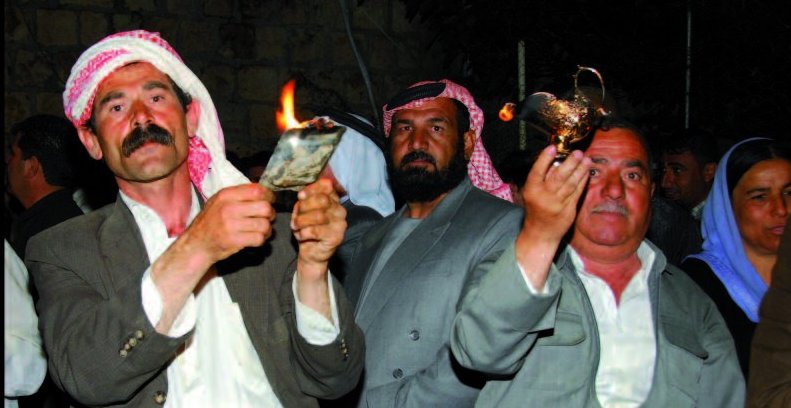
Fasting and the Wednesdays in March according to Hesenê Şêx Kelaşê (1995)
Fasting (Rojî). Three days for Ezîd are obligatory, three days for Xidirnebî are a good work; on the fourth day there is Ayd in each case. A week after the Ezîd fast there follows a fast day for Şems, and a day before the fasts one for Xudanê Malê (Şêxûbekir). One gets up at night for the Paşîv, eats and before going to sleep speaks the intention three times (“Îşev nêt, sibê rojî, eşqî Ezîd”). From the Paşîv one bowl is given for the dead and one for Bapîrê Paşîv – a pious man without descendants, who in this way is not left without Xêr.
Xidirnebî. On the third evening after the breaking of the fast the houses and Ocax of the Şêx and P’îr should stand open; people visit them and ask for fortune (miraz). Young and old go “Leyleqedr” from house to house until morning and wish each other fortune. The author rejects the custom K’osegeldî on this evening: it was introduced by Muslims out of hostility toward Melekî Tawis.
Çarşemê Hesav – the four Wednesdays in March:
| Wednesday | Name | Content |
|---|---|---|
| 1st | Oxirçarşem | a bowl of food for the lord of March, Melek Zeydîn |
| 2nd | Axirçarşem | the old New Year of the people; joy in the house, Qurban for Melek Zeydîn |
| 3rd | Qereçarşem | Çarşema Kiloça: bake the Kiloç, cut it on Thursday (see Kiloça Serê Salê) |
| 4th | Hesenpîrk | day of the graves, “day of the open gate” (see Days of remembrance) |
In a leap year (February with 29 days) March has five Wednesdays; then the count begins with the second.
Source: Hesenê Şêx Kelaşê, Rê-rizma mileta Êzdî angorî qirarê dîn, Şamîran 1995. The author supports almost every rule with a stanza from a Qewl or Beyt.
Sources
- Һ'әсәне Шех К'әләше (Hesenê Şêx Kelaşê, Hesen Hesenyan): Р'е-р'ьзма мьләте Эзди ангори qьраре дин (Rê-rizma mileta Êzdî angorî qirarê dîn). Şamîran 1995 (scan and new text edition in the EZDIKI.COM library), p. 32–39
- Birgül Açıkyıldız: The Yezidis. The History of a Community, Culture and Religion. London 2010, p. illustrations
- A. V. Perminov: Езиды – древний народ Адаби (The Ezidis – the ancient people Adabi). Sharya 2016, p. 95, 100–101
- S. M. Polatov: Дети Солнца (Children of the Sun). Rybinsk 2011, p. 46–47, 72, 165–166
- M. B. Rudenko: Обрядовая поэзия – Похоронные причитания (Ritual poetry – funeral laments). Moscow 1982, p. 65
- Khanna Omarkhali (Ханна Омархали): Йезидизм. Из глубины тысячелетий (From the depths of the millennia). Saint Petersburg 2005, p. 31, 70–77, 124, 126, 131, 145–146, 158
- E’zîz T’amoyan: The heroic deed of the Ezidi people – Ezidis in the Karabakh war (Armenian, memorial publication, Yerevan, c. 2000–2007), p. 59
- Mirza Sloyan (Mirzoyê Çolo Siloyan): Дорога, ведущая в храм. Три года спустя (The road leading to the temple. Three years later). Yerevan 2015, p. 37, 42, 49–54
- Khanna Omarkhali: The religious textual tradition of the Ezidis – from the oral to the written. Saint Petersburg 2023 (Russian translation of the English original, Wiesbaden 2017), p. 14, 25, 129, 142, 145–146, 247, 524
- Dimitri Pirbari (P’îr Dîma), A. Ščedrovickij: Тайна жемчужины (The secret of the pearl). Moscow/Tbilisi 2016, p. p-035, p-136
- Roger Lescot: Enquête sur les Yezidis de Syrie et du Djebel Sindjār (Study of the Ezidis of Syria and of the Şengal mountains). Beirut 1938, p. 70–72, 80, 87, 215, 244–250
- Şefik Tagay, Serhat Ortaç: Die Eziden und das Ezidentum. Geschichte und Gegenwart einer vom Untergang bedrohten Religion. Hamburg (Landeszentrale für politische Bildung) 2016, p. 84–89
- S. A. Yegiazarov (Егиазаров): Краткий этнографический очерк курдов Эриванской губернии – containing the ethnographic-legal outline on the Ezidis. Tbilisi 1884, p. p. 190–191, 228–230 (PDF p-096, p-114–p-115)
- Austen Henry Layard: Nineveh and Its Remains, Vol. 1. London 1849, p. p. 301–302 (PDF 354–355)
- E. S. Drower: Peacock Angel. Being some Account of Votaries of a Secret Cult and their Sanctuaries. London 1941, p. p. 14, 48–49, 180–181 (PDF 25, 65–66, 219–220)
- E’zîzê E’mer, H’esenê Şêx-Me’mûdê: E’debyet û zimanê êzdîkî, grade 4. Yerevan: Spîka 2013, p. p-094 (ill.)
- E’zîzê E’mer, H’esenê Şêx-Me’mûdê: E’debyet û zimanê êzdîkî, grade 5. Yerevan: Spîka 2013, p. p-004–006
- E’zîzê E’mer, Omerê Şero (Omar Mamoyan), Xidirê Sûrên (Chidir Hadschojan): E’debyet û zimanê êzdîkî, grade 11. Yerevan: Spîka 2014, p. p-005, p-087–088
Found a mistake?
Is something wrong – a fact, a spelling, a source, an image? Let us know: we check every report and correct the article.
Other spellings: Roji · Ayda Ezid · Ayda Xidir Nebi · Ayda Chidir Nebi · Ayda Khidir Nebi · Qawl · Qaul · Kewl · Siltan Êzîd · Lalish · Lalisch · Lalesh · Sheikh Adi · Scheich Adi · Shaikh Adi · Şêxadî · Shikhadi · Qers · Charshama Sor · Tscharschema Sor