
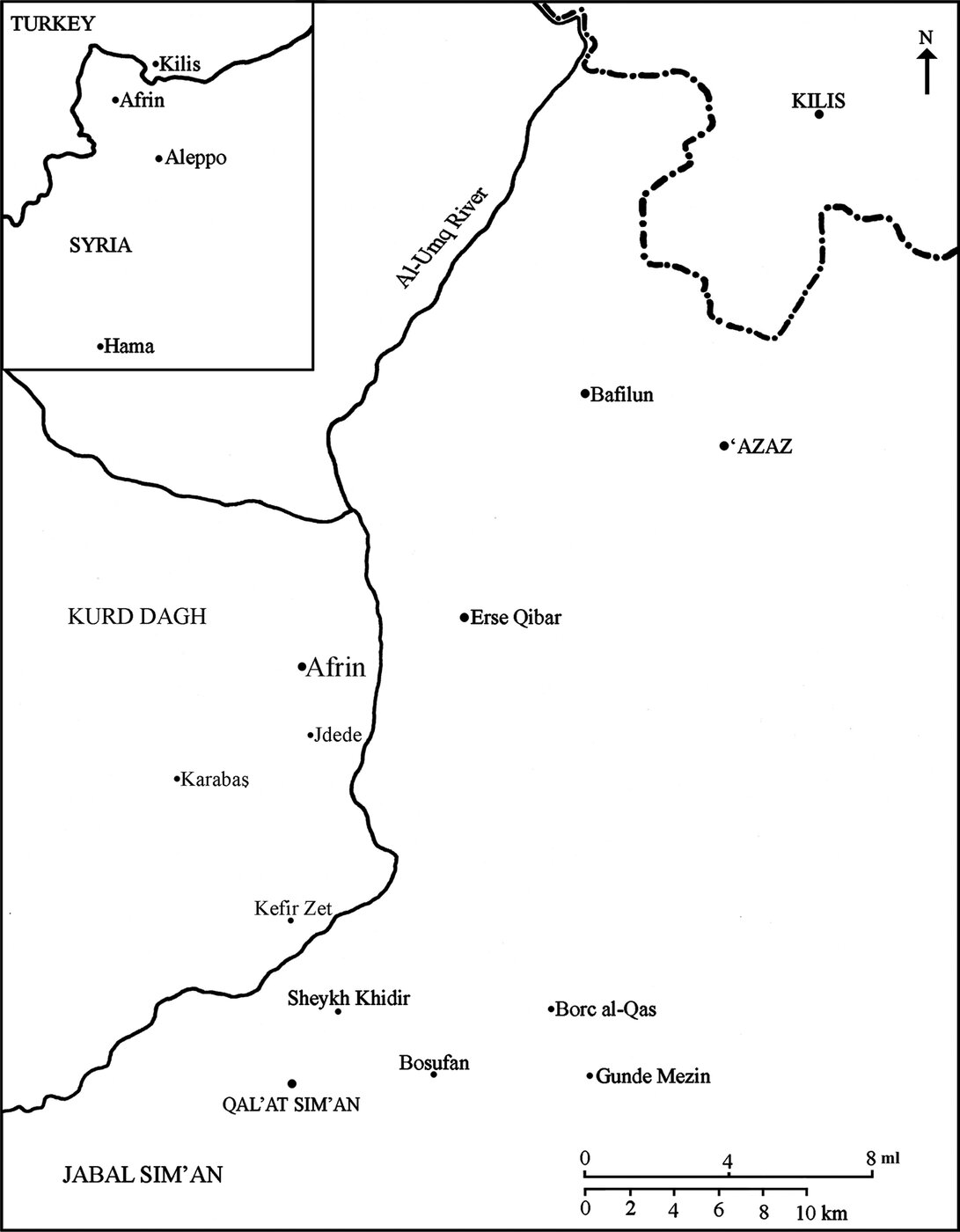
In the 20th century there were two Ezidi areas of settlement in Syria, about 400 km apart: the Cezîre in the northeast and the area around Afrîn and the Djebel Sim'ân northwest of Aleppo. The most important source for the period of the French mandate is the field study by Roger Lescot, who traveled through both areas in 1936 (published 1938). He wrote as an orientalist in the service of the mandate administration; his factual information is precise, his judgments about the Ezidis are bound to their time and are not adopted here.
The two areas at a glance
| Area | Location | Groups | Number (1936) |
|---|---|---|---|
| Cezîre | plain in the northeast: south of Amûda, near Qamişlî and Qubûr el-Bîd (Tirbespî), area of Hesekê | Şerqîyan (since the 18th c.); immigrants of the Hevêrkan and Hesenan (after 1925); refugees from Şengal (1935/36) | about 1,500 Şerqîyan and a few hundred others |
| Afrîn valley and Djebel Sim'ân | hill country and river valley between the Turkish border and Dêr Sim'ân, northwest of Aleppo | predominantly Feqîran, plus Şêx, P’îr and Mirîd families | about 1,500 (according to Cemîl axa), in 22 villages |
| Cities | Azaz, Aleppo | individual small traders and day laborers | few |
In total Lescot estimated the Ezidis of Syria at 3,000 to 4,000 people. Details, villages and numbers of houses are in the articles Ezidis in the Cezîre and Ezidi villages in the Afrîn region and in the Djebel Sim'ân.
Way of life
- In both areas in 1936 the Ezidis lived almost entirely settled as farmers, mostly on land belonging to Muslim or Christian owners. In the Cezîre they went out with their herds only for two to three months in spring.
- In the west the tribal order was hardly alive any more; tribal names served only as a designation of origin.
- Clothing: a distinct Ezidi dress was hardly to be seen in Syria in 1936. Under the clothing of their surroundings, however, the men always wore the Ezidi shirt with an open collar (see Traditional clothing).
- Feasts were celebrated as inconspicuously as possible; people also took part in the feasts of their Muslim neighbors.
- Education: in the Kurd Dagh (Afrîn) in 1936 two respected Şêx, Şêx Cinnêt in Karabaş and Şêx Hsên in Xezewîyê, taught pupils. According to Fuccaro (1999), Şêx in the Cebel Siman are said to have founded a separate Ezidi religious school at that time. Young educated men such as Cemîl axa and Murad, the Muxtar of Qestel, collected traditions.
Under the French mandate (1920–1946)
Leadership of the community
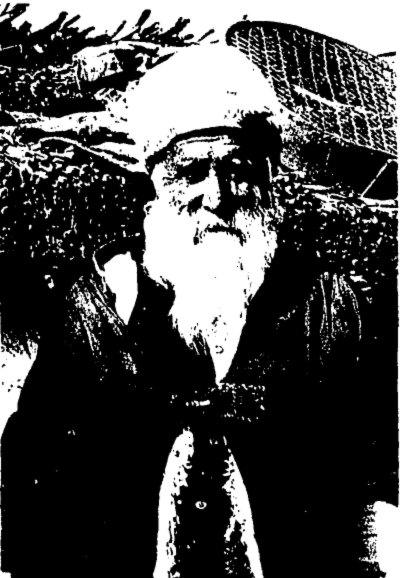
- Derwîşê Şemo (Derwîş axa), the leader of Erşê Qîbar, took the side of the mandate power right at the beginning of the French occupation. Several Ezidis served in the “Escadrons Légers”, an auxiliary force. Derwîş was officially recognized as the religious head of the Ezidi community in Syria and was murdered out of revenge in 1928.
- His son Cemîl axa succeeded him. He had no official powers; his position rested on the trust of the community.
Legal situation
Lescot, himself an official of the mandate administration, describes the situation of the Ezidis in 1936 in expressly critical terms:
- They had no personal status law of their own. Marriages had to be concluded before the Muslim judge (qadi); marriages concluded by Ezidi clerics were considered void. According to Lescot this was one of the bitterest grievances of the Ezidis.
- They were not represented in the local assemblies. Even in villages with an Ezidi majority they were represented by a Muslim Muxtar.
- Young Ezidi women were frequently abducted; the Ezidis mostly lost lawsuits.
- They had long demanded a school in Erşê Qîbar and finally built it at their own expense. A Christian teacher taught there, and a Şêx from Şengal gave religious instruction. When the teacher had himself transferred, no new one came; in 1936 the building was falling into ruin.
- In October and November 1936, at the time of the parliamentary elections, a Sunni movement called Murûd gained followers in the Kurd Dagh (Afrîn); it banned tobacco, alcohol and music and at the same time turned against large landowners. The Ezidis feared attacks.
Connections with Şengal and Şêxan
- Visits: in 1933 Mîr Seîd Beg visited Erşê Qîbar. Cemîl axa and his father were in contact with Îsmayîl Beg until the latter’s death. In October 1936 Dawûdê Dawûd came and was allowed to collect gifts in the villages.
- Sencaq: the Qewal from Şêxan came only irregularly, with the Sencaq (the peacock image) only every two to three years, most recently in October 1936. According to Fuccaro, in the 1920s one of the three Sencaq that were still traveling went to Syria and parts of eastern Turkey. Two further Sencaq were kept by Cemîl axa himself.
- Kekê Ezîz: the cave sanctuary of Kekê Ezîz in the Kara Dagh (today Turkey) was destroyed around 1925. Its relics were secretly brought to Syria to Derwîş axa; in 1936 Cemîl axa kept them.
- Refugees: after the uprising in Şengal in 1935 many Ezidis fled to the Cezîre (see Ezidis in the Cezîre).
The border with Iraq
In the 1920s France claimed the west of the Şengal mountains for Syria. According to a British-French convention of October 1920, about a third of the mountains was to belong to Syria; but the whole range was administered by Iraq. In 1932 the League of Nations decided that all of Şengal would remain with Iraq. Details: Şengal under the Mandate (1918–1936).
Later period
The sources cited here end with the 1930s. On the worldwide distribution of the Ezidis see Worldwide distribution.
Sources
- Birgül Açıkyıldız: The Yezidis. The History of a Community, Culture and Religion. London 2010, p. 64 (ill.)
- Roger Lescot: Enquête sur les Yezidis de Syrie et du Djebel Sindjār (Study of the Ezidis of Syria and of the Şengal mountains). Beirut 1938, p. 3, 74–75, 199–216
- Nelida Fuccaro: The Other Kurds. Yazidis in Colonial Iraq. London 1999, p. 21, 29–30, 113–117, 139, 168
Found a mistake?
Is something wrong – a fact, a spelling, a source, an image? Let us know: we check every report and correct the article.
Other spellings: Cezire · Dschezire · Jezire · Afrin · Djebel Siman · Französisdschhes Mandat · Französisjhes Mandat · Suriye · Sinjar · Sindschar · Shingal · Shengal · Singal · Feqîr · Faqir · Fakir · Sheikh · Scheich · Shex · Pîr