
The peacock (tawûs) is the best-known emblem of the Ezidis. It stands for Tawûsî Melek, the first and highest of the seven angels. The peacock is the image in which this angel is depicted – not itself an object of worship. Ezidis do not worship a bird, any more than Christians worship the wood just because a wooden cross hangs in a church. This article describes the emblem, its forms and the misunderstanding surrounding it; the teaching about Tawûsî Melek belongs to the section Religion.
Name
- Tawûs means “peacock”, Melek “angel”. Khanna Omarkhali emphasizes that Tawûsî Melek is correctly rendered as “angel-peacock”, not as “peacock king”, as one often reads.
- According to a tradition reproduced by Pirbari, the angels called their leader Tawûsî Melek, the “peacock among the angels”.
- The Ezidis understand themselves as the “people of Tawûsî Melek”; according to E’zîz T’amoyan, they are also called so in Iran.
Peacock or rooster?
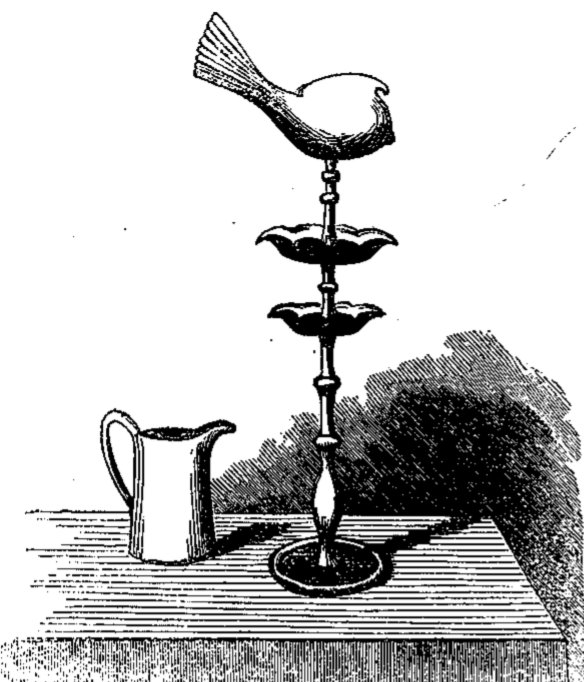
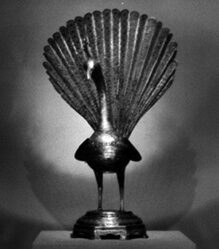
According to Omarkhali, Tawûsî Melek is depicted as a peacock, more rarely as a rooster. The cast bird figures on the peacock standards often resemble a rooster more; some, such as that of Şengal and those in Armenia, according to Peter Nicolaus even rather a duck. What matters, then, is not a lifelike form but what the figure stands for.
Where the peacock appears
| Place / object | Description | Source |
|---|---|---|
| Sencaq | standard of brass or bronze in the form of a tall lampstand, with a bird figure on top; formerly seven, with which the Qewal went through the villages | see Sencaq and Tawûs gêran |
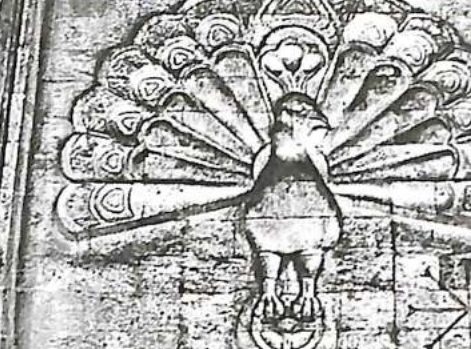
| Lalîş, gate Derîyê Kapî | in the gable two peacocks facing each other | Açıkyıldız |
| “Valley of the Peacock” near Lalîş | a peacock carved into the rock; here the Sencaq is assembled before the circuit | Nicolaus (2024) |
| Gravestones in northern Iraq | more recent grave slabs frequently bear a peacock | Açıkyıldız |
| in the house | almost every family has an object with a peacock image – figure, carpet or picture; in addition jewelry with a peacock: earrings, rings, bracelets | Perminov |
| Aknalich (Armenia) | monument “Friendship and Brotherhood” with sun and peacock as Ezidi emblems; an archway with sun and peacocks was planned | Sloyan |
| Flag | stylized peacock in the sun on the flag of the Ezidis in Armenia | see Flags |
See also Lalîş, Sacred architecture, Gravestones and Sanctuary and temple in Aknalich.
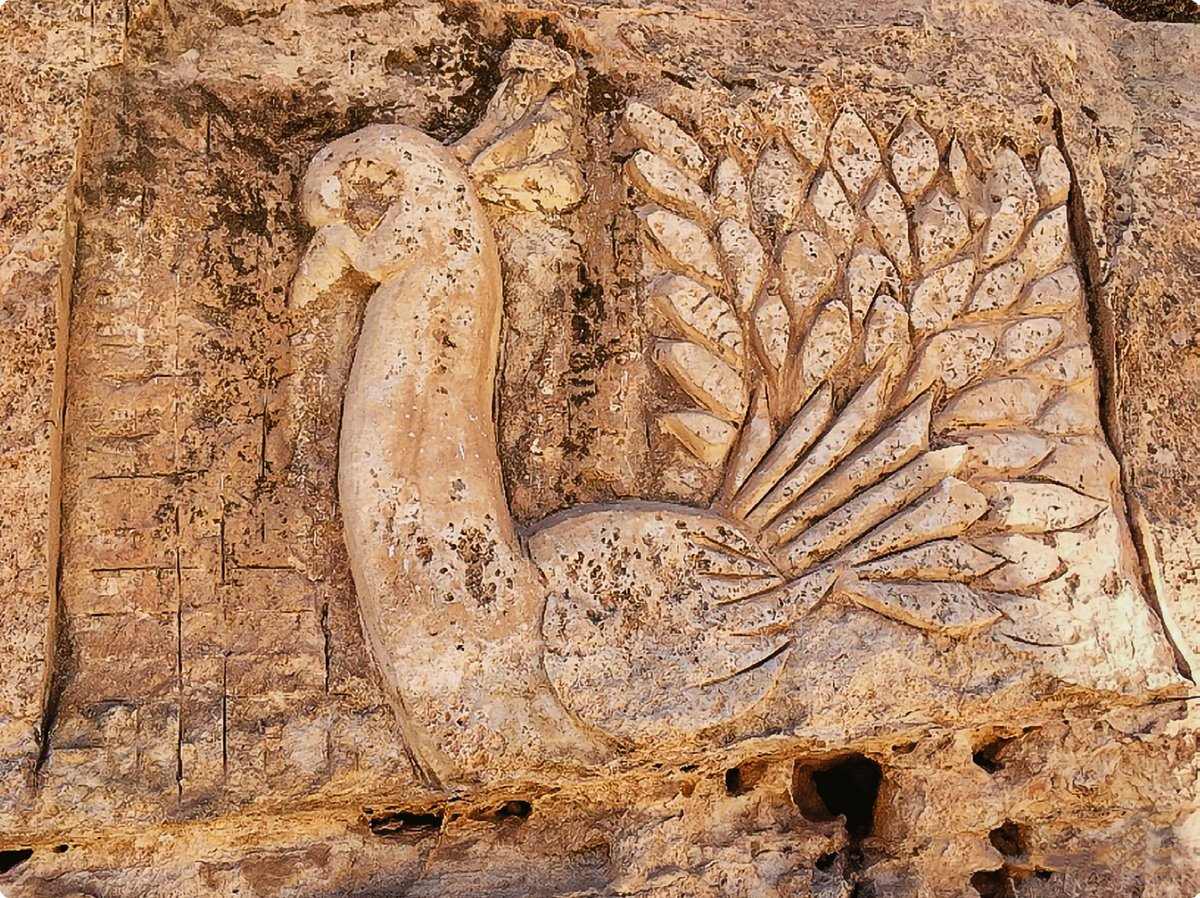
According to Guest, at the autumn festival in Lalîş the great peacock was brought, and all the Sencaq returned there. In 1892 Ottoman troops confiscated five bronze peacocks in Lalîş (see Ferman 1890–1918).
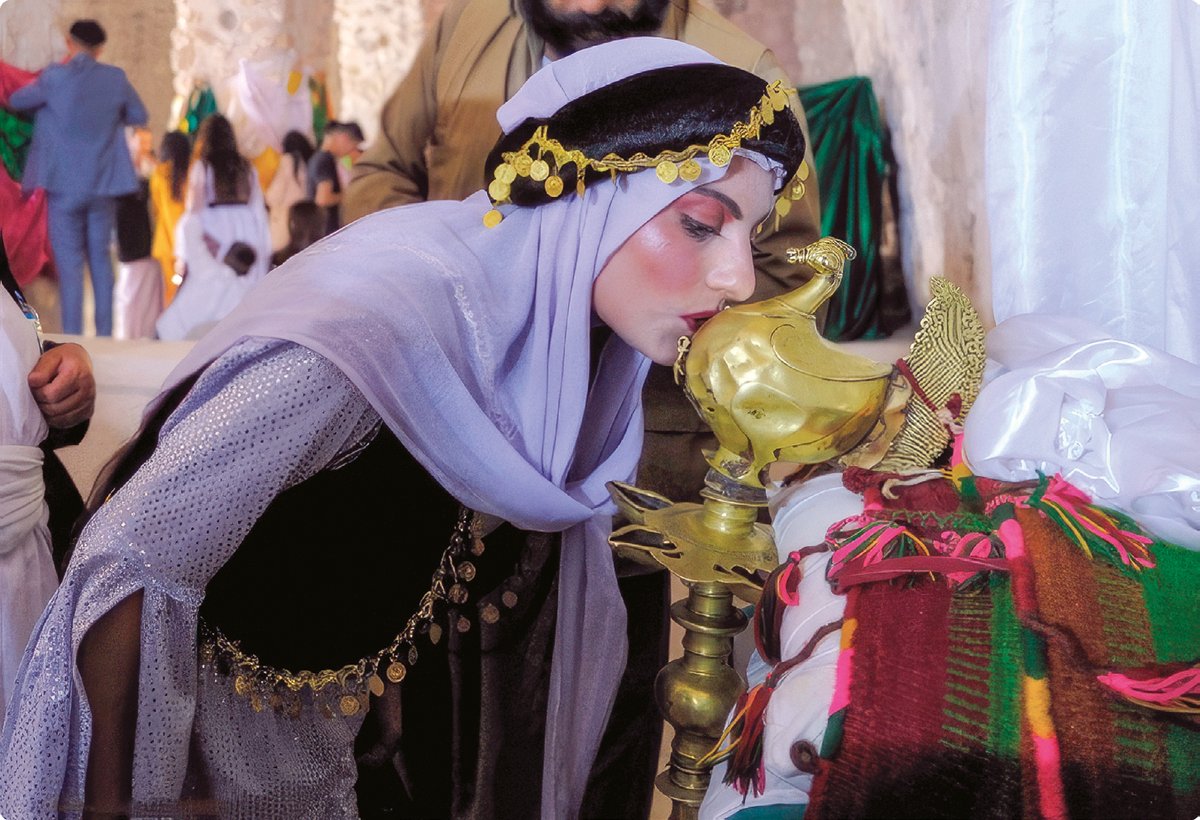
Not an idol
Foreign visitors have often misunderstood the peacock figures. In 1849 the British archaeologist Austen Henry Layard saw a Sencaq in the village of Redwan and compared the figure in his account to an idol. But at the same time he recorded what the Ezidis themselves told him: the figure is not regarded as an idol, but – so Şêx Nasir – as an emblem or banner of the Mîr’s house.
This agrees with what Ezidi informants and authors say to this day:
- The Ezidis believe in one God (Xwedê). Tawûsî Melek is his angel, not a second god (Perminov, Omarkhali, Lescot’s informants in Şengal).
- The peacock is the sign of this angel. One honors the sign – one receives the Sencaq ceremonially, gives it gifts, keeps peacock images in the house – just as Christians honor the cross without worshipping the wood.
- Nor are the Ezidis “sun worshippers” because they pray facing the sun (see The sun).
Further disparaging external designations and their origin are classified in the article External ascriptions and appropriation.
Peacock and sun
Several authors connect the peacock with the sun. Perminov writes that among the Ezidis the peacock is equated with the sun. Omarkhali connects Tawûsî Melek with the “solar” principle and points out that in many cultures the peacock is regarded as a sun bird; in Persian the sun is figuratively called the “peacock of heaven”. On the flag of the Ezidis in Armenia the peacock stands in the middle of the sun. Further emblems according to Perminov are the sun, the moon and the morning star (see Other emblems).
The modern peacock image in a circle
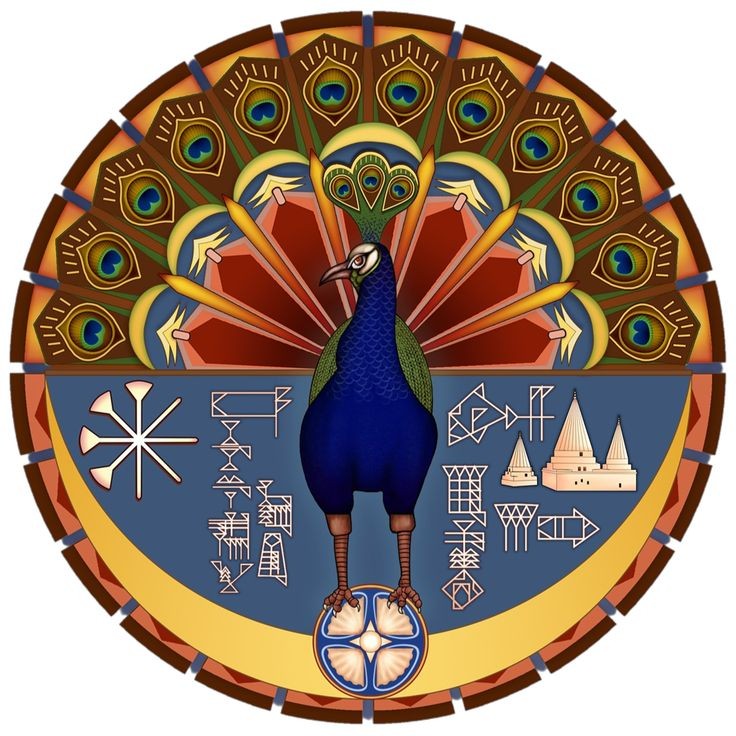
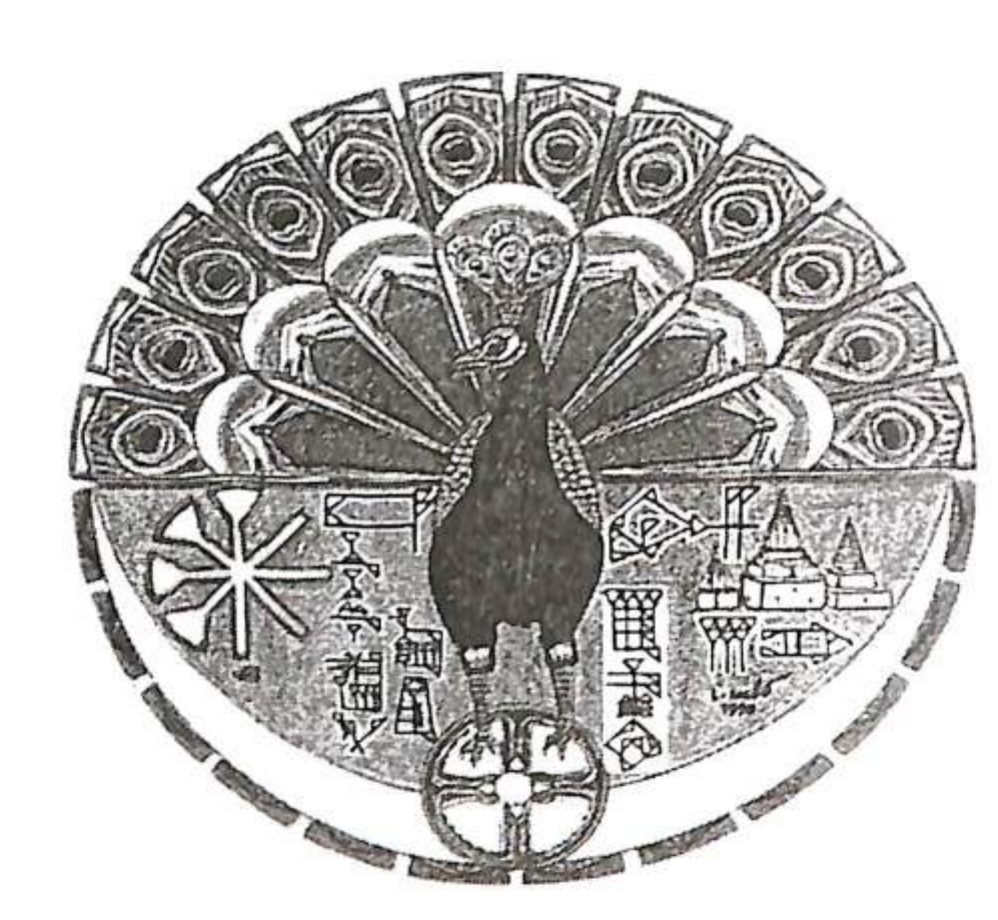
According to Omarkhali (2005), a new emblem is found more and more often in books and on Ezidi websites: a peacock in a circle standing on a sun cross, with a crescent moon and cuneiform-like signs. The sources contradict each other about its creator:
- According to S. M. Polatov (2011), it was drawn by Lafrey Nabo.
- According to Khanna Omarkhali (2005), it “probably” comes from a present-day Syrian archaeologist.
Both authors interpret the details (number of fields, cross, crown) at length; Omarkhali herself emphasizes that the artist may have meant something else. These interpretations are those of the authors, not tradition.
The peacock and the ban on blue
Among the explanations for the old ban on blue clothing, Omarkhali also names a connection with the blue-shimmering peacock. Other explanations predominate (see Colors and dress rules).
Sources
- Şefik Tagay, Serhat Ortaç: Die Eziden und das Ezidentum. Geschichte und Gegenwart einer vom Untergang bedrohten Religion. Hamburg (Landeszentrale für politische Bildung) 2016, p. 78 (ill.)
- Manuk Muradyan: Усуб Бек (Ûsiv Beg). Yerevan 2013 (Russian translation of the Armenian original, Yerevan 2012), p. 44 (ill.)
- Khanna Omarkhali (Ханна Омархали): Йезидизм. Из глубины тысячелетий (From the depths of the millennia). Saint Petersburg 2005, p. p. 50–57, 64–65, 147–148
- Dimitri Pirbari (P’îr Dîma), A. Ščedrovickij: Тайна жемчужины (The secret of the pearl). Moscow/Tbilisi 2016, p. p-041, p-045
- E’zîz T’amoyan: The heroic deed of the Ezidi people – Ezidis in the Karabakh war (Armenian, memorial publication, Yerevan, c. 2000–2007), p. p. 52, 54
- A. V. Perminov: Езиды – древний народ Адаби (The Ezidis – the ancient people Adabi). Sharya 2016, p. p. 90, 92, 107
- Austen Henry Layard: Discoveries among the Ruins of Nineveh and Babylon (abridged edition). New York 1853, p. p. 46–47
- Birgül Açıkyıldız: The Yezidis. The History of a Community, Culture and Religion. London 2010, p. p. 92–93, 195
- International Journal of Yezidi Studies, Vol. 1. Tbilisi 2024, p. p. 82, 90–91
- John S. Guest: The Yezidis. A Study in Survival. London/New York 1987, p. p. 55, 140, 181
- S. M. Polatov: Дети Солнца (Children of the Sun). Rybinsk 2011, p. p. 29–31
- Mirza Sloyan (Mirzoyê Çolo Siloyan): Дорога, ведущая в храм. Три года спустя (The road leading to the temple. Three years later). Yerevan 2015, p. p-087–088, p-167, p-465
- Roger Lescot: Enquête sur les Yezidis de Syrie et du Djebel Sindjār (Study of the Ezidis of Syria and of the Şengal mountains). Beirut 1938, p. p. 48–49
Found a mistake?
Is something wrong – a fact, a spelling, a source, an image? Let us know: we check every report and correct the article.
Other spellings: Tawusi Melek · Meleke Tawus · Melek Tawûs · Tawuse Melek · Tawus Melek · Tawûs Melek · Melek Taus · Taus-i Melek · Malak Tawus · Sinjar · Sindschar · Shingal · Shengal · Singal · Sanjaq · Sandschak · Sancak · Shekhan · Scheichan · Shaikhan