
The Mirîd are the third and largest caste of the Ezidis: the laypeople. According to Omarkhali (2023), 93–94 percent of Ezidis belong to it. The word comes from the language of mysticism and means "pupil" or, according to Pirbari, "one who wants to know". The Mirîd are divided into tribes (eşîr) and lineages (ber) (Lalişa Nûranî); according to Şêx Mak’sîm, the Agha and Beg, the leaders of the tribes, mostly come from them.
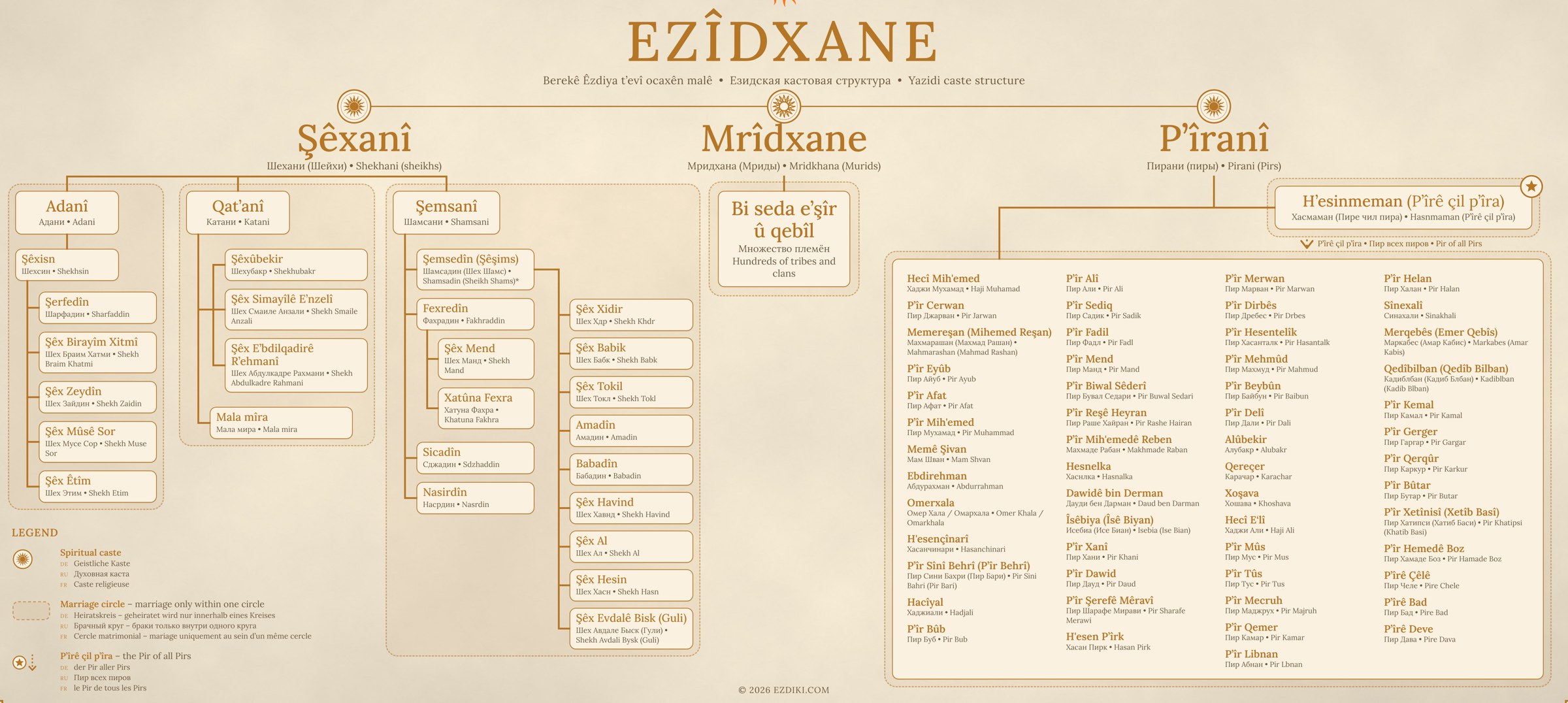
Three meanings of the word
Kreyenbroek distinguishes three usages:
- the follower of a particular Şêx or P’îr – this can also be a Şêx or P’îr;
- the laypeople in general, that is, the caste;
- in the hymns every devout believer.
Therefore the photo book Lalişa Nûranî says that basically all Ezidis are Mirîd. Şêx and P’îr are called dunav ("two names"), because they are clergy for others and at the same time Mirîd of their own Şêx and P’îr; the laypeople are called yeknav ("one name"). Şêx Mak’sîm puts it this way: whoever is not a Mirîd is not an Ezidi. A hymn about the duties of the laypeople is the Qewlê Mirîdiyê ("Qewl of the Mirîd"), which Kreyenbroek has published.
The bond with Şêx and P’îr
Every Mirîd has a Şêx and a P’îr by inheritance. For Mirîd the tribe determines which Şêx and P’îr one belongs to, for clergy the line (Kreyenbroek). In their manuscripts (Mişûr) the P’îr record the Mirîd tribes that belong to them (Omarkhali 2023).
Formerly the Mirîd were obliged to give levies to their Şêx and P’îr; today, according to Omarkhali (2005), this is voluntary. A tradition explains the origin: Şêx Adî persuaded the leaders to give up land and goods in favor of the Mirîd; since then the Mirîd have given a part annually to their P’îr and Şêx (P’îr Xidir Silêman, in Omarkhali 2023). Şêx Mak’sîm calls the annual gift to the Ferz Her.
In the rite Dest Danîn, according to Şêx Mak’sîm, the person who receives his bond with Şêx or P’îr is called K’oçek; afterwards he is the "Mirîd" of his Ferz. Both sides are regarded as equal in this.
Mirîd as bearers of religious knowledge
Laypeople traditionally perform no rituals (Omarkhali 2023). Nevertheless many Mirîd are important experts in the religion:
- The Qewal, the singers of the sacred hymns, are exclusively Mirîd (see Qewal).
- Among the Feqîr there are many Mirîd; one example is Feqîr Hecî from the Reşî tribe (see Feqîr).
- Koçek can come from any caste (see Koçek).
- Twice Mirîd even became Babê Şêx, the highest spiritual office: Koçek Cem and Koçek Birim (list of the Extiyarê Mergehê in Lalişa Nûranî; Omarkhali 2023). Once the knowledgeable Mirîd Koçek Bra’îm became Pêşîmam.
According to Omarkhali (2023), it is an old norm in Iraq that Mirîd are religious experts; knowledgeable Mirîd enjoy the same respect there as clergy. In Armenia, by contrast, religious knowledge lies almost entirely with the spiritual families.
Marriage
Marriages within the Mirîd caste are permitted. Omarkhali (2005) names one exception: the Qewal belong to the Yeknavî tribe; the men may marry all Mirîd, the women only men of the Yeknavî. A marriage with a Şêx or P’îr is forbidden by the first of the three basic rules (see Three basic rules and five duties).
See also
- Şêx and P’îr
- Tribes of the Ezidis in the section People & Culture: Tribes in the South Caucasus, Tribes in Şengal and Iraq
Sources
- Philip G. Kreyenbroek, Khalil Jindy Rashow: God and Sheikh Adi Are Perfect. Sacred Poems and Religious Narratives from the Yezidi Tradition. Wiesbaden: Harrassowitz 2005, p. pp. 6–7, 9, 292–296
- Khanna Omarkhali: The religious textual tradition of the Ezidis – from the oral to the written. Saint Petersburg 2023 (Russian translation of the English original, Wiesbaden 2017), p. pp. 23–24, 45–47, 121, 124–125, 513
- S. A. Grigoriev, L. V. Ivasko, D. V. Pirbari (P’îr Dîma): Lalişa Nûranî / Святой Лалыш / Holy Lalish. Yekaterinburg: Basko 2008, p. pp. 12–17, 201
- Şêx Mak’sîm (Maksim Ezdi): Grundpfeiler der Religion ScherfeDin, 2017 (on EZDIKI.COM in the Religion section and in the library), p. pp. 51, 55–56, 62–64, 83 (PDF)
- Dimitri Pirbari (P’îr Dîma), A. Ščedrovickij: Тайна жемчужины (The secret of the pearl). Moscow/Tbilisi 2016, p. pp. 53, 253 (PDF)
- Khanna Omarkhali (Ханна Омархали): Йезидизм. Из глубины тысячелетий (From the depths of the millennia). Saint Petersburg 2005, p. p. 100
Found a mistake?
Is something wrong – a fact, a spelling, a source, an image? Let us know: we check every report and correct the article.
Other spellings: Miridxane · Miridchane · Miridkhane · Yek navi · Miridi · Lalîş · Lalish · Lalisch · Lalesh · Sheikh · Scheich · Shex · caste system · Pîr · Qawl · Qaul · Kewl · Sheikh Adi · Scheich Adi · Shaikh Adi