
The Pêşîmam is a spiritual office of the Şêx caste. The word means roughly "the one who stands before the imam" or "prayer leader". All Pêşîmam come from the Şêx house of the Adanî, which goes back to Şêx Hesen (Şêx Sin) (Kreyenbroek; Lalişa Nûranî). Omarkhali (2005) explains why: among the Şêx lineages the lineage Şêxisin is especially honored, and only it could provide the Pêşîmam.
The various Pêşîmam
Kreyenbroek names three Pêşîmam, all appointed by the Mîr:
| Office | Residence / task (according to Kreyenbroek) |
|---|---|
| Great Pêşîmam (Pêşîmamê Mezin), also Pêşîmamê Mergehê | ranks alongside the Babê Şêx and the Mîr Hec; leads the prayer in Lalîş on the night of Şeva Berat; travels and receives gifts; lives in Başîqe-Behzanê |
| Pêşîmam of the Feqîr | lives in Şengal |
| Pêşîmam of the Babê Şêx | lives in the village of Esibyê and accompanies the Babê Şêx |
The photo book Lalişa Nûranî distinguishes two by their line:
- Pêşîmamê Mergê from the lineage Şêx Sin: at the rites in Lalîş he goes before all the clergy.
- Pêşîmamê Babê Şêx from the lineage Şerfedîn: he goes before the Babê Şêx.
Omarkhali (2023) names among the participants of the Sema procession the Pêşîmamê Şêxisin, the Pêşîmamê Mergehê (Adanî) and the Pêşîmamê Babêşêx (Şerfedîn).
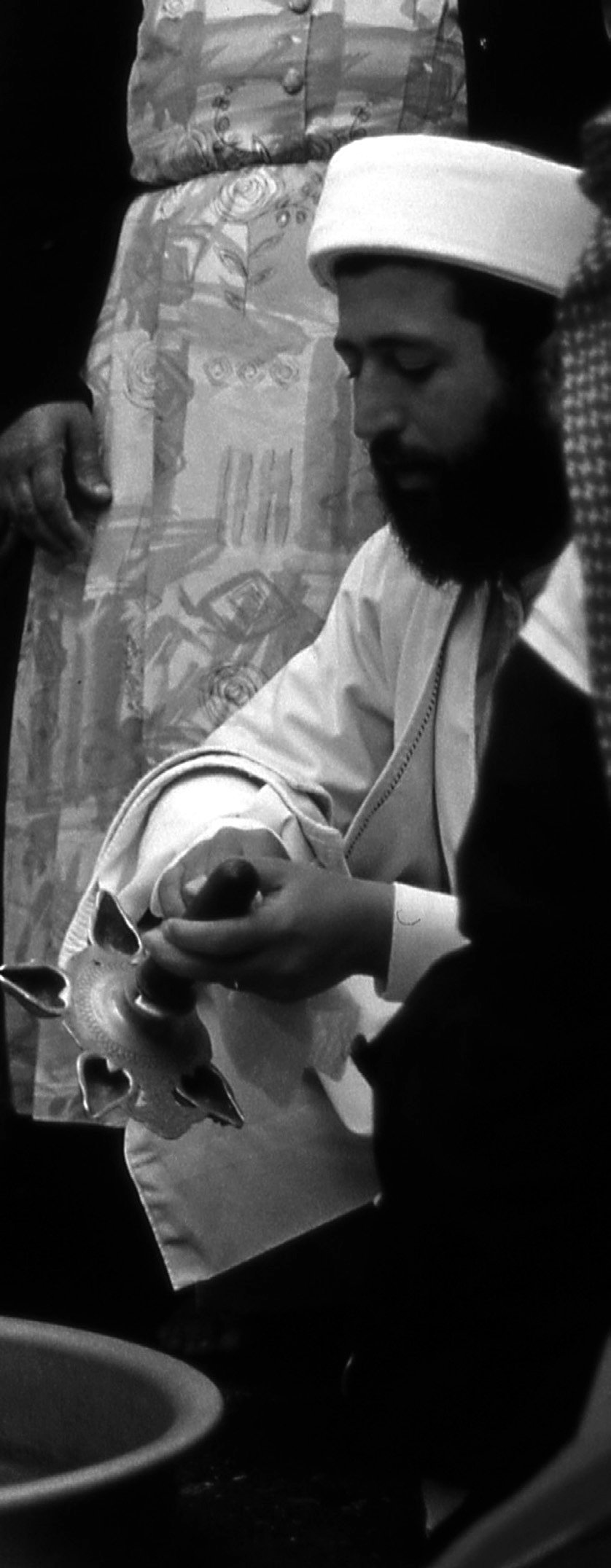
Tasks
Prayer leader on the night of Şeva Berat
The night of Şeva Berat (15 Şa’bān of the lunar calendar) is regarded as the night on which God determines the coming year. Then the dignitaries gather in the sanctuary of Şêx Adî, and the Pêşîmam from the house of the Adanî leads a modified form of the prayer. According to Kreyenbroek, he was traditionally interrupted in this by Şêx from the house of the Şemsanî – in his interpretation a trace of old tensions between the houses. On this night Qesîde are also sung in Lalîş.
Guardian of the knowledge of writing
According to Pirbari, the family of the Pêşîmam from the lineage Şêxsin was the guardian of the knowledge of writing; Şêx Hesen himself is regarded as the "lord of paper and pen" and as the author of many texts (Pirbari; Omarkhali 2005). Kreyenbroek reports the tradition that formerly only the Adanî were permitted to learn to read and write.
At weddings
According to Guest, the Pêşîmam supervises weddings and marriage contracts. According to Drower (1941), a Şêx of the line of Şêx Hesen should be present at every wedding. The course of the wedding ceremony is described in Wedding; the history of the office in Spiritual offices.
At the Sema and in fasting
In the line of dignitaries at the solemn procession (Sema), the Great Pêşîmam goes, according to Kreyenbroek, in second place, directly after the head of the Feqîr (see Sema). Like the Babê Şêx and the Koçek, the First Pêşîmam keeps the two 40-day fasts in summer and winter.
A Mirîd as Pêşîmam
That the office always lay with the Adanî is not entirely without exception: according to Omarkhali (2023), a particularly knowledgeable Mirîd, Koçek Bra’îm, once became Pêşîmam. As with the Babê Şêx, this shows that knowledge and piety could break through hereditary right.
See also
Sources
- Philip G. Kreyenbroek, Khalil Jindy Rashow: God and Sheikh Adi Are Perfect. Sacred Poems and Religious Narratives from the Yezidi Tradition. Wiesbaden: Harrassowitz 2005, p. pp. 8, 10–11, 16
- S. A. Grigoriev, L. V. Ivasko, D. V. Pirbari (P’îr Dîma): Lalişa Nûranî / Святой Лалыш / Holy Lalish. Yekaterinburg: Basko 2008, p. pp. 25, 26–29, 205
- Khanna Omarkhali: The religious textual tradition of the Ezidis – from the oral to the written. Saint Petersburg 2023 (Russian translation of the English original, Wiesbaden 2017), p. pp. 24, 139
- Dimitri Pirbari (P’îr Dîma), A. Ščedrovickij: Тайна жемчужины (The secret of the pearl). Moscow/Tbilisi 2016, p. p. 24 (PDF)
- Khanna Omarkhali (Ханна Омархали): Йезидизм. Из глубины тысячелетий (From the depths of the millennia). Saint Petersburg 2005, p. pp. 86, 96
- John S. Guest: The Yezidis. A Study in Survival. London/New York 1987, p. p. 51
- Birgül Açıkyıldız: The Yezidis. The History of a Community, Culture and Religion. London 2010, p. p. 107
- E. S. Drower: Peacock Angel. Being some Account of Votaries of a Secret Cult and their Sanctuaries. London 1941, p. p. 19 (PDF 32)
Found a mistake?
Is something wrong – a fact, a spelling, a source, an image? Let us know: we check every report and correct the article.
Other spellings: Pesimame Mezin · Peschimame Mezin · Peshimame Mezin · Pesimam Mezin · Pesimame Mergehe · Peschimame Mergehe · Peshimame Mergehe · Pesimam Mergehe · Pesimame Babe Sex · Pesimame Babe Sheikh · Pesimame Babe Scheich · Peschimame Babe Sex · Pesimame Sexisin · Peschimame Schechisin · Peshimame Shekhisin · Pesimam Sexisin · Sheikh · Scheich · Shex · Lalish