
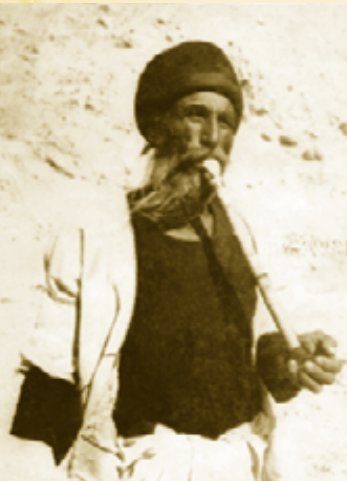
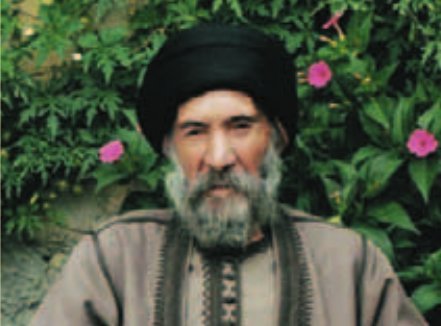
The Feqîr (a word from Arabic: "poor") are a group of special piety. They are not a caste of their own: a Feqîr can be a Şêx, a P’îr or a Mirîd. They can be recognized by the Xerqe, a black, hairy woolen shirt. The photo book Lalişa Nûranî calls the Feqîr "Şkestiyê Xwedê" – "God's broken one", one who is devoted to prayer and surrender. Pirbari calls the Feqîr "monks" or dervishes, without a monastery being meant by this.
Who becomes a Feqîr
According to Omarkhali (2023), Feqîr come from the Şêx families Şêxûbekir (Qatanî) and Şêxisin (Adanî), from the P’îr lineage Omerxalî and from many Mirîd families; Lalişa Nûranî names the same groups. Today the status is mostly hereditary; formerly, according to Kreyenbroek, it was probably open to all the devout. In the Şengal mountains there are Feqîr villages of their own.
One does not put on the Xerqe as a child. The well-known expert Feqîr Hecî wore it, according to Omarkhali (2023), only from about the age of 40. When it is put on, the Qewlê Şêxûbekir and the Qewlê Xerqe are performed.
The Xerqe
Appearance and making
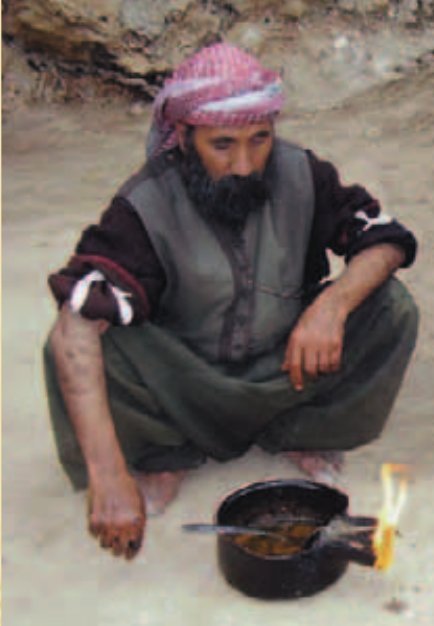
The Xerqe is of sheep's wool, dyed black or dark brown with leaves and branches of the Zergûz tree, a barren kind of walnut tree (Lalişa Nûranî; Kreyenbroek). In the courtyard Gaykuj in Lalîş lies the Kela Xerqe: there the Zergûz branches are boiled, the woolen yarn is dyed black in the brew and the Xerqe is knitted from it. The Xerqe is worn over a red belt with copper rings; in addition the Feqîr wear the Meftûl, a thread around the neck, and the cap Kulik (Lalişa Nûranî). According to Omarkhali (2023), the Meftûl is the sign of the Feqîr instead of the round collar (Toqa Êzîd).
What the Xerqe means
The Xerqe is far more than an item of clothing. The sources agree that it is among the holiest signs of the religion; but they interpret it differently:
- In the hymns (Kreyenbroek): at the creation the Xerqe was "the first thing beside God". It stands for the spiritual authority that has existed since the creation, came to Şêx Adî and was passed on to the Feqîr. According to the Qewlê Qere Firqan, God sent Qewl and Xerqe together and entrusted them to Melek Fexredîn (Omarkhali 2023). Feqîr Hecî told Omarkhali: "Our knowledge is the one preserved in memory, it is heavenly" – knowledge and Xerqe, he said, came together from heaven.
- According to Pirbari, the Xirqe is the penitential garment of the saints. The prophet Îdrîsê Xeyat (Enoch), he says, was the first after Adam to sew it. Şêxûbekir, the "Feqîr", wore it and is the head of the dervishes.
- According to Şêx Mak’sîm, the Xerqe Nûranî is the first sacred object without a soul, a testimony that everything is created by God. It certifies the rituals; without the Xerqe the ritual Dest Danîn is not valid. His maxim: "Our faith is the knowledge (Ulim), our witness the Xerqe."
Derba xerqe – the inviolable Xerqe
One of the three basic rules is called Derba xerqe, "blow on the Xerqe". Whoever strikes or insults a Feqîr commits, according to Kreyenbroek, one of the gravest sins; according to Lalişa Nûranî, he leaves the religion. Şêx Mak’sîm interprets the rule more broadly: it commands respect for all castes, peoples and religions. The phrase also serves as an oath formula (see Oath and blessing). In a dispute, according to Lalişa Nûranî, the opponents handed each other the holy earth Berat over the Xerqe of a Feqîr – as a sign of reconciliation.
Way of life
The Feqîr embody the ideal of piety: long fasts, no smoking and no alcohol, a hard bed (Kreyenbroek). According to Omarkhali (2005), before the two great fasts they fast for up to 40 days. Pirbari describes 99 principles of the Feqîr estate with three pillars: knowledge, truth, modesty. The Qewlê Hevsarê compares the ego-soul (nefs) with a horse that must be bridled.
Tasks
- In Lalîş the Feqîrê Serderî serve permanently (Omarkhali 2023). A Feqîr serves at the main gate and gives the pilgrims the holy earth Berat (Lalişa Nûranî). Their head is called Metbexçî ("steward of the kitchen") or Micêwirê Lalişê (Kreyenbroek; see Offices in Lalîş).
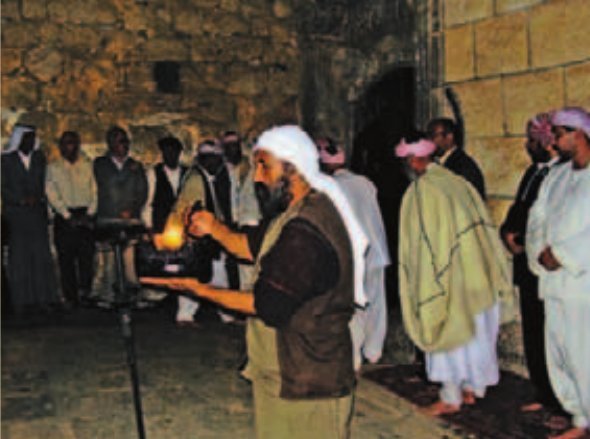
- At the Sema a Feqîr goes ahead. In the sanctuary he puts on "Tac û hil" – cap and garment of Şêx Adî – and steps through the gate into the courtyard; everyone stands up (Lalişa Nûranî; see Sema).
- At the New Year festival a Feqîr brings the holy fire out of the sanctuary, from which everyone lights his wick (Lalişa Nûranî).
- As experts in the texts: the Feqîr from Şengal in particular are regarded as professional experts in the hymns (Omarkhali 2023). According to Omarkhali, the tradition lies not primarily with the Qewal but with such trained men (see Religious education).
Women
Unmarried women who serve in the sanctuary are called Feqra; their superior is the Kebanî (see Offices in Lalîş).
See also
- Holy clothing
- Three basic rules and five duties (People & Culture)
Sources
- Philip G. Kreyenbroek, Khalil Jindy Rashow: God and Sheikh Adi Are Perfect. Sacred Poems and Religious Narratives from the Yezidi Tradition. Wiesbaden: Harrassowitz 2005, p. pp. 8, 18, 27–28, 38–39
- S. A. Grigoriev, L. V. Ivasko, D. V. Pirbari (P’îr Dîma): Lalişa Nûranî / Святой Лалыш / Holy Lalish. Yekaterinburg: Basko 2008, p. pp. 8, 12, 26–35, 204–205
- Khanna Omarkhali: The religious textual tradition of the Ezidis – from the oral to the written. Saint Petersburg 2023 (Russian translation of the English original, Wiesbaden 2017), p. pp. 15, 55, 84, 121, 124–125, 139, 482–483, 510, 520
- Khanna Omarkhali: Yezidi Religious Oral Poetic Literature: Status, Formal Characteristics, and Genre Analysis. With some examples of Yezidi religious texts. In: Scrinium VII–VIII.2 (2011–2012): Ars Christiana, Leiden: Brill, pp. 144–195, p. pp. 150–151
- Dimitri Pirbari (P’îr Dîma), A. Ščedrovickij: Тайна жемчужины (The secret of the pearl). Moscow/Tbilisi 2016, p. pp. 183–199, 250, 257–260 (PDF)
- Şêx Mak’sîm (Maksim Ezdi): Grundpfeiler der Religion ScherfeDin, 2017 (on EZDIKI.COM in the Religion section and in the library), p. pp. 12–14, 60–63, 203 (PDF)
- Khanna Omarkhali (Ханна Омархали): Йезидизм. Из глубины тысячелетий (From the depths of the millennia). Saint Petersburg 2005, p. pp. 98, 132
Found a mistake?
Is something wrong – a fact, a spelling, a source, an image? Let us know: we check every report and correct the article.
Other spellings: Feqir · Cherqe · Kherqe · Chirqe · Meftul · Derba cherqe · Derba kherqe · Feqire Serderi · Feqir Serderi · Feqîr Serderî · Skestiye Xwede · Schkestiye Chwede · Shkestiye Khwede · Skestiy Xwede · Faqir · Khirqa · Sheikh · Scheich · Shex · Pîr