
The Sema (Sema, from Arabic samā, "hearing") is the most solemn ceremony of the Ezidis. The Qewal sing sacred hymns to frame drum and flute, and the clergy move in a slow procession three times around the light in the middle of the courtyard of Lalîş. The photo book Lalişa Nûranî calls it a "holy dance" and the dance of the angels.
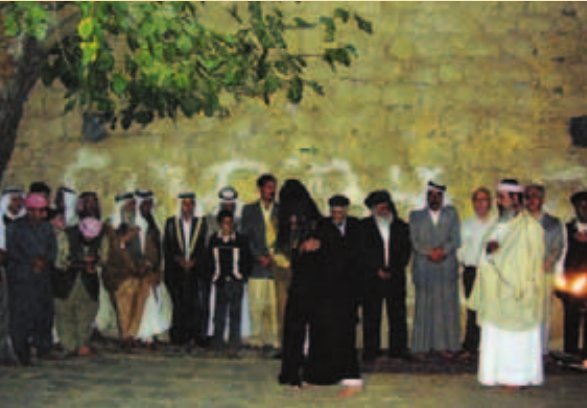
Dance or prayer?
Is the Sema a dance? The sources answer differently:
- The photo book Lalişa Nûranî speaks of the "holy dance" (reqasa pîroz, govenda dînî) and of the dance of the angels; those present, it says, are spiritually purified by it.
- A Qewal expressly corrected Omarkhali (2011/12) when the word reqs ("dance") came up: the Sema is not a dance, but means: "angels bow before God." He called it a "religious ceremony".
- According to Qewal Semaîl (in Omarkhali 2023), the Sema represents the worship of God by the angels.
- Omarkhali (2023) interprets it as a repetition of primordial time: the procession at the Festival of the Assembly recalls the time of creation. Kreyenbroek sees in the Festival of the Assembly the earthly image of the heavenly assembly of God with the Seven Angels.
Common to all interpretations: what the people do in the Sema repeats a heavenly act.
When and where
The Sema takes place in Lalîş (Omarkhali 2011/12; Lalişa Nûranî):
- on every evening of the seven days of the Festival of the Assembly (Cemaya Şîxadî, Assembly of Şêx Adî) in the courtyard Celsa Şîxadî in front of the temple gate;
- by day also at the dome of Şêşims, at the spring Kaniya Sipî and at the building of Şêx Ebdil Qadir;
- at the festivals after the two 40-day fasts (Çilê havînê and Çilê zivistanê).
In the Caucasus the Sema does not exist in this form. There Sema is the name of the religious dance to the Qewlê Şerfedîn (Omarkhali 2011/12 and 2023).
The course
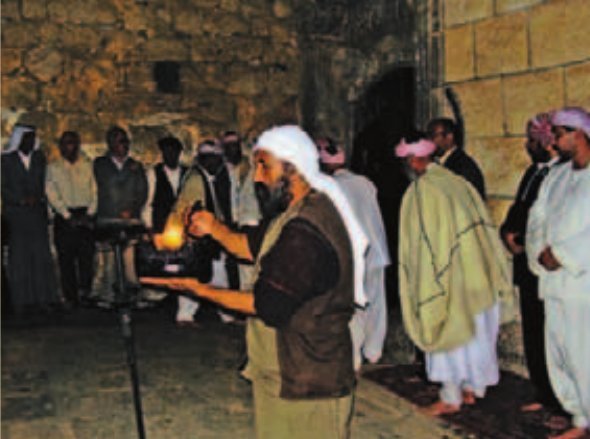
The photo book Lalişa Nûranî describes a Sema on the evening of the Cemaya Şîxadî:
- Gathering: in the evening everyone gathers in the courtyard in front of the temple gate (Derê Qapîyê) and sits on carpets and felts. The clergy sit along the walls on both sides of the gate; the Extiyarê Mergehê, the Babê Şêx and his Dîwan under the colonnade (Rewaq). The Qewal sit opposite the gate at the Nîşangeha Pîrê Kemal.
- Sermon: a cleric asks the Qewal to begin with the sermon (mişabet).
- Light: the Feraş fetches the lamp Çeqeltû from the sanctuary and lights the candelabrum Çirayê Merîfetê ("light of knowledge") in the middle of the courtyard.
- The Feqîr: a Feqîr in the Xerqe goes into the sanctuary and puts on "Tac û hil" – cap and garment of Şêx Adî. He steps out through the gate; everyone stands up.
- The movement: the Feqîr places his right hand on his left shoulder and slowly moves it down to the left hand; he takes a step and slowly draws the left foot after it. This movement is regarded as a sign of the purification of the heart.
- The line: the participants (Semakêş) follow him in a line. The Qewal intensify the rhythm and sing. From the crowd people call out the names of Sultan Êzîd and Tawûsî Melek.
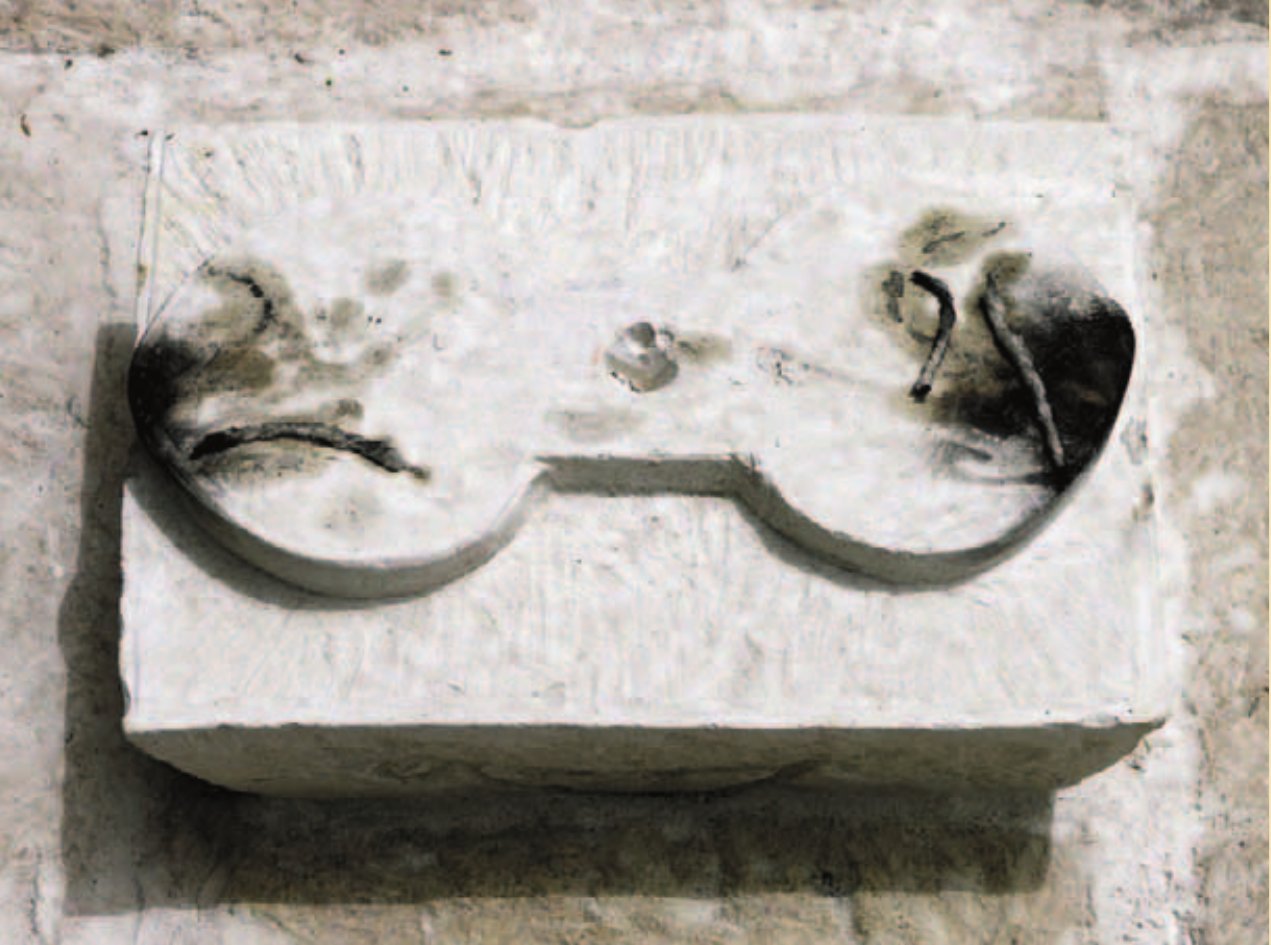
- Three rounds: when the Feqîr reaches the Qewal, a second line under the Pêşîmam of the Babê Şêx and the Babê Şêx joins. All circle the candelabrum three times. Its location, a white stone in the courtyard, is called Nîşanga Guharzêr û Zerguhar.
- Conclusion: the Feqîr stands at the gate and kisses the threshold. The participants and the crowd kiss the cap and garment of Şêx Adî. Afterwards, according to the English version, the holy dish Simat is distributed to everyone.
Music and order
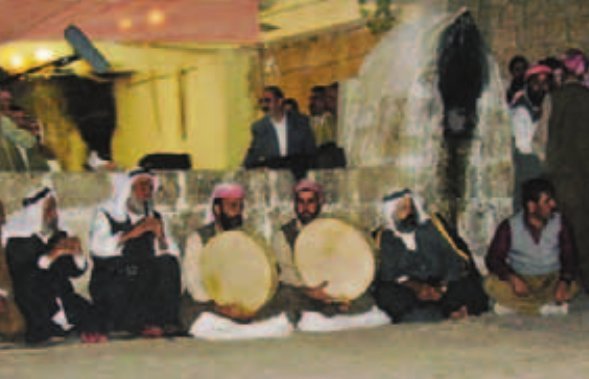
At the Sema five Qewal sit, all others stand. Two play the flute (Şibab) and sit on the right; they come from the Hekarî tribe. Three play the frame drum (Def), sit on the left, sing as well and come from the Dumilî tribe (Omarkhali 2023).
According to Kreyenbroek, the dignitaries walk in a fixed order: 1. the head of the Feqîr (Metbexçî), 2. the Great Pêşîmam, 3. the Mîr Hec, 4. the Şêx el-Wezîr, 5. a Şêx of the line of Şêx Ismail/Ebd el-Qadir, 6. the Pîrê Esbiya, 7. a Koçek, 8. the Babê Çawîş. Thus all three Şêx houses and the P’îr are represented (see Offices in Lalîş).
The seven Sema
There are seven Sema – the number is regarded as significant (seven angels, creation). Each combines certain Qewl and Qesîde; of each Qewl only the first seven stanzas are sung (Omarkhali 2011/12). The most solemn is called Semaya Qanûnî (Kreyenbroek). Omarkhali names:
- Semaya Bilind
- Semaya Maka Êzîd (to the Qewl of the mother of Êzîd)
- Semaya Merkeba (also Semaya Miriya, of the dead)
- Semaya Qanûnî (Sema of Şêx Adî)
- Semaya Şerfedîn û Şêx Hesen
- Semaya Şêx Şems
- Semaya Zerzayî
According to Kreyenbroek, the Sema apart from the Semaya Merkeba are interchangeable. He also writes that the Qewlêd Beran ("ram Qewl") stand above the other Qewl because they are performed in the Sema. Omarkhali (2011/12) disagrees: not only the Sema Qewl belong to these highest hymns.
The Sema of the dead
One Sema is held not in Lalîş but at the grave: the Semaya Merkeba or Sema Miriya. Men perform it after the burial in the presence of the mourning women (Kreyenbroek; Omarkhali). When a Şêx from the house of the Adanî dies, the Semaya Şerfedîn û Şêx Hesen is held; when a Şemsanî dies, the Semaya Şêx Şems (Omarkhali 2023). See Burial – religious meaning.
Old depictions
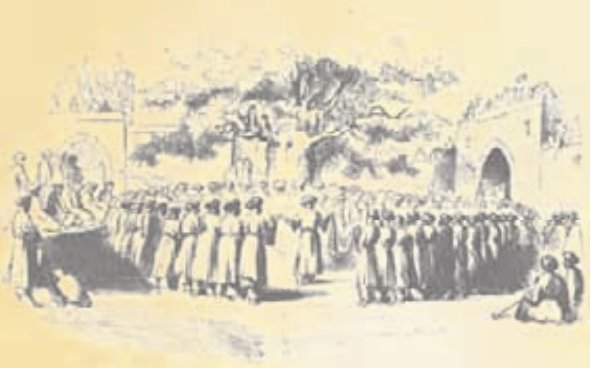
Travelers of the 19th century already drew the round dance at the festival in Lalîş. In 1849 Layard saw a great religious dance in front of the temple facade.
Threat
The Sema depends on the Qewal from Başîqe and Behzanê. According to Omarkhali (2023), their expulsion by IS in 2014 threatens the institution of the Qewal and thus the Sema itself.
See also
- Cejna Cimayê · Celsa Şîxadî and the courtyards
- The festival in Lalîş 1849 (People & Culture)
Sources
- S. A. Grigoriev, L. V. Ivasko, D. V. Pirbari (P’îr Dîma): Lalişa Nûranî / Святой Лалыш / Holy Lalish. Yekaterinburg: Basko 2008, p. pp. 24–31, 63, 67, 137
- Philip G. Kreyenbroek, Khalil Jindy Rashow: God and Sheikh Adi Are Perfect. Sacred Poems and Religious Narratives from the Yezidi Tradition. Wiesbaden: Harrassowitz 2005, p. pp. 10–11, 16, 48
- Khanna Omarkhali: The religious textual tradition of the Ezidis – from the oral to the written. Saint Petersburg 2023 (Russian translation of the English original, Wiesbaden 2017), p. pp. 100, 126, 139–140, 146–147, 458–459, 493–496
- Khanna Omarkhali: Yezidi Religious Oral Poetic Literature: Status, Formal Characteristics, and Genre Analysis. With some examples of Yezidi religious texts. In: Scrinium VII–VIII.2 (2011–2012): Ars Christiana, Leiden: Brill, pp. 144–195, p. pp. 184–188
- Dimitri Pirbari (P’îr Dîma), A. Ščedrovickij: Тайна жемчужины (The secret of the pearl). Moscow/Tbilisi 2016, p. pp. 248, 255 (PDF)
Found a mistake?
Is something wrong – a fact, a spelling, a source, an image? Let us know: we check every report and correct the article.
Other spellings: Govenda dini · Dilana dini · Semakes · Semakesch · Semakesh · Semaya Qanuni · Tac u hil · Tadsch u hil · Taj u hil · Ciraye Merifete · Tschiraye Merifete · Chiraye Merifete · Ciray Merifete · Qawwal · Kawal · Kewal · Lalish · Lalisch · Lalesh · Faqir