
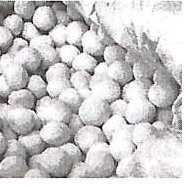
Berat are small white or light green balls made of the earth of Lalîş, kneaded with the water of the holy spring. They are about the size of an olive or a pearl (Lalişa Nûranî). In Armenia and Georgia they are also called Glok Şêx Adî, "ball of Şêx Adî" (Omarkhali 2005). Because they are a piece of Lalîş, every Ezidi should carry a Berat and there should be one in every Ezidi house (Lalişa Nûranî; Omarkhali 2005).
What the word means
Kreyenbroek gives for berat the meanings "innocence" and "remission". Pirbari and Omarkhali (2005) translate it as "gift". The word also occurs in the name of the night Şeva Berat, on which according to tradition God determines the coming year (Kreyenbroek; see Pêşîmam). According to Omarkhali (2011/12), a hymn says: "The lines and Berats of Siltan Êzîd are golden."
What Berat are made of
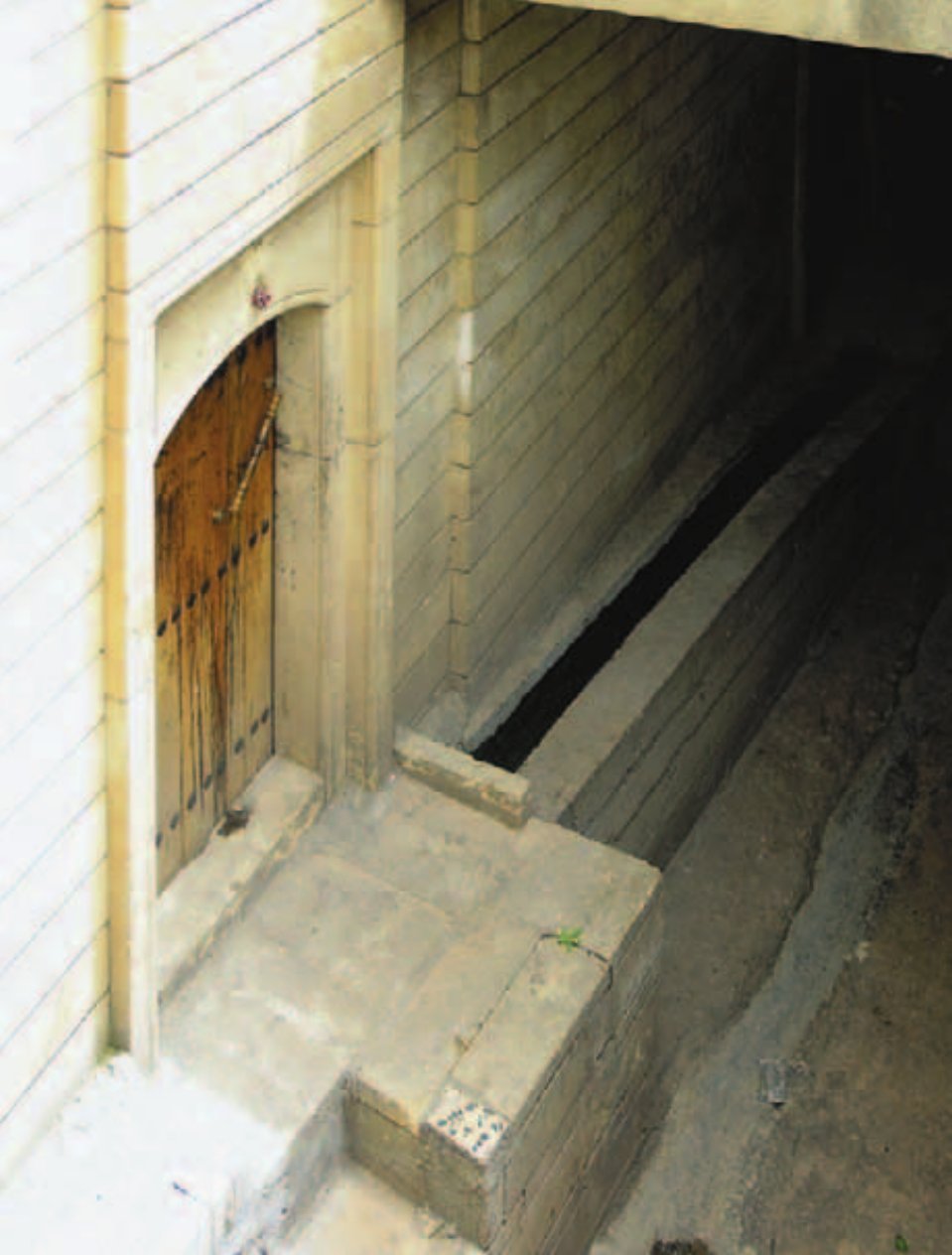
The earth comes from an old cave in Lalîş, the Şikefta Berata. It lies between the building of Şêşims and that of Xatûna Fexra and is said, according to tradition, to have existed "thousands of years before Şîxadî". Its entrance is so narrow that one has to climb up on one's hands; inside it is three to four meters wide. With lamps one climbs up, digs the earth, sieves it, kneads it with water into a dough and forms the balls from it (Lalişa Nûranî).
The water comes from the Kaniya Sipî (Lalişa Nûranî; Omarkhali 2005 and 2023) or from the Zimzim (Kreyenbroek). The English version of the photo book additionally names the leaven (havên). The Berat thus unites the two holiest things of Lalîş: its earth and the water of the spring at which, according to tradition, the earth came into being (see Mor kirin).
The Berat are made by the Feqra, the unmarried female servants of the sanctuary (Lalişa Nûranî; Omarkhali 2005 and 2023; see Offices in Lalîş). They are kept in the building of Sitiya Ês, the mother of Şêx Adî (Lalişa Nûranî); Açıkyıldız found a clay jar full of Berat in a room of the Çilexane (see Berat (Lalîş)).
How Berat are used
- As a sign of the pilgrimage: at the entrance of Sitiya Ês a Feqîr gives the pilgrims the Berat as a sign of their visit to Lalîş (Lalişa Nûranî; Guest). See Pilgrimage.
- In the communities: Berat is distributed during the circuit with the Sencaq and at visits of the Extiyarê Mergehê, a Şêx or P’îr (Lalişa Nûranî).
- In the house: in Armenia and Georgia the Berat lies with other holy things on the Stêr, the holy place in the house (Omarkhali 2005).
- During fasting: in the fasting periods one kisses a Berat in the evening after the prayer and before eating; it is also used at the breaking of the fast (Lalişa Nûranî; see Fasting).
- For yogurt: it is used to start yogurt (Lalişa Nûranî) – an echo of the tradition of the leaven that made the earth solid.
- At a wedding: according to Drower (1941), the Şêx gave the bride earth from Lalîş.
- In the grave: some Berat are buried with the dead (Kreyenbroek).
Protection and reconciliation
The Berat is supposed to protect against misfortune and illness (Omarkhali 2005). It has a special role in a dispute: a Şêx or P’îr places a Berat between the two parties; they hand each other the Berat over the Xerqe of a Feqîr (Lalişa Nûranî). Bedelê Feqîr Hecî (2002), son of a Feqîr family from Lalîş, describes the same custom: the reconciliation takes place before a Şêx or P’îr, the Berat lies on the Xerqe of the Feqîr. He also names its use with the sick. The earth of Lalîş and the holy garment thus bear witness to the reconciliation. See Oath and blessing.
Part of one's clothing
In the Iraqi school textbook for Ezidi religion the Berat, together with the Tok, the round collar of the shirt, count as "symbolic clothing" of the Ezidis (Omarkhali 2023) – that is, as something an Ezidi wears on his person to show his belonging.
See also
- Berat (Lalîş) · Holy signs and objects
- Pilgrimage to Lalîş (People & Culture)
Sources
- S. A. Grigoriev, L. V. Ivasko, D. V. Pirbari (P’îr Dîma): Lalişa Nûranî / Святой Лалыш / Holy Lalish. Yekaterinburg: Basko 2008, p. pp. 32, 92–93, 204–205
- Philip G. Kreyenbroek, Khalil Jindy Rashow: God and Sheikh Adi Are Perfect. Sacred Poems and Religious Narratives from the Yezidi Tradition. Wiesbaden: Harrassowitz 2005, p. pp. 14, 16, 36
- Khanna Omarkhali (Ханна Омархали): Йезидизм. Из глубины тысячелетий (From the depths of the millennia). Saint Petersburg 2005, p. pp. 98, 122, 133, 135–136
- Khanna Omarkhali: The religious textual tradition of the Ezidis – from the oral to the written. Saint Petersburg 2023 (Russian translation of the English original, Wiesbaden 2017), p. pp. 237, 519
- Khanna Omarkhali: Yezidi Religious Oral Poetic Literature: Status, Formal Characteristics, and Genre Analysis. With some examples of Yezidi religious texts. In: Scrinium VII–VIII.2 (2011–2012): Ars Christiana, Leiden: Brill, pp. 144–195, p. p. 163
- Dimitri Pirbari (P’îr Dîma), A. Ščedrovickij: Тайна жемчужины (The secret of the pearl). Moscow/Tbilisi 2016, p. p. 247 (PDF)
- E. S. Drower: Peacock Angel. Being some Account of Votaries of a Secret Cult and their Sanctuaries. London 1941, p. p. 19 (PDF 32)
- John S. Guest: The Yezidis. A Study in Survival. London/New York 1987, p. p. 55
- Bedelê Feqîr Hecî (Bedilê Feqîr Heci): Bawerî û Mîtologiya Êzidiyan. Çendeha Têkist û Vekolîn [Faith and mythology of the Ezidis. Some texts and studies]. Dihok 2002, p. p. 24
- Birgül Açıkyıldız: The Yezidis. The History of a Community, Culture and Religion. London 2010, p. pp. 152–153
Found a mistake?
Is something wrong – a fact, a spelling, a source, an image? Let us know: we check every report and correct the article.
Other spellings: Glok Şêx · Glok Sex Adi · Glok Sheikh Adi · Glok Scheich Adi · Glok Sheikh Adî · Gloka Sexadi · Gloka Schechadi · Gloka Shekhadi · Sikefta Berata · Schikefta Berata · Shikefta Berata · Heilig Erde · Axa Lalise · Agha Lalise · Aga Lalise · Axa Lalische · Lalish · Lalisch · Lalesh · Sheikh Adi