
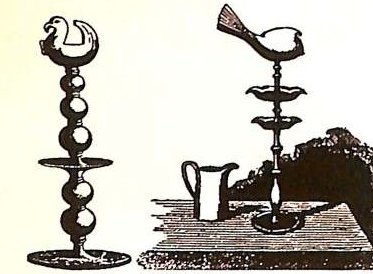
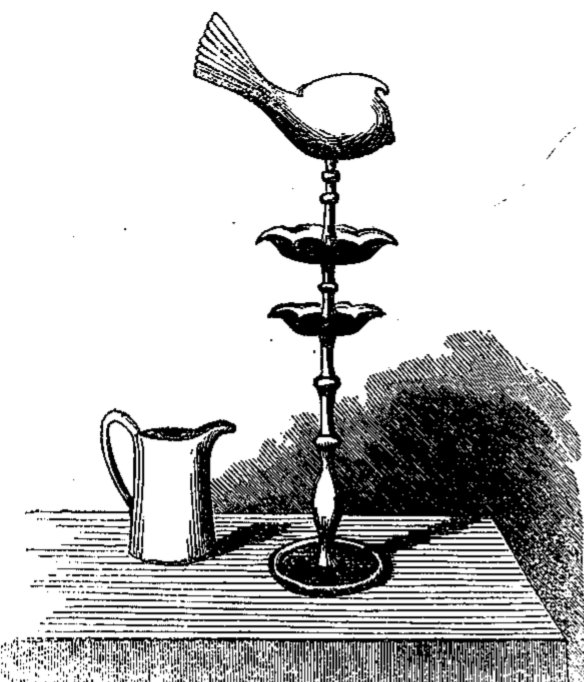
The Sencaq (also Tawûs, "peacock") is a metal figure of a peacock on a stand. It is the sign of Tawûsî Melek, the head of the angels (Kreyenbroek), and according to Pirbari the banner of the Ezidis and the sign of their unity. With it the Qewal traveled once or several times a year through the Ezidi communities – this is called Tawûs gêran ("leading the peacock around"). Appearance, areas and routes of the Sencaq are described in detail in Sencaq and Tawûs gêran (People & Culture); on the object as a symbol see Sencaq and Tawûs. This article explains the religious meaning of the circuit.
An image, not an idol
The Sencaq does not depict Tawûsî Melek bodily, but is his sign. According to Kreyenbroek, in the hymns the peacock stands for Tawûsî Melek; his name is rarely pronounced in the learned tradition, mostly only alluded to. Şêx Mak’sîm stresses elsewhere that it is forbidden to depict the archangels with human faces, because no one has seen their true form. On the figure of Tawûsî Melek see Melek Tawis.
Seven Sencaq for the communities
There were seven Sencaq; each belonged to one of the Ezidi communities (Lalişa Nûranî). Omarkhali (2023) names:
| Sencaq | Area |
|---|---|
| Tawûsa Enzel (Êzî) | Şêxan |
| Tawûsa Şingalê | Şengal |
| Tawûsa Helebê | Aleppo |
| Tawûsa Xalitiya | Diyarbakır |
| Tawûsa Zozana | Hakkari |
| Tawûsa Miskoviya ("Moscow") | Armenia and Georgia |
| Tawûsa Tewrêzê | Iran |
Lalişa Nûranî counts the communities somewhat differently: Şêxan, Şengal, Heleb (Aleppo), Tewrêz (Tabriz), Diyarbekir, Hekarî and Serhed – without a separate Sencaq for Armenia and Georgia (pp. 8–11; see Sencaq and Tawûs).
Today only the Sencaq of Şêxan and Şengal are still carried around (Omarkhali 2023). One Sencaq (Tawûsa Enzel) had been entrusted to other families in troubled times; Omarkhali found it in Armenia in 2008.
What happens during the circuit
Without the permission of the Mîr no circuit takes place (Lalişa Nûranî). The Qewal carry the Sencaq into the villages; according to Kreyenbroek, their visit is a highlight of the village year. The sources name these parts:
- Arrival: when approaching a village the Qewal perform the Qewlê Êzîd (Omarkhali 2023).
- Opening the image: setting up or opening the Sencaq is called Tawûs siyar kirin (Omarkhali 2023). Before holy objects are opened, the audience stands in silence.
- Singing and sermon: the chief Qewal preaches (mişabet); the Qewal sing Qewl with frame drum and flute. In the morning and evening Beyt are sung (Kreyenbroek; Omarkhali). The Dirozge, the long prayer with the names of the saints, belongs to this.
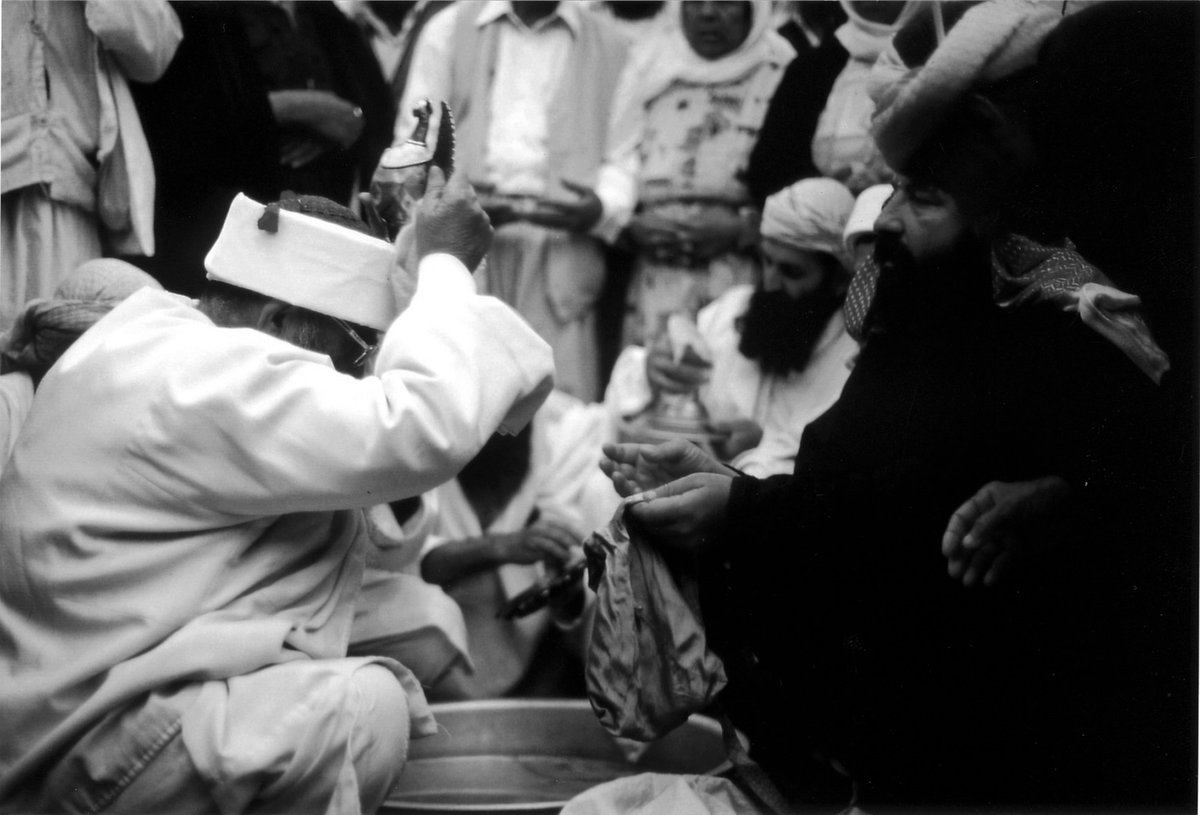
- Water of the White Spring: at the end the Qewal pour water of the Kaniya Sipî on people's heads and say that this is the water of the White Spring, the "cup of Êzîd" (Kreyenbroek). Thus Ezidis far from Lalîş also receive the consecration Mor kirin.
- Holy earth: during the circuit the Berat is distributed (Lalişa Nûranî; see Berat and holy earth).
- Gifts: the Qewal collect gifts for Lalîş. According to Kreyenbroek, the donations to three of the seven Sencaq went to the Mîr. According to Lalişa Nûranî, the holy places are maintained and the poor supported with them.
- Law and peace: according to Lalişa Nûranî, the Qewal were at the same time preachers and executors of legal tasks; they settled disputes.

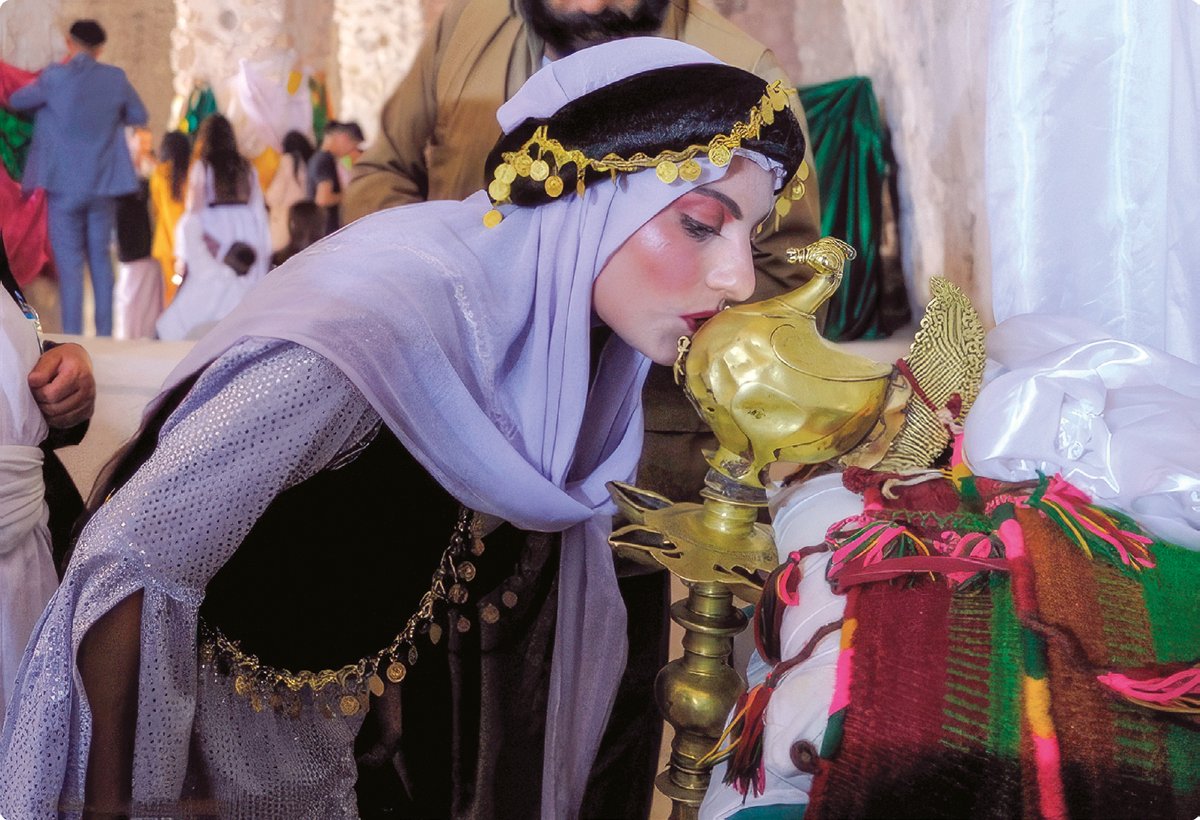
When the collector returns to Lalîş from his journey, according to Lalişa Nûranî, he hangs his little bells on a tree on the "square of the angels", the Dara Zengila ("tree of the little bells"), and rests there.
What the circuit meant
The circuit brought Lalîş to the people who could not come to Lalîş: the sign of Tawûsî Melek, the water of the White Spring, the earth of Lalîş, the hymns and the teaching. According to Omarkhali (2023), the Qewal also taught on these occasions and brought news. The circuits kept the scattered communities connected with the center – that is why Pirbari calls the Sencaq the sign of the unity of the Ezidis. At the Festival of the Assembly the Qewal bring the Sencaq and the gifts back to Lalîş (Kreyenbroek).
The consecration of the Sencaq
The Sencaq itself is also consecrated. Açıkyıldız describes how at the New Year in Lalîş – taken apart into five pieces – it is "baptized" in a basin with water from the Zimzim spring.
Bedelê Feqîr Hecî (2002), too, mentions the distribution of the Berat at the Tawûs gêran.
See also
Sources
- Philip G. Kreyenbroek, Khalil Jindy Rashow: God and Sheikh Adi Are Perfect. Sacred Poems and Religious Narratives from the Yezidi Tradition. Wiesbaden: Harrassowitz 2005, p. pp. 7, 9, 15–16, 38
- Khanna Omarkhali: The religious textual tradition of the Ezidis – from the oral to the written. Saint Petersburg 2023 (Russian translation of the English original, Wiesbaden 2017), p. pp. 51, 137–138, 146–147, 472, 524
- S. A. Grigoriev, L. V. Ivasko, D. V. Pirbari (P’îr Dîma): Lalişa Nûranî / Святой Лалыш / Holy Lalish. Yekaterinburg: Basko 2008, p. pp. 8–11, 36–37, 204–205
- Dimitri Pirbari (P’îr Dîma), A. Ščedrovickij: Тайна жемчужины (The secret of the pearl). Moscow/Tbilisi 2016, p. pp. 71, 255 (PDF)
- Birgül Açıkyıldız: The Yezidis. The History of a Community, Culture and Religion. London 2010, p. pp. 92, 120–121
- John S. Guest: The Yezidis. A Study in Survival. London/New York 1987, p. p. 140
- International Journal of Yezidi Studies, Vol. 1. Tbilisi 2024, p. pp. 82, 90
- Bedelê Feqîr Hecî (Bedilê Feqîr Heci): Bawerî û Mîtologiya Êzidiyan. Çendeha Têkist û Vekolîn [Faith and mythology of the Ezidis. Some texts and studies]. Dihok 2002, p. p. 24
- Khanna Omarkhali: Yezidi Religious Oral Poetic Literature: Status, Formal Characteristics, and Genre Analysis. With some examples of Yezidi religious texts. In: Scrinium VII–VIII.2 (2011–2012): Ars Christiana, Leiden: Brill, pp. 144–195, p. pp. 174, 177
- Şêx Mak’sîm (Maksim Ezdi): Grundpfeiler der Religion ScherfeDin, 2017 (on EZDIKI.COM in the Religion section and in the library), p. p. 48 (PDF)
Found a mistake?
Is something wrong – a fact, a spelling, a source, an image? Let us know: we check every report and correct the article.
Other spellings: Sendschaq · Senjaq · Sendscheq · Senjeq · Tawus · Tawus geran · Gera Tawise · Tawus siyar kirin · Sandschak · Sancak · Tawuse Melek · Melek Taus · Taus-i Melek · Malak Tawus · Qawwal · Kawal · Kewal · Shekhan · Scheichan · Shaikhan