
The religion Şerfedîn has no fixed doctrine that one learns by heart. According to Omarkhali (2023) and Kreyenbroek, it is traditionally based on orthopraxy: what matters is right action – at the right time, in the right place, with the right persons. Kreyenbroek lists as the main duties: respect for the clergy, visiting the sanctuaries, the festivals, alms and levies, the rules of food and conduct and, less strictly regulated, prayer.
This article gives an overview and leads to the individual articles. How the customs are celebrated in everyday life – wedding, birth, festivals, dishes – is described in the section People & Culture.
Basic rules of all rituals
- No ritual without Ferz. Rituals are performed by a person's own Şêx and P’îr, his Ferz. A rite without the responsible Şêx or P’îr is regarded as invalid (Omarkhali 2005; Şêx Mak’sîm). Laypeople traditionally perform no rituals (Omarkhali 2023). See Clergy and castes.
- Fixed days. Many rituals have fixed weekdays. Holy objects may only be opened on "their" day and not after sunset (Omarkhali 2023). Wednesday (Çarşem) is the holy day of the Ezidis (Pirbari; Omarkhali 2005). According to Şêx Mak’sîm, each weekday belongs to one of the archangels; sacrifices are brought on the day of the respective angel.
- Light and sun. Prayer is said facing the sun; wicks are lit at holy places (Lalişa Nûranî).
- Purity of the elements. Fire, water, air and earth are regarded as holy and must not be polluted (Omarkhali 2023).
- Holy words. Almost every ritual is accompanied by prayers and hymns (Qewl, Du’a, Terqîn). Their texts belong in the Prayers section; here they are only named.
The rituals at a glance
| Ritual | What it is about | Article |
|---|---|---|
| Mor kirin | consecration with the water of the White Spring Kaniya Sipî; also the washing of the dead | Mor kirin |
| Dest Danîn | admission into the bond with Şêx and P’îr; oath on the three basic commandments | Dest Danîn |
| Prayer | prayer toward the sun in the morning and evening, declaration of faith before sleep | Prayer and prayer times |
| Fasting | three days before the great festivals; 40 days for clergy | Fasting |
| Qurban | animal sacrifice with the prayer Terqîn | Qurban and Terqîn |
| Ziyaret | pilgrimage to Lalîş, once in a lifetime | Pilgrimage |
| Sema | solemn procession with hymns and sacred music | Sema |
| Tiwaf | local festivals at the sanctuaries of the villages | Tiwaf |
| Tawûs gêran | circuit with the peacock image Sencaq | Sencaq and Tawûs gêran |
| Berat | holy earth from Lalîş | Berat and holy earth |
| Burial | washing, prayers, bridge into the hereafter | Burial – religious meaning |
| Oath and blessing | oaths, formulas of blessing, reconciliation | Oath and blessing |
Rites of passage
Omarkhali (2023) has observed the following rites of passage:
- Çilçû ("forty have passed"): rite 40 days after birth.
- Mor kirin: consecration of the child with water of the Kaniya Sipî.
- Bisk birîn: the Şêx cuts a boy's first lock of hair and speaks the Du’aya biskê (see Birth: Bisk and Sinet). All boys undergo this initiation, whatever their caste.
- Circumcision (Sunet): according to Şêx Mak’sîm, valid only with the Yal.
- Wedding: no Qewl and Beyt are performed, only the prayer du’a me’r birînê by a P’îr or Şêx (see Wedding).
- Burial and mourning (ser miriya) and the funeral meal (ser xêrê).
Rituals at holy objects
Holy objects – the manuscripts of the P’îr (mişûr), the bowls (tas), the holy keys (kilît) – are opened only at certain times. Beforehand chickens or rams are sacrificed and the prayer Terqîn is spoken. The audience stands in silence (Omarkhali 2023). The rings in the ritual bag of a P’îr family are called nîşan and xadim.
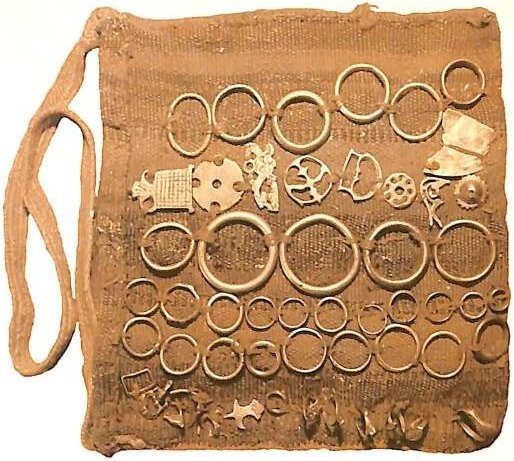
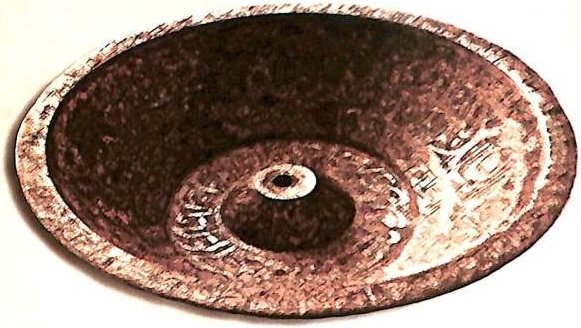
According to Omarkhali, the bowls are not regarded as "magical" but as part of religious practice: one drinks water from them; they serve healing, help against the evil eye and convey the blessing of an intercessor.
The 99 foundations (Erkan)
Şêx Mak’sîm arranges the duties in an order of rank: at the very top stands faith in the one God, below it the Îman, below that the 99 Erkan – stages of religious development. According to him, the five Ferz are only one of these 99 foundations. Kreyenbroek, too, cites the term Erkan ("foundations") from the hymns, where "99 foundations" are mentioned. Another series of "pillars of the religion" is presented in the article Basic pillars of the faith.
See also
- Religious festivals
- Festivals and fast days (People & Culture)
Sources
- Philip G. Kreyenbroek, Khalil Jindy Rashow: God and Sheikh Adi Are Perfect. Sacred Poems and Religious Narratives from the Yezidi Tradition. Wiesbaden: Harrassowitz 2005, p. pp. 6, 15–18, 36–39
- Khanna Omarkhali: The religious textual tradition of the Ezidis – from the oral to the written. Saint Petersburg 2023 (Russian translation of the English original, Wiesbaden 2017), p. pp. 9, 14, 22–24, 46–58, 125, 144–147, 528
- S. A. Grigoriev, L. V. Ivasko, D. V. Pirbari (P’îr Dîma): Lalişa Nûranî / Святой Лалыш / Holy Lalish. Yekaterinburg: Basko 2008, p. pp. 20–31
- Şêx Mak’sîm (Maksim Ezdi): Grundpfeiler der Religion ScherfeDin, 2017 (on EZDIKI.COM in the Religion section and in the library), p. pp. 46, 65, 83, 206–208 (PDF)
- Khanna Omarkhali (Ханна Омархали): Йезидизм. Из глубины тысячелетий (From the depths of the millennia). Saint Petersburg 2005, p. pp. 110, 126
- Dimitri Pirbari (P’îr Dîma), A. Ščedrovickij: Тайна жемчужины (The secret of the pearl). Moscow/Tbilisi 2016, p. p. 258 (PDF)
Found a mistake?
Is something wrong – a fact, a spelling, a source, an image? Let us know: we check every report and correct the article.
Other spellings: Orthoprachie · Orthoprakhie · Ayin · Sheikh · Scheich · Shex · Pîr · Lalish · Lalisch · Lalesh · Qawl · Qaul · Kewl · Tawûsî Melek · Tawuse Melek · Melek Taus · Taus-i Melek · Malak Tawus · Sanjaq · Sandschak