
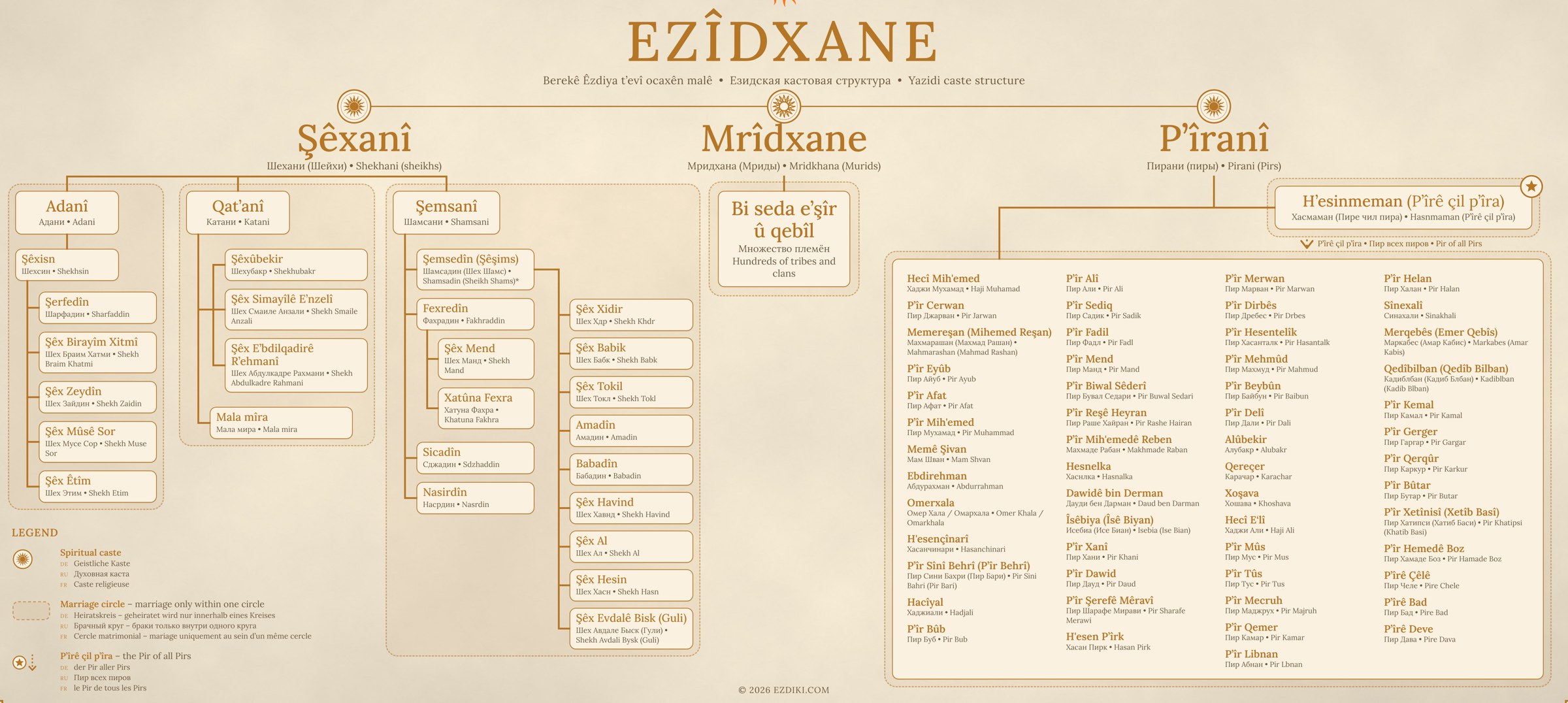
In the religion Şerfedîn there are no priests whom one becomes through study or ordination. One is a cleric by birth: the Ezidis are divided into three hereditary groups, usually called "castes" – Şêx, P’îr and Mirîd. Şêx and P’îr form the clergy, the Mirîd are the laypeople. At the same time every Ezidi, including every Şêx and P’îr, is tied to others by fixed spiritual bonds. This article explains the basic terms and leads to the individual articles.
The social side – marriage rules, tribes, levies, history of the offices – is described in the section People & Culture: Caste system, Three basic rules and five duties and Spiritual offices. Here the subject is the religious significance.
The three castes
| Caste | Position | Origin according to tradition | Article |
|---|---|---|---|
| Şêx | clergy | companions and relatives of Şêx Adî; three houses Adanî, Qatanî, Şemsanî | Şêx and P’îr |
| P’îr | clergy | about 40 lineages ("P’îr of the forty P’îr") | Şêx and P’îr |
| Mirîd | laypeople | tribes (eşîr), the great majority | Mirîd |
According to Omarkhali (2023), the clergy make up only about 6–7 percent, the Mirîd 93–94 percent. In Armenia and Georgia the clergy are called terîq ("path") or ruhanî ("spiritual"), in Iraq dunav ("two names"); the laypeople are called yeknav ("one name"). The whole community is called Êzdîxane.
Why "two names"? According to the photo book Lalişa Nûranî, basically all Ezidis are "Mirîd", that is, pupils. A Şêx or P’îr is a cleric for others and at the same time a Mirîd of his own Şêx and P’îr – he therefore bears two names. Şêx Mak’sîm sums this up in one sentence: whoever is not a Mirîd is not an Ezidi.
No one can become an Ezidi
One belongs to the community and to a caste only by birth; the religion does not recruit followers (Omarkhali 2023; Lalişa Nûranî). A change of caste is impossible. Marriages between the castes and with non-Ezidis are forbidden – this is regulated by the three basic commandments (sê herf), whose breach excludes one from the religion (see Three basic rules).
Where do the castes come from? – three perspectives
There are different views on the origin:
- According to one tradition (P’îr Xidir Silêman, in Omarkhali 2023), before Şêx Adî society was divided only into P’îr and Mirîd. With Şêx Adî the Şêx and the Merebî were added. The leaders gave up their land in favor of the Mirîd; in return the Mirîd gave a part annually to their P’îr and Şêx.
- The photo book Lalişa Nûranî says in the Êzdîkî version that the system arose over centuries; the English version writes that it was introduced with the reform of Şêx Adî. The authors follow O. Vil’čevskij (1930), according to whom an old institution of "elders" is hidden beneath the Arabic titles.
- Şêx Mak’sîm interprets the number three from a Qewl: the three castes exist in honor of three archangels – P’îr for Melekî Tawis (Tawûsî Melek), Şêx for Sultan Şîxadî, Mirîd for Sultan Êzîd. The clergy, he says, are "servants" (micêwir) of an angel on earth, not his physical descendants. He calls the claim that the Ferz arose only in the 12th century a false doctrine. This is his interpretation.
Kreyenbroek stresses that for the Ezidis right action (orthopraxy) is more important than a fixed doctrine: knowing one's place in the network of relationships is a main duty.
The five spiritual bonds (Pênc ferz)
The Pênc ferz ("five duties") are not actions as in Islam, but five persons who accompany the religious life of each individual (Kreyenbroek). The lists differ slightly:
| Source | The five |
|---|---|
| Omarkhali (2023, 2005), Kreyenbroek | Şêx, P’îr, Hosta, Merebî, brother/sister of the hereafter |
| Pirbari (glossary) | Şêx, P’îr, Oste, Merebî, Yar-birayê axretê |
| Lalişa Nûranî (Êzdîkî text) | Şêx, P’îr, Hosta, Merebî, Yar û birê axretê |
| Şêx Mak’sîm | Şêx, P’îr-Hosta, Merhebî, Yal, Birê Axiretê |
With Şêx Mak’sîm, P’îr and Hosta are one person; instead, the Yal is added: a Şêx from the house of Şîxsin who performs circumcision and marriage. The details are in the articles Şêx and P’îr, Hosta and Merebî and Brother and sister of the hereafter. How these bonds are received is described in the article Dest Danîn.
According to Pirbari, the five are at the same time the intercessors of a person in the hereafter: in the Qewlê Şêxûbekir they appear as witnesses at the judgment of the soul.
Offices
Besides the hereditary castes there are offices that belong to certain families. Omarkhali stresses that status and office must not be confused: one has status by birth, an office is a task.
| Office | In brief | Article |
|---|---|---|
| Mîr | secular and spiritual head | Mîr |
| Babê Şêx (Extiyarê Mergehê) | highest cleric | Babê Şêx |
| Pêşîmam | "prayer leader" from the house of Şêx Hesen | Pêşîmam |
| Babê Çawîş, Kebanî, Feqra etc. | service in the sanctuary of Lalîş | Offices in Lalîş |
Across the castes stand three groups of special piety or art, from which Şêx, P’îr and Mirîd can come: the ascetic Feqîr, the singers and guardians of the hymns, the Qewal (only Mirîd), and the seers, the Koçek.

What clergy do
Şêx and P’îr watch over the faith of their Mirîd and perform the rites: at birth, circumcision, wedding, washing and burial of the dead, at festivals (Lalişa Nûranî; Kreyenbroek). A rite without the responsible Şêx or P’îr is regarded as invalid (Omarkhali 2005; likewise Şêx Mak’sîm). In everyday life, according to Lalişa Nûranî, they have no privileges. The office is hereditary and, according to Kreyenbroek, not tied to knowledge – who knows the hymns is a separate question (see Religious education).
Traditionally no layperson performs rituals (Omarkhali 2023). Women of the spiritual castes have spiritual rank from birth; in Iraq adult women from Şêx and P’îr families are called Dayê ("mother").
See also
- Rituals and duties – overview
- Basic pillars of the faith
- Poster and detailed account: Caste system
Sources
- Khanna Omarkhali: The religious textual tradition of the Ezidis – from the oral to the written. Saint Petersburg 2023 (Russian translation of the English original, Wiesbaden 2017), p. pp. 23–24, 45–47, 121–125, 513–520
- Philip G. Kreyenbroek, Khalil Jindy Rashow: God and Sheikh Adi Are Perfect. Sacred Poems and Religious Narratives from the Yezidi Tradition. Wiesbaden: Harrassowitz 2005, p. pp. 6–12
- S. A. Grigoriev, L. V. Ivasko, D. V. Pirbari (P’îr Dîma): Lalişa Nûranî / Святой Лалыш / Holy Lalish. Yekaterinburg: Basko 2008, p. pp. 12–19, 204–206
- Şêx Mak’sîm (Maksim Ezdi): Grundpfeiler der Religion ScherfeDin, 2017 (on EZDIKI.COM in the Religion section and in the library), p. pp. 50–56, 61–77 (PDF)
- Dimitri Pirbari (P’îr Dîma), A. Ščedrovickij: Тайна жемчужины (The secret of the pearl). Moscow/Tbilisi 2016, p. pp. 53, 159, 254, 259 (PDF)
- Khanna Omarkhali (Ханна Омархали): Йезидизм. Из глубины тысячелетий (From the depths of the millennia). Saint Petersburg 2005, p. pp. 93–110
Found a mistake?
Is something wrong – a fact, a spelling, a source, an image? Let us know: we check every report and correct the article.
Other spellings: Sheikh · Scheich · Sex · Pir · Mirid · Qebil · Teriq · Ruhani · Ezdixane · Ezdichane · Ezdikhane · Penc ferz · Pendsch ferz · Penj ferz · Shex · Murid · Sheikh Adi · Scheich Adi · Shaikh Adi · Şêxadî