
The religion of the Ezidis knows only a few rules whose breach excludes a person from the community, but many commandments and prohibitions in everyday life. Kreyenbroek distinguishes absolute taboos, general but less strict taboos and local taboos (p. 18). According to him, many prohibitions serve to protect the purity of the elements – water, fire, air and earth (p. 18).
The three basic rules (sê herf)
Three rules are called sê herf, "the three letters". Whoever breaks one of them leaves the religion automatically, according to Lalişa Nûranî (pp. 12–13):
| Rule | Literally | Content |
|---|---|---|
| Şerbikê zêrîn | "golden cup" | no marriage between the castes and between the groups within the castes |
| Dîzka denê | "dye pot" | no marriage between Ezidis and non-Ezidis |
| Derba Xerqe | "blow on the Xerqe" | no violence and no contradiction against a Feqîr with Xerqe, against one's own Şêx or P’îr |
Şêx Mak’sîm calls the rules Şelpke zerîn, Dîska Denê and Derba Xerqe and interprets them in detail; whoever marries against the first rule is called refzî by him (pp. 59–61). Kreyenbroek counts among the absolute taboos: no marriage with Muslims, no marriage into the family of one's own Şêx or P’îr and no violence against a Feqîr (dirba xerqe) (p. 18). Tradition grounds marriage only among Ezidis in the myth of Şehîd bin Cer (Kreyenbroek, p. 31).
The basic rules and the five duties in social life are described in Three basic rules and five duties; the teaching behind them in Basic pillars of the faith.
Coercion is no sin
Şêx Mak’sîm stresses: what an Ezidi does under coercion or force, including a forced renunciation of the faith, is not regarded as a sin (p. 184). After the genocide of 2014 the Baba Şêx created a purification rite for women and girls who returned from IS captivity. Formerly, whoever had changed faith could not return; now all who were forcibly converted can return (Omarkhali 2023, p. 494).
Forbidden words
Certain words are not pronounced, above all the name of the "evil spirit" in any language (Omarkhali 2005, p. 64; Kreyenbroek, p. 18). Şêx Mak’sîm writes such names only with their initial letter and explains why for Ezidis they are neither pronounced nor written: to equate Tawûsî Melek with a "fallen angel", he says, is an error (pp. 129, 138). Background: Prejudices and errors.
According to Şêx Mak’sîm, it is moreover forbidden to depict the angels with human faces, because no one has seen their true form (p. 48).
Food prohibitions
| Prohibition | Source and reason |
|---|---|
| Pork | Lalişa Nûranî, p. 12; Omarkhali 2005, p. 64 |
| Cabbage (lehane) | according to a legend, cabbage leaves betrayed Şêx Hesen; perhaps also because of the echo of Arabic la’na, "curse" (Kreyenbroek, p. 123 n. 16, 126) |
| Lettuce (xes) | Lalişa Nûranî, p. 12; according to Kreyenbroek a general, less strict taboo (p. 18) |
| Rooster meat | only for the Şêx line Amadîn (Kreyenbroek, p. 192 n. 23) |
Omarkhali also names hemp. For each prohibition, she says, there are one or more legends; she considers these to be later layers (2005, p. 64).
Fire, water, earth
According to Omarkhali (2005, pp. 63–64):
- Fire must not be polluted, not even with words; one does not extinguish it with water.
- One does not spit on the earth and does not pour used water onto the earth.
Local taboos forbid, for example, entering a mosque (Kreyenbroek, p. 18).
Clothing
Traditionally one wears no blue (Kreyenbroek, p. 18; Omarkhali 2005, pp. 64–65). See Colors and the prohibition of blue. Tearing the Toq of the shirt or dishonoring the Xerqe is regarded as a grave sacrilege; see Holy clothing.
Holy places and holy times
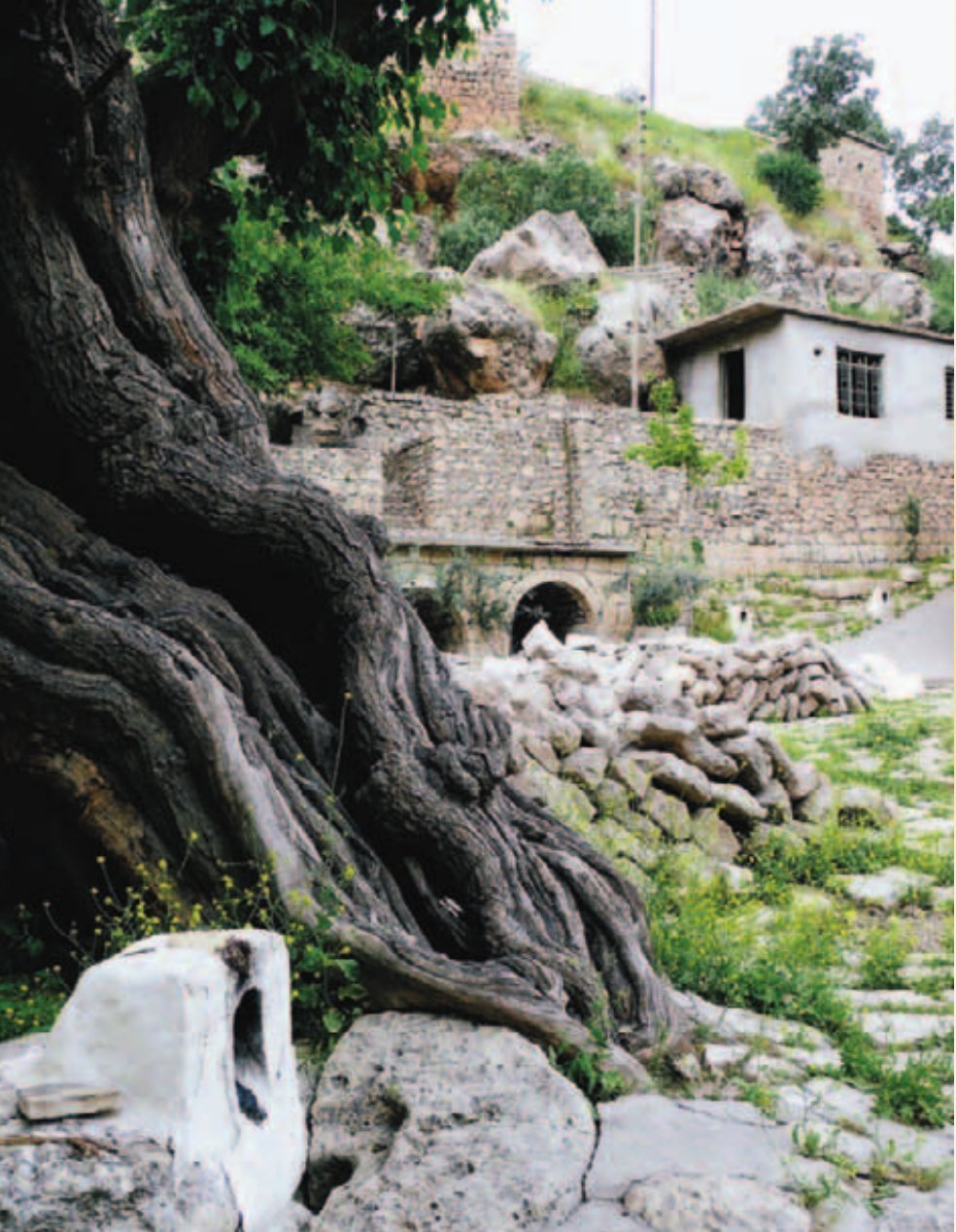
- In the valley of Lalîş no tree may be felled and no branch cut; the servants fetch their firewood from outside (Lalişa Nûranî, pp. 20/25). The olives of the holy grove are not eaten, because their oil is intended for the lamps of Lalîş (pp. 30, 37).
- One does not enter a sanctuary bareheaded, does not step on the threshold and takes off one's shoes before the bridge Pira Selatê (pp. 20/25). See Ziyaret – visit and rules.
- Holy objects may be opened only on "their" weekday and not after sunset (Omarkhali 2023, p. 53 n. 119).
- Wednesday is holy. According to Şêx Mak’sîm, one should behave every Wednesday as on a fast day: not bathe, pray, do as much good as possible, no marital intercourse (p. 190).
Sins
Hesenê Şêx Kelaşê (1995) lists as sins: lying, cursing, adultery, slander, quarreling, telling of things unseen and not happened, murder, oppression and arrogance. What is commanded is to help those in need and to raise up those who have fallen (pp. 41–42). On good and evil in the faith: Good and evil.
Sources
- S. A. Grigoriev, L. V. Ivasko, D. V. Pirbari (P’îr Dîma): Lalişa Nûranî / Святой Лалыш / Holy Lalish. Yekaterinburg: Basko 2008, p. pp. 12–13, 20, 25, 30, 37, 39, 104
- Philip G. Kreyenbroek, Khalil Jindy Rashow: God and Sheikh Adi Are Perfect. Sacred Poems and Religious Narratives from the Yezidi Tradition. Wiesbaden: Harrassowitz 2005, p. pp. 18, 31, 123 (n. 16), 126, 155, 192 (n. 23)
- Şêx Mak’sîm (Maksim Ezdi): Grundpfeiler der Religion ScherfeDin, 2017 (on EZDIKI.COM in the Religion section and in the library), p. pp. 48, 59–61, 129, 138, 184, 190
- Khanna Omarkhali (Ханна Омархали): Йезидизм. Из глубины тысячелетий (From the depths of the millennia). Saint Petersburg 2005, p. pp. 63–65
- Khanna Omarkhali: The religious textual tradition of the Ezidis – from the oral to the written. Saint Petersburg 2023 (Russian translation of the English original, Wiesbaden 2017), p. pp. 53 (n. 119), 494
- Һ'әсәне Шех К'әләше (Hesenê Şêx Kelaşê, Hesen Hesenyan): Р'е-р'ьзма мьләте Эзди ангори qьраре дин (Rê-rizma mileta Êzdî angorî qirarê dîn). Şamîran 1995 (scan and new text edition in the EZDIKI.COM library), p. pp. 41–42
Found a mistake?
Is something wrong – a fact, a spelling, a source, an image? Let us know: we check every report and correct the article.
Other spellings: Se herf · Serbike zerin · Scherbike zerin · Sherbike zerin · Serbik zerin · Selpke zerin · Schelpke zerin · Shelpke zerin · Selpk zerin · Dizka dene · Derba Cherqe · Derba Kherqe · Lalish · Lalisch · Lalesh · Xirqe · Kherqe · Khirqa · Faqir · Fakir