
Background: why documents of the Soviet era say “Kurdish”
Many books, newspapers, certificates and photos on this page say “Kurdish” – for example “Kurdish alphabet”, “Kurdish newspaper” or “Kurmancî”. This was a requirement of Soviet nationalities policy and not a self-designation of the people:
- In the first Soviet census of 1926, the Ezidis were still counted as a distinct people (12,237 in Armenia, 14,523 in the whole USSR; see Recognition as a distinct nationality).
- From the 1930s, under Stalin, nationality in the Soviet Union was determined above all by language; religion had no place in the atheist state. The Ezidis were therefore assigned to the Kurds without any involvement of their own: in the census of 1939, the number of “Kurds” in Armenia rose from 3,025 to 20,481, and there were no longer any separate Ezidi figures. A Politburo resolution of February 26, 1935 regulated work “among the Kurdish population” of the USSR.
- In passports, censuses, publishing houses, schools and newspapers, the Ezidis were henceforth called “Kurds” and their language “Kurdish” or “Kurmancî” – regardless of how they saw themselves. Whoever resisted this had no possibility in this system of changing it.
- The teachers, authors and journalists on this page – Lazo, Îsahak Marogulov, Erebê Şemo, Hecîyê Cindî and many others – were Ezidis, and the pupils were Ezidi children in Ezidi villages. The language of the books is Êzdîkî.
- Only with the movement from 1988 were the Ezidis in Armenia again able to appear publicly as a distinct people; in the census of 1989 they were recorded separately again for the first time.
The books, newspapers and photos are shown on EZDIKI.COM unaltered – as testimonies of their time and as part of the Ezidi cultural heritage (see also the books of the Soviet era in the Library).
First schools (1900–1920)
For a long time, reading and writing were regarded as unseemly among the Ezidis. Between 1900 and 1904, the first state Russian-language schools were established in Ezidi villages: in Zor (Surmelî, 1902), Qundexsaz (Aparan) and Bacelû (Kars). 15,000 rubles were spent on the two-story school building in Zor; the teacher was Îsahak Marogulov.
The Armenian alphabet: “Şems” (1921)
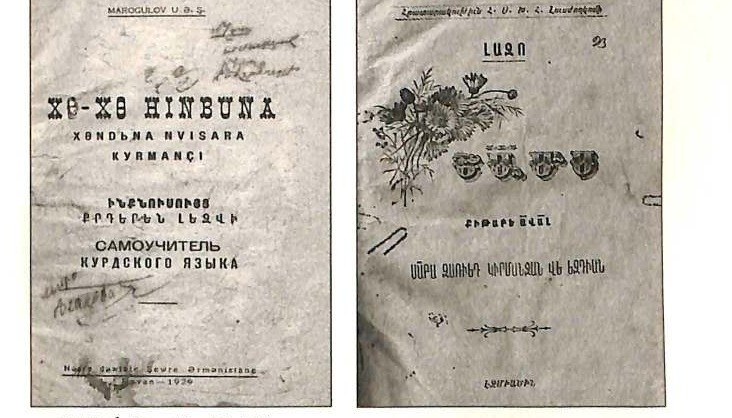
On April 23, 1921, the Commissariat of Education of Armenia decided on instruction in the mother tongue. For the Ezidis, however, there was neither an alphabet nor teachers. Lazo created an alphabet based on the Armenian script within a few months; in October 1921 the primer “Şems” appeared.
| Year | Schools | Pupils |
|---|---|---|
| 1921 | 5 | 267 |
| 1925/26 | 10 | 520 |
| 1927 | 13 | – |
| 1930 | 27 | 1451 |
| 1932 | 35 | 2051 |
The figure for 1930 is given by Isabel Broian (2025) after Çatoev (1965); the other figures come from Eskerê Boyîk.
The Latin alphabet (1928–1938)
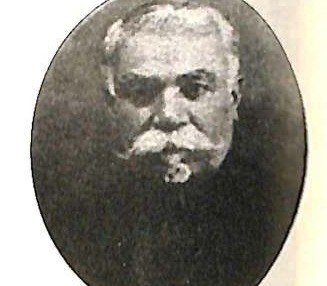
The Armenian alphabet did not render all the sounds of the language. At the end of 1928, Îsahak Marogulov and Erebê Şemo worked out a Latin alphabet; from 1930 it was used for teaching and printing in all schools. By 1933, 59 books had appeared in 91,000 copies, in total over 180 books and brochures.
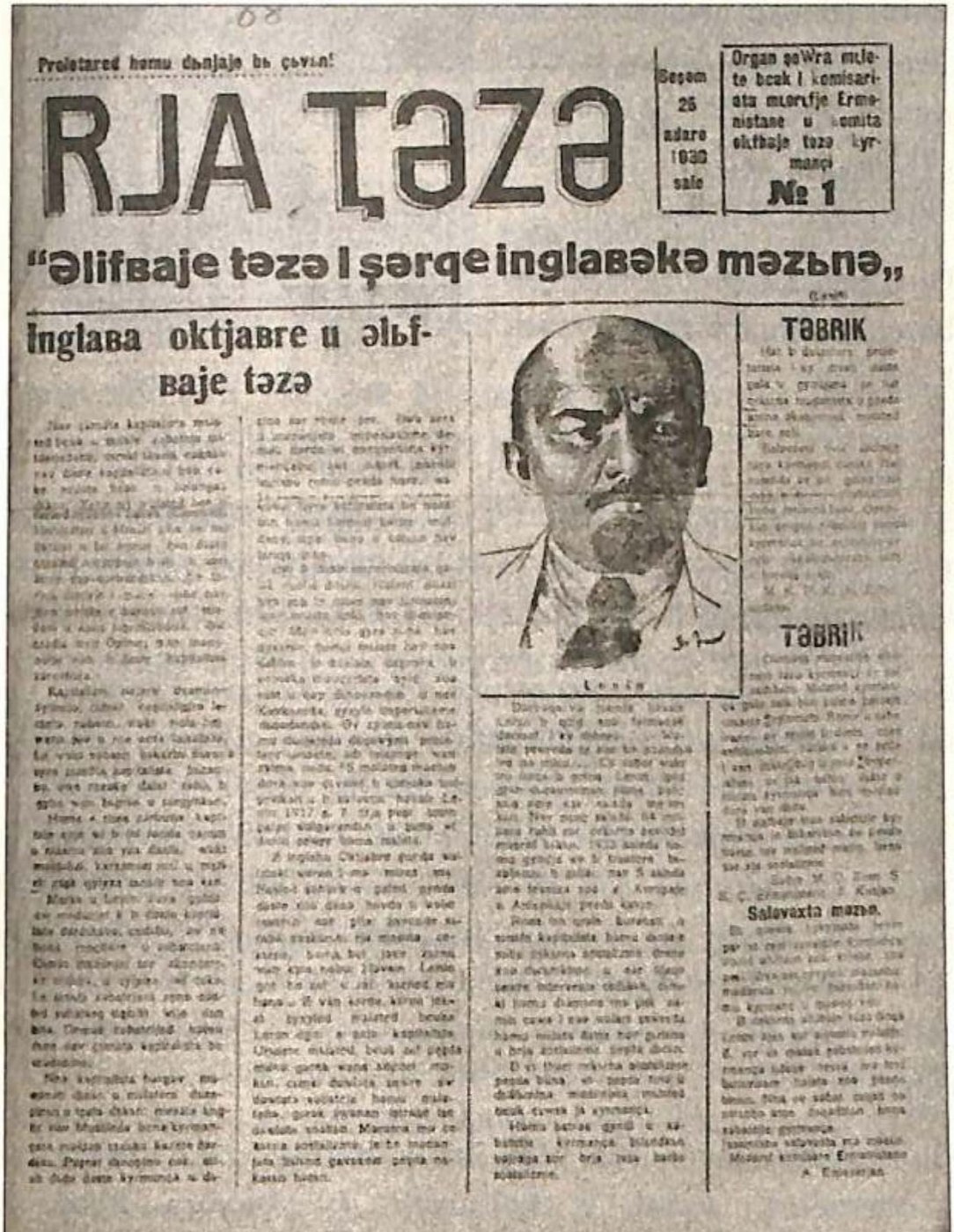
- On March 25, 1930, the first issue of the newspaper Rîya Teze (“New Path”) appeared in Yerevan.
- In 1931, a pedagogical technical college opened in Yerevan; about 80 percent of the students were Ezidis. By the end of the 1930s, 70 teachers had been trained.
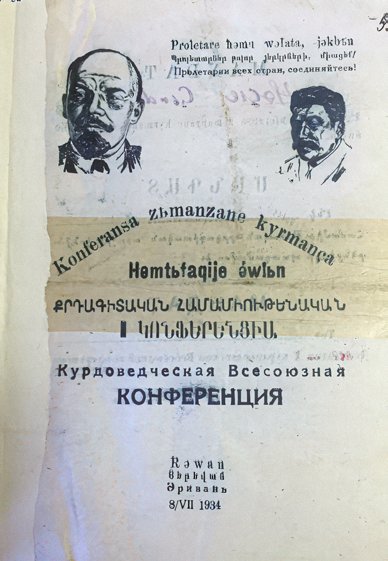
- In July 1934, a language conference in Yerevan with 90 participants recognized the dialect of the Ezidis of Armenia as the basis of the written language.
- In 1936–1937 there were courses for Ezidi girls as nursery teachers and teachers.
The Cyrillic alphabet (from 1946)
In 1938 the changeover to the Cyrillic script was proposed; the war delayed it. In 1946 the primer “Elifba” by Hecîyê Cindî appeared in Cyrillic script with some Latin characters. It was reissued again and again until the end of the Soviet Union.
After Stalin
There were now seven-year and secondary schools in the Ezidi villages, but teaching was in Armenian, with only one or two hours per week of the mother tongue. Alongside this there were the newspaper Rîya Teze and a program on Radio Yerevan. More recently, the subject Êzdîkî has been taught at some schools in Armenia, with its own textbooks.
Additions according to Broian (2025)
In 2025, Isabel Broian evaluated files of the National Archives of Armenia, the private archive of Hecîyê Cindî and issues of the newspaper Rîya Teze.
- Reading centers from 1919: According to a decree of 1919, all persons aged 8 to 50 were to learn to read and write. There were reading centers, among others, in the Ezidi villages of Hakko, Gyalto, Tlik, Sorrik, Kyalaşbek, Siçanlû, Baysiz, Dian, Greater Camuşlû, Mîrek, Carcaris and Karvansera (according to Çatoev).
- Instruction in the mother tongue: The decree of the People’s Commissariat of April 23, 1921 determined that the Ezidis should learn to read and write in their mother tongue; in October 1921 Lazo’s primer “Şems” appeared with a reader.
- Latin alphabet: According to Broian, the People’s Commissariat had already approved a Latin alphabet on March 25, 1925; at the end of 1928 came the new alphabet of Erebê Şemo and Îsahak Marogulov (see above).
- Study in Leningrad: Eleven young people were sent to study at the Leningrad Oriental Institute.
- The technical college: In January 1931, People’s Commissar A. Mravyan founded the technical college in Yerevan (official name: “Transcaucasian Kurdish Technical College”). Its director was Erebê Şemo. In six years it trained 70 teachers; in 1937 it was closed during the Great Terror.
- Rîya Teze: The newspaper was a party organ under strict censorship. The early issues in Latin script were largely destroyed during the repressions. In 1938 the newspaper was closed and the editorial staff were charged; in 1955 it was refounded, now in Cyrillic script (see Repressions 1937–1939).
Additions and discrepancies according to Pirbari/Amoev (2013) and Pobedonostseva-Kaya (2022)
In their brochure on Ezidi writing (Tbilisi 2013), Dimitri Pirbari and Kerim Amoev give an overview of the alphabets of the 20th century; Angelika Pobedonostseva-Kaya (2022) adds information from St. Petersburg archives.
| Year | Script | Details |
|---|---|---|
| until the early 20th c. | Perso-Arabic script | in Iraq a modified Arabic script to this day |
| 1872 | draft of an alphabet | S. A. Yeghiazarov, as a student in Tiflis, drafted an alphabet and a grammar (according to Bakhchinyan 2003, cited in Pobedonostseva-Kaya) |
| 1921 | Armenian script | primer “Şems” by Lazo; according to Pirbari/Amoev the alphabet did not catch on |
| 1928 | Latin script | reformed in 1929 and in the mid-1930s |
| 1946 | Cyrillic script | author Hecîyê Cindî |
| after 1991 | Latin script | see below |
- Where did “Şems” originate? Pirbari and Amoev write that Lazo created the alphabet in Tiflis, where he lived; according to Pobedonostseva-Kaya the primer was printed on behalf of the People’s Commissariat of Education of Armenia. The two do not exclude each other.
- How long did Lazo work on it? Above (according to Boyîk) it says that Lazo created the alphabet “within a few months”. According to Pobedonostseva-Kaya he worked on the textbook for ten years. The statements contradict each other; perhaps one refers to the preparatory work, the other to the completion after the decision of 1921 – this is a conjecture.
- First attempts: The alphabets of 1921 and 1928 were not the first attempts; already in 1872 there was Yeghiazarov’s draft (see table).
- Teachers: In the 1920s, the teachers at the Ezidi schools were mostly Armenians. As an exception, Pobedonostseva-Kaya names an Ezidi teacher “A. Avdal” – presumably Emînê Evdal; this has not been verified.
- Women teachers from Leningrad: In the mid-1930s, the Ezidi women Kude Nadirova, Mariam Saroyan, Maria Čatoeva and Telli Šamoeva studied at the courses for national minorities of the Soviet East in Leningrad, which trained teachers for instruction in the mother tongue (archival evidence in the Central State Archive of St. Petersburg).
- Cyrillic and Latin after 1991: According to Pirbari and Amoev, the Cyrillic alphabet rendered the sounds of Êzdîkî most accurately. After 1991 the Ezidis of Armenia and Georgia largely abandoned it and went over to the Latin script, in order to be able to read literature printed abroad as well; in Armenia some continue to use it. That Cyrillic is “most accurate” is the authors’ view.
- Georgia: On schools and instruction of the Ezidis in Georgia (boarding school in Tiflis 1923, School No. 7) see Ezidis in Georgia.
Additions according to T’amoyan’s school textbooks (2011–2019)
The Ezidi school textbooks by E’zîz T’amoyan and H’esen T’amoyan (Spîka publishing house, Yerevan, approved by the Ministry of Education of Armenia) are themselves part of this history and contain information about it:
- School in Zor: According to Ahmedê Gogê (textbook grade 8), the Russian-language boarding school in Zor was opened in 1904 (above, according to Boyîk: 1902); the parents paid school fees. On September 1, 1917 it was closed; Ûsiv Beg’s petition for reopening with the teacher Elîxanê Serdar Şagînov was unsuccessful during the war.
- Primer “Şems”: According to the primer (grade 1), Lazo’s “Şems” appeared in 1921 in Armenian script and was printed in Etchmiadzin. In the preface Lazo writes that he first thought of characters of his own and then weighed Arabic, Latin and Armenian script; Arabic was difficult and, for religious reasons, not acceptable.
- Reading and writing in 1926: According to the census of 1926, of 12,237 Ezidis of Armenia only 184 men and 21 women could read, of whom 17 and 5 respectively in the mother tongue (grade 7).
- Schools around 1928–1930: According to reports of the Tiflis newspaper “Zarya Vostoka”, which the grade 9 textbook summarizes, there were 11 schools with about 300 pupils for about 20,000 Ezidis, among them only 16 girls; teaching was partly in Armenian, partly in Ezidi. In Mîreka Mezin and Mîreka Ç’ûk a school for 80 children with instruction in Êzdîkî was built.
- First students: According to the grade 7 textbook, in 1928 the first group of Ezidi young people went to Leningrad, among them the later surgeon Îsoyê Şemo Nadîrov; in the same year Semend Sîabendov also came to the Leningrad Oriental Institute (grade 9). Among the first teachers with higher education, the grade 2 textbook counts Qaçaxê Tihar and Seh’îdê Ûsiv.
- New school alphabet: In 2005, E’zîz T’amoyan published the primer “E’lîfba êzdîkî”. The textbooks are printed in a Cyrillic alphabet with 40 letters (grade 4). This contradicts the statement of Pirbari and Amoev (above) that the Ezidis of Armenia largely went over to the Latin script after 1991; evidently both scripts existed side by side.
- Extent of instruction: According to grade 8, instruction in Êzdîkî existed in over 30 villages (textbooks up to grade 8), according to grade 9 in about 30 villages (up to grade 9) and according to grade 11 (2014) in 32 schools (up to grade 11). In 2019 a language textbook for grades 11–12 followed.
See also The Ezidi movement in Armenia since 1988.
Sources
- Eskerê Boyîk: Bi Kurtayî Dîroka Êzidiyên Ermenistanê (A short history of the Ezidis of Armenia). Diyarbakır 2016, p. 60–62, 72–77, 189–198
- International Journal of Yezidi Studies, Vol. 2. Tbilisi 2025, p. p. 74–77, 89–90
- Dimitri Pirbari, Kerim Amoev: Езидская письменность (The Ezidi script). Tbilisi: Nekeri 2013, p. p-023–p-025, p-029
- Angelika O. Pobedonostseva-Kaya: „Советская власть одобряет нашу религию“: езидизм в советском кино. In: Vostočnyj kur'er / Oriental Courier 2022, No. 3, pp. 159–178 (page references = PDF pages and paragraphs), p. p6, p13 (paras. 26–27, n. 10)
- H’esenê Şêx-Me’mûdê (Hasan T’amoyan), E’zîzê E’mer (E’zîz T’amoyan): Elîfba êzdîkî (primer, grade 1). Yerevan: Spîka 2014 (approved by the Ministry of Education of Armenia), p. p-099
- E’zîzê E’mer, H’esenê Şêx-Me’mûdê: E’debyet û zimanê êzdîkî, grade 2. Yerevan: Spîka 2011, p. p-098–100
- E’zîzê E’mer, H’esenê Şêx-Me’mûdê: E’debyet û zimanê êzdîkî, grade 4. Yerevan: Spîka 2013, p. p-039
- E’zîzê E’mer, H’esenê Şêx-Me’mûdê: E’debyet û zimanê êzdîkî, grade 7. Yerevan: Spîka 2014, p. p-013, p-061–062
- E’zîzê E’mer, H’esenê Şêx-Me’mûdê: E’debyet û zimanê êzdîkî, grade 8. Yerevan: Spîka 2011, p. p-013–015, p-098
- H’esenê Şêx-Me’mûdê, E’zîzê E’mer: E’debyet û zimanê êzdîkî, grade 9. Yerevan: Spîka 2012, p. p-022, p-046–050
- E’zîzê E’mer, Omerê Şero (Omar Mamoyan), Xidirê Sûrên (Chidir Hadschojan): E’debyet û zimanê êzdîkî, grade 11. Yerevan: Spîka 2014, p. p-013
- E’zîzê E’mer, H’esenê Şêx-Me’mûdê: Zimanê êzdîkî (language textbook, grades 11–12, Cyrillic). Yerevan: Spîka 2019, p. p-003
Found a mistake?
Is something wrong – a fact, a spelling, a source, an image? Let us know: we check every report and correct the article.
Other spellings: Sems · Schems · Shems · Riya Teze · Ezidiki · Ezdeki · Abaran · Bash-Aparan · Qers · Jerewan · Eriwan · Erivan · Tbilissi · Eziden