
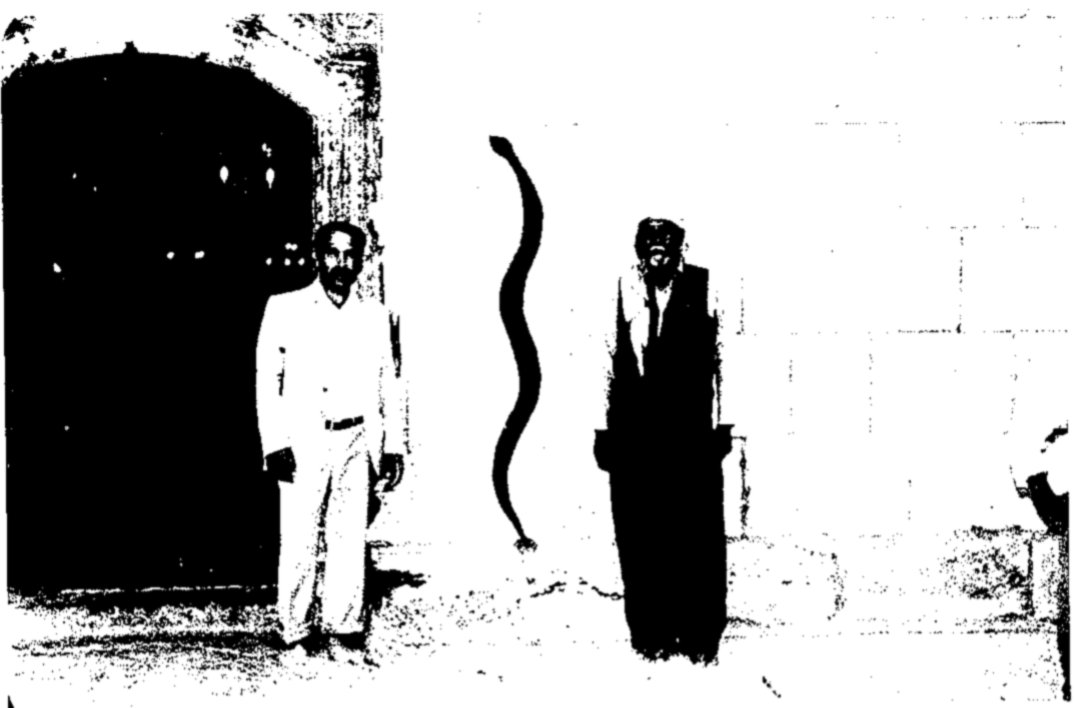
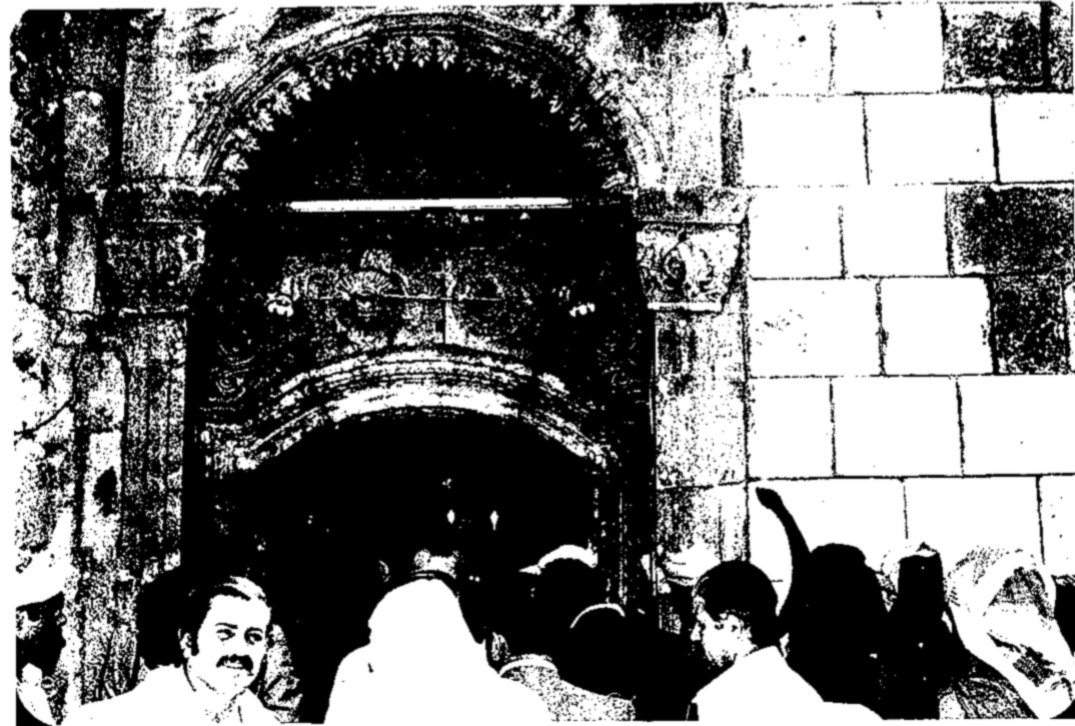
Beside the portal that in the sanctuary of Şêx Adî in Lalîş leads from the inner courtyard into the hall, a large black snake is set into the wall. It is the most striking image at this place and is almost always mentioned by visitors. For the Ezidis it is connected with Şêx Mend, the lord of the snakes, and with the tradition of the ark. It is not worshipped.
Appearance and location
- The snake stands vertically to the right of the portal and is about 6 feet (about 1.80 m) high (Edmonds, Guest).
- It is black. The color is renewed again and again: in 1906, according to a British missionary, two or three old servants blackened it daily with charcoal; in 1944, according to Edmonds, it had been freshly blackened with lamp soot; Guest mentions shoe polish.
- The sources describe the same wall from different viewpoints: Guest speaks of the “east wall”, Edmonds of the west façade of the sanctuary (at the same time the east side of the courtyard), Açıkyıldız of the west wall of the hall facing the inner courtyard. Açıkyıldız considers the snake to be original (see Lalîş).
- Beside it there were and are further reliefs: a horizontal snake, an axe, a comb, staffs, birds, a lion, a circle of sun, moon and stars. During a more recent renovation, according to Guest, many of them were plastered over; the snake remained.
- According to the Baba Şêx Şêx Nasir, who invited Layard to the autumn festival in 1846, a Christian stonemason cut the reliefs on the door (according to Guest). Layard himself writes (nineveh1 p. 282–283): on the lintel a lion, a snake, an axe, a man and a comb were carved, the snake particularly conspicuous. Şêx Nasir explained to him that the Christian mason who had repaired the tomb some years earlier had put them there as mere decoration. Layard saw the axe and comb on many stones of the building; he was assured that they were signs of those who had given money for the restoration or had helped with the work.
Not an object of worship
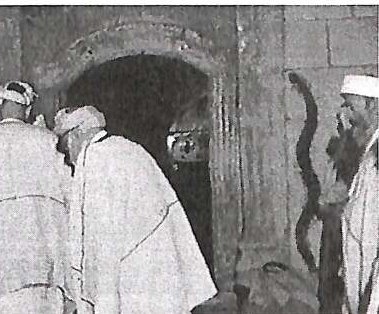
At the autumn festival of 1849, the traveler Layard observed that the participants in the evening procession kissed the right side of the entrance, on which the snake is depicted. Şêx Nasir and Qewal Yûsif expressly explained to him: what is kissed is the entrance of the sanctuary, not the image of the snake (see The festival in Lalîş 1849). This corresponds to the treatment of the peacock: the image is a sign, not an idol.
The tradition of the ark
According to Ezidi tradition, the ark was built in Eyn Sifnî at the time of the Flood. On its voyage it struck a peak of the Şengal mountains and sprang a leak; a snake coiled itself up and plugged the hole. After that the ark landed on Mount Cûdî (Guest). Açıkyıldız names this tradition as the Ezidi explanation of why the snake is depicted on sanctuaries.
Şêx Mend, the lord of the snakes
- Şêx Mend, a son of Şêx Fexredîn, is regarded as the patron of snakes; Perminov calls the image at the entrance of Lalîş his emblem and him the “Mîr of all snakes”.
- According to Omarkhali, the Şêx family Şêx Mend may do no harm to snakes; according to popular belief, its members are never bitten by snakes. In general: one may not kill or injure snakes.
- The Şêx of this family were regarded as snake charmers and healers of snakebites; Lescot describes how they sucked out bites (likewise Fuccaro, Edmonds).
- In her book of 1941, the Englishwoman E. S. Drower describes how in an Ezidi village she saw a Şêx from the Şêx Mend family with his little daughter, who carried large snakes – according to her informant not rendered harmless – around their necks and showed them from house to house. Layard already describes a snake charmer from Şengal who displayed snakes in his camp with his little son.
- According to a tradition recorded by Edmonds, the Mend Şêx were miraculously created from an apple, a snake and a staff.
Snakes at other sanctuaries
The snake is a characteristic motif of Ezidi buildings (see Sacred architecture):
- on the doors of Şêx Amadîn (Şengal, a pair of snakes facing each other) and Şêx Ebû Bekir (Mem Şivan);
- on all mausoleums of Şêx Mend Paşa;
- according to Drower formerly also on Şêx Nasirdîn and Şêx Şems in Lalîş; according to her, only mausoleums of Şêx from the Şemsanî family bore the snake motif.
Among the objects that Ottoman troops carried off from Lalîş in 1892 there was also a cast bronze snake (see Ferman 1890–1918).
Interpretations
Some authors connect the snake with figures from the folk art of the neighbors (such as the snake queen Şahmaran) or with older religions. These are interpretations of the authors. The Ezidis themselves explain the snake by the ark and by Şêx Mend.
Sources
- Austen Henry Layard: Discoveries among the Ruins of Nineveh and Babylon (abridged edition). New York 1853, p. p. 76, 212–213
- John S. Guest: The Yezidis. A Study in Survival. London/New York 1987, p. p. 48, 56, 58, 113, 137, 181, 188
- C. J. Edmonds: A Pilgrimage to Lalish. London (Royal Asiatic Society) 1967, p. p-017, p-025, p-047–048
- Birgül Açıkyıldız: The Yezidis. The History of a Community, Culture and Religion. London 2010, p. p. 153, 170–172, 253–254
- Khanna Omarkhali (Ханна Омархали): Йезидизм. Из глубины тысячелетий (From the depths of the millennia). Saint Petersburg 2005, p. p. 97, 139–140
- A. V. Perminov: Езиды – древний народ Адаби (The Ezidis – the ancient people Adabi). Sharya 2016, p. p. 89, 94
- Nelida Fuccaro: The Other Kurds. Yazidis in Colonial Iraq. London 1999, p. p. 26
- Roger Lescot: Enquête sur les Yezidis de Syrie et du Djebel Sindjār (Study of the Ezidis of Syria and of the Şengal mountains). Beirut 1938, p. p. 89
- E. S. Drower: Peacock Angel. Being some Account of Votaries of a Secret Cult and their Sanctuaries. London 1941, p. p. 27
- Austen Henry Layard: Nineveh and Its Remains, Vol. 1. London 1849, p. p. 282–283
Found a mistake?
Is something wrong – a fact, a spelling, a source, an image? Let us know: we check every report and correct the article.
Other spellings: Sdschhlange · Sjhlange · Sdschhwarze Sdschhlange · Sjhwarze Sjhlange · Schwarz Schlange · Sdschhwarz Sdschhlange · Schlange von Lalis · Sdschhlange von Lalisch · Sjhlange von Lalish · Schlang von Lalis · Sheikh Mend · Scheich Mend · Sex Mend · Sdschhlangenrelief · Sjhlangenrelief · Lalish · Lalisch · Lalesh · Sheikh Adi · Scheich Adi