
Music and dance accompany every Ezidi festival, above all the wedding.
Instruments
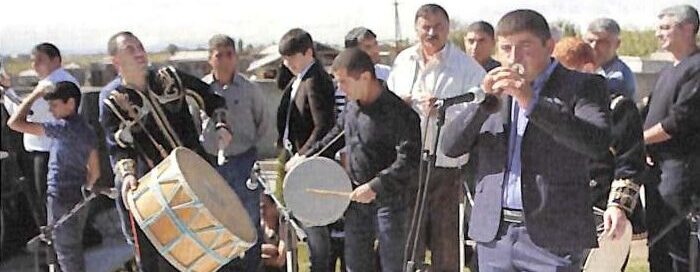
The traditional instruments include the zurna (a woodwind instrument) and the def (the frame drum).
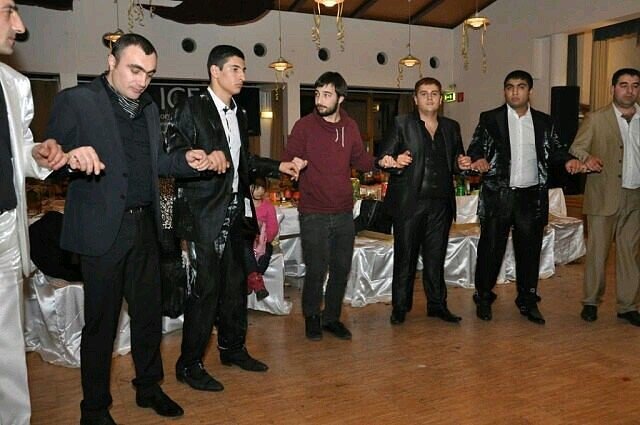
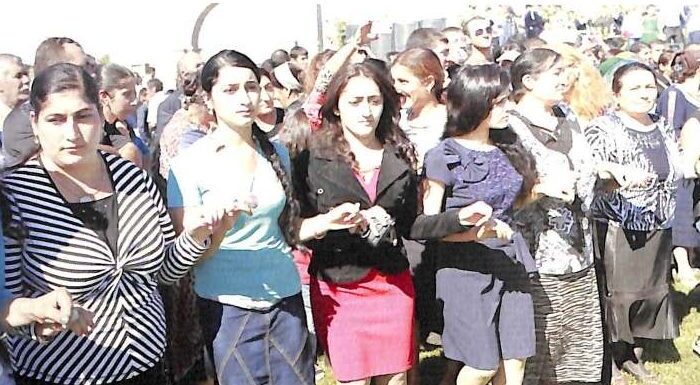
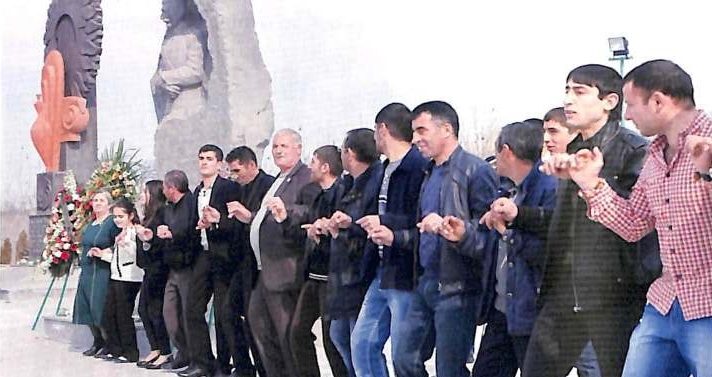
Govend – the circle dance
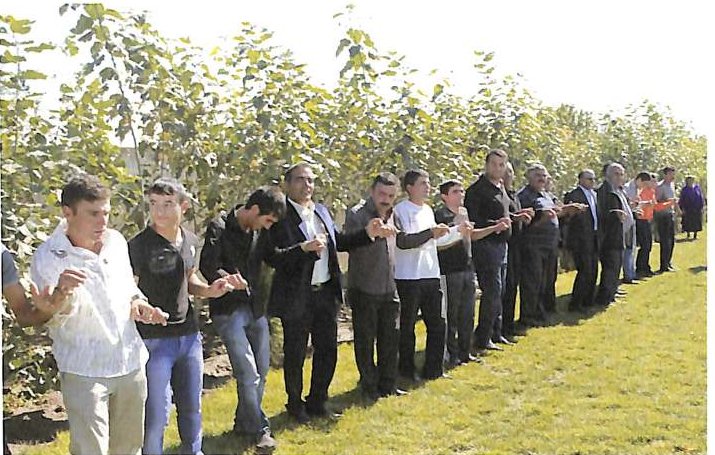
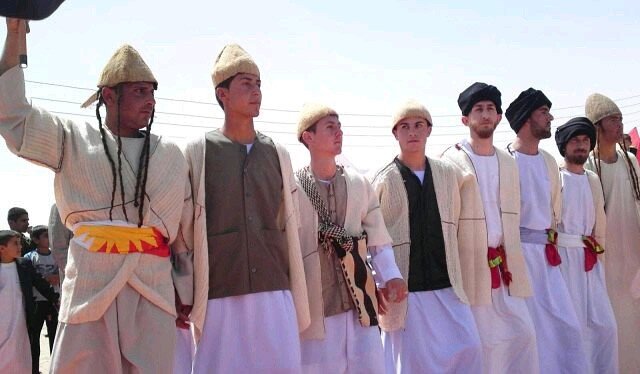
The most important dance is the Govend, a chain and round dance in which the dancers hold each other by the hands or shoulders. It is danced in a circle in the direction of the sun's course – in the Ezidi understanding an image of the movement of the sun. Other dances are the Tringi and the fiery Koçarî.
Merani
Especially popular are the Merani – slow, often sad songs about life and love.
Today
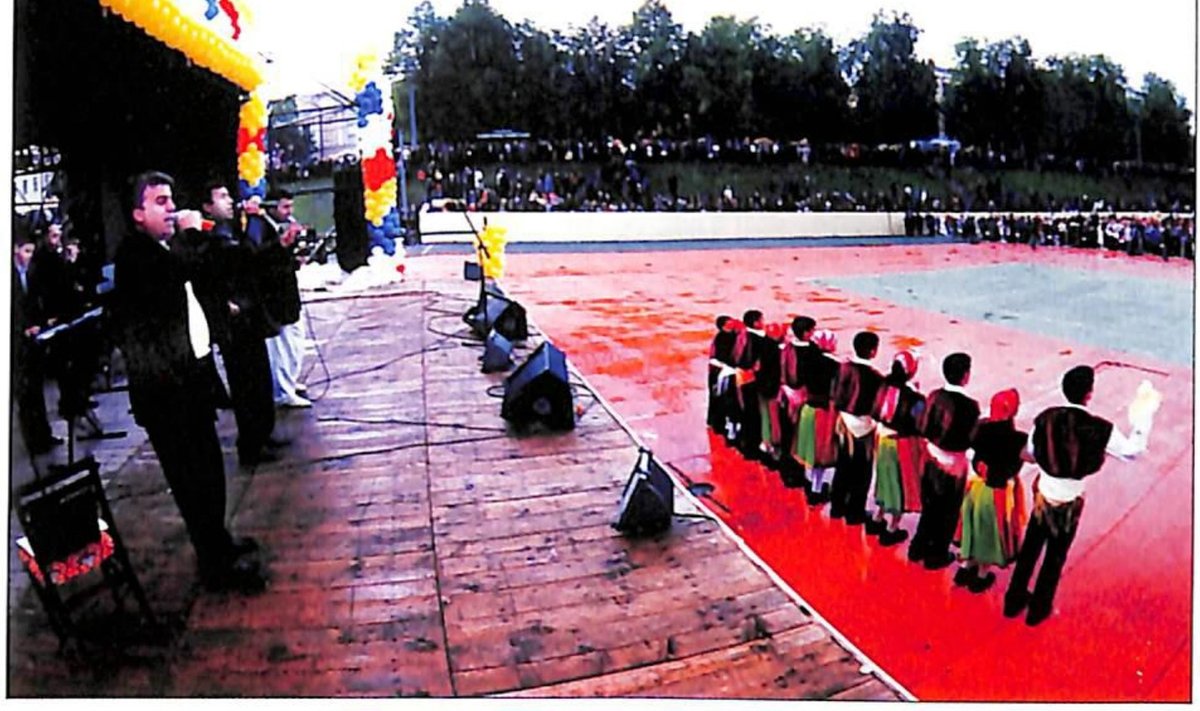
In Europe and Russia the young are increasingly adopting modern music and dances. Many families and associations therefore endeavor to pass on Govend and old songs to the next generation.
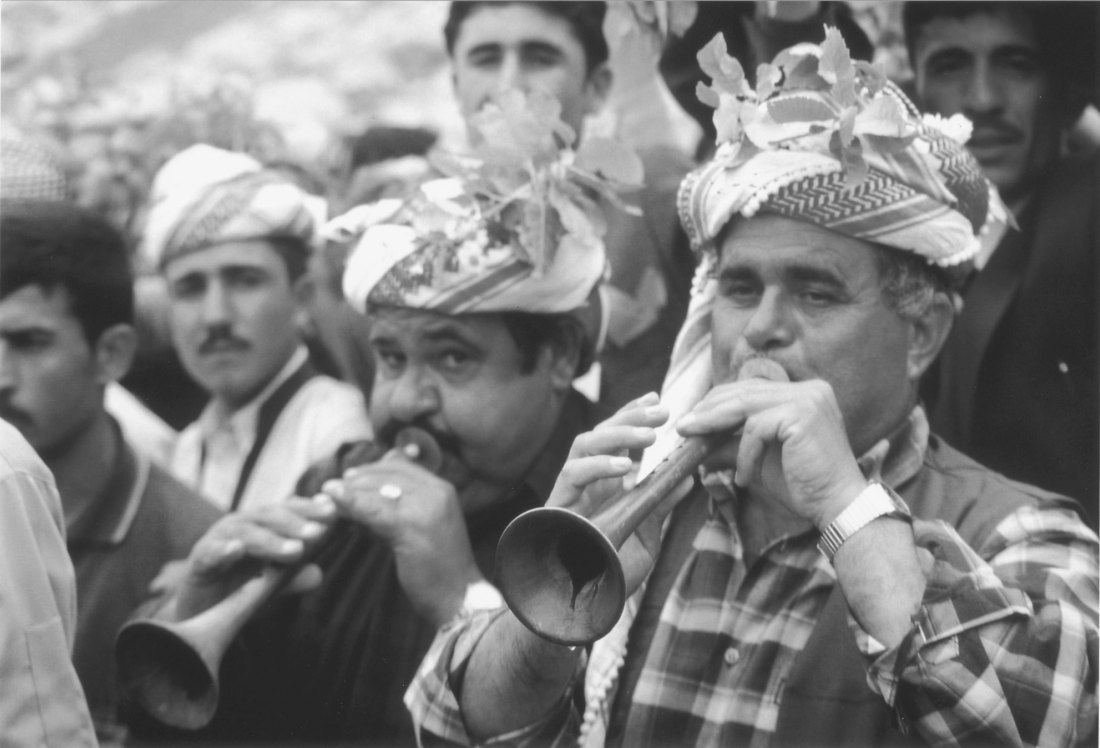
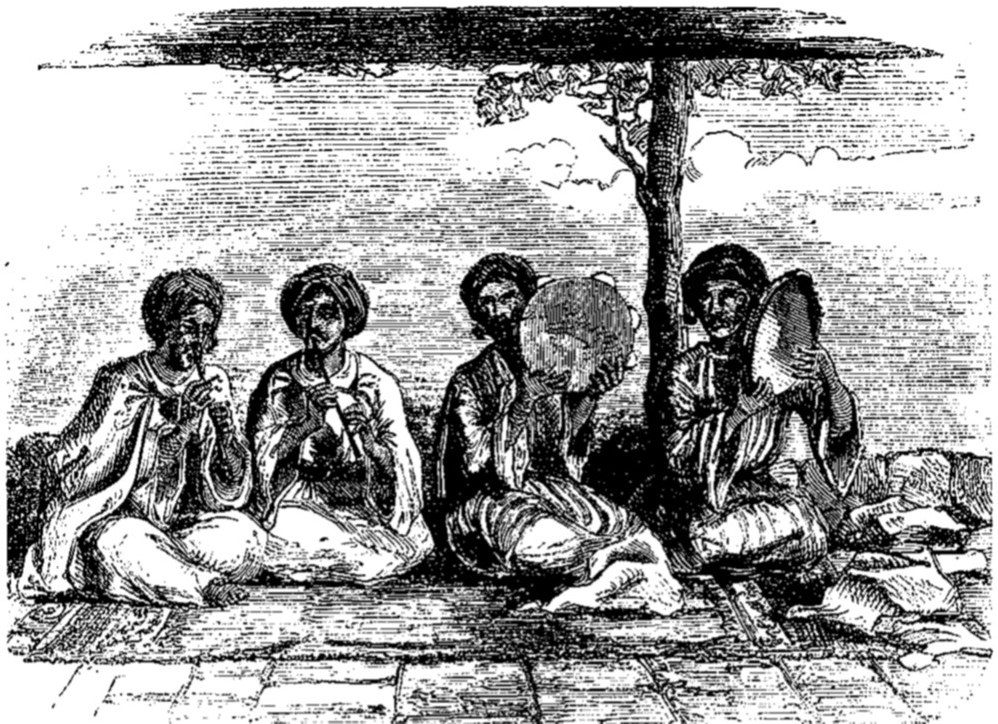

Def and Şibab – the instruments of the Qewal
Besides the instruments of the festivals there are two instruments that are regarded as sacred among the Ezidis: the frame drum Def and the flute Şibab. According to Khanna Omarkhali (2023), in Iraq they accompany many religious texts. They are played by the Qewal (see Qewal and their training).
- Seating order: At the great assembly with recitation (Sema) five Qewal sit while all others stand. Two play the Şibab, three the Def. The flute players sit on the right and come from the Hekarî tribe, the drummers sit on the left and come from the Dumilî tribe. The Def players sing at the same time.
- Learning: In the Qewal schools of Başîqa and Bahzanê, which existed until about the mid-1920s, the children also learned to play the Def and Şibab in the evenings.
- At burials: According to Rudenko, Qewal with Def and Şibab formerly also came at the death of particularly respected people (see Burial and mourning).
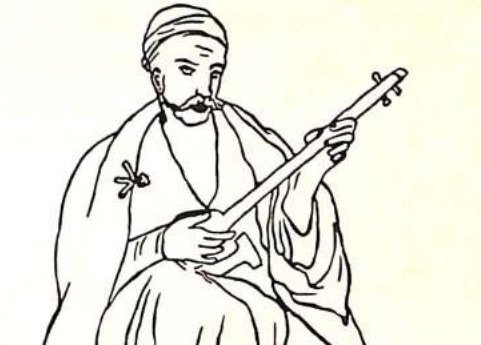
According to Omarkhali, the Tanbûr, a long-necked lute, is used as accompaniment for some songs and is likewise revered, for example for the song Xerîbo (“O stranger”).
Music and dance in old depictions
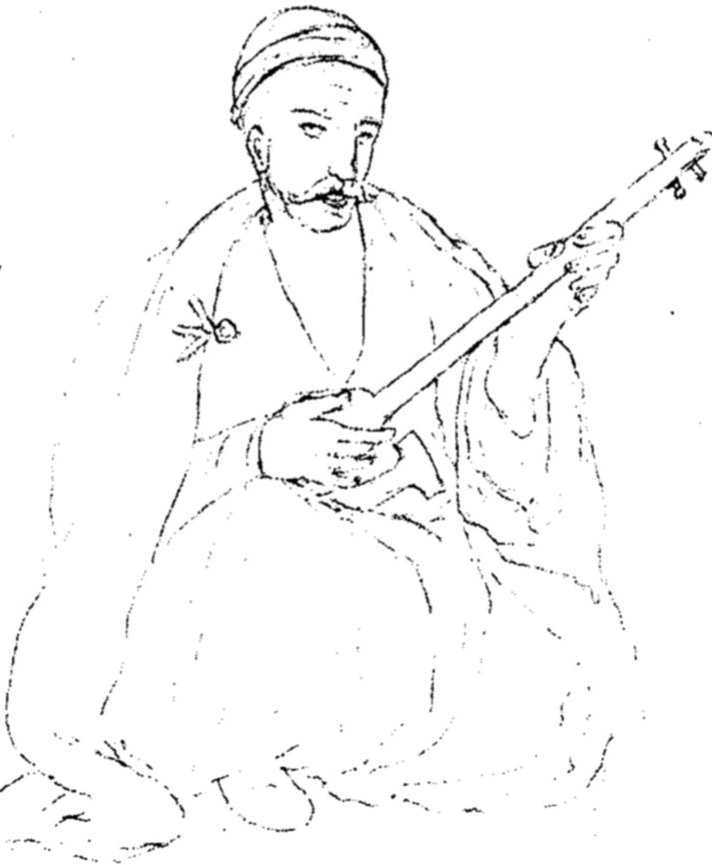
The book by Dmitrij Pirbari (2016) contains engravings from 19th-century travel works: an Ezidi playing the Tembûr (around 1836), the Ezidi Qewal after A. H. Layard (1853) and a ritual dance of the Ezidis after Layard (1853). In the courtyard of Lalîş, too, people dance under the trees at the festivals.
Music and dance in 1846 and 1940 – eyewitness accounts
Lalîş 1846 (Layard)
- In the procession from Bacidrê to Lalîş, musicians with Def and Şibab went in front.
- In the afternoon young men danced in a circle before the Mîr; others sang in chorus. Layard compares the dances with the Arab Debke and the Çopî.
- At night, in the inner courtyard of the sanctuary, about 30 Qewal played frame drums and flutes, together with cymbals; Şêx, Qewal and women sang. The singing began slowly and solemnly and rose ever higher; the women uttered the trilling cry (tahlîl). Afterwards some Qewal played at the spring until dawn.
- According to Layard, only the Qewal play the flute and frame drum; these are regarded as semi-sacred, and the Qewal kiss the drum before and after playing.
- Details: The festival in Lalîş 1846.
Başîqa and Bahzanê 1940 (Drower)
| Instrument | Information according to Drower |
|---|---|
| Def | large frame drum with jingles; instrument of the Qewal; warmed at the charcoal brazier before playing |
| Şibab | wooden flute with five finger holes; instrument of the Qewal; also depicted as a relief in Lalîş |
| Tembûr | long-necked lute; the guardian of the sanctuary of Şêx Mend in Bahzanê built it himself from mulberry wood, with four wire strings, slanting bridge and sound holes |
| Zurna and Dahol | oboe and large drum; played at the New Year festival by lay musicians |
| Shepherd's flute | of reed, cut by oneself |
| Double reed flute | heard in Lalîş |
- At the New Year vigil in Şêx Mihemed the Qewal played three Def and two Şibab.
- For the remembrance of the dead the Qewal played a short, haunting melody on Şibab and Def at the graves.
- At the festival the men first danced the round dance in the courtyard of the sanctuary; the right to dance in the first round was auctioned. Afterwards men and girls danced together on the meadow; instead of handkerchiefs the men waved their long sleeves. See Sersal in Başîqa 1940.
- At weddings there was dancing for seven days to flute and drum (see Wedding).
Instruments according to the 9th-grade textbook
The Ezidi 9th-grade textbook (T’amoyan et al., 2012) classifies the instruments by their use:
| Instrument | Type | Use according to the book |
|---|---|---|
| Def (Qewal Def) | single-headed frame drum, struck with the hand | only Qewal, only in the religious rite |
| Şivêv (Şibab) | flute | only Qewal, only in the religious rite |
| Saz, T’embûr | lutes | also played at festivals and by Dengbêj |
| Def (wedding Def) | double-headed drum, with stick (şivik) and beater (çomax) | wedding, Govend |
| Zur’ne, T’ulum | oboe, bagpipe | wedding instruments, Govend melodies |
| Fîq, Bilûr | shepherd's flutes; the Bilûr sounds plaintive | shepherds; increasingly displaced by the Meya |
| Meya | wind instrument | general |
According to the book, the instruments are played by men. Saz, T’embûr, Def and Şivêv are also mentioned in Qewl and Beyt.
Ensemble “E’zîzê E’mer”
In 2007, at the initiative of E’zîz T’amoyan, an Ezidi song and dance ensemble was formed in Armenia and named after him; its director was the teacher Omerê Şero. The 6th-grade textbook (2014) calls it the first Ezidi song and dance ensemble and reports performances in many areas of Armenia.
Sources
- Birgül Açıkyıldız: The Yezidis. The History of a Community, Culture and Religion. London 2010, p. illustrations
- S. M. Polatov: Дети Солнца (Children of the Sun). Rybinsk 2011, p. 79 (ill.)
- Mirza Sloyan (Mirzoyê Çolo Siloyan): Дорога, ведущая в храм. Три года спустя (The road leading to the temple. Three years later). Yerevan 2015, p. p-137 (ill.)
- A. V. Perminov: Езиды – древний народ Адаби (The Ezidis – the ancient people Adabi). Sharya 2016, p. 109–110
- Khanna Omarkhali: The religious textual tradition of the Ezidis – from the oral to the written. Saint Petersburg 2023 (Russian translation of the English original, Wiesbaden 2017), p. 78, 137, 139–140
- Dimitri Pirbari (P’îr Dîma), A. Ščedrovickij: Тайна жемчужины (The secret of the pearl). Moscow/Tbilisi 2016, p. illustrations p-055, p-083, p-100
- Austen Henry Layard: Nineveh and Its Remains, Vol. 1. London 1849, p. p. 279–280, 286, 291–294, 303–304 (PDF 332–333, 339, 344–347, 356–357)
- E. S. Drower: Peacock Angel. Being some Account of Votaries of a Secret Cult and their Sanctuaries. London 1941, p. p. 16, 23, 38, 87, 97–98, 118–119, 129–131, 143, 155 (PDF 27, 36, 53, 110, 120–121, 145–148, 158–162, 176, 190)
- E’zîzê E’mer, H’esenê Şêx-Me’mûdê: E’debyet û zimanê êzdîkî, grade 6. Yerevan: Spîka 2014, p. p-046–047
- H’esenê Şêx-Me’mûdê, E’zîzê E’mer: E’debyet û zimanê êzdîkî, grade 9. Yerevan: Spîka 2012, p. p-019–021
Found a mistake?
Is something wrong – a fact, a spelling, a source, an image? Let us know: we check every report and correct the article.
Other spellings: Sibab · Schibab · Shibab · Tanbur · Kocari · Kotschari · Kochari · Duhok · Dahuk · Dihok · Qawwal · Kawal · Kewal · Emir · Bashiqa · Baschika · Lalish · Lalisch · Lalesh · Sheikh