
In April 1940 the British orientalist Ethel Stefana Drower spent about ten days in Başîqa on the edge of the plain of Mosul to experience the Ezidi New Year and spring festival Sersal (Serê Sal, “beginning of the year”; in Iraq also Çarşema Sor, “Red Wednesday”). She describes it in her book Peacock Angel (London 1941). Her informants were above all Reşîd, son of the landowner Sadiq, the chief Qewal of the place Qewal Sîvo, and Mîra Wansa.
Drower records many precise observations. Her interpretations – for instance of the festival as a “pagan” spring ritual – and her remarks on the appearance of the people are not adopted here. What was prayed belongs to the section Religion. On the festival in general see Festivals and fast days, on the New Year pastry Kiloça Serê Salê.
Date and significance
- Sersal falls on the first Wednesday in Nisan (April) of the eastern (Julian) calendar. In 1940 this was April 17 (Gregorian) = 4 Nisan.
- No weddings take place in Nisan.
- According to Reşîd, the festival in Başîqa was bigger than the one in Lalîş – a “festival of the people”. From all the villages of the surroundings, even from Mosul and Kirkuk, visitors came for the dance, which in Başîqa is called Tewafî (cf. Tiwaf, the local festivals in Şêxan).
- The Feqîr Reşo in Lalîş called Sersal the second most important festival of the Ezidis and at the same time the “festival of the dead”.
Eve (April 16): remembrance of the dead
- In the afternoon above all older women in white veils and muted colors went to the graves of their relatives.
- Qewal played a short, haunting melody of lament at each grave for about ten minutes on Şibab and Def (flute and frame drum with jingles); the women beat their breasts and faces, one sang the lament for the dead. Afterwards the Qewal received money.
- On the graves the women laid bulgur and colored eggs, which were distributed to passers-by so that they would ask for blessing for the dead; incense was burned as well.
- Every household slaughtered a lamb or kid, the poor a chicken; whoever could gave some of it to the poor. The women washed the meat at the washing place.
See also Days of remembrance for the dead and Lament for the dead.
First day of the festival (April 17): flowers and eggs
- Early in the morning the girls picked red buttercups (ranunculus) – according to the informants only this flower.
- Over every front door they stuck three bunches upside down with wet clay – over the lintel and on both posts – and pressed colored eggshells into the clay. Some smeared the lintel and posts with the blood of the sacrificial animal.
- Flowers were also placed over the entrance holes of the beehives – reed baskets plastered with clay, built into the house wall.
- Colored eggs: mostly orange (with the same plant dye as the women's cloaks), also violet, green or madder red (with onion skins) – never blue. In the egg game two players knock their eggs together; whoever's egg breaks first loses.
- In the streets there were peep shows, jugglers and a man with a dancing bear.
- In the evening followed the great washing: in every house water was heated, and everyone washed for the following days.
Second day (April 18): night vigil in Şêx Mihemed
The largest sanctuary of Başîqa, Şêx Mihemed, lies on the edge of the village next to the Jacobite (Syriac Orthodox) church. Its permanent guardian is a Koçek dressed in white. Reşîd's father Sadiq had had it rebuilt (see Sanctuaries in northern Iraq).
- The men – in white robes, with red turbans and colorful belts – sat on mats around the courtyard. Whoever entered touched his chest with both hands, stroked his face and beard and kissed the threshold and doorposts.
- Vows: A child that had recovered from an illness was carried in wrapped in green silk; the next day the silk was fastened to the ball at the tip of the sanctuary's cone. Others brought gifts such as a sugarloaf.
- The Koçek filled and lit the lamp with four wicks with oil from the sanctuary's olive grove.
- The Qewal with three frame drums and two flutes warmed the drumheads at charcoal braziers and sang; those seated held their palms upward during the prayer and afterwards stroked their faces.
- To the trilling cry of the women (heyhele) the Baba Şêx came, walked through the sanctuary, kissed the walls and received the hand kiss: the layman kisses the hand of the Şêx and raises it to his forehead, the Şêx raises the kissed hand to his own mouth.
- The women had prepared Herîse (wheat porridge with meat) and meat with thin flatbread; people ate together from bowls with wooden spoons.
- The night vigil lasted until after midnight. Drower and her companion, as women and guests, were exceptionally allowed to stay.
Third day (April 19): Tewafî – the dance
- Early in the morning the women mourned once more at the graves and laid festive pastries on them.
- On the road to the sanctuary there was a market: sweets, nuts, terebinth berries, toys, a wheel of fortune.
- The courtyard of Şêx Mihemed was open to all; Muslim and Christian visitors too, mostly women, kissed the walls.
- Zurna and Dahol: Two lay musicians – with the drum Dahol and the oboe Zurna – entered to trilling cries, knelt before the tomb and played for about ten minutes an uninterrupted call with a drum roll; then they kissed the walls and threshold.
- The first round dance (Govend, in Drower Debke) was danced by the men in the courtyard of the sanctuary. The right to dance in this first round was auctioned.
- Afterwards people danced in a large round on the meadow in front of the sanctuary. Girls joined in; only the outermost ones took a man's hand. Instead of handkerchiefs the men waved their long sleeves.
- At noon meat, bulgur and Kleiçe (festive pastry) were eaten; in the evening the girls danced in the moonlight to hand-clapping.
- On the following day the festival continued in Bahzanê.
Festive dress in 1940
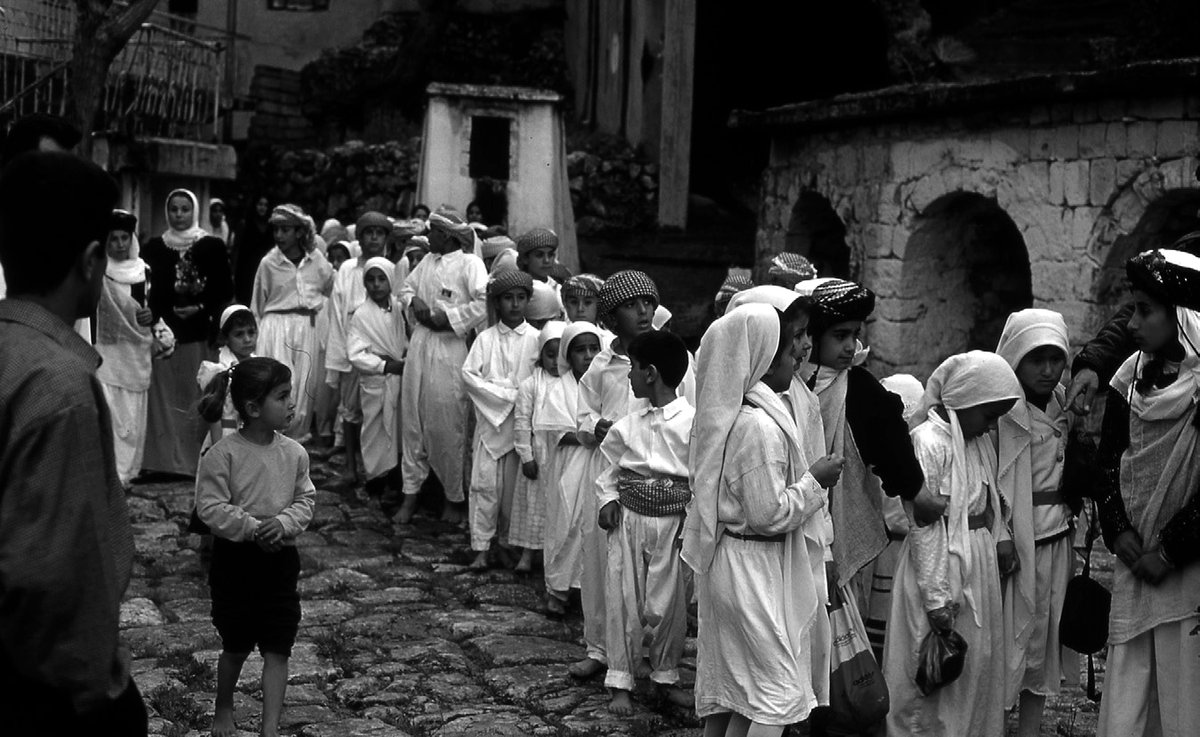
Women and girls
Drower noted the names of the garments (spelling adapted):
| Item | Description |
|---|---|
| Kumêdrav | helmet-like cap of silver coins arranged like scales, worn only by young women; from about age 30 passed on to a daughter or niece |
| Camadanî | turban of several silk scarves, with a silver pin (derzî) and chain; the middle of the head remains free for the coin cap |
| Daçek | white veil of the older women over the turban and lower face |
| Kiras, Derpê | long shirt, wide trousers |
| Bindêna, Kotek | sleeveless vest, jacket |
| Meyzer | hand-woven woolen cloak, drawn under the left arm and knotted on the right shoulder, dyed red, yellow or orange, often embroidered with stars and triangles |
- Jewelry: earrings (gohar) of gold filigree, often triangular; hinged bracelets (bazin) of silver or gold, with stones; no anklets; pearl and amber necklaces; a long silver chain with a crescent-shaped pendant (berbeng) and two triangular silver boxes filled with beeswax, with little bells; sash (qambara).
- Brides and some girls wore a stiff belt with a large embossed silver buckle; the bride's buckle may be fastened only by her “sister of the hereafter” (see Wedding).
- The braids were lengthened with black wool and adorned with silver pendants. At the festival one girl wore an old gold headdress set with turquoises and rubies from the family's possessions.
- According to Drower, Muslim women from the neighboring villages who came to the festival were dressed even more splendidly and wore amulet boxes on the left arm.
Men and boys
- Bushy hair under red turbans; younger men shaved their beards and let their mustaches grow long, older men wore beards.
- White clothing, colorful belts; the layman's shirt has a wide collar, round in front and closed at the back.
- At the festival boys wore long white sleeves knotted at the nape of the neck, and embroidered jackets.
- Small children wore a special haircut: a broad shaved strip over the crown and one each toward the temples, a fringe in front.
Colors
Blue is forbidden as a color for clothing; a blue bead against the evil eye is allowed. According to Drower, the Ezidis wore fewer amulets than their neighbors. In Başîqa members of all religions wore a similar regional costume.
Hospitality
In Sadiq's house the door stood open during the festival. According to Drower, tea and coffee are always prepared by the host or his son himself, not by the women – this is regarded as an act of honor; Sadiq's son roasted and brewed the coffee himself. See Homestead and guest room.
Comparison with 1945
Five years later C. J. Edmonds experienced the festival in Başîqa (main Wednesday April 18, 1945) with a fair on Friday, horse races and mixed round dances – see Başîqa and Bahzanê. The Friday celebration at the sanctuary of Şêx Mihemed corresponds to the third day in Drower.
About the source
Drower (1879–1972) was married to a British judicial adviser in Iraq and researched above all the Mandaeans. She spoke no Êzdîkî and communicated in Arabic or through interpreters. She expressly distanced herself from the rumors she had reproduced in an earlier book (1923) and rejected the external designation “devil worshippers”. Her photos of the festival are not shown here for legal reasons.
Sources
- Birgül Açıkyıldız: The Yezidis. The History of a Community, Culture and Religion. London 2010, p. 124 (ill.)
- E. S. Drower: Peacock Angel. Being some Account of Votaries of a Secret Cult and their Sanctuaries. London 1941, p. p. 14–17, 25, 33, 41–44, 56, 97–137 (PDF 25–30, 38, 48, 56–61, 75, 120–170)
Found a mistake?
Is something wrong – a fact, a spelling, a source, an image? Let us know: we check every report and correct the article.
Other spellings: Sere Sal 1940 · Ser Sal 1940 · Carsema Sor 1940 · Tscharschema Sor 1940 · Charshema Sor 1940 · Neujahr in Basiqa · Neujahr in Baschiqa · Neujahr in Bashiqa · Tewafi · Frühlingsfest Basiqa · Frühlingsfest Baschiqa · Frühlingsfest Bashiqa · Bashiqa · Baschika · Mossul · Mûsil · Charshama Sor · Tscharschema Sor · Qawwal · Kawal