
Besides reading and grammar, the Ezidi school textbooks of Armenia (2011–2014) also teach children rules of conduct: how to greet, how to speak with elders, how to behave at table and which formulas suit festivals and bereavements. They reflect the custom of the Ezidis of Armenia as the authors wanted to teach it; other regions may differ.
Greeting and honoring (Silav û qedirgirtin)
According to the 2nd-grade textbook:
- The greeting (silav) is regarded as the “greeting of God”; everyone should greet one another.
- The younger greets the elder first.
- The younger should honor (qedir girtin) the elder and show them respect; all should respect one another.
- Greeting and respect strengthen friendship and kinship.
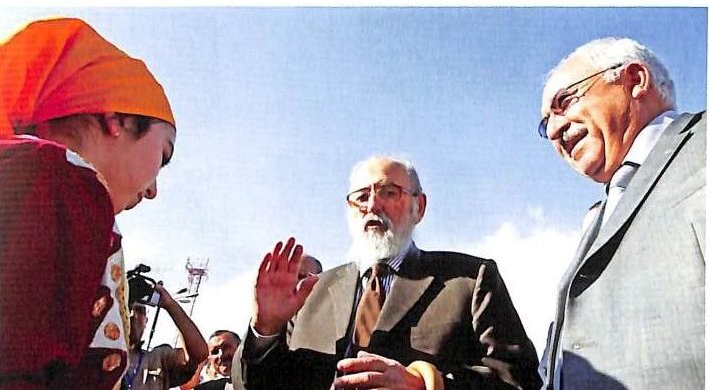
Rules for speaking (Borcdarîê xeverdanê)
- do not speak loudly,
- do not talk too much in company,
- listen when another is speaking,
- speak kindly and gently.
As misconduct the same book names, among other things, cursing, spitting at another person, slander and lying (see also Avoided words).
At table
- Before the meal one says: “Bi destûrî Xwedê û Tawisî-Melek” (“With the permission of God and Tawûsî Melek”).
- During the meal one should not talk.
- After the meal: “Ya Xwedê, me kêmkir, tu zêde bikî” (“O God, we have diminished, may you increase”).
On cuisine see Ezidi cuisine, on hospitality Homestead and guest room.
Everyday greetings
According to the 8th-grade textbook, many formulas are connected with the sun (Şems) (see Sun):
- Morning greeting: “R’oja te bi xêr” (“May your day be good”).
- A common greeting that remembers the dead: “R’e’ma Şems li r’uh’ê dû bavê teve” (in essence: may the grace of Şems be with the souls of your ancestors).
- A request in the morning after washing, facing east: “Ya Şems, tu k’omekê bidî me” (“O Şems, help us”).
Festival greetings
According to the 5th-grade textbook (see Festivals and fast days):
- In the nights of fasting one greets in the evening with “Qebûlve r’ojîya we” (“May your fast be accepted”).
- At the festival of the dead and the living: “Bimbarekve e’yda mirî û zêndîa” (“Blessed be the festival of the dead and the living”).
- One does not go empty-handed on festival visits.
- For the festival of Êzdîd one visits those in mourning and reconciles those who have quarreled; according to the book, whoever does not reconcile at this festival “is not considered an Ezidi”.
Invitation and courtship
- In the village of Bendemûrad (Surmelî) people used to invite to a wedding by bringing each house a red apple (sêva sor). From this comes a jocular saying for uninvited guests: Did I send you a red apple, then? (textbook grade 8).
- At the courtship of a bride the young man's parents say: “Em hatine de’wa merivtayê we bikin” (“We have come to ask for your kinship”) (textbook grade 9; see Wedding).
About the source
The textbooks are teaching texts with an educational mission; they describe how things should be, not how they are everywhere. The formulas are reproduced here briefly and with our own translation.
Sources
- Mirza Sloyan (Mirzoyê Çolo Siloyan): Дорога, ведущая в храм. Три года спустя (The road leading to the temple. Three years later). Yerevan 2015, p. 381 (ill.)
- E’zîzê E’mer, H’esenê Şêx-Me’mûdê: E’debyet û zimanê êzdîkî, grade 2. Yerevan: Spîka 2011, p. p-013, p-016–017
- E’zîzê E’mer, H’esenê Şêx-Me’mûdê: E’debyet û zimanê êzdîkî, grade 5. Yerevan: Spîka 2013, p. p-005–006
- E’zîzê E’mer, H’esenê Şêx-Me’mûdê: E’debyet û zimanê êzdîkî, grade 8. Yerevan: Spîka 2011, p. p-015, p-037–039
- H’esenê Şêx-Me’mûdê, E’zîzê E’mer: E’debyet û zimanê êzdîkî, grade 9. Yerevan: Spîka 2012, p. p-014
Found a mistake?
Is something wrong – a fact, a spelling, a source, an image? Let us know: we check every report and correct the article.
Other spellings: Silav u qedirgirtin · Tisdschhsitten · Tisjhsitten · Borcdarie xeverdane · Bordschdarie cheverdane · Borjdarie kheverdane · Borcdari xeverdane · Emir · Tawuse Melek · Melek Taus · Taus-i Melek · Malak Tawus · Eziden