
The Ezidis calculate their festivals according to the eastern calendar – as the sources call the Julian calendar or “old style”. Today it lags 13 days behind the generally used (Gregorian) calendar. A festival on the “first Friday in December” therefore falls, by today's reckoning, in the second half of December. This article only compiles the calendrical aspects; the course and customs of the festivals are described in the article Festivals and fast days. The annual dates are in the website's Ezidi calendar.
The months
According to Dmitrij Pirbari (2016), the year has 12 months of 30 days each. The names of the months in the language of the Ezidis are:
| Name | corresponds roughly to | Notes in the sources |
|---|---|---|
| Kanûna pêşîn (“first Kanûn”) | December | Festival of Êzîd |
| Kanûna paşîn (“second Kanûn”) | January | End of the winter fast |
| Sibat | February | Festival of Xidir Nebî |
| Adar | March | New Year in the Caucasus (according to Omarkhali) |
| Nîsan | April | New Year; “bride of the year” |
| Gulan | May | Local festivals in Şêxan and Şengal |
| Hezîran | June | End of the local festivals |
| Tîrmeh | July | Çilê Havînê |
| Tebax | August | – |
| Îlon | September | Cejna Cimayê in Lalîş |
| two Çirî months | October and November | – |
The sources expressly assign Kanûna pêşîn and paşîn (December and January), Sibat (February), Nîsan (April), Tîrmeh (July) and Îlon (September); the others follow from the order.
In the enumeration of a religious text reproduced by Pirbari, Kanûn stands in first place and is regarded as the “head of all twelve months” – although the New Year is celebrated in spring. Pirbari also divides the months into six “wet” and six “dry” ones. According to him, the wintry “forty” periods (çile and erbeîn) are assigned to the two Kanûn months. According to the same text, the solstice falls on 13 Hezîran.
The days of the week
| Name | Day | Significance in custom |
|---|---|---|
| duşem (“second day”) | Monday | – |
| sêşem (“third day”) | Tuesday | Beginning of the three-day fasts (rojî) |
| çarşem (“fourth day”) | Wednesday | regarded as a special, holy day; New Year's Day |
| pêncşem (“fifth day”) | Thursday | last day of fasting; in the evening visits to bereaved families |
| înî | Friday | feast day of the great festivals (ayd) |
| şemî | Saturday | – |
The names from Monday to Thursday are ordinal numbers (“second” to “fifth day”). The sources used give no name for Sunday.
According to Khanna Omarkhali (2023), many customs have fixed days of the week. A family's sacred objects may be opened only on “their” day and not after sunset.
The basic rule of the festivals
According to Perminov, all periods of fasting begin on a Tuesday and last until Thursday; on the following Friday the festival is celebrated. This applies above all to the festival of Êzîd in December and the festival of Xidir Nebî in February. The New Year, on the other hand, falls on a Wednesday – as the name Çarşema serê salê (“Wednesday of the beginning of the year”) in T’amoyan also indicates.
The beginning of the year
The Ezidi New Year (Serê Salê) is in spring. The sources give the day differently:
| Source | New Year |
|---|---|
| Omarkhali 2023 (Iraq) | first Wednesday in April (eastern calendar) |
| Omarkhali 2023 (Caucasus) | first Friday in March (eastern calendar) |
| Omarkhali 2005 (Armenia, Georgia, Russia) | first Wednesday in March (eastern calendar) |
| Polatov 2011 | Wednesday of the first week of April (eastern calendar) |
| Sloyan 2015 | first Wednesday after April 13 (today's calendar) |
| Textbooks T’amoyan 2013–2014 (Armenia) | first Wednesday after 13 Nîsan; fasting on the Tuesday before |
| Perminov 2016 | equinox on March 20 or 21 |
The Ezidi primer (T’amoyan, 2014) teaches on this: among the Armenians the year begins on January 1, among the Ezidis in Nîsan; the first Wednesday after 13 Nîsan is New Year and is also called E’yda Tawisî Melek; the first month of the Ezidi year is thus Nîsan. Wednesday is there regarded as the “dear, precious day” (r’oja e’zîz) of the Ezidis. It also names time words such as par, pêrar, bet’ripêrar (one, two, three years ago) and duh, pêr, bet’irpêr (yesterday, the day before yesterday, three days ago).
The statements “first Wednesday in April according to the eastern calendar” and “first Wednesday after April 13” mean the same day. The statements about March and the equinox differ from this (see Festivals and fast days).

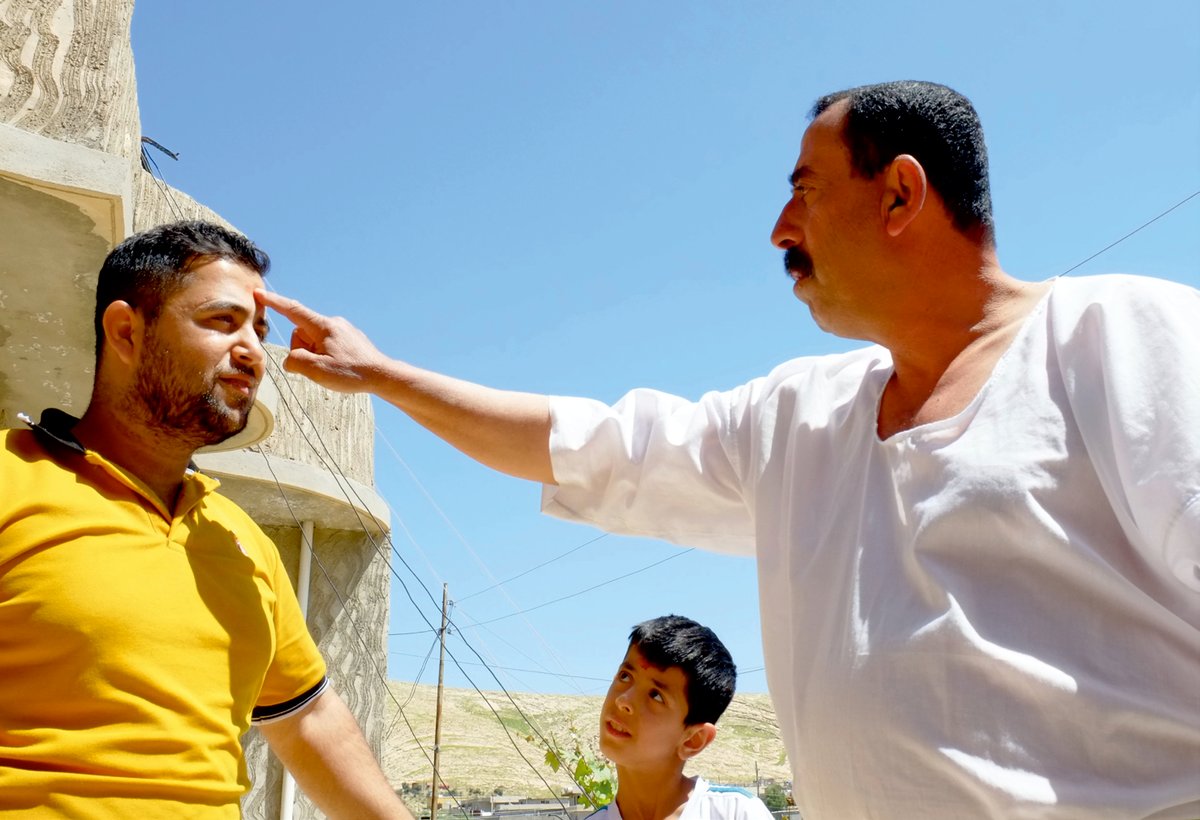
The festival cycle
All dates according to the eastern calendar; sources: Omarkhali 2005 and 2023, Polatov, Perminov.
| Time | Festival or period |
|---|---|
| December (Kanûna pêşîn) | three days of fasting and Festival of Êzîd on the first Friday |
| December 13 to January 21 | Çilê Zivistanê, the “forty days of winter” with voluntary fasting |
| December 25 (or December or January) | Bêlênda, winter festival with fires (above all Iraq) |
| February (Sibat) | three days of fasting and Xidir Nebî û Xidir Eylas on the first Friday |
| March (Adar) / April (Nîsan) | New Year (Serê Salê, Kiloça Serê Salê, Çarşema Sor) |
| April to the end of June | Tiwaf (Şêxan) and Cema (Şengal), festivals of the village sanctuaries |
| July (Tîrmeh) | Çilê Havînê, end of the “forty days of summer”; visit to Lalîş from July 18 to 21 |
| Summer and autumn | Tawûs gêran, tour of the Qewal |
| September 23 to October 1 (Îlon) | Cejna Cimayê, the great pilgrimage festival in Lalîş |
| October/November | Beran berdan (“releasing the rams”) |
| in the middle of winter | Sada pez |
Festivals without a fixed date, such as the festival of sacrifice Eyda Qurbaniyê, are not listed here. On the pilgrimage festival see Pilgrimage to Lalîş.
Sources
- H’esenê Şêx-Me’mûdê (Hasan T’amoyan), E’zîzê E’mer (E’zîz T’amoyan): Elîfba êzdîkî (primer, grade 1). Yerevan: Spîka 2014 (approved by the Ministry of Education of Armenia), p. p-077–079
- E’zîzê E’mer, H’esenê Şêx-Me’mûdê: E’debyet û zimanê êzdîkî, grade 5. Yerevan: Spîka 2013, p. p-005
- E’zîzê E’mer, Omerê Şero (Omar Mamoyan), Xidirê Sûrên (Chidir Hadschojan): E’debyet û zimanê êzdîkî, grade 11. Yerevan: Spîka 2014, p. p-087–088
- International Journal of Yezidi Studies, Vol. 1. Tbilisi 2024, p. 212 (ill.)
- Dimitri Pirbari (P’îr Dîma), A. Ščedrovickij: Тайна жемчужины (The secret of the pearl). Moscow/Tbilisi 2016, p. p-035, p-131–p-141
- Khanna Omarkhali: The religious textual tradition of the Ezidis – from the oral to the written. Saint Petersburg 2023 (Russian translation of the English original, Wiesbaden 2017), p. 25, 53
- Khanna Omarkhali (Ханна Омархали): Йезидизм. Из глубины тысячелетий (From the depths of the millennia). Saint Petersburg 2005, p. 70–77
- A. V. Perminov: Езиды – древний народ Адаби (The Ezidis – the ancient people Adabi). Sharya 2016, p. 95, 100–101
- Mirza Sloyan (Mirzoyê Çolo Siloyan): Дорога, ведущая в храм. Три года спустя (The road leading to the temple. Three years later). Yerevan 2015, p. 49–54
- S. M. Polatov: Дети Солнца (Children of the Sun). Rybinsk 2011, p. 46–47, 165–166
- E’zîz T’amoyan: The heroic deed of the Ezidi people – Ezidis in the Karabakh war (Armenian, memorial publication, Yerevan, c. 2000–2007), p. 59
Found a mistake?
Is something wrong – a fact, a spelling, a source, an image? Let us know: we check every report and correct the article.
Other spellings: Östlidschher Kalender · Östlijher Kalender · Wodschhentage · Wojhentage · Kanun · Nisan · Carsem · Tscharschem · Charshem · Shekhan · Scheichan · Shaikhan · Sinjar · Sindschar · Shingal · Shengal · Singal · Lalish · Lalisch · Lalesh