
In 1936 Roger Lescot described the tents and houses of the Ezidis of Şengal and of the area around Afrîn and the Djebel Sim'ân in northern Syria, and had the draftsman Kh. Moaz make floor plans. The terms are given in the dialect of his informants. What an Ezidi homestead in the Kars region looked like is described in the article Homestead and guest room (Ode).
The tent in Şengal
The semi-nomadic tribes in the west of Şengal (the Xwerka, see The tribes of Şengal according to Lescot) moved with tents into the steppe in the course of the year.
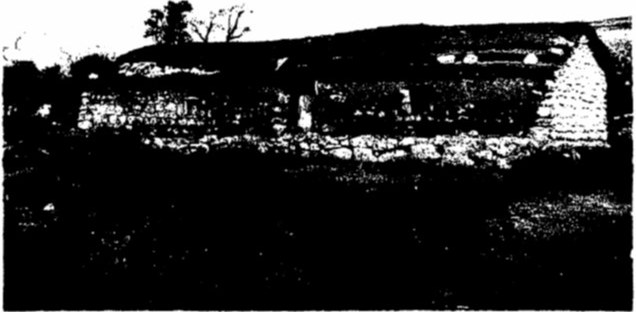
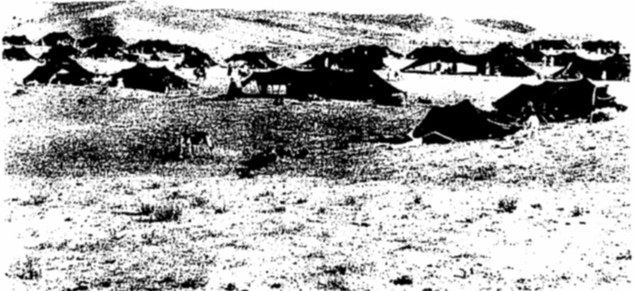
- The tent (kwîn, the tent cloth kon) was low and guyed with many short ropes.
- It seldom had more than five poles (istûn). Even the chief of the Semmoqa, Xelefê Ehmed, had a tent with five poles, the richest man of the tribe one with four.
- A reed wall (çît) separated the women's part from the reception room. There, a fireplace lay in the ground, at which coffee was made.
- Other words: rewaq (cloth wall), sing (peg), werîs or şêlît (rope), perde (curtain). Among other groups the pole was also called stûn or sûn.
- In permanent winter camps – such as that of the Semmoqa in Cerîba – the tent was stretched over dry-stone walls. Lescot saw in this a preliminary stage of the house.
The house in Şengal
According to Lescot, the house (xanî) of the settled villages consisted of three rooms:
| Room | Name | Purpose |
|---|---|---|
| Living room | mezûl | with a movable partition between the women's part and the reception room |
| Stable | koz | for the livestock |
| Storeroom | qadûr | provisions |
In addition there was a large courtyard (hewşa mezin) and a small courtyard (hewşa keçik).
Construction: The roof was flat, of rammed earth on a thick layer of branches. It rested on two rows of wooden pillars about six feet apart, above them crossbeams (sercîl) and laths (medd). A square opening in the roof let the smoke out. The size of a house was measured by the number of pillars: the house of Elî Wûso had 16 pillars in the living room, 8 in the stable and 4 in the storeroom; houses of chiefs are said to have had over 100. Lescot's photos show houses with dry-stone walls.
Furnishings: People slept on the floor in blankets; only the well-to-do had mattresses. As tableware there were a few trays and the coffee set.
Gardens: Every tribe was proud of its gardens (bustan) with vegetables, tobacco, grapes and figs. They lay away from the villages and had a hut of their own.
The house in the Afrîn valley
In the Afrîn valley and in the Djebel Sim'ân northwest of Aleppo the Ezidis were completely settled in 1936 (see Ezidi villages in the Afrîn area and in the Djebel Sim'ân). According to Lescot, a complete house had:
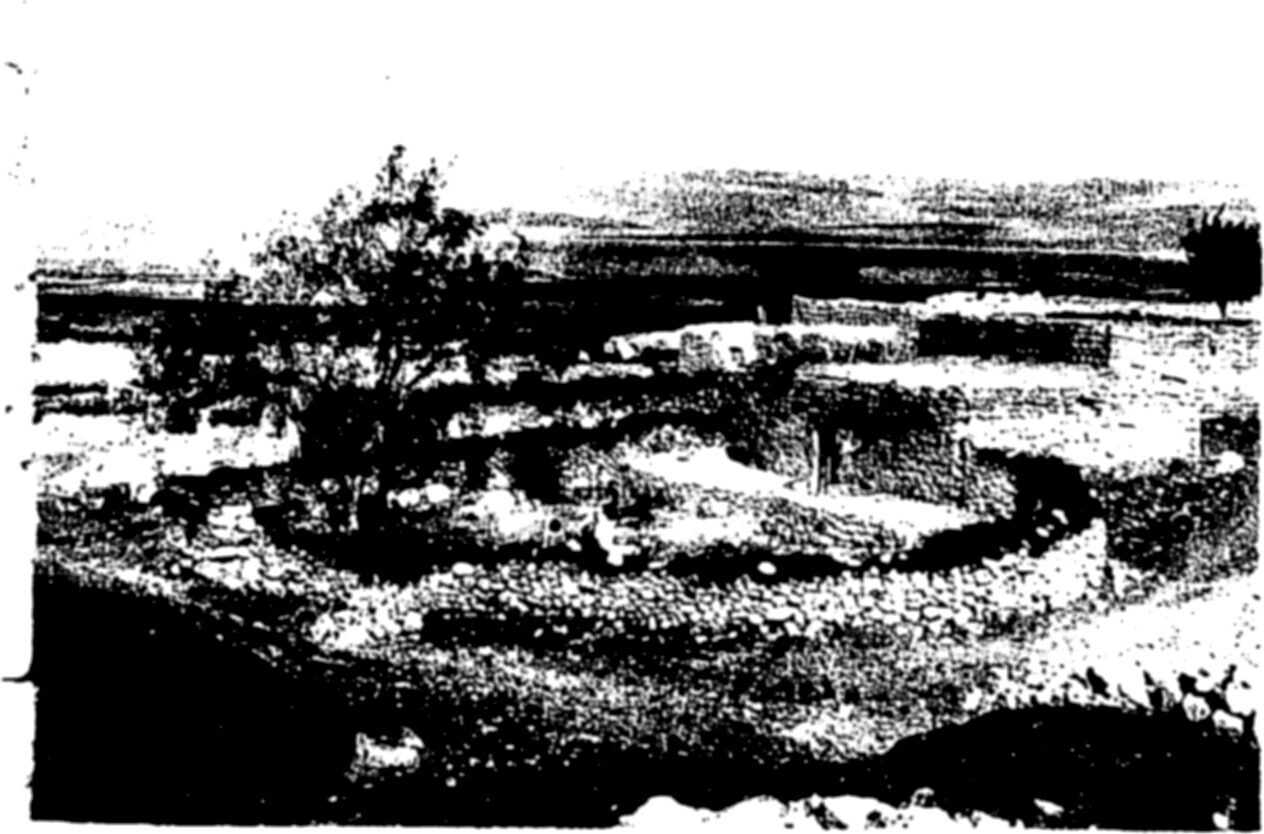
- a front and a back room (maxê pêşî, maxê paşî) and a courtyard (hewş);
- a conical mud hut for firewood (qûzik);
- mud platforms (sewkî) as a storage place or as a sleeping place in summer; a platform next to the entrance was intended for guests;
- a fireplace in the wall (pixîrê) and a stack of mattresses;
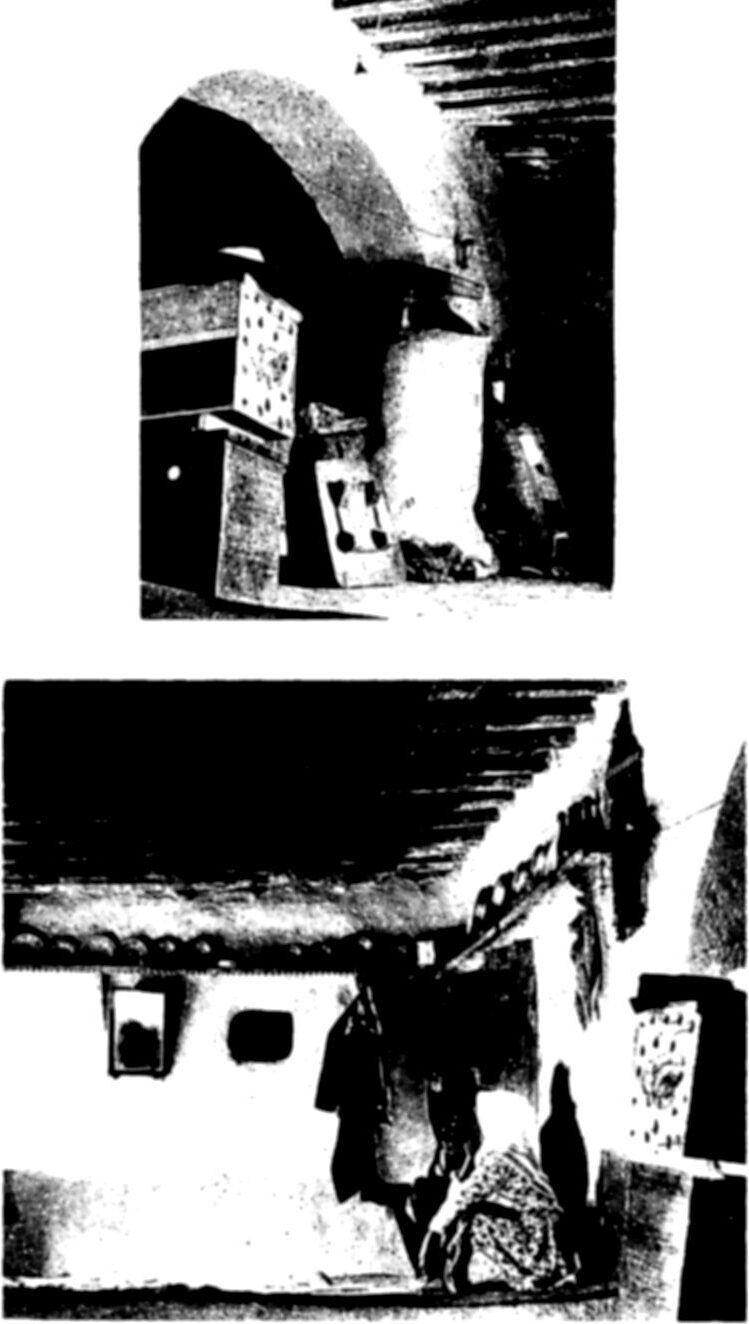
- a stone arch (qentere) with a stretched wire on which curtains, cloths and amulets hung;
- a storeroom (zexîrê) and a granary (bidar).
Poor families had only one room. In Xezewîyê the houses had one room and were roofed with reeds (birdî); some families lived there in reed huts. In the mountains the inhabitants built into the ruins of ancient places and, for lack of wood, covered the rooms with domes. Photos in Lescot show a house in Xezewîyê, one in Erşê Qîbar and the interior of a house in Turunde with stone arch and wall niches.
From tent to house
In the Kurd Dagh (Afrîn) settled life was still recent: around 1830 the traveler Eli Smith met Ezidi nomads in the Afrîn valley, in 1906 Lammens mentions tent dwellers, and the people of Qîmar still remembered pasture migrations in 1936. In Şengal, among the semi-nomadic tribes, some family members always stayed behind in the villages while the others moved with the herds.
The house in Şengal in 1846 according to Layard
A. H. Layard already described the villages of Şengal in 1846 (Nineveh and Its Remains, vol. 1, 1849): all were built on one plan, with houses on the slopes, surrounded by terraces of piled-up stones with olive and fig trees and in part vineyards. The houses had flat roofs and often several rooms and were very clean. The whitewashed inner walls were full of small niches for household goods and decorated with red and black dabs of paint.
The house in Başîqa and Bahzanê around 1940 according to Drower
E. S. Drower describes in 1940 the houses of the plain of Mosul (Peacock Angel, 1941):
- The living rooms lay around a courtyard; in the house of her host Sadiq in Başîqa a brook flowed through the courtyard, above it a vine arbor, at the gate a stone arch with seats.
- An outside staircase without a railing led to the upper floor. The flat roof served as a living space and in summer as a sleeping place.
- The livestock stood on the ground floor; in the cellar births also took place (see Birth, Bisk and Sinet).
- Beehives – reed baskets plastered with mud – were built into the house wall, with the entrance hole facing outward.
- Among other things, tinfoil from cigarette packets served as wall decoration.
- Larger homesteads had their own mill, oil press, soap works and bakehouse (Drower describes such a homestead of a Christian deacon in the same place).
- In Bahzanê the paved lanes were so narrow that one could almost touch the houses on both sides.
The Istêr’ in the house (Armenia)
According to the Ezidi primer for the 1st grade (T’amoyan, 2014), there is an Istêr’ (also called xudan, mal or ocax) in every Ezidi house: a stack of bedding piled up by the girls, the daughter-in-law or the housewife.
- Every morning after washing one bows before it, likewise before a long journey.
- In the evening the front is opened, in the morning closed again.
- In families of Şêx and P’îr, the sacred object of the family (şexs) is kept in the Istêr’ and unveiled on feast days (siyar kirin).
- Nothing blue may be in the Istêr’ (see Colors and clothing rules).


Sources
- Khanna Omarkhali (Ханна Омархали): Йезидизм. Из глубины тысячелетий (From the depths of the millennia). Saint Petersburg 2005, p. 103 (ill.)
- Manuk Muradyan: Усуб Бек (Ûsiv Beg). Yerevan 2013 (Russian translation of the Armenian original, Yerevan 2012), p. 248 (ill.)
- Eskerê Boyîk: Bi Kurtayî Dîroka Êzidiyên Ermenistanê (A short history of the Ezidis of Armenia). Diyarbakır 2016, p. 174 (ill.)
- Roger Lescot: Enquête sur les Yezidis de Syrie et du Djebel Sindjār (Study of the Ezidis of Syria and of the Şengal mountains). Beirut 1938, p. 144–147, 203–204, plates V, VI, XI, XII
- H’esenê Şêx-Me’mûdê (Hasan T’amoyan), E’zîzê E’mer (E’zîz T’amoyan): Elîfba êzdîkî (primer, grade 1). Yerevan: Spîka 2014 (approved by the Ministry of Education of Armenia), p. p-100
- Austen Henry Layard: Nineveh and Its Remains, Vol. 1. London 1849, p. p. 322 (PDF 377)
- E. S. Drower: Peacock Angel. Being some Account of Votaries of a Secret Cult and their Sanctuaries. London 1941, p. p. 13, 34, 37–39, 103–104, 110–112 (PDF 24, 49, 52–54, 128–129, 135–137)
Found a mistake?
Is something wrong – a fact, a spelling, a source, an image? Let us know: we check every report and correct the article.
Other spellings: Kwin · Xani · Chani · Khani · Mezul · Hews · Hewsch · Hewsh · Istun · Sewki · Sinjar · Sindschar · Shingal · Shengal · Singal · Qers · Elegez · Alagyaz · Alagjas · Bashiqa