
Şêx and P’îr are the two spiritual castes of the Ezidis. Both words mean "old man, sage" – Şêx is the Arabic, P’îr the Iranian word (Pirbari, glossary). Every Ezidi, including every cleric, has a Şêx and a P’îr of his own. This bond is hereditary and accompanies a person from the first haircut to the grave.
No "higher" and "lower" clergy
The photo book Lalişa Nûranî stresses: Şêx and P’îr each have their own duties, neither exists without the other, and the division into "higher" and "lower" clergy is wrong. According to Omarkhali (2005), Êzdîkî distinguishes precisely: pîr without aspiration means "old, old man", p’îr with aspiration only "member of the P’îr caste".
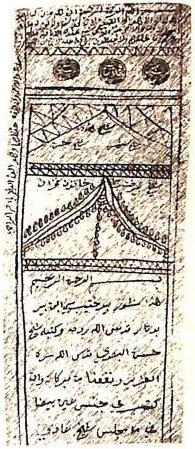
According to the Qewlê Qere Firqan (in Omarkhali 2023 and Pirbari), God gave the Şêx "the lock of hair and the scissors" and the P’îr the levies (zikat) and the Mişûr – the holy manuscripts of the P’îr families. All services, it says there, are carried by the Xerqe, the holy garment.
The Şêx
The three houses
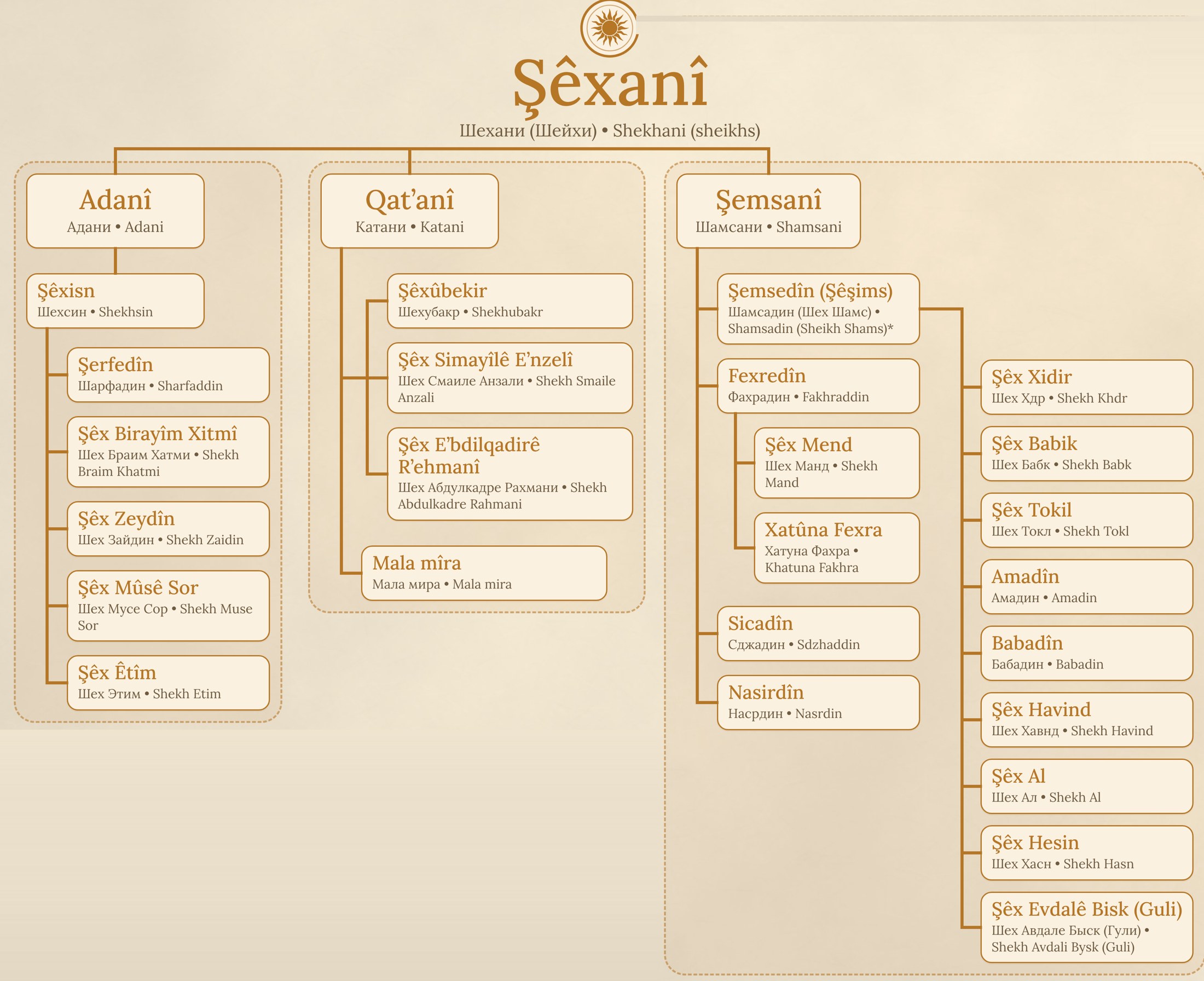
The Şêx are divided into three houses. According to Omarkhali (2005) and Lalişa Nûranî, the three houses do not intermarry; marriage takes place only within one's own house.
| House | Ancestor according to tradition | Lines (selection) |
|---|---|---|
| Adanî | Şêx Hesen (Şêx Sin) | Şerfedîn, Şêx Birayîm Xitmî, Şêx Zeydîn, Şêx Mûsê Sor, Şêx Êtim |
| Qatanî | Şêxûbekir (Şêx Obekr), brother of Şêx Adî | Şêx Simayîlê Enzelî, Şêx Ebdilqadirê Rehmanî, Şêx Mihemedê Batinî – the house of the Mîr |
| Şemsanî | the four sons of Êzdîna Mîr: Şemsedîn, Fexredîn, Sicadîn, Nasirdîn | sons of Şêşims (Amadîn, Şêx Babik, Şêx Tokil …), Fexredîn with Şêx Mend and Xatûna Fexra |
Sources: Lalişa Nûranî (diagram p. 14), Kreyenbroek, Omarkhali (2005). Şêx Mak’sîm calls the house Şemsanî Zer’zanî and assigns it as servants to the archangels Şemsedîn, Ferxedîn, Sicadîn and Nasirdîn.
According to Kreyenbroek, the Şêx lines mostly bear Arabic names. He also reports that formerly only the Adanî were permitted to learn to read and write. Among the Şemsanî there are, according to Lalişa Nûranî, branches of their own among the Ezidis from Serhed (today Armenia, Georgia): Cin Teyar, Dara Miraza, Toxa Enzel. According to Omarkhali, the Şêx of the lineage Cin Teyar (Şêxê Reş, Cindîyar) have no Mirîd of their own and do not say prayers for the dead, but are regarded as healers; exorcism with the bowls (tas) is their task.
What the Şêx does
- He cuts a boy's first lock of hair (bisk) and prays for him; therefore he is also called şêxê biskê (Lalişa Nûranî). Şêx Mak’sîm compares the Bisk with baptism. The custom is described in Birth: Bisk and Sinet.
- He comes into the house of his Mirîd and performs the necessary rites; only a man can be a Şêx; he must come from the same lineage as the Şêx of the paternal family (Omarkhali 2005).
- He receives gifts. According to Kreyenbroek, the Mirîd give the Şêx more than the P’îr.
The P’îr
The lineages
Tradition speaks of forty P’îr – the disciples of Şêx Adî, at whose head he placed Hesmeman (Pirbari, glossary). Therefore this lineage is called "P’îrê çil p’îra", "P’îr of the forty P’îr". Omarkhali (2023) counts about 70 lineages today, Lalişa Nûranî lists about 50 in its diagram; the poster of EZDIKI.COM names 56 lineages (with H’esinmeman). Şêx Mak’sîm writes that originally there were 90 lineages, today 40. Kreyenbroek names four main branches: Hesen Meman, Pîr Afat, Pîr Cerwan, Pîr Hecî Elî. A lineage is called ocax ("hearth").
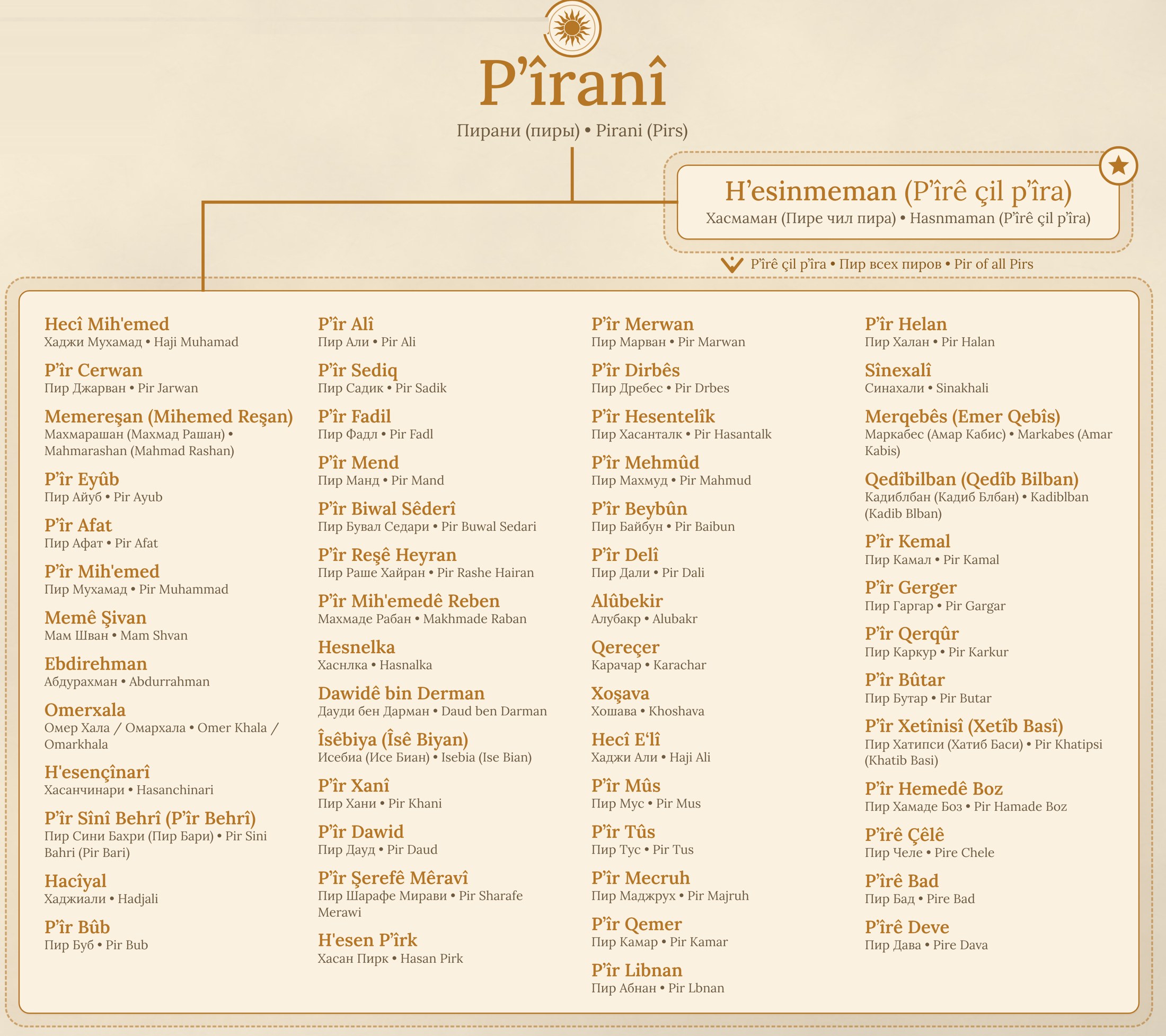
Among the P’îr, marriage between lineages is permitted, except with the house Hesmeman, which marries only within itself (Omarkhali 2005 and 2023). According to Lalişa Nûranî, some P’îr families also do not intermarry because they are spiritually connected – a marriage would then count as one between brother and sister.
Many P’îr lineages are connected with an area of protection: Pîr Cerwan protects against scorpions, Gavanê Zerza(n) the cattle, Memê Şivan the sheep, Pîr Afat is connected with hail and storm (Kreyenbroek; Omarkhali 2005 and 2023).
What the P’îr does
- According to Lalişa Nûranî, the pîrê zikatê visits the house of his Mirîd once a year (according to the English version every spring) and prays over bread and salt for prosperity. For this he receives the gift zikat.
- His main task, according to Omarkhali (2005), is religious instruction. Without a P’îr no burial takes place.
- The P’îr keep the Mişûr, manuscripts with the origin of the lineage and the list of its Mirîd tribes (see below).
- Şêx Mak’sîm: "Without a P’îr no Îman" – without a P’îr no firm faith.
Hereditary, not freely chosen
The bond between Mirîd and Şêx/P’îr is hereditary: one cannot choose or renounce one's Şêx or P’îr, and they cannot reject their Mirîd (Omarkhali 2005). Today, according to Kreyenbroek, the assignment is almost entirely determined by fixed relationships between tribes and lines; when a Şêx dies, his Mirîd are divided among the heirs. If a family dies out, the Mirîd chooses new ones (Lalişa Nûranî). Şêx Mak’sîm: if a Ferz does not come for seven years, the person, but not the house, may be changed.
The mediator to the holy beings
According to Kreyenbroek, every Şêx and P’îr line descends from a holy being. Its members connect their Mirîd with this being and through it with Tawûsî Melek and with God. Şêx Mak’sîm sees it differently: the clergy, he says, are not descendants but servants (micêwir) of an angel; no lineage serves Melekî Tawis or Şîxadî themselves, so that all remain equal.
In the hymns the titles also appear for the highest beings themselves: Tawûsî Melek and Siltan Êzîd are called "P’îr of all P’îr", and Şêxadî says: "I am Şêx, I am P’îr, I am Mirîd!" (Pirbari).
See also
- Mirîd · Hosta and Merebî · Brother and sister of the hereafter
- Caste system (People & Culture)
Sources
- Philip G. Kreyenbroek, Khalil Jindy Rashow: God and Sheikh Adi Are Perfect. Sacred Poems and Religious Narratives from the Yezidi Tradition. Wiesbaden: Harrassowitz 2005, p. pp. 6, 9, 12–13
- Khanna Omarkhali: The religious textual tradition of the Ezidis – from the oral to the written. Saint Petersburg 2023 (Russian translation of the English original, Wiesbaden 2017), p. pp. 23–24, 45, 56–57, 515–520
- S. A. Grigoriev, L. V. Ivasko, D. V. Pirbari (P’îr Dîma): Lalişa Nûranî / Святой Лалыш / Holy Lalish. Yekaterinburg: Basko 2008, p. pp. 12–17
- Şêx Mak’sîm (Maksim Ezdi): Grundpfeiler der Religion ScherfeDin, 2017 (on EZDIKI.COM in the Religion section and in the library), p. pp. 51–56, 67–70 (PDF)
- Dimitri Pirbari (P’îr Dîma), A. Ščedrovickij: Тайна жемчужины (The secret of the pearl). Moscow/Tbilisi 2016, p. pp. 53, 159, 254, 259 (PDF)
- Khanna Omarkhali (Ханна Омархали): Йезидизм. Из глубины тысячелетий (From the depths of the millennia). Saint Petersburg 2005, p. pp. 93–105
Found a mistake?
Is something wrong – a fact, a spelling, a source, an image? Let us know: we check every report and correct the article.
Other spellings: Sdschheidschh · Sjheijh · Sexani · Schechani · Shekhani · Pirani · Adani · Qatani · Semsani · Schemsani · Shemsani · Zerzani · Odschach · Ojakh · Sexe biske · Scheche biske · Shex · Lalîş · Lalish · Lalisch