
The Babê Şêx (also Baba Şêx or Bavê Şêx, "father of the Şêx") is, after the Mîr, the most important person of the Ezidis and the highest cleric. He almost always bears at the same time the title Extiyarê Mergehê – according to Lalişa Nûranî, from extiyar ("elder") and merge, the name of the area in which Lalîş lies; thus roughly "elder of the sanctuary". According to Omarkhali (2005), this title is even more common among the Ezidis than "Babê Şêx".
Biographies of individual office holders are in People & Culture: Baba Şêx Şêx Nasir, Baba Şêx Xirto, Succession 2019/2020.
Origin of the office
The office is hereditary in the Şêx house of Fexredîn (house of the Şemsanî), often from father to son (Kreyenbroek; Omarkhali 2023). According to the list in the photo book Lalişa Nûranî, it goes back to Şêx Fexredîn in the 13th century. The list then names, among others, Şêx Xoşêna, Şêx Sara, Şêx Xetarî, Şêx Îdo, Şêx Meşal, Şêx Reşkê, Şêx Nasir, Şêx Îsmaîl and, as the last, Şêx Xeto.
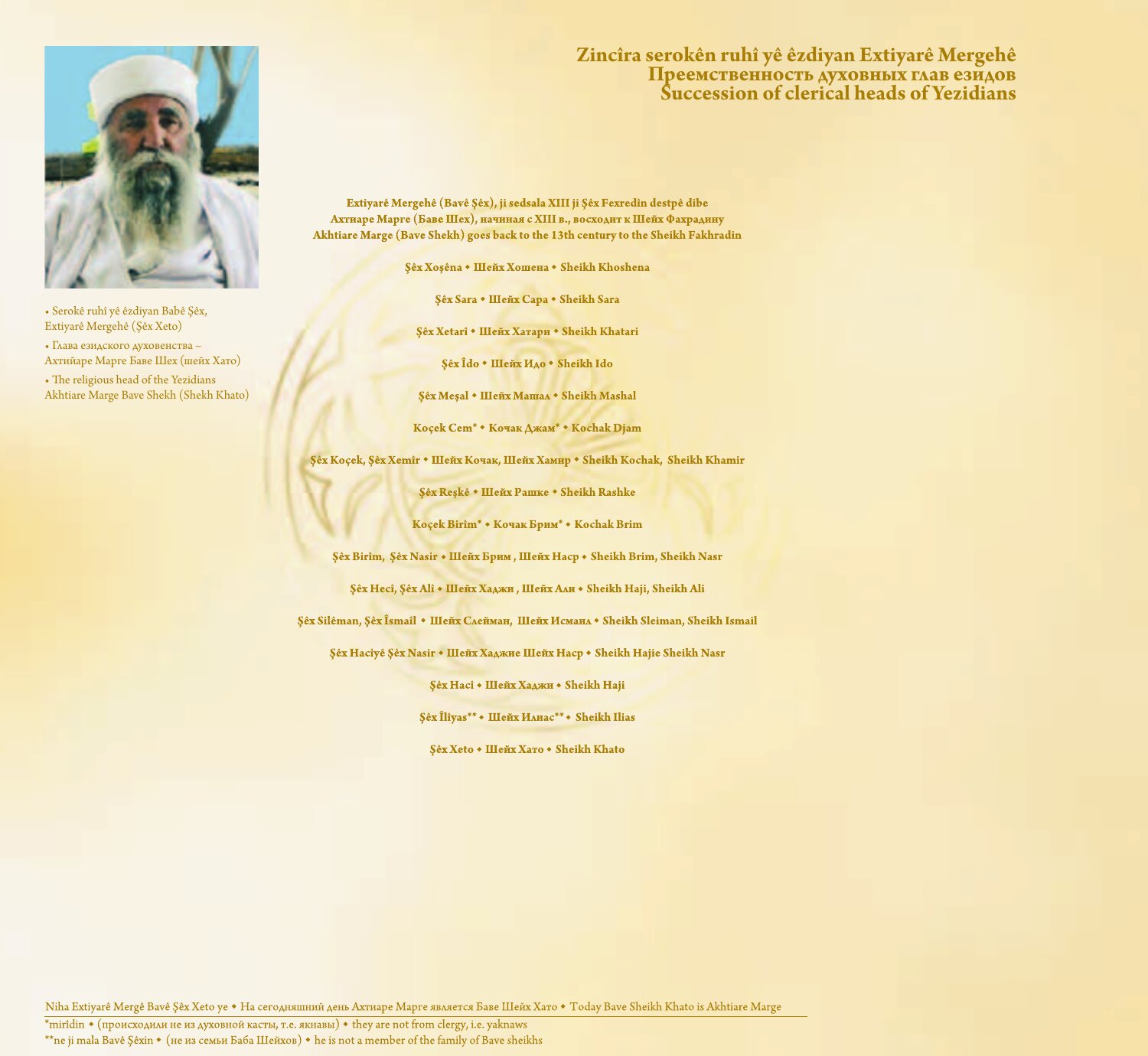
Remarkable are the exceptions in this list: Koçek Cem and Koçek Birim were Mirîd, that is, not clergy by birth, and Şêx Îliyas did not come from the family of the Babê Şêx. Omarkhali (2023) confirms that in history Koçek from the lay estate also became Babê Şêx. The office thus depends not only on descent but also on piety and prestige.
The Mîr determines who becomes Babê Şêx; after the death of a Babê Şêx, the elders and the Spiritual Council (Civata Ruhanî) deliberate and propose a successor (Lalişa Nûranî). Kreyenbroek: formally the Mîr appoints him.
Rules of life
The Babê Şêx leads a strict, devout life (Kreyenbroek; Lalişa Nûranî):
- He keeps the two 40-day fasts in summer and in winter (Çilê havînê, Çilê zivistanê; see Fasting).
- Wine is forbidden to him.
- After taking office he may no longer marry – whoever wants to be married must be so beforehand.
- He wears white and the black belt (rist), which is wound seven times around the body and on which holy copper rings hang.
Tasks
- He is the head of all Şêx and has supervision over the Koçek (Kreyenbroek).
- He is adviser to the Mîr (Lalişa Nûranî). According to the English version of the photo book, the Extiyarê Mergehê blesses the heir to the Mîr's throne after the Mîr has himself confirmed him.
- He visits the villages twice a year and guides the clergy.
- At the festivals he is in Lalîş. There on feast days he sits in the Celsa Şêx Fexredîn on a holy carpet (sicade) (Lalişa Nûranî).
- At the Sema he sits with his council under the colonnade (Rewaq). After the Feqîr, he leads with his Pêşîmam the second line, which goes three times around the candelabrum in the courtyard.
- A Pêşîmam of his own from the house of Şerfedîn goes before him; a Baba Gavan (Şemsanî, line of Emadîn) accompanies him (Kreyenbroek).
According to Kreyenbroek, in the hymns the title Extiyarê Mergehê is often applied to him. Kreyenbroek also explains the term Firwar ("command"): in the texts it denotes God's command, which is passed on through angels, Şêx Adî and Şêx Hesen – a chain of authority at whose earthly end the clergy stand.
Decisions in recent times
- In 1880 a Babê Şêx explained to the French vice-consul in Mosul, N. Siouffi, that the Ezidis had two holy books (Omarkhali 2023).
- In the 1970s Babê Şêx Hecî Şêx Îsmaîl permitted sacred texts to be recorded for publication. According to Omarkhali, he said: "Let this sin be on my conscience." With this, according to the author, "the seal was broken" for later editions.
- After the genocide of 2014 the Babê Şêx created a new purification rite for women and girls who returned from IS captivity. Formerly no one who had changed faith could return; now all who were forcibly converted can return (Omarkhali 2023). See Şengal 2007 and 2014.
Death of a Babê Şêx
When a Babê Şêx dies, according to Omarkhali (2023), only the Qewlê Firwarê may be performed at his burial, not the usual burial Qewl.
Older depictions
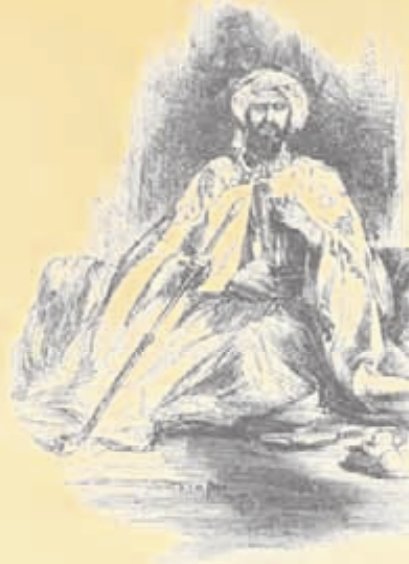
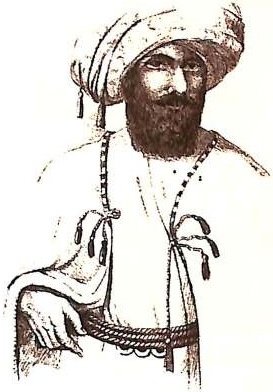
Travelers of the 19th century drew the Babê Şêx Şêx Nasir. The pictures show him in a long robe, sitting on cushions.
See also
Sources
- Philip G. Kreyenbroek, Khalil Jindy Rashow: God and Sheikh Adi Are Perfect. Sacred Poems and Religious Narratives from the Yezidi Tradition. Wiesbaden: Harrassowitz 2005, p. pp. 10–11, 17, 36–39
- S. A. Grigoriev, L. V. Ivasko, D. V. Pirbari (P’îr Dîma): Lalişa Nûranî / Святой Лалыш / Holy Lalish. Yekaterinburg: Basko 2008, p. pp. 25–31, 201, 204–205
- Khanna Omarkhali: The religious textual tradition of the Ezidis – from the oral to the written. Saint Petersburg 2023 (Russian translation of the English original, Wiesbaden 2017), p. pp. 24, 31, 238–239, 473, 494, 513
- Khanna Omarkhali (Ханна Омархали): Йезидизм. Из глубины тысячелетий (From the depths of the millennia). Saint Petersburg 2005, p. pp. 129–130
- Dimitri Pirbari (P’îr Dîma), A. Ščedrovickij: Тайна жемчужины (The secret of the pearl). Moscow/Tbilisi 2016, p. pp. 20, 29, 90 (PDF, ill.)
Found a mistake?
Is something wrong – a fact, a spelling, a source, an image? Let us know: we check every report and correct the article.
Other spellings: Baba Scheich · Baba Sex · Bave Sex · Bave Sheikh · Bave Scheich · Bav Sheikh · Extiyare Mergehe · Echtiyare Mergehe · Ekhtiyare Mergehe · Extiyar Mergehe · Ihtiyare Mergehe · Ihtiyar Mergehe · Ihtiyar Mergehê · Akhtiar Marge · Scheich · Shex · Emir · Lalish · Lalisch · Lalesh