
Şêx Nasir was for over four decades Baba Şêx, that is, holder of the highest religious office of the Ezidis, which the Mîr confers. His seat was Êsiyan (Ain Sifni) in Şêxan. In the accounts of 19th-century European visitors he is one of the most important figures.
Life
- In the early 1840s he became guardian of the young Mîr Huseyn Beg.
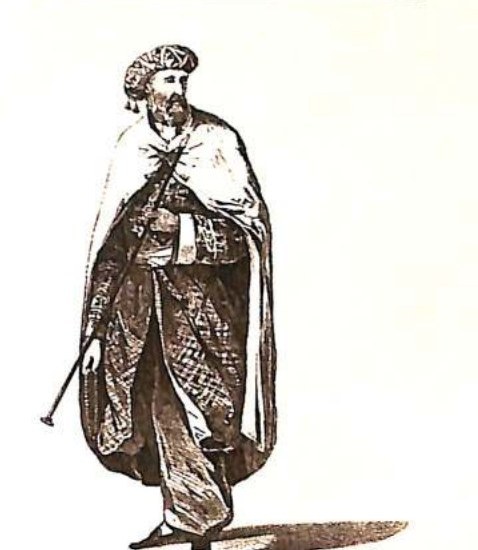
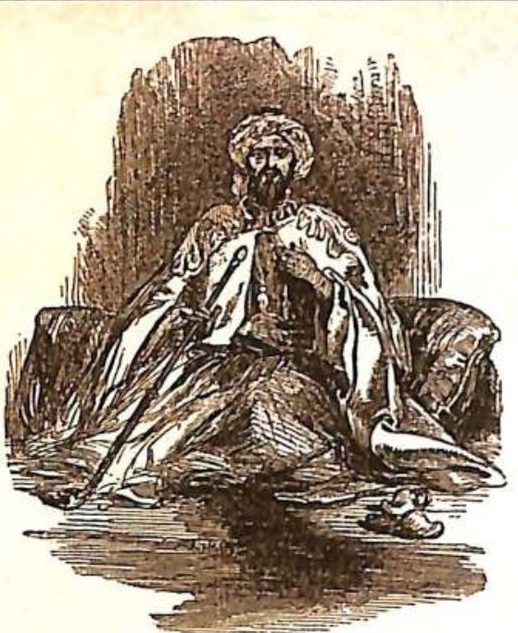
- American missionaries called him “young” and “foppish” in 1844; Layard described him in 1846 as mild and under 40 years of age. The painter Frederick Cooper portrayed him in 1849.
- In 1846, together with the Mîr, he invited Layard and Rassam to the assembly festival in Lalîş and gave Layard a letter of recommendation “in the name of Şêx Adî” to the chiefs of Şengal.
- In 1849 he sealed the letters to the Grand Vizier and to Stratford Canning as “Şêx of the Ezidis”.
- In 1853 he was arrested on the way to Mosul and freed by mounted Ezidis.
- In 1854 he was daguerreotyped in Lalîş by American missionaries.
- In 1872/73 he dictated the statement of the religious rules for the government in Arabic, Turkish and French.
- In 1879, until the confirmation of Mîr Mîrza Beg, he led the community together with Ebdî Beg. In October of the same year the French vice-consul Siouffi described him as almost 60 years old, in a long gown, fur jacket, black woolen coat and white turban around a black cap.
- In 1883/84 he received Russian visitors in Lalîş; in 1887 a British clergyman met him in Êsiyan.
- He died in the autumn of 1889.
According to Layard's account of 1849–1850
- Position in 1849: Layard calls Şêx Nasir by rank “only the head of the Şêx of the Şêxan district”; because Mîr Huseyn Beg was young and inexperienced, he performed the religious duties in his stead.
- Embassy: According to Layard, Huseyn Beg and Şêx Nasir, “the heads of the whole community”, sent the delegation under Qewal Yûsif to the Sultan in 1849. According to Guest it was the British vice-consul Christian Rassam who sent it. Both statements stand side by side.
- Reception of Layard: In September 1849 he rode with the Mîr through the night almost 40 miles to meet Layard near Sêmêl.
- Festival in Lalîş 1849: He went ahead to prepare the celebrations and received Layard with P’îr Sino, the Qewal and the chiefs in front of the valley. In the evening procession he walked beside Huseyn Beg (see The festival in Lalîş 1849).
- Scribe: Şêx Nasir had a scribe; according to Layard he was the only Ezidi who could read the booklet of verses that Qewal Yûsif showed him.
- Sencaq: Şêx Nasir described the Sencaq to Layard as the “banner” of the house of Huseyn Beg.
- House in Êsiyan: Shortly before 1850 he had built himself a dwelling house in Êsiyan; Layard spent the night there with him, Huseyn Beg and many Qewal.
- Arbiter: In Şengal in 1850 the feuding tribes promised in future to leave disputes to the decision of Huseyn Beg, Şêx Nasir and the Qewal.
P’îr Sino
In mid-1845 soldiers of the governor of Mosul wanted to arrest Şêx Nasir. In his place his deputy P’îr Sino let himself be taken prisoner and tortured without revealing the deception. The British vice-consul Rassam bought his freedom. P’îr Sino is among the signatories of the letters of 1849.
According to Layard's first account (1846)
- Appearance: Layard describes Şêx Nasir in 1846 as hardly older than 40, dressed entirely in white linen, mild and friendly. During the festival he lived in the sanctuary.
- Office: According to Layard, the office of Baba Şêx is hereditary; the Ezidis, however, choose the most suitable among the descendants, not according to primogeniture. Şêx Nasir's father had already held it.
- Writing: According to Layard, Şêx Nasir did not know the alphabet in 1846; only one or two Ezidis could read. His letter to the villages of Şengal was written by his secretary; it was delivered by Qewal Murad. The places and persons greeted in it are listed in Şengal.
- Attitude: Şêx Nasir told Layard that he himself had no objection to letting him see all the rites; many Şêx, however, were against it, and he did not want discord among the people.
- Year: He gave Layard the year 1550 as the era of the Ezidis.
- Course of the festival: The festival in Lalîş 1846.
Sources
- Dimitri Pirbari (P’îr Dîma), A. Ščedrovickij: Тайна жемчужины (The secret of the pearl). Moscow/Tbilisi 2016, p. illustrations
- John S. Guest: The Yezidis. A Study in Survival. London/New York 1987, p. 109–128, 162, 167, 171–175, 258
- Austen Henry Layard: Discoveries among the Ruins of Nineveh and Babylon (abridged edition). New York 1853, p. 17, 47, 53, 72–82, 181, 220
- Austen Henry Layard: Nineveh and Its Remains, Vol. 1. London 1849, p. p. 269–271, 280, 288, 294, 302–308 (PDF 322–324, 333, 341, 347, 355–361)
Found a mistake?
Is something wrong – a fact, a spelling, a source, an image? Let us know: we check every report and correct the article.
Other spellings: Baba Şêx · Baba Sex Sex Nasir · Scheich Nasir · Sex Nasir · Pir Sino · Baba Sheikh · Baba Scheich · Baba Sex · Bave Şêx · Scheich · Shex · Emir · Shekhan · Scheichan · Shaikhan · Lalish · Lalisch · Lalesh · Sheikh Adi · Scheich Adi