
Xetîv Axa came from the Mala Bişar family. His grandfather Bişar was executed in Persia at the Ottomans' request, his father Cango (“Midûr Axa”) was poisoned. Xetîv Axa took over the leadership of the Zuqurî from the Simoyê Çeto family.
Activities
- He was regarded as wise, just and far-sighted and was the first tribal leader to rely not on war but on agriculture.
- He built a dam that collected meltwater and spring water for irrigation. In a year of famine he sold grain and thereby saved thousands – thus he became the richest man in the Vilayet of Wan.
- He held together the alliance of the Ezidi and the Muslim Kurdish tribes of the area and had Armenian and Assyrian friends. In the Ottoman Hamidiye regiments, which were raised among the Kurdish tribes, he saw a danger to this peace.
- During the Ferman of 1891/92, through the wife of the Wali of Wan, he achieved the revocation of the order for forced conversion.
Among his six sons he chose Cihangîr as his successor. He died in 1904–1906 at about 90 years of age.
Information in Sloyan (2015)
The book by Mirza Sloyan about the sanctuary of Aknalich contains recollections of the descendants of Cangîr Axa (the Xatoyan family) and reports of a journey to Çubuxlî in 2014. It spells the father's name Xetîf Axa.
Tribe
Sloyan calls Xetîf Axa the leader of the Ezidi Mandikî tribe. Boyîk (dirok), by contrast, assigns the family to the Zuqurî. The two do not necessarily exclude each other: according to Boyîk, the Mendikî belonged to the confederation of the Zuqurî. The book does not explain the difference.
Family and property
- Ancestors: According to family tradition, Cangîr Axa's great-grandfather, Bişar Paşa, was a companion of the prince Şêx Mirza of Siirt; after the latter's murder he is said to have gone to Persia and been executed there. The grandfather Mdur Axa is said to have been poisoned by the Wali of Wan. In its core this agrees with Boyîk (grandfather Bişar, father Cango “Midûr Axa” – each counted from Xetîv Axa).
- Property: According to his grandson Mraz Xatoyan, Xetîf Axa was the richest leader of the area of Berkri (today Muradiye); the family owned extensive grain fields and twelve villages.
- Succession: According to a speech of 2015, after Xetîf Axa's death the Pasha of Wan tried to seize power over the villages; Cangîr resisted (tradition).
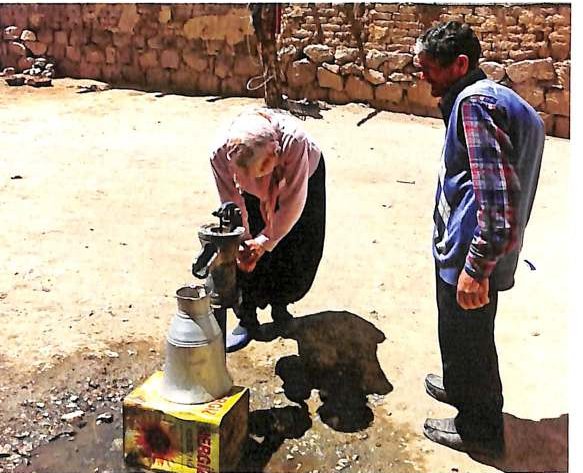
- Çubuxlî today: In 2014 residents showed the visitors the “spring of Xetîf”, the site of his house, the guest house and the assembly place. A well that Cangîr Axa is said to have built is still in use.
On Cangîr Axa
- Birth: 1874 in Çubuxlî (Berkri area, Wan province).
- Places of residence in Armenia: 1918–1919 for about six months in the village of Jarsaris (today Charsaris) on the Pambak mountains, where relatives from Çubuxlî lived; later in the village of Chobankyara near Metsamor in the Ararat plain, with a large guest house. Many descendants live in the village of Sartonk (Armavir province).
- Exile and death: According to Sloyan, he lived 1937–1943 in exile in the village of Messer (today Ust-Solikha) in the Saratov region and died there in October 1943. He was buried in a mass grave near the former Lutheran church.
- Repatriation in 2015: At the beginning of April 2015 a delegation – Mirza Sloyan, the grandson Wazir Xatoyan, Sergo Yerizyan and a representative of the Armenian community of Saratov – traveled to Ust-Solikha and took earth with remains from the mass grave. Earth from Çubuxlî had already been placed in the foundation of his monument in Aknalich in 2014. On April 22, 2015 the earth from Saratov was buried there with military honors.
- Descendants: son Suren Xatoyan (b. 1937 in Gavar), grandsons Wazir and Mraz Xatoyan.
Where this information differs from the person page Cangîr Ax’a, it is to be understood as the account of Sloyan and the family.
Sources
- Eskerê Boyîk: Bi Kurtayî Dîroka Êzidiyên Ermenistanê (A short history of the Ezidis of Armenia). Diyarbakır 2016, p. 117–132
- Mirza Sloyan (Mirzoyê Çolo Siloyan): Дорога, ведущая в храм. Три года спустя (The road leading to the temple. Three years later). Yerevan 2015, p. 16–27, 189–197, 216–229, 273–275
Found a mistake?
Is something wrong – a fact, a spelling, a source, an image? Let us know: we check every report and correct the article.
Other spellings: Xetiv Axa · Xetiv Agha · Xetiv Aga · Chetiv Axa · Chetiv Agha · Chetiv Aga · Khetiv Axa · Khetiv Agha · Khetiv Aga · Firman · Fermans · Sheikh · Scheich · Shex · Eziden · Ezidis