
Mîr Huseyn Beg (around 1829–1879) was Mîr of Şêxan in the period in which the Ezidis first came into close contact with European diplomats and travelers. The events of his rule are described in the article The Mîrs of Şêxan 1832–1913.
Childhood and accession to power
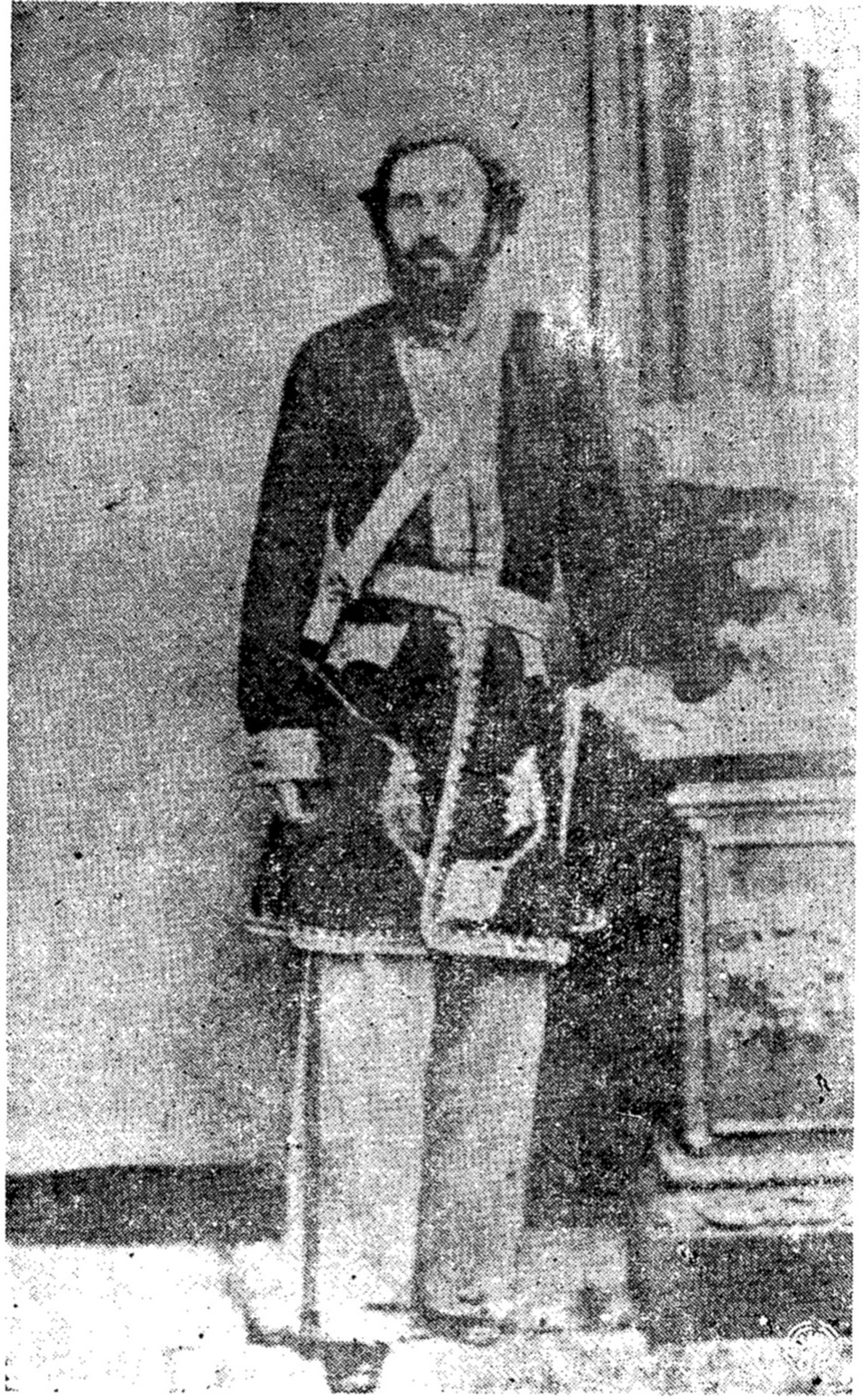
Huseyn Beg was the little son of Mîr Elî Beg, who was beheaded in 1832 by the Kurdish Emir of Soran, Mîr Mihemed of Rewandiz (see The massacre of 1832). He was rescued and hidden and raised in Şengal. Between the end of 1841 and the autumn of 1843 he came to Êsiyan, killed his cousin Mîr Cesim Beg and was elected Mîr, at first under the guardianship of the Baba Şêx Şêx Nasir.
Appearance
- Layard described him in 1846 as a very handsome young man of about 18 with regular features and long black curls under a colorful turban.
- The physician Humphry Sandwith saw him in 1849 as a pale, sickly youth of 19 in a crimson, gold-embroidered jacket and white cloak, with his father's scimitar in a silver scabbard.
- In 1852 he rode to Lalîş with ten companions carrying long spears and daggers; the horses wore splendid harness.
Activities
- In 1846 his first son was born in Bacidrê; at Layard's suggestion he received the name of his grandfather, Elî (see Mîr Elî Beg).
- On October 1, 1849 he sealed the letters to the Grand Vizier and Stratford Canning as “Huseyn, Mîr of Şêxan”.
- In 1853 he was deposed, fled to Şengal and later returned to office. His debts at that time amounted to 122,000 piasters.
- In February 1855 he led 2,000 Ezidi horsemen against the rebel Yezdanşêr Beg and took Zaxo; the Sultan received him and conferred an honorary title on him.
- In 1869, on the advice of Midhat Pasha, he brought in a teacher for his sons, but failed because of the resistance of the community.
- In 1872/73 he signed the statement of the religious rules for the government.
- Around 1875 he was interned in Mosul for three years and afterwards lost important rights.
According to Layard's account of 1849–1850
Layard, who often met Huseyn Beg in 1849 and 1850, records the following:
- Position: Huseyn Beg was “the religious as well as the political head of all the Ezidis, wherever they live”; he was also called Kalifa, and the position was hereditary. Because he was young and inexperienced, he left the religious duties to Şêx Nasir.
- Embassy: According to Layard, Huseyn Beg and Şêx Nasir sent the delegation under Qewal Yûsif to the Sultan in 1849 to take action against forced conscription. According to Guest, the British vice-consul Christian Rassam sent the delegation. Both statements stand side by side.
- Reception of Layard: In September 1849 Huseyn Beg rode with Şêx Nasir, Qewal and elders almost 40 miles through the night to meet Layard near Sêmêl, and escorted him as far as Tel Isqof, where the danger from Bedouins ended.
- Festival in Lalîş 1849: He came to meet Layard with many horsemen on the way to Bacidrê and entertained him. In Lalîş he walked in the evening procession behind Şêx Cindî and two old Şêx; afterwards, on the threshold of the sanctuary, he received the homage of the Şêx and elders, who touched his hand and raised it to their lips (see The festival in Lalîş 1849).
- 1850: He hunted gazelles with Layard and entertained him in Bacidrê; at the end of March he accompanied Layard part of the way when he set out for Şengal.
- Arbiter: In Şengal the feuding tribes promised Layard to leave their disputes in future to the decision of Huseyn Beg, Şêx Nasir and the Qewal (see Şengal).
- Gifts: Of the gifts that the Qewal collected on their tours, a quarter was due to him (see Religious offices).
- Customs: Neither the Mîr nor the clergy shaved their beards. According to Qewal Yûsif, the Mîr was to take his wife from the Çol Beg family; unlike the other Ezidis he was permitted more than one wife.
Family and death
According to Guest, Huseyn Beg was married seven times; in 1850 he had three wives, in 1852 four. His younger brother was Ebdî Beg, the father of Mayan Xatûn. He died in 1879 at about 50 years of age. His successor was his third son Mîrza Beg.
According to Layard's first account (1846)
- In 1846 Huseyn Beg was about 18 years old and wore a colorful turban and a wide white cloak of fine cloth over a rich jacket.
- At that time he already had two wives; a young wife from the Koçer (nomads) wore flowers and gold coins in her hair. His mother also lived in the women's house.
- In the reception room of his house in Bacidrê a spring brook flowed through the middle of the room.
- At the festival in Lalîş his family sacrificed a sheep; Huseyn Beg, with the others, tore the meat apart with bare hands and distributed it to the poor.
- With Şêx Nasir he received the arriving pilgrims at the spring and accompanied Layard three miles down the valley on his departure. See The festival in Lalîş 1846.
Sources
- John S. Guest: The Yezidis. A Study in Survival. London/New York 1987, p. 83, 109, 112, 119–128, 161–168, 258
- Austen Henry Layard: Discoveries among the Ruins of Nineveh and Babylon (abridged edition). New York 1853, p. 17, 53, 72–83, 181, 198, 220
- Austen Henry Layard: Nineveh and Its Remains, Vol. 1. London 1849, p. p. 272–276, 285–288, 306–307 (PDF 325–329, 338–341, 359–360)
Found a mistake?
Is something wrong – a fact, a spelling, a source, an image? Let us know: we check every report and correct the article.
Other spellings: Huseyn Beg · Mir Huseyn Beg · Mir Huseyn Bek · Mir Huseyn Bey · Mîr Huseyn Bek · Mîr Huseyn Bey · Hüseyin Bek · Hüseyin Bey · Hisen Beg · Hisen Bek · Hisen Bey · Hisên Bek · Huseyn Beg Col · Huseyn Bek Col · Huseyn Bey Col · Huseyn Beg Tschol · Shekhan · Scheichan · Shaikhan · Sinjar