
Temir Axa led the Hesinî tribe from about 1840 to 1880. Under him, according to a later letter by his grandson Ûsiv Beg, a large part of the tribe came from the Ottoman Empire to Surmelî.
In 1843 the German traveler August von Haxthausen visited him together with Xaçatur Abovyan; he counted 1400 Ezidi houses in Russia and praised their hospitality. In the winter of 1846 Abovyan spent two weeks with Temir Axa and with the Sîpkî leader Îbrahîm Axa.
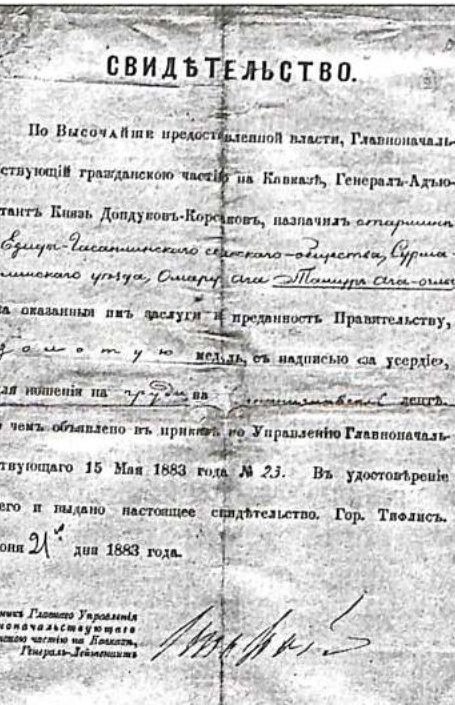
Temir Axa was highly respected: people swore by his grave and his hearth. The ethnographer Yeghiazarov called him the “father of the community”. He had six sons, among them Hesen Axa II. His brother Omer Axa received a gold medal “for bravery” in 1883.
Additions according to Muradyan (2013)
Name and term of leadership
- In the sources he is also called Temur, Tamir, Tamur or Taman. His name became the surname of his grandson Ûsiv Beg (Temurov, Temuryants).
- In 1843 he was already head. According to the records of the Caucasian Archaeographic Commission (1878), he had 400 houses as subjects. Muradyan concludes from this that his term lasted at least 35 years; this fits Boyîk's statement (around 1840–1880).
The second immigration
In an undated letter to the viceroy, Ûsiv Beg wrote that 3000 Ezidi families had come from the Ottoman Empire “60 years ago” under Temir Axa. Muradyan dates the letter to 1913 and thus arrives at about 1853. In July 1854 the Russian army took Bazîd again. Temir Axa was there with his horsemen and, as Muradyan supposes, helped the Hesinî who had stayed behind to move. A great-grandson states that Temir Axa led an Ezidi cavalry unit of 300 men in 1853. Neither is documented.
Visits by Haxthausen and Abovyan
- According to Artashes Abeghyan, August von Haxthausen came to Temir Axa on August 24, 1843, together with Abovyan. Haxthausen wrote that the Ezidis in Russia were divided into two clans with hereditary elders. In Russian territory there lived up to 1400 tents, and as many beyond the border. For protection and grazing rights they paid up to 4 silver rubles per family. Almost all of them spoke Armenian.
- The guests were served flatbread from the Sac (iron griddle), sour milk and sheep's milk. The host's greeting was, in essence: “I lay my head under the hoof of your horse.”
- Before Christmas 1846 Temir Axa was in Tiflis at the invitation of the viceroy, Prince Vorontsov, and received gifts.
- Over Christmas 1846 Abovyan stayed with him for two weeks in Eslanlû. Based on Temir Axa's accounts he wrote about the customs of the Ezidis, for example Thursday as a feast day, on which even the poor send a plate of pilaf to their neighbors.
- Muradyan mentions that Abovyan gave a coat to an impoverished Îbrahîm Axa. Whether he is the same as the Sîpkî leader Îbrahîm Axa named by Boyîk remains open.
Reputation
People swore “by the grave and hearth of Temir Axa”. The people did not call him “Axa” but “father of the people”. A tradition tells of a man who stole three rams from his flock, went blind, and after his confession and Temir Axa's forgiveness was able to see again.
Sons
Temir Axa had six sons: Elo, Kelaş, Emer (Omar), Esed, Hesen and Ewas. Hesen Axa II was not the eldest. Şamil Temurov descends from Kelaş, Mehmûd Beg Teymurov from Esed.
Emer Axa was village elder of the community of the Hesinî Ezidis. The Ezidis elected him unanimously three times in succession, each time for three years (“We have an Axa, why elect another?”). On June 21, 1883 he received the gold medal “for zeal” on the Stanislaus ribbon.
Discrepancy: Above, Omer (Emer) Axa is described as a brother of Temir Axa who received a gold medal “for bravery”. According to Muradyan and the certificate, Emer Axa was a son of Temir Axa and younger brother of Hesen Axa II; the medal was awarded “for zeal”.
Temir Axa in Yeghiazarov (1884)
In the study by S. A. Yeghiazarov (Tiflis 1884), which is now available in the original, Temir Axa appears as the father of his informant Hesen Axa II:
- In the line of descent of the leading family, Temir Axa is the seventh link, Hesen Axa the eighth (p. 202–203; see Hesinî).
- By age, the house of Temir Axa stands first among all the houses of the tribe (p. 202).
- The oath formula in the original reads: “I swear by the grave and hearth of Temir Axa” (p. 203).
- There was a saying about him in the language of the Ezidis, which Yeghiazarov prints verbatim: he was not the Axa of the people, but its father (p. 203).
On the statement above: That “Yeghiazarov called him the ‘father of the community’” does not exactly reflect the original. In Yeghiazarov it is a saying of the people that he records, not his own designation. This corresponds to the “father of the people” in Muradyan.
On Emer Axa: Yeghiazarov calls Emer Axa the younger brother of Hesen Axa (p. 214), i.e. a son of Temir Axa. This supports Muradyan; the statement above (after Boyîk) that Omer Axa was a brother of Temir Axa remains as a divergent account. On the question of whether Emer was older or younger than Hesen, see Hesen Axa.

Sources
- Eskerê Boyîk: Bi Kurtayî Dîroka Êzidiyên Ermenistanê (A short history of the Ezidis of Armenia). Diyarbakır 2016, p. 43–58
- Manuk Muradyan: Усуб Бек (Ûsiv Beg). Yerevan 2013 (Russian translation of the Armenian original, Yerevan 2012), p. 45–46, 57–73, 241
- S. A. Yegiazarov (Егиазаров): Краткий этнографический очерк курдов Эриванской губернии – containing the ethnographic-legal outline on the Ezidis. Tbilisi 1884, p. p. 202–203, 214 (PDF p-102, p-108)
Found a mistake?
Is something wrong – a fact, a spelling, a source, an image? Let us know: we check every report and correct the article.
Other spellings: Temir Agha · Temir Aga · Teman Agha · Teman Aga · Tbilisi · Tbilissi · Eziden