
Hesenê Şêx Kelaşê (Cyrillic Һ'әсәне Шех К'әләше, officially Hesen Hesenyan, Russian Гасан Гасанян) (1943–2017) was an Ezidi Şêx from the village of Şamîran in Armenia. In 1995 he wrote a guide on how Ezidis should live, pray, mourn, fast and marry according to the rules of their religion.
The information on his person comes almost entirely from his own book; the life dates are on his gravestone (see below).
Origin and teachers
Hesen is a son of Şêx K’eleş (K’eleşê H’esen). According to his own statement he studied with his father, with his brother Şêx Xwedêda, with Şêx Dewrêş (Kiloç) and with Şêx Zade and Şêx Zayîl; these in turn had studied with their Seyda. Şêx Dewrêşê Kelaş (1928–1973), one of the best-known experts on the tradition in Armenia, was likewise a son of Şêx K’eleş and, according to Omarkhali, belonged to the Şêxûbekir lineage.
The book (1995)
“Р'е-р'ьзма мьләте Эзди ангори qьраре дин” (Rê-rizma mileta Êzdî angorî qirarê dîn – “Manners and customs of the Ezidi people according to the rules of religion”) is written in the Ezidi Cyrillic alphabet and bears at the end the note “Sala 1995-a, gundê Şamîranê”. It comprises 45 pages:
- a preface on the origin and name of the people (formerly E’debî, “people of modesty”; the religion is called Şerfedîn, “Êzdî” is the name of the people),
- the Şehdetî (profession of faith) in eleven parts,
- washing and burial of the dead, the prayer for committing them to the earth,
- Xêr and Qurban, fasting, the Wednesdays in March,
- marriage and a list of sins,
- a closing word to the young.
The author supports almost every rule with stanzas from Qewl and Beyt, above all from the Qewlê Seremergê. He writes that he has “not added a single question of his own”.
Occasion: From 1937 into the 1950s, he writes, the religion was suppressed by the state; many Şêx and P’îr were exiled, many did not return. The knowledge of the T’irêq declined as a result. Since 1990 the faith has been returning. The book is meant to give every young Ezidi the rules (see Repressions 1937–1939).
The contents have been incorporated into the articles on burial, days of remembrance and Xêr, festivals and fasting, Kiloça, wedding and the traditions of origin.
At the New Year festival in Aknalich (2015)
Mirza Sloyan reports in his book on the first festival of Tawûsî Melek (Ezidi New Year, Çarşema Sor) celebrated at the sanctuary in Aknalich in 2015. After a message of greeting from the Armenian president, Şêx Hesen Hesenyan (in the book in Russian “шейх Гасан Гасанян”) spoke there as an Ezidi cleric. He said that the festival was being celebrated that day for the first time among the inhabitants of Armenia, thanks to Mirza Sloyan, and that he was sure the Ezidi people would from now on celebrate this main festival every year. He wished that the day of Tawûsî Melek might bring happiness and peace to the whole world and that all wars might cease (Sloyan 2015, p. 49–50).
Grave in Aknalich
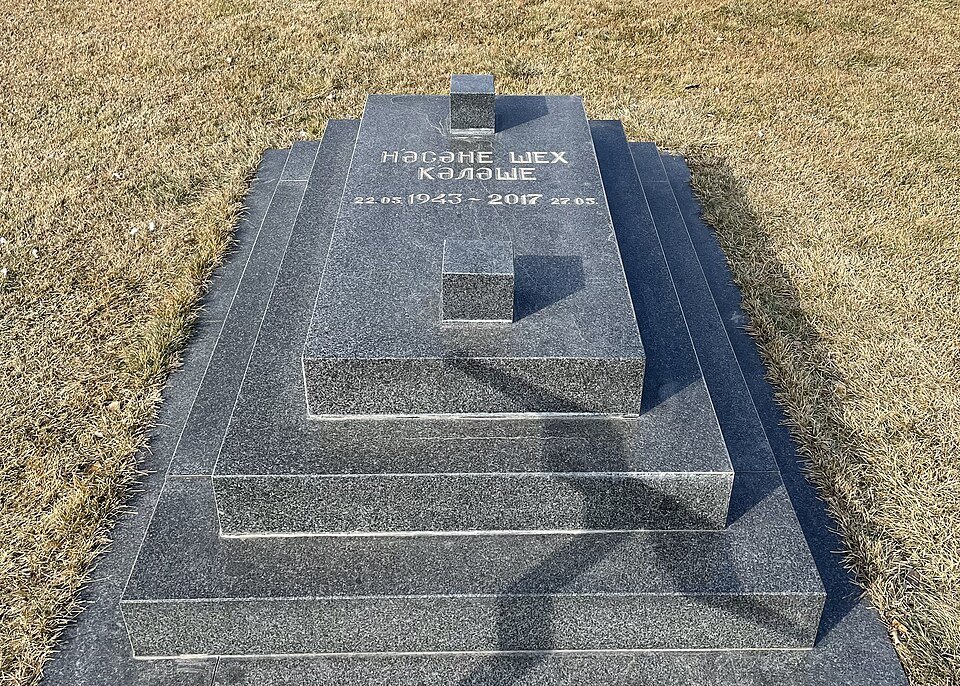
Hesenê Şêx Kelaşê is buried in Aknalich (Armavir province); the Ezidi sanctuary of 2012 and the temple Quba Mêrê Dîwanê also stand there. His gravestone of dark granite bears in Ezidi Cyrillic script the inscription “Һәсәне Шех К'әләше” and the dates 22.05.1943 – 2017 27.05., i.e. May 22, 1943 to May 27, 2017 (photo 2022, Wikimedia Commons).
In the library
- Original edition 1995 (scan)
- New text edition 2026 – newly typeset by EZDIKI.COM, text copyable and searchable
- Audio version: The whole book is read aloud in a podcast (some prayers are omitted there).
Sources
- Һ'әсәне Шех К'әләше (Hesenê Şêx Kelaşê, Hesen Hesenyan): Р'е-р'ьзма мьләте Эзди ангори qьраре дин (Rê-rizma mileta Êzdî angorî qirarê dîn). Şamîran 1995 (scan and new text edition in the EZDIKI.COM library), p. 3–11, 43–45 and portrait
- Khanna Omarkhali: The religious textual tradition of the Ezidis – from the oral to the written. Saint Petersburg 2023 (Russian translation of the English original, Wiesbaden 2017), p. 134 (on his brother Şêx Dewrêş)
- Wikimedia Commons: File:Yazidi grave in Aknalich.jpg (photo: Dor Shabashewitz, 29.1.2022, CC BY 4.0), accessed 25.11.2026, p. photo of the gravestone
- Mirza Sloyan (Mirzoyê Çolo Siloyan): Дорога, ведущая в храм. Три года спустя (The road leading to the temple. Three years later). Yerevan 2015, p. 49–50
Found a mistake?
Is something wrong – a fact, a spelling, a source, an image? Let us know: we check every report and correct the article.
Other spellings: Hesenê Şêx · Hesene Sex Kelase · Hesene Sheikh Kelase · Hesene Scheich Kelase · Hesene Sex Kelasche · Hesene Sheikh Kelasche · Hesene Scheich Kelasche · Hesene Sex Kelashe · Hesene Sheikh Kelashe · Hesene Scheich Kelashe · Sex Hasan Kalas Hasanyan · Hesene Sex · Hesene Sheikh · Hesene Scheich · Hesen Sheikh · Sheikh · Scheich · Shex · Qawl · Qaul