
Îsmayîl Beg of the family of the Mîrs of Şêxan traveled from the end of 1908 to the beginning of 1909, at the age of 18, for several months to the Ezidis in Aparan, Kars and Surmelî. He was the guest of Ûsiv Beg, visited Etchmiadzin and met the Viceroy Vorontsov-Dashkov in Tiflis. There he asked that Ûsiv Beg be recognized as head of the Ezidis of Russia, also in religious matters.
In letters to Ûsiv Beg (1916, 1918, 1919) he condemned the genocide of the Armenians and reported that the Ezidis of Şengal were protecting Armenians. In 1919 clergy from Lalîş brought a letter to the Armenian parliament, where it was read out.
Additions according to Guest
Origin and youth
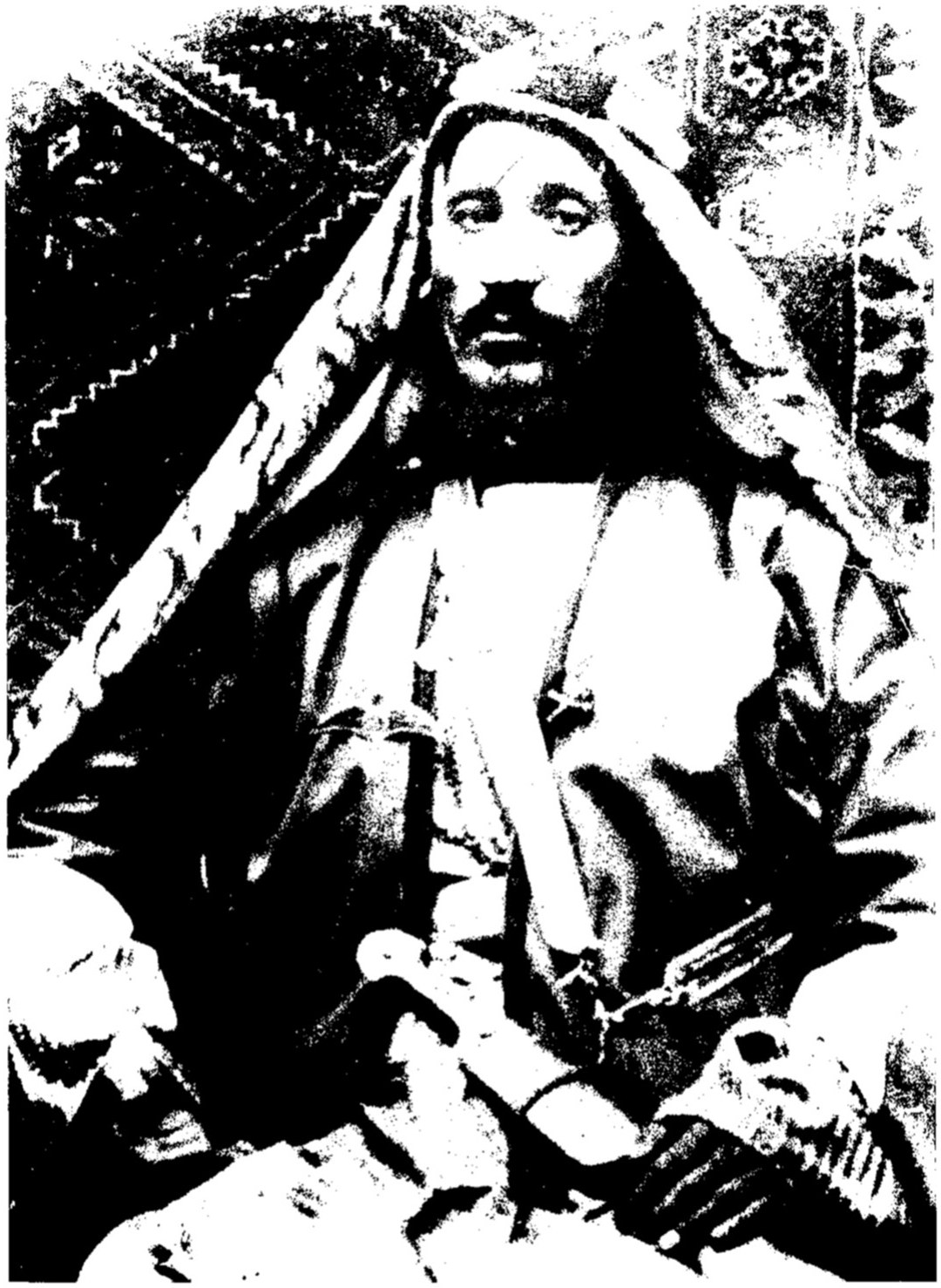
Îsmayîl Beg was born in 1888 as the son of Ebdî Beg, a younger brother of Mîr Huseyn Beg; Mayan Xatûn was his half-sister by the same mother. His father died when he was six months old, his mother when he was three; sisters raised him. At the age of 18 he married the daughter of a Feqîr, who soon died. After that he traveled through the communities as a wandering preacher, gave blessings and collected alms. In Şengal he formed a lifelong friendship with Hemo Şero.
The journey to the Caucasus (1908/09)
Because at the border a high duty was demanded of him on his splendid robes, he traveled through the mountains disguised as a dervish. In December 1908, at an assembly in Iğdır, he issued a code of conduct (maximum bride price 100 rubles; command to found schools). With the Armenian Catholicos he agreed on seven schools. On March 3, 1909 he presented to the viceroy in Tiflis a petition in the name of 72 villages and 3,500 households. See The Ezidis in Transcaucasia.
The edict of 1909 and the dispute in the family
In the spring of 1909 he obtained in Istanbul an edict that recognized the religion and the sanctity of Lalîş. Mîr Elî Beg and the tribal heads, however, declared him unauthorized, and the edict was suspended. A feud in the family followed. Îsmayîl married his cousin Emşa and lived in Başîqa. In 1913 he took possession of the Sencaq of Şengal; it was agreed that he would become its keeper and receive a share of the donations from Şengal and eastern Anatolia. He settled in Beled Sinjar, where his house stood on the foundations of a Roman fort.
World War and the British period
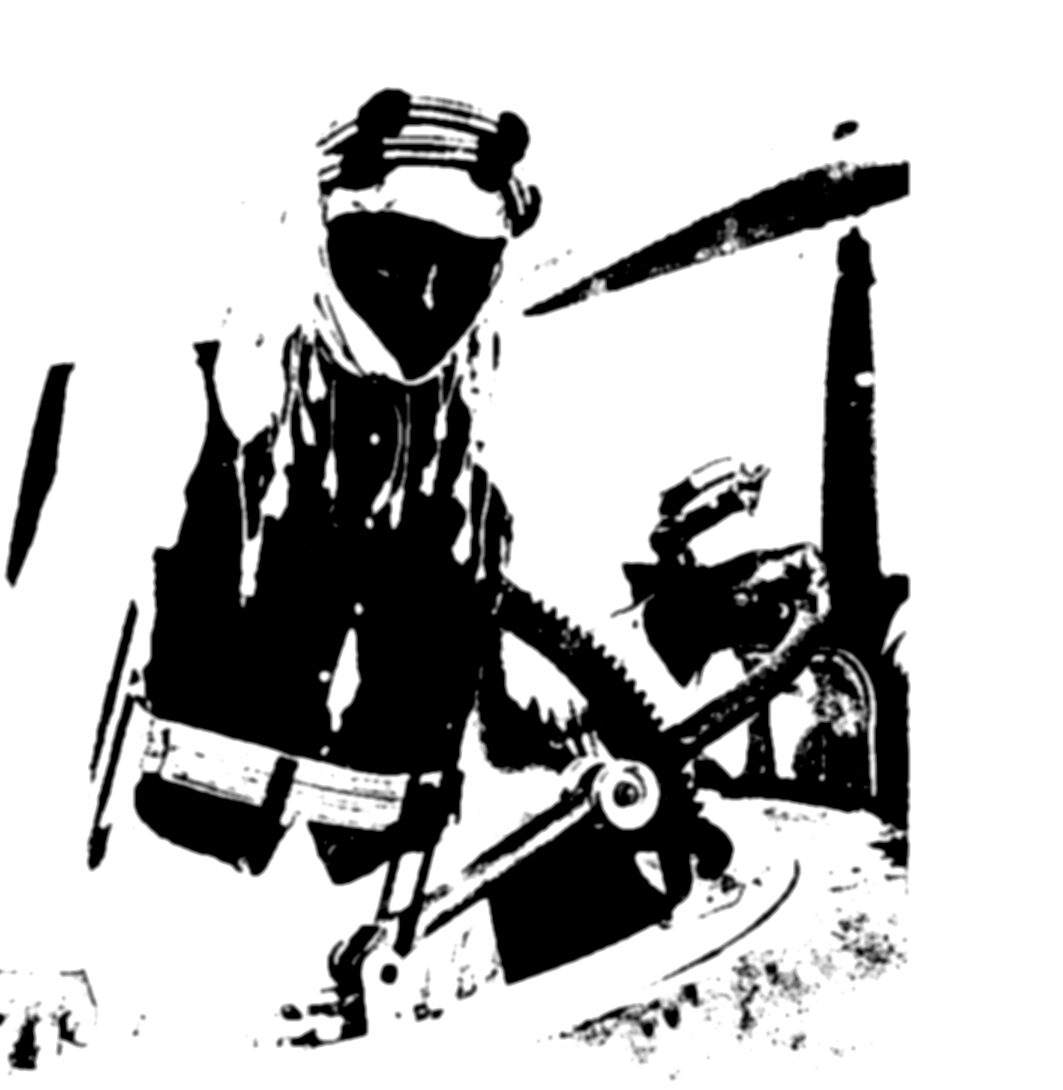
In the First World War he took in Armenian refugees and promised Armenians in Mardin refuge in Şengal. In 1918 an Ezidi war council sent him to the British; he entered Mosul with them. Afterwards he was detained in Baghdad for two and a half years and was allowed to return only in 1921. In 1924 he recruited for an Ezidi squadron of the Iraq Levies. In 1928 he asked the journalist Paul Schütz to make the principles of the Ezidi faith known in Europe.
Death and descendants
Îsmayîl Beg died on March 9, 1933 in Mosul at the age of 45. His memoirs and writings were published by Constantin Zurayk in Beirut in 1934. His children included Ebdulkerîm, Wansa (who married Mîr Seîd Beg in 1934), Yezîd Xan Beg (later head of the Şengal branch of the family, d. 1982), Bayezîd Beg (d. 1981) and Mu’awiya Beg. His house in Şengal was a museum in the 1980s.
Note on his age: According to Eskerê Boyîk, Îsmayîl Beg was 18 years old at the time of his journey in 1908/09; according to Guest he was born in 1888 and was thus about 20.
Additions according to Muradyan (2013)
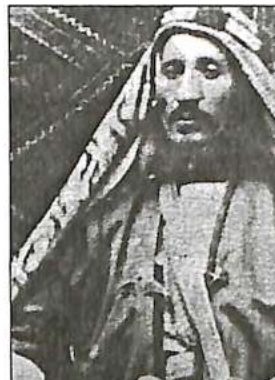
Muradyan relies on Armenian newspapers of the time, on family stories of the Ûsivyans and on the scroll of Îsmayîl Beg in the Matenadaran. In Armenian sources he is called Mîr Îsmayîl or “Reîs Abdî Beg zade Mîr Îsmayîl Beg”.
Visits to the Caucasus
- Various sources name visits in the years 1907, 1908, 1909 and 1912. Muradyan therefore assumes several journeys. On each visit he met Ûsiv Beg.
- According to the priest Emanuel Nazaryants, he came to the Caucasus on January 30, 1909 and stayed for some days in Etchmiadzin.
- In 1908 Îsmayîl Beg, Ûsiv Beg, Komitas and the Armenian politician Khachatur Melikyan met with the Catholicos in Etchmiadzin. The subject was schools for Ezidi children. Îsmayîl Beg permitted the opening of schools.
- On February 19, 1909 Viceroy Vorontsov-Dashkov received him in Tiflis, accompanied by Armenian advocates. He asked for schools for Ezidi children. (Guest gives March 3, 1909 as the day of the petition. Whether these are two dates or the same day in different calendars is open.)
- In 1909, with a special letter, he appointed Ûsiv Beg as his deputy for the Ezidis in the Caucasus. This is also confirmed by the cleric Sion Ter-Manvelyan (1910).
- In 1912, according to family tradition, he was a guest in Eslanlû.
- He had already asked the Armenian Catholicos Khrimian (1892–1907) to support the education of the Ezidis. He sent his own children to an Armenian school in Baghdad.
Letters and the scroll of 1919
His letters from the years 1916–1919 to Ûsiv Beg and others were written down in Baghdad. They are preserved as a 5 m long scroll. In 1919 a delegation of Ezidi clergy brought the scroll to Yerevan, where it was read out in parliament. In a letter of autumn 1919 he writes that more than 56 Ezidi villages lay around Lalîş. The content and the handover are described in the article Şengal 1915–1918.
Later mentions
- Lazo stated in 1923 that Îsmayîl Beg had in 1918 lifted the traditional prohibition of reading and writing.
- In the NKVD file of 1938/39 against Ezidi men in Armenia, Îsmayîl Beg was named as the alleged mastermind of a “counter-revolutionary group”. See Repressions 1937–1939.
Additions according to Fuccaro (1999) and Lescot (1938)
Claim to the office of Mîr (1913)
According to Nelida Fuccaro, after the murder of Mîr Elî Beg in 1913 Îsmayîl Beg claimed the office on the grounds that the new Mîr Seîd Beg was too young. The Ottomans confirmed Seîd Beg under the guardianship of Mayan Xatûn and threatened Îsmayîl Beg with expulsion from the province of Mosul; he went to Şengal and lived there also in the Mandate period. Fuccaro calls him a brother of Elî Beg, Guest a half-brother of Mayan Xatûn – the statements on kinship contradict each other.
1918 and the British
- Lescot writes that in 1918 Îsmayîl Beg was politically leading in Şengal. With the help of the Bedouin leader Obeyd el-Khad'ân he reached the British in Baghdad.
- According to Lescot, Hemo Şero became “representative of the government” in Şengal on his proposal. This fits Guest's statement that he declined the governorship in favor of Hemo Şero.
Petitions of 1930
- On November 1, 1930 Hemo Şero and Îsmayîl Beg expressed in a petition their concern for the sanctuary of Şêx Adî; it was forwarded to the British government via Hormuzd Rassam.
- In November 1930 he wrote, together with Hemo Şero and Qulo Huseyn, to Rassam, who campaigned in London for the non-Muslim minorities of Iraq. See Petitions of the Ezidis 1923–1932.
- In 1929, according to Fuccaro, he tried to win Mîr Seîd Beg over to the association Xoybûn, active in Syria. In 1932 he received from there the draft of a petition to the Frontier Commission to assign Şengal to Syria; it was never submitted.
Education and writings
- Îsmayîl Beg had his children educated: a son attended the teachers' seminary in Baghdad, his wife and a daughter the American University in Beirut (Lescot).
- Lescot considered his book (Beirut 1934) to be the only writing whose Ezidi origin was beyond doubt. Fuccaro mentions a history of the Ezidis in Arabic written by him.
- He was in contact until his death with the leaders of the Ezidis in the Syrian Afrîn area, Derwîş axa and his son Cemîl axa.
Additions according to Ali and Al Omar (2025)
In 2025 Majid Hassan Ali and Diar Al Omar evaluated new sources: the original manuscript of his book (American University of Beirut), his letter scroll in the Matenadaran (Yerevan), files of the League of Nations, British and Ottoman archives and the archive of the Ezidi Spiritual Council of Georgia. They advance the thesis that Îsmayîl Beg understood the Ezidis as a people of their own; but they also point out his contradictions.
Origin and family
- Born around 1888/89 in Bacidrê as the son of Mîr Ebdî Beg, a son of Mîr Elî Beg I. Ebdî Beg briefly held the office of Mîr after the Ottomans had detained his elder brother Huseyn Beg in 1875. According to Ali and Al Omar, Îsmayîl was a cousin of Mîr Elî Beg and brother of his wife Mayan Xatûn (on the divergent statements on kinship see above).
- He could not read and write; his writings were dictated.
- His eldest son Ebdulkerîm was the first Ezidi graduate of the teachers' seminary in Baghdad and the first Ezidi teacher in Baghdad. His daughter Wansa, according to the authors, was the first Ezidi woman with formal schooling (American girls' school in Beirut, from 1933 in Baghdad). After 1908/09 he named sons Yezîdxan, Bayezîd and Mu’awiya.
The journey of 1908/09
- The code of conduct of December 11, 1908 treats the Ezidis as a religious community and at the same time as a people of their own; Article 5 requires respect for other peoples, because all exist by God's will. A previously unknown part contains an oath formula in his language, in Armenian script.
- With the Catholicos in Etchmiadzin he asked for protection for the Ezidis in the districts of Alexandropol, Kars and Erivan. According to his book, the document names 72 Ezidi villages with about 350 households. Discrepancy: Guest gives 72 villages and 3,500 households for the petition to the viceroy (see above).
- According to his own account, Viceroy Vorontsov-Dashkov is said to have said that the Ezidis had formerly been thought similar to the Kurds, but that it was now known that the Ezidi people was distinct from the Kurds and from Islam. Îsmayîl Beg believed that his efforts had led Russia to classify Ezidis and Kurds as separate peoples. He handed over a memorandum asking Russia to protect Şengal.
- Because Armenian newspapers claimed that he wanted to lead the Ezidis into the Armenian Church, the Ottomans arrested him together with 75 Ezidis; the accusations proved unfounded.
- On the return journey he asked the Young Turks for the return of the Sencaq that Governor Ömer Vehbi Pasha had confiscated in 1892/93 (see Sencaq and Tawûs gêran), and for his recognition as head; Mîr Elî Beg prevented this.
- Petition to the Grand Vizier of March 20, 1909: He asked that the Ezidis be recognized as a community “with their national and religious characteristics”, and for school attendance for Ezidi children (reported in the Istanbul newspaper La Turquie under the title “Une nouvelle communauté”).
Seal and title: “Head of the Ezidi people”
Ali and Al Omar document how Îsmayîl Beg described himself:
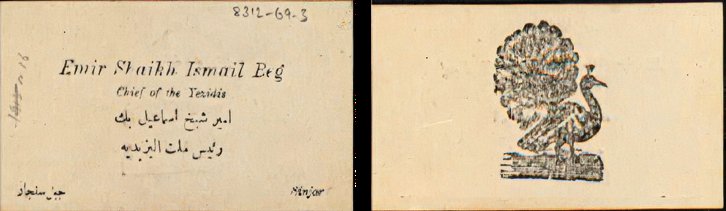
- His seal read Ameer Ismael, Rais Mulat al-Yezidia – “Emir Îsmayîl, head of the Ezidi people”.
- In a letter to Gertrude Bell he signed as “head of the Ezidi nation”; his business card of 1916 calls him “Prince of the Ezidi nation”.
- In his Arabic texts he called the Ezidis milla, qawm and umma, in his own language “Qewm û miletê êzidî” (see History of terms).
- He had 40 seals made in Mosul with the names of the Axas of Şengal so that they would remain able to act in an emergency.
The letters of 1917–1919
His letters in Armenian to the Ezidis in the Caucasus (“To my people and my children”) form a scroll a good 5 m long with the seals of many leaders. They describe the situation in Şengal, the rescue of thousands of Armenians and the persecutions of the last 200 years; as the beginning of the decline they name Dawud Pasha and Mîrê Kor of Rewandiz. He speaks of the “Ezidi language” and calls for education. The letters were first published in 1975 by Karlênê Çaçanî, who interpreted them as testimony of Armenian-Kurdish relations; according to Ali and Al Omar, however, the letters mention Kurds only a single time, and negatively (Mîrê Kor).
1918: Declaration of independence and British recognition
- After the British capture of Mosul in 1918, over 50 Ezidis of Şengal signed a declaration “in the name of the whole Ezidi people in the Vilayets of Diyarbakır and Mosul”: they wished to live under British, not under Arab rule.
- On December 3, 1918 Colonel G. Leachman, in a British “Ferman”, recognized him as Mîrê Mîran and “Emir of the Ezidi nation”. According to his book, Mîr Seîd Beg received a certificate as spiritual head, he himself as secular head.
The National Council of the Ezidis in Tiflis (1919)
In July 1919, on his advice, Ezidis in Tiflis founded the National Council of the Ezidis, approved by the Georgian government. The founding assembly took place in the community house in the Ortachala quarter; one aim was the connection with the Armenian National Council (according to Pirbari 2012). Open question: The article Ezidi organizations 1919–1931 names for 1919 the National Union of Ezidis founded by Lazo in Tiflis. Whether this is the same organization is not clear from the sources.
The relationship to Xoybûn
- In 1926 Şêx Mehdî, later a founding member of the Kurdish association Xoybûn, visited Şengal. He wrote afterwards that there was no Kurdish national consciousness among the Ezidis, and that Îsmayîl Beg should not be trusted.
- In 1928 Kamuran Bedirxan recruited him for Xoybûn in Syria.
- In a letter about Xoybûn to the British of February 17, 1930, he described himself “as a Kurd”. According to Ali and Al Omar this was a tactical step in the power struggle with Mîr Seîd Beg. Another letter to the president of the American University of Beirut, in which “my Kurdish nation” is mentioned, is handwritten and without a seal; its authenticity is questionable.
- The petition that Kamuran Bedirxan wrote in 1932 in the name of the Ezidis (Şengal should come to Syria) was signed by no Ezidi leader. A British official noted that the Ezidis had never shown “pan-Kurdish sentiments”.
- Before the Frontier Commission of the League of Nations on May 2, 1932 he said, in essence: the Ezidis had good relations with Christians and Muslims, in the war they had saved the Christians; also with the Kurds, “who are of the same family as we”, but who had converted under Turkish pressure. Ali and Al Omar see in this a distinction between two peoples. Îsmayîl Beg believed that the Kurds descended partly from Ezidis, partly from Assyrians, and had been Islamized – that is his view.
Celadet Bedirxan replaces “Êzdîxan” with “Kurdistan”
In 1933 Celadet Bedirxan published a Qewl that Îsmayîl Beg had recited. In doing so he replaced the word Êzdîxan with “Kurdistan” and added two verses against Turks and Arabs. The word “Kurdistan” does not occur in any Qewl. Ali and Al Omar document this alteration of the text. Kamuran Bedirxan claimed in 1936 to the researcher Hadank that Îsmayîl Beg's book was not by him and was unfortunately written in Arabic instead of Kurdish.
His theses of origin
Through his cooperation with Assyrian nationalists (Agha Petros, Hormuzd Rassam), from the 1920s he held that the Ezidis were “pure Assyrians”; at the same time he saw himself as a descendant of the Umayyads and of Şêx Adî. These are his views without evidence. The writer Leo Matthias, after a conversation with him around 1931, reported the sentence: “One cannot become an Ezidi, any more than one can become Chinese.”
His book (Beirut 1934)
The book al-Yazīdiyya qadīman wa-ḥadīthan (“The Ezidis past and present”, Beirut 1934, ed. by Constantin Zurayk, 134 pages; English subtitle The Yazidis: Past and Present, published posthumously in the Oriental Series of the American University of Beirut, No. 6) contains an autobiography, a part on religion, customs and festivals, and a part on the history of Şengal, tribal genealogies and persecutions. Manuscript and print agree in content. Ali and Al Omar point out that some words, such as Yazdan, were unusual at that time in the language of the Ezidi religion and were probably taken from the Syriac manuscript of the priest Ishaq al-Bartali; the early history in the book is also undocumented.
Legacy
His children held different theses of origin – Yezîdxan Beg (book 1961) and Bayezîd Beg an Umayyad one, Mu’awiya Beg a Zoroastrian or Assyrian one – but all distinguished the Ezidis from the Kurds. Bayezîd Beg founded the first Ezidi political movement in Baghdad. Wansa demanded Ezidi self-government in Şengal under the French Mandate and was still rejecting the classification of the Ezidis as Kurds in 2007–2009. According to Ali and Al Omar, his ideas continue to have an effect among the Ezidis in the South Caucasus, especially in Georgia.
On divergent life dates
In some compilations 1882 is given as the year of birth. The sources evaluated, by contrast, give 1888 (Guest) or 1888/89 (Ali and Al Omar); Eskerê Boyîk's statement of his age for 1908/09 fits 1890 better. No evidence was found for 1882. The name Îsmayîl Beg Çol (English Ismail Beg Chol) denotes his membership of the Mîr family Çol and appears thus in the library entry of his book.
Additions according to Drower (1941) and Tezcür (ed., 2021)
- Wansa: His daughter Wansa has an article of her own: Mîra Wansa. According to Drower, Îsmayîl Beg broke with custom when he sent her to school.
- Bayezîd Beg: His son Bayezîd Beg headed an oppositional branch of the Mîr family which in 1964 in Baghdad proclaimed an “Arab Movement of the Ezidi Umayyads”. In April 1980 the Ba‘th government appointed him by decree “President and Mîr” of the Ezidis; he died on June 13, 1981 (Majid Hassan Ali). On the classification of the Umayyad thesis see External attributions and appropriation.
- 1908: According to Tutku Ayhan, Îsmayîl Beg wrote in 1908 that the Ezidis were forbidden to join with members of other nations.
Sources
- Eskerê Boyîk: Bi Kurtayî Dîroka Êzidiyên Ermenistanê (A short history of the Ezidis of Armenia). Diyarbakır 2016, p. 78–80
- John S. Guest: The Yezidis. A Study in Survival. London/New York 1987, p. 151 (ill.), 211–231, 240, 247
- Manuk Muradyan: Усуб Бек (Ûsiv Beg). Yerevan 2013 (Russian translation of the Armenian original, Yerevan 2012), p. 109, 111, 125–138, 196, 203, 234
- Nelida Fuccaro: The Other Kurds. Yazidis in Colonial Iraq. London 1999, p. 130–131, 137, 163–164, note p. 200–202
- Roger Lescot: Enquête sur les Yezidis de Syrie et du Djebel Sindjār (Study of the Ezidis of Syria and of the Şengal mountains). Beirut 1938, p. 6, 127–128, 183, 187, 190–191, 216
- International Journal of Yezidi Studies, Vol. 2. Tbilisi 2025, p. p. 9–53
- Library catalogue ZENON (DAI) and NYU: Ismail Beg Chol, The Yazidis: Past and Present (al-Yazīdiyya qadīman wa-ḥadīthan), ed. Costi K. Zurayk, Beirut 1934, accessed 24.11.2026
- E. S. Drower: Peacock Angel. Being some Account of Votaries of a Secret Cult and their Sanctuaries. London 1941, p. p. 1–2 (PDF 12–13)
- Güneş Murat Tezcür (ed.): Kurds and Yezidis in the Middle East. Shifting Identities, Borders, and the Experience of Minority Communities. London: I.B. Tauris 2021, p. 49–50 (Ali), 173 (Ayhan)
Found a mistake?
Is something wrong – a fact, a spelling, a source, an image? Let us know: we check every report and correct the article.
Other spellings: Ismail Beg · Ismayil Beg · Ismayil Bek · Ismayil Bey · Îsmayîl Bek · Îsmayîl Bey · Ismayil Beg Col · Ismayil Bek Col · Ismayil Bey Col · Ismayil Beg Tschol · Ismail Bek Chol · Ismail Bey Chol · Ismail Beg Dschhol · Ismail Bek Dschhol · Mir Ismayil · Mir Îsmayîl · Shekhan · Scheichan · Shaikhan · Abaran