
During the genocide against the Armenians in the First World War, the Ezidis in the Şengal mountains took in thousands of Armenian and other Christian refugees. Despite Ottoman attacks, they did not hand them over. The most detailed source on this is a letter by Îsmayîl Beg (Mîr Îsmayîl) of the Mîr family, which was read out in the Armenian parliament in 1919.
The general history of the persecutions of these years and the last Ottoman campaign against Şengal in 1918 are described in the article Ferman 1890–1918. Here the subject is the reception of the refugees and the letter itself.
The source
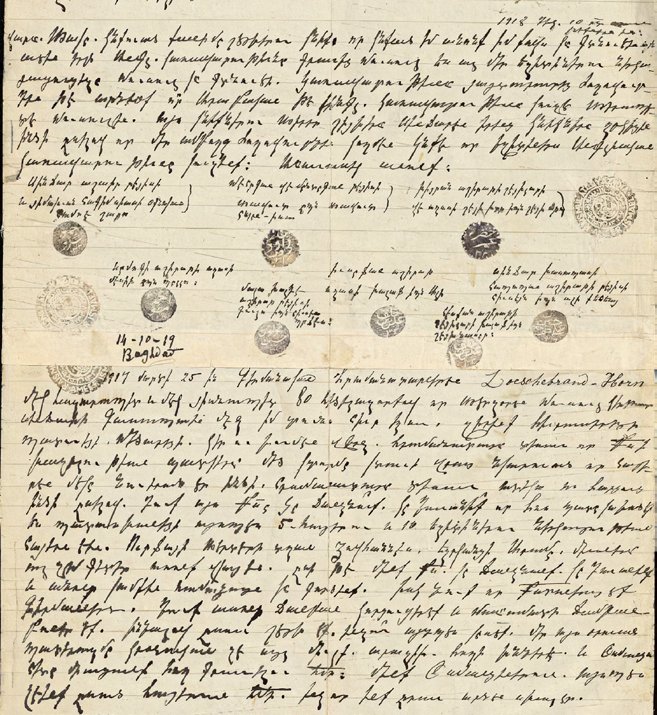
- The letter is a scroll 5.05 m long and 27 cm wide. Today it is kept in the Matenadaran in Yerevan, the institute of ancient manuscripts.
- The scroll bears the title “To the people and its great sons”. It contains letters of Îsmayîl Beg to Ûsiv Beg and others from the period from October 1, 1916 to November 6, 1919.
- The letters are written in Armenian. They were written down by Sargis Farshyan in Baghdad. Beneath them are the seals and signatures of several Ezidi clergy. A peacock is drawn at the top.
- Manuk Muradyan presents the scroll in detail in his book (2012), with illustrations of excerpts. Boyîk (dirok) also mentions it, following an article by Karlen Chachanyan.

The following information comes from Îsmayîl Beg’s report. It has not been independently verified.
The reception of the refugees (1915–1918)
- In 1915 the Armenians were deported in the direction of Ras al-Ain and Deir ez-Zor. First 4000, later 6000 Armenians and other Christians fled into the Şengal mountains.
- The Ezidis distributed them among their houses, gave them food and did not hand them over.
- About 2000 refugees were hidden, also in the sanctuary of Şêx Adî in Lalîş. The Armenian Patriarch Zaven in Mosul knew of this.
- The Ezidis resisted Turkish and German soldiers and captured German vehicles.
Guest, too, reports according to other sources that Îsmayîl Beg took in Armenian refugees and promised Armenians in Mardin refuge in Şengal (see Îsmayîl Beg).
The attack of 1918
- In 1918 the Turkish army attacked Şengal in great force. After 24 hours the Ezidis had to leave their villages, which the attackers burned down.
- The Armenian professor Astvatsatur Khachatryan notified the British, who sent help.
- On September 30, 1918 the Turkish troops withdrew.
- According to Îsmayîl Beg, in 35 days of fighting 75 Ezidis and 10 Armenians fell; on the Turkish side 285 soldiers.
For comparison: According to Guest, an Ottoman force occupied Beled Sinjar on September 10, 1918; the inhabitants withdrew into the caves under Hemo Şero. Already in February 1918 an expedition had demanded the surrender of the Armenian refugees, which the Ezidis refused. The two accounts come from different sources and give different dates; whether they refer to the same attack is open.
Hemo Şero as protector of the refugees
Other sources emphasize the role of the leader Hemo Şero, head of the Feqîran in Bardahalî:
- According to the historian Nelida Fuccaro, in 1915/16 Armenians, Chaldeans, Jacobites and Nestorians from Mardin, Nusaybin and Cizre sought protection in Şengal. By 1916 about 900 people had settled permanently in Beled Sinjar and in Bardahalî.
- According to custom in Şengal, Christians were allowed to settle if an Ezidi Axa vouched for them. Hemo Şero was their most important protector.
- According to Fuccaro, the last Ottoman campaign against Şengal in the summer of 1918 was triggered by his refusal to hand over the Christian refugees. Birgül Açıkyıldız also writes that Hemo Şero did not hand over the Armenians and other Christians who had fled to Şengal, whereupon the last Ottoman occupation followed in 1918.
On the figures: Îsmayîl Beg names 4000, later 6000 refugees; Fuccaro names about 900 who settled permanently by 1916. The two do not exclude each other – many refugees moved on or stayed only temporarily. That Hemo Şero saved “thousands” of Armenians is supported in this form only by Îsmayîl Beg’s higher figure, which has not been independently verified.
On the persecution of the Ezidis
In the same document Îsmayîl Beg also writes about the persecution of his own people: forced conversion to Islam and murders. Formerly there had been 230,000 houses with 1,150,000 people, now only 14,000 houses with about 80,000 people. These figures are his own statement and have not been verified.
The handover in Yerevan (1919)
- In 1919 Îsmayîl Beg sent a delegation of Ezidi clergy with the scroll to Yerevan. Muradyan places the reception in the autumn (probably November) of 1919.
- Simon Vratsian, later prime minister, prepared the reception. The town commandant Arshavir Shahkhatuni had a gold order made for the head of the delegation.
- At the ceremony in parliament, Ûsiv Beg received the scroll, kissed it and handed it to the president of parliament, Avetik Sahakyan. Then it was read out.
- The president hung the order around the neck of the head of the delegation. The government gave each member a pistol and other gifts.
In Baghdad the Armenian representative Arsen Kitur reminded Îsmayîl Beg of his earlier visits to Ûsiv Beg. In the Armenian club of Baghdad he was celebrated as the representative of an allied people.
Significance
The scroll is an early written testimony by an Ezidi leader about the genocide against the Armenians. At the same time it reports on the persecution of the Ezidis themselves. It also shows how close the connection was between the Mîr family in Şengal and the Ezidis in the Caucasus – see Ûsiv Beg: chronology.
Sources
- International Journal of Yezidi Studies, Vol. 2. Tbilisi 2025, p. 22 (ill.)
- Manuk Muradyan: Усуб Бек (Ûsiv Beg). Yerevan 2013 (Russian translation of the Armenian original, Yerevan 2012), p. 6, 126–138
- Eskerê Boyîk: Bi Kurtayî Dîroka Êzidiyên Ermenistanê (A short history of the Ezidis of Armenia). Diyarbakır 2016, p. 79–80
- John S. Guest: The Yezidis. A Study in Survival. London/New York 1987, p. 222–224
- Nelida Fuccaro: The Other Kurds. Yazidis in Colonial Iraq. London 1999, p. 49–50
- Birgül Açıkyıldız: The Yezidis. The History of a Community, Culture and Religion. London 2010, p. 69
Found a mistake?
Is something wrong – a fact, a spelling, a source, an image? Let us know: we check every report and correct the article.
Other spellings: Kondak Mîr · Kondak Mir Ismayils · Kondak Mir Îsmayîls · Kondak Mir · Sindschar · Shingal · Shengal · Singal · Emir · Firman · Fermans · Jerewan · Eriwan · Erivan · Sheikh Adi · Scheich Adi · Shaikh Adi · Şêxadî · Shikhadi · Lalish