
The Ezidi wedding (Dawet) is a great festival with folk music, dances and festive clothing. Two elements are obligatory: the marriage rite Mar birîn and the blessing Dara Mirazê.
Mar birîn – the marriage rite
Mar birîn is the spiritual union of man and woman and the proof of a religiously valid marriage. The rite takes place during the wedding and may be performed only by a Şêx of the Şêxsin lineage.
The Şêx asks the bridal couple three times whether they want to stay together in joy and sorrow and be faithful to each other. Then he braids seven different threads into a single one and speaks a prayer. With this, according to Ezidi belief, the two are husband and wife. The wording of the prayer is known only to the Şêx of the Şêxsin lineage. According to the commentary of the Celîl collection (1978), the father who marries off his son calls his Şêx for this, who speaks the prayer “Dua’ me’r birînê” at the conclusion of the marriage.
Dara Mirazê – the tree of fortune
There is a Şêx lineage of its own, the Şêxê Dara Mirazê. Formerly the newlyweds went to their house to receive the blessing for a happy marriage.
Today, since the Ezidis live scattered in many countries, this has become a custom at the wedding itself: a little tree is decorated with a cloth. The Birazava – the groomsman and friend of the bridegroom – carries it through the rows of guests, who put money into the cloth.
The apple
At some weddings the bridegroom climbs onto a raised place and throws an apple to the bride. The custom is regarded as borrowed: according to Ezidi tradition it was not an apple but wheat that was the reason why Adam and Eve had to leave paradise.
A Sîpkî wedding around 1900
In “Children of the Sun” (2011) S. M. Polatov describes, following family tradition, the wedding of Xezal, daughter of Usoyê Polat, with Ozman of the Şerqî tribe in the Kars region. It shows how a wedding proceeded among the Sîpkî at the end of the 19th century.
Courtship and bride price
The bridegroom's father came with neighbors to the bride's house. Nothing of the banquet was touched before the request had been answered. The bride price (qelen) was negotiated by representatives of both sides – here a Şêx for the bridegroom and a relative for the bride – with much jocular haggling. For a family of rank, at first 150 milk sheep, two oxen, a rifle, a saddled horse and three gifts were demanded; agreement was reached on 50 sheep, a horse and three gifts. Afterwards there was a feast with pilaf, roast meat, shashlik, pastry (gata) and wine.
Preparation
The wedding was celebrated in autumn after the harvest; over 300 guests were invited. A messenger from the bridegroom's house, the “fox” (rûvî), had to get into the bride's house unrecognized to announce the day of fetching the bride. If he was recognized beforehand, he was doused with water, rolled in the mud and made to fetch water from the spring in front of the whole village.
Girlfriends prepared the bride, friends the bridegroom. The village barber shaved the bridegroom's head piece by piece; each friend paid for a piece, and the more money came together, the larger the shaved circle became. A windless wedding day was regarded as a sign of a happy life for the bride.
Fetching the bride
The wedding was directed by a master of the wedding (serdawatî). Two young women (barbû) accompanied the bride. Her trousseau was fetched with two ox carts and shown to the guests on tables. There were ransom customs: the bride's brother sat on the trousseau and released it only for gold pieces; a cousin barred the door with drawn dagger. For fun the bride's companions stole the bride's mother's ladle. The bride's pillow was carried by the owner of the best horse – whoever caught up with him took it over, and whoever brought it into the bridegroom's house received a gift. The procession went in fixed order: in front the master of the wedding, then the bride with her companions, the guests and last the musicians.
The reception
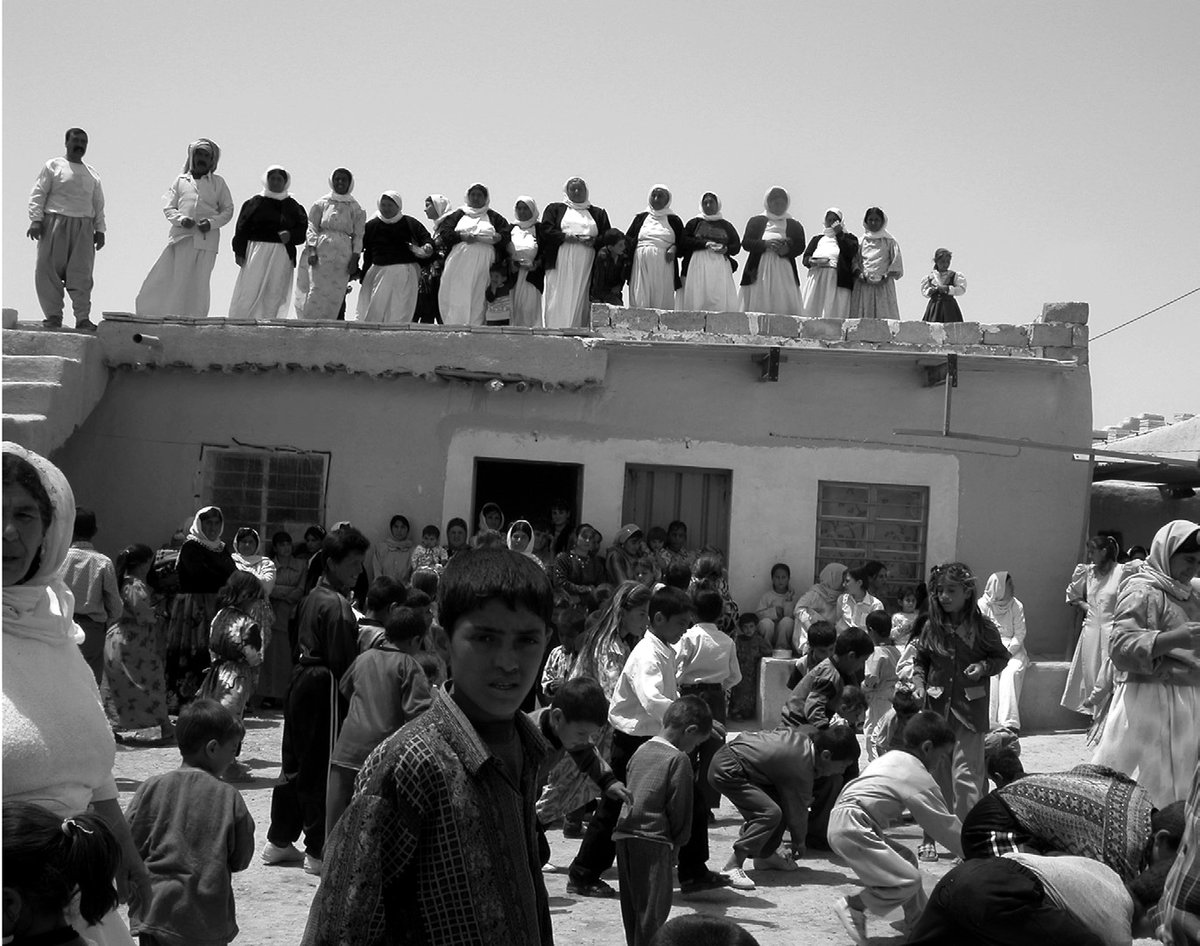
The bridegroom stood with his friends on the roof above the front door; the Birazava held the decorated wedding tree Dara Mirazê. The bride was received with volleys of gunfire, and the bridegroom's mother danced the dance Tringî before her with ladle and bowl. At the threshold the bride stamped on a plate. The bridegroom threw an apple from the roof at her head – as a sign that he had found his chosen one and that the wedding was valid. The Birazava shook sweets from the tree, friends threw copper coins, which the children collected.
In the evening the round dance (Govend) was danced in the largest sheepfold. The master of the wedding gave the bride two gold coins and unveiled her face, which until then had been covered with a red silk cloth. The wedding lasted three days and three nights; on the last day the gifts were announced.
Differences between the sources
- Dara Mirazê: According to Perminov (ezidy2), the Birazava carries the little tree decorated with a cloth through the rows of guests, who put money into it. In Polatov he holds it on the roof at the reception of the bride and shakes sweets down from it. Presumably these are forms from different periods and regions.
- Apple: Perminov considers the apple throw a borrowed custom, because according to Ezidi tradition wheat and not an apple led to the expulsion from paradise. Polatov describes it for the Sîpkî around 1900 as a fixed part of the wedding that indicated its validity.
A wedding in Başîqa in 1850
An early eyewitness account of an Ezidi wedding in Şêxan is given by the British archaeologist A. H. Layard. Qewal Yûsif had invited him in 1850 to the wedding of his niece in Başîqa. Layard arrived on the second day of the celebration.
- Reception: Qewal Yûsif rode out to meet Layard with the respected men of the village, followed by many people on foot and by music; children brought lambs as gifts.
- First day: Before the customary witnesses the families concluded the marriage contract, amid rejoicing and dances.
- Second day: The bride, surrounded by the festively dressed villagers and by Qewal with their instruments, was led to the bridegroom's house. She was thickly veiled from head to foot and remained behind a curtain in the corner of a darkened room. There she stayed until the guests had celebrated for three days; only then was the bridegroom allowed to go to her.
- Dance: In the courtyard there was dancing all day and almost all night; the joyful cries of the women and drum and pipe could be heard.
- Third day: Friends fetched the bridegroom early in the morning and led him in triumph from house to house; in each he received a small gift. Then he stood in the circle of the dancers, and guests and spectators stuck moistened small coins on his forehead. Whatever fell down was caught by his companions in an open cloth under his chin.
- Ransom: Afterwards young men from the bridegroom's retinue rushed into the crowd, carried off the richest guests and locked them in a dark room until they paid a ransom. The money went to the dowry of the young couple.
Polatov describes similar ransom customs for the Sîpkî around 1900 (see above).
Marriage rules according to Qewal Yûsif (1849)
In conversation with Layard in 1849 Qewal Yûsif named some rules, which Layard reproduces:
- Strictly speaking, only one wife is allowed; the Mîr takes several.
- A wife may be repudiated only for serious misconduct, in fact only for adultery. The husband may then remarry with the consent of the Şêx, the repudiated wife never. Formerly, when the Ezidis still applied their own secular laws, adultery by the wife had been punished with death.
- The clergy should not marry outside their estate. The men did not keep to this quite strictly, but women were never married to anyone outside the religious estate.
- The Mîr should take his wife from the Çol Beg family.
On marriage rules in general see Family and the position of women and Caste system.
Other customs
In her study of laments for the dead (1982), M. B. Rudenko names some wedding customs of the Ezidis of Transcaucasia:
- Henna: Bridegroom and bride dye their palms and nails with henna. “To die with bridegroom's henna on one's nails” means to die as a bridegroom.
- Nîsar (“strewing”): The bridal couple and guests are showered from trays with sweets, nuts, fruit and small coins – a sign of prosperity in the new home.
- Zeyî: Half a year to a year after the wedding the young wife returns to her parental home for some time; after one or two months her husband fetches her. The custom and the young wife are called zeyî.
- Farewell songs: The wedding includes lyrical songs (dilok) about the bride's farewell from her family. Similar songs are sung at the burial of young unmarried people (see Lament for the dead).
Additions according to Omarkhali (2005)
- Şar: Before the bride leaves her parental home, a red or white cloth (şar) is symbolically tied around her waist three times and untied again.
- Dara Miraza: Omarkhali describes a third form of the wedding tree: a little tree is hung with jewelry, fruit and sweets, all the guests dance around it and put money into a red scarf tied to it; then the tree is shaken over the heads of the bridal couple – an image of happiness, prosperity and a “sweet” life. The responsible Şêxê Dara Miraza is regarded as the patron of lovers and newlyweds.
- On the marriage rules (who may marry whom) see Family and the position of women.
On the clothing of bride and bridegroom see Traditional clothing.
Wedding in Şengal according to Lescot (1936)
Roger Lescot describes the wedding (zewicî) among the Ezidis of Şengal according to the information of his informants; he did not see a wedding himself.
- Age and marriages: Boys married from about 15, girls from 12–13 years. The informants gave different answers as to whether a man could have several wives; rich chiefs in Şengal had at most two. Remarriage was allowed.
- Bride price: The bride price (next or siyag) was negotiated by the fathers; it had to be paid before the wedding. On the rates among the Semmoqa, exchange marriage and bride abduction see Law and custom in Şengal.
- Preparation: The future mother-in-law gave the bride about 100 Medjîdiyye for the trousseau. Respected people were invited with gifts.
- Time: People mostly married at the time of the fig harvest, never in April. In Şengal this was explained thus: in April nature renews itself, and its purity must not be clouded. According to Îsmayîl Beg, the prophets marry in April.
- Fetching the bride: On the morning of the wedding the Şêx and P’îr with the bridegroom's friends fetched the bride. She rode, the Şêx and P’îr held the reins, young men formed chains, people sang and fired into the air. The procession first visited the Şêx and P’îr – their wives received gifts – and then went to the husband's house.
- Blessing and celebration: The bridegroom saw the bride only in the night. The Şêx and P’îr blessed the marriage and gave a sheep or a goat respectively. The celebration took place at the faction leader's (mehqûl) with food, coffee, music and dance, for several days up to a week; the guests brought food with them. The bride gave her mother-in-law a dress.
Compared with the descriptions from the Caucasus, it is striking that in Şengal the Şêx and P’îr fetch the bride themselves and lead the procession.
Additions according to Tagay and Ortaç (2016)
Şefik Tagay and Serhat Ortaç describe the marriage customs above all with regard to the Ezidis from Turkey and in Germany.
Marriage and choice of partner
- Monogamy: Monogamy is customary. Several wives are not expressly forbidden but very rare; in the diaspora they practically do not exist (p. 81).
- Arranged marriages are still customary in the regions of origin, in the diaspora the exception (p. 81).
- Marriage ceremony: According to Tagay and Ortaç, the marriage is usually performed by a Pêşîmam; it can also be performed later and is not a compelling precondition for the marriage to be recognized (p. 82).
- Time: No weddings take place in April, the holy month, and on Wednesday, the holy day (after Issa 2007, p. 82). Lescot also names the prohibition for April for Şengal (see above).
The decision of Lalîş in 1929
On May 12, 1929 the Religious Council in Lalîş passed a resolution on marriage (Tagay/Ortaç after Maisel 2005, p. 81):
- The minimum age for girls was raised from 12 to 15 years.
- No pressure was to be exerted in the choice of partner; the promise of marriage was to be voluntary.
- The clergy were to ensure its implementation.
Lescot still gives for Şengal in 1936 a marriageable age of girls from 12–13 years (see above). To what extent the resolution was followed in the individual regions is not clear from the sources.
Divorce
Marriage is regarded as a lifelong bond. According to Tagay and Ortaç, divorce is possible only for serious reasons – such as infidelity, domestic violence or neglect of marital duties (p. 82):
- First relatives, friends and clergy try for a long time to mediate between the spouses.
- If this fails, the divorce is carried out symbolically.
- Both may then remarry; custody of the children is negotiated case by case.
Bride price in the diaspora
In the old homeland the bridegroom's family paid a rather symbolic gift in kind; in the diaspora very high sums of money are often demanded today. The bride price has been controversial among the Ezidis in Germany for decades: a large part rejects it, a conservative minority holds on to it, also because it is supposed to protect against quick divorce (p. 133–134). On the marriage questions of the younger generation see Ezidis in Germany.
Discrepancies with other sources
- Who performs the marriage: According to Perminov (above), the marriage rite Mar birîn may be performed only by a Şêx of the Şêxsin lineage; Tagay and Ortaç name the Pêşîmam as the usual officiant. Possibly the two describe different communities.
- Divorce and remarriage: According to Qewal Yûsif (1849, above), a repudiated wife could never remarry; according to Tagay and Ortaç (2016), after a divorce both sides may marry again.
- Wednesday: Only Tagay and Ortaç name Wednesday as a day without weddings.
Wedding according to Layard (1846)
According to the Qewal whom Layard questioned in 1846, the bride and bridegroom appear before a Şêx, who establishes the consent of both sides. The bride receives a ring or money. The celebration lasts one day with sherbet and dance. Layard thought that there was no actual religious ceremony; that is his observation and does not agree with later sources (see Mar birîn above).
Wedding in Şêxan and Şengal around 1940 according to Drower
In 1940 E. S. Drower had the course described to her above all by Mîra Wansa and supplemented it with her own observations in Başîqa and Bacidrê (Peacock Angel, 1941, with an appendix on wedding customs).
Courtship and contract
- The parents arrange the marriage and usually know the wishes of the children. The father asks the daughter; silence counts as consent, she may refuse.
- The bridegroom's father goes with a Şêx and a P’îr to the bride's father. The bride money (nexd) is agreed; for families of middling status it averaged 40 dinars in 1940, but it could be very high.
- The Şêx writes and seals the contract and speaks prayers of blessing. At every wedding a Şêx of the Şêx Hesen lineage should be present. The Şêx gives the bride earth from Lalîş; she gives him and the P’îr money or a sheep or a goat.
- Between the contract and the bringing home of the bride, days or years may pass. In the month of Nisan (April) no weddings take place.
Preparation
- Two days before the wedding the bride takes a hot bath and afterwards wears only white.
- The next day the hands of the bride and of all her girlfriends are dyed with henna. The henna bowl goes through the village, and the women put money into it.
- On the day before, the young people ride from the bridegroom's village to the bride's village – the girls three or four together on mules, the young men on horseback, singing and shooting.
Bringing the bride home
- At four o'clock in the morning the bride is dressed. That the bride and her mother weep is regarded as a good sign and as protection against the evil eye.
- The bride wears a red veil. A man from the village who is neither Şêx nor P’îr leads her horse. The boys of the bride's village pelt the young men with pebbles, these throw coins back; on leaving the village the Muxtar receives money.
- Her belt with the large silver buckle may be fastened only by her “sister of the hereafter”.
- On arrival the mother-in-law throws sugar, sweets and flowers from the roof. The bride smashes a jug of sweets at the threshold, steps over the shards and over the blood of a sheep slaughtered before her. There is a mock fight over the bridegroom's headdress.
The seven days
- The Şêx and P’îr hang up a curtain (sitar); behind it the bride remains silent for seven days. She may not walk over running water; in Bacidrê it was said that for seven days she sees “no sun”.
- On the day of arrival the bridegroom stays away with his “brother of the hereafter”. If the bride arrives on a Tuesday, the wedding night takes place only in the night before Wednesday at midnight.
- During the seven days there is dancing to flute and drum, in the mornings until ten o'clock and in the afternoons until midnight.
- Not allowed near the bride are: menstruating women, women from a house of mourning and women who have given birth before their bath on the 40th day.
- After seven days the bride bathes. Then a porridge of dates and seven grains (among them wheat, lentils, oats, beans, broad beans and peas) is cooked without fat. The bride throws seven handfuls of it into running water, crosses it and eats with her girlfriends. Oleander flowers are put into the turbans.
Rules
- Marriages between the castes were forbidden. In Başîqa in 1940 a couple who wanted to marry against this rule fled under police protection.
- Hair is not thrown away, so that no one treads on it; only in a bride's first night is it stuffed into cracks in the wall as protection against magic.
- On the “sister” and the “brother of the hereafter”, who play a role at wedding and birth, see Brother of the hereafter.
Wedding in Armenia according to the 9th-grade textbook
The Ezidi 9th-grade textbook (T’amoyan et al., 2012) describes the wedding as it was customary in Armenia about 50–60 years ago:
- Courtship: Young people got to know each other at festivals. The young man's parents went to the girl's father (“We have come to ask for your kinship”); the mother asked the daughter through a sister or sister-in-law. After the consent (soz) a pledge was sometimes given at once (nîşanîk: jewelry or a cloth).
- Engagement (nîşankirin): An older woman or the young man's mother brought the ring. The bridegroom visited the bride with gifts (xişir); on feast days the bride received gifts (sertêdan); in the bride's house there was the şîranî. The bride price (qelin) was abolished in the Soviet period (cf. The assembly on Aragats 1923), a gift to the bride's family (navqelin) remained. Weddings mostly took place in autumn.
- Eve: Invitation with t’opayî (usually a bottle); Def in the bridegroom's house, slaughtering; the bridegroom's tree (dara ze’vê), an apple or apricot branch decorated with fruit, was carried around with music. There were groomsmen (biraze’va, unmarried young men) and a master of ceremonies (serde’watî).
- Fetching the bride: A forerunner (r’ûvî) was allowed to “steal” a chicken or lamb secretly in the bride's house; if he failed, he was mocked with flour and water. The bridegroom and his mother stayed at home. The dowry (cihêz) was displayed and announced; the couple's pillow was “sold” to a young rider. No one from the bride's house accompanied the procession. A woman (berbû) led the bride.
- Arrival: The bridegroom and groomsmen stood on the roof with the tree and pillow; the bridegroom threw three apples at the bride, the children got the sweets from the tree, and the tree stayed on the roof until it fell apart. The mother-in-law received the bride with a spindle and laid a flatbread (loş) on her shoulder; the bride sat behind a curtain (p’erde).
- Afterwards: Visit to the bride's family with gifts (serşûştin); the marriage rite me’rbir’în could be performed only by a Şêx of the Şîxisinî, without it the marriage was not considered h’elal (cf. Mar birîn above); the bride's parents took their daughter home for a time (zêyî); after a year the parental home sent a calf or a ram (şikart).
In the village of Bendemûrad (Surmelî) people used to invite to a wedding with a red apple (sêva sor) (textbook grade 8; see Greetings and rules of conduct).
Marriage rules according to Hesenê Şêx Kelaşê (1995)
- An Ezidi marries only an Ezidi (“Xûna êzdiya ji êzdiya ye”). Marriage with outsiders is a sin.
- Şêx, P’îr and Mirîd do not intermarry. The three Şêx lineages – Şêxûbekir, Şems and Şêxsin – also do not intermarry. That is “as great a sin as if an Ezidi took a Muslim woman”; a Şêx who violates this is excluded from the people. There is also no marriage between some P’îr lineages (named are H’ezmemman, Îsebiya, Omer Xala, Merqewesa, K’emala, Mamê Şivana and others).
- The father must have Me’r and Nik’ah cut for the bride and bridegroom by a Şêx of the Şêxsin lineage. Without Me’r a couple is not regarded as lawfully married before the Mala Xwedê, and their children are called “bîjenek”.
Source: Hesenê Şêx Kelaşê, Rê-rizma mileta Êzdî angorî qirarê dîn, Şamîran 1995. The author supports almost every rule with a stanza from a Qewl or Beyt.
Sources
- Һ'әсәне Шех К'әләше (Hesenê Şêx Kelaşê, Hesen Hesenyan): Р'е-р'ьзма мьләте Эзди ангори qьраре дин (Rê-rizma mileta Êzdî angorî qirarê dîn). Şamîran 1995 (scan and new text edition in the EZDIKI.COM library), p. 39–41
- Birgül Açıkyıldız: The Yezidis. The History of a Community, Culture and Religion. London 2010, p. 113 (ill.)
- A. V. Perminov: Езиды – древний народ Адаби (The Ezidis – the ancient people Adabi). Sharya 2016, p. 101–103
- S. M. Polatov: Дети Солнца (Children of the Sun). Rybinsk 2011, p. 124–128
- M. B. Rudenko: Обрядовая поэзия – Похоронные причитания (Ritual poetry – funeral laments). Moscow 1982, p. 14, 54–55, 122–124, 128
- Khanna Omarkhali (Ханна Омархали): Йезидизм. Из глубины тысячелетий (From the depths of the millennia). Saint Petersburg 2005, p. 68, 152
- Ordîxanê Celîl, Celîlê Celîl: Zargotina K’urda, Part 2. Moscow 1978, p. 487
- Roger Lescot: Enquête sur les Yezidis de Syrie et du Djebel Sindjār (Study of the Ezidis of Syria and of the Şengal mountains). Beirut 1938, p. 149–154
- Austen Henry Layard: Discoveries among the Ruins of Nineveh and Babylon (abridged edition). New York 1853, p. 82–83, 171–172
- Şefik Tagay, Serhat Ortaç: Die Eziden und das Ezidentum. Geschichte und Gegenwart einer vom Untergang bedrohten Religion. Hamburg (Landeszentrale für politische Bildung) 2016, p. 81–82, 109, 133–134
- Austen Henry Layard: Nineveh and Its Remains, Vol. 1. London 1849, p. p. 301 (PDF 354)
- E. S. Drower: Peacock Angel. Being some Account of Votaries of a Secret Cult and their Sanctuaries. London 1941, p. p. 17–23, 40, 86, 186, 207 (PDF 30–36, 55, 109, 227, 248)
- E’zîzê E’mer, H’esenê Şêx-Me’mûdê: E’debyet û zimanê êzdîkî, grade 8. Yerevan: Spîka 2011, p. p-015
- H’esenê Şêx-Me’mûdê, E’zîzê E’mer: E’debyet û zimanê êzdîkî, grade 9. Yerevan: Spîka 2012, p. p-013–019
Found a mistake?
Is something wrong – a fact, a spelling, a source, an image? Let us know: we check every report and correct the article.
Other spellings: Mar birin · Dara Miraze · Sheikh · Scheich · Shex · Qers · Bashiqa · Baschika · Shekhan · Scheichan · Shaikhan · Qawwal · Kawal · Kewal · Emir · caste system · Sinjar · Sindschar · Shingal · Shengal