
Germany today has one of the largest Ezidi communities outside the old homeland. It is particularly diverse: Ezidis from Turkey, Iraq, Syria and Iran live here as well as Ezidis from Armenia and Georgia. The first sections reflect the state of the sources around 1990–2005; from the section “Waves of immigration according to Tagay and Ortaç (2016)” onward follow additions from the book by Şefik Tagay and Serhat Ortaç, two Ezidis who in 2016 headed the Society of Ezidi Academics.
Immigration
- From Turkey: at the latest in the 1980s, Ezidis from eastern Turkey were working in the then Federal Republic. John S. Guest, who wrote in the mid-1980s, knew villagers from eastern Turkey who lived in West Germany, and estimated the Ezidis in Turkey at about 10,000, some of whom worked in West Germany. According to Karam Ankosi, they came as whole tribes or as individual families; their villages in Turkey remained empty. Many still possess land register deeds for land in the homeland.
- From the South Caucasus: after the end of the Soviet Union in 1991, Ezidis from Armenia and Georgia moved to Germany, France, Belgium and the Netherlands, among other places (according to Khanna Omarkhali). As the main reason, besides social insecurity, Ankosi names concern for the preservation of the faith.
- Residence: according to Ankosi (2004), Ezidis from Turkey, Iran and Syria obtained residence and work permits comparatively easily, while Ezidis from the former Soviet Union had great difficulties, up to and including deportation.
Figures
| Period | Information | Source |
|---|---|---|
| mid-1980s | some of the approx. 10,000 Ezidis from Turkey work in West Germany | Guest |
| 1999 | about 50,000–60,000 Ezidis in Germany | statement of German officials at the first World Congress of the Ezidis in Hanover, according to Ankosi |
According to Ankosi, the community in Germany is, after the one in Russia, the second largest outside the homeland and the most diverse in terms of its tribes. Omarkhali (2005) gives no figure for Germany. A figure in E’zîz T’amoyan’s memorial volume is not fully legible in the surviving text and is not reproduced here.
Places of residence
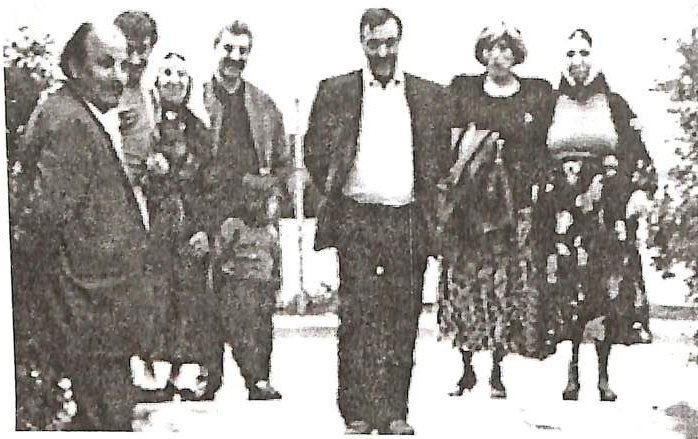
- According to Ankosi, the Ezidis live in groups almost everywhere in Germany, most of all in the Hanover and Bielefeld areas. He carried out his own surveys in 1990 and 1991 mainly in Celle and its surroundings, where the Anqosî tribe was particularly numerous.
- Omarkhali names as places of compact settlement Berlin, Bremen, Hanover, Gießen, Oldenburg, Frankfurt am Main and Celle with the neighboring town of Wietze.
Community life
- In Oldenburg there is the “Ezidi House” (Mala Êzdiyan). According to Omarkhali, its founders included the P’îr Xidir Silêman, who collected Ezidi religious texts in northern Iraq and published teaching booklets.
- The historian Eskerê Boyîk from Armenia has lived in Oldenburg since 1993; since 1999 he has headed the cultural committee of the Mala Êzdiyan.
- According to Guest, as early as the 1980s the Qewal – the singers of the hymns who travel through the communities with the holy Sancaq figures – also visited the Ezidis in West Germany.
- In 1999 the first World Congress of the Ezidis took place in Hanover.
Tribes
The tribes of the Ezidis from Turkey who live in Germany – with the Şerqî and Xaltî confederations – are listed in the article Tribes of the Ezidis in Germany. In his book Ankosi also calls for a pan-Ezidi religious center in Europe, for example in Germany; that is his opinion.
Waves of immigration according to Tagay and Ortaç (2016)
Tagay and Ortaç distinguish several waves (p. 92):
| Period | Origin | Occasion |
|---|---|---|
| end of the 1960s | Turkey | recruitment as guest workers (recruitment agreement with Turkey of 1961, p. 7) |
| 1980s | Turkey | a veritable wave of flight after the military coup of 1980 – persecution as a non-Muslim minority by Muslim neighbors, without protection by the state (see Ezidis in Turkey) |
| 1990s | Iraq, Syria | increasing immigration |
| after 1991 | Armenia, Georgia, Russia, Ukraine | end of the Soviet Union |
| after 2003, 2011, 2014 | Iraq, Syria | Iraq War, Syrian civil war, genocide in Şengal from 3 August 2014 |
At the end of the 1990s only a few hundred, mostly older Ezidis still lived in Turkey. Because the groups came at different times, they are at different points of integration (p. 92).
On the dating: the older sources above attest Ezidi workers from Turkey “at the latest” for the 1980s; Tagay and Ortaç date the beginning more precisely to the end of the 1960s.
Asylum and right of residence in the 1980s
- In the 1980s German administrative courts in asylum proceedings and politicians dealt with the reasons why the Ezidis from Turkey had fled (pp. 92–93).
- In 1989 the Interior Minister of North Rhine-Westphalia, Herbert Schnoor, traveled to Turkey. Among other things he found that land belonging to the Ezidis was deliberately destroyed or transferred to Muslim neighbors and that they had to hide their religion (pp. 93–94; details under Ezidis in Turkey).
- After his return Schnoor issued a deportation ban for Ezidis from Turkey for North Rhine-Westphalia and campaigned nationwide for a permanent right of residence (p. 94).
- The orientalist Gernot Wießner wrote numerous religious-studies expert opinions in asylum proceedings. According to Tagay and Ortaç, he thereby contributed decisively to the Ezidis from Turkey being recognized as victims of a religiously motivated group persecution and receiving the right of residence. He was one of the first European researchers to carry out systematic field research in the Ezidi areas (p. 94).
- Until the end of the 1980s the first generation lived in constant fear of deportation. Only after recognition as “group-persecuted” did the Ezidis begin to deliberately build their future in Germany; the first communities and associations came into being (p. 96).
Places of residence according to Tagay and Ortaç
Most Ezidis live in Lower Saxony and North Rhine-Westphalia, others in Hesse and Berlin (pp. 30, 95). Main areas are (p. 95):
- the greater Hanover and Celle area, Oldenburg and Bremen,
- East Westphalia, above all Bielefeld, Detmold and Herford,
- the Lower Rhine, above all Emmerich, Kleve, Goch and Kalkar,
- Gießen, Frankfurt am Main and Berlin.
Through the more recent immigration from Syria and Iraq, smaller communities have come into being above all in southern Germany (p. 96). According to the authors, the community in Celle is the largest in Germany (p. 138).
Figures compared
There is no official count of the Ezidis. The figures differ greatly:
| Year | Number | Source |
|---|---|---|
| 1999 | about 50,000–60,000 | statement of German officials, according to Ankosi (2004) |
| around 2005–2010 | about 25,000 | Açıkyıldız (2010, p. 46) |
| before 2014 | about 190,000 | Kunze/Sedik/Becker (2019), according to Krimmer (2020) |
| 2016 | about 100,000 (“realistic”) | Tagay/Ortaç (p. 30) |
According to Tagay and Ortaç, the community in Germany is thus the largest diaspora community of the Ezidis worldwide (pp. 7, 24, 30); Ankosi, by contrast, saw it in 2004 in second place after the one in Russia. Whether the difference between 50,000–60,000 (1999) and 100,000 (2016) is due solely to the immigration after 2003 and 2014 and to births, or to different methods of estimation, cannot be decided from the sources.
The figure of 190,000 “before 2014” is almost twice as high as Tagay and Ortaç’s estimate for 2016; the cited work does not say what it is based on. An expert interviewed by Krimmer gives 150,000–200,000.
The Baden-Württemberg special quota (2014–2016)
After the genocide of 2014, the state of Baden-Württemberg admitted particularly vulnerable women and children from northern Iraq. The information follows the master’s thesis of Anna Maria Krimmer (Innsbruck 2020), which relies on the account by Kunze, Sedik and Becker (2019).
- Decision: on 13 October 2014 the state, in agreement with the Federal Foreign Office, decided to admit 1,000 women and children. Lower Saxony and Schleswig-Holstein joined with 100 further places.
- Who came: the majority were Ezidi women and their children, among them many who had been in IS captivity; Christian women and some Muslim women were also admitted. 70% of those admitted were younger than 20.
- Selection: project leader Michael Blume, Jan Ilhan Kızılhan and an employee of the visa office selected the women in northern Iraq. Criteria were the severity of the traumatization, the duration of captivity, medical reasons and the question of whether protective family structures existed.
- Cooperation: the program was run in coordination with the High Council of the Ezidis and the government of the Kurdistan Region.
- Entry: from March 2015 to January 2016. 19 municipalities provided accommodation.
- Health: in an accompanying study, 92.7% of the women interviewed (116 respondents) showed signs of post-traumatic stress disorder in 2017, and 94.7% (96 respondents) in 2018 (according to Denkinger et al. 2019).
- Follow-up project: in 2017 the state, the University of Tübingen and the Baden-Württemberg Cooperative State University founded an Institute for Psychotherapy and Psychotraumatology in Duhok; the first master’s cohort (28 students, among them six Ezidis) graduated in November 2019.
According to Krimmer, there were similar admission programs in Canada and Australia. The edited volume by G. M. Tezcür (2021) also highlights the special quota (Tezcür et al. p. 86).
Additions according to Tezcür (ed.) 2021
- According to Tutku Ayhan, Germany is the largest Ezidi diaspora; the majority of the Ezidis there come from Turkey (p. 171).
- On 7 February 2015 the association Eziden Weltweit (EWW) was founded in Germany (Ali p. 57 n. 60; see Ezidi organizations).
Education and social advancement
- The first generation, mostly from Turkey, had usually lived from agriculture in the homeland; only a few had attended school, most women could not read and write, and hardly any had vocational training (p. 96).
- Many parents said, in essence, that their children should get the education that had been denied to them. In the 1980s the Abitur (university entrance qualification) was an exception in an Ezidi family; in 2016 usually at least one child per family is studying (p. 97).
- In the homeland the Ezidis often had to hide their religion; in Germany this is no longer necessary, and many are grateful for this (according to Wießner, p. 97).
- In the European diaspora all castes have the same educational opportunities; according to the authors, most Ezidi academics today are Mirîd (p. 100).
- The Ezidis who have lived here longer help the newcomers from Iraq and Syria (p. 98).
The generations
According to Tagay and Ortaç, in 2016 the fourth generation already lives in Germany (pp. 107–108):
- First generation: pronounced piety, little schooling, often little knowledge of German even after decades; it was not prepared for a pluralistic society (pp. 107, 145).
- Second generation: according to Wunn (2009), holds on to customs whose meaning it no longer knows itself (p. 145).
- Third and fourth generation: more individualistic, well educated, very good language skills, considerably lower religiosity; they question rules and rites, and the standing of the father as head of the family is waning (pp. 107–108).
According to the authors, a survey with the “Ezidi Identity Inventory” (see Self-understanding after 2014) shows that younger people in particular view the marriage rules and the caste system critically (pp. 133–135).
Marriage in the diaspora
- The generational conflict is sharpest over marriage: young Ezidis want to know why they may not marry non-Ezidis, and are no longer willing to marry partners chosen by their parents. The commandment to marry only among Ezidis is beginning to waver especially in the third and fourth generation; among the newly immigrated Ezidis from Syria and Iraq it is hardly questioned (p. 109).
- Bride price: in the old homeland the groom’s family paid a rather symbolic gift in kind; in the diaspora very high sums of money are now demanded. The bride price has been disputed for decades; a large part rejects it, a conservative minority holds on to it (pp. 133–134).
- Şêx and P’îr find it particularly difficult in the diaspora to find a partner from their own group; increasingly there are calls to at least lift the marriage barriers between the three Şêx groups and the four P’îr groups (p. 149).
See also Wedding and Family and the position of women.
Cemeteries
- In the two decades before 2016, Ezidi communities set up their own sections in municipal cemeteries, for example in Wesel; in some cities the graves are even separated by caste (pp. 83–84).
- Many families continue to have their dead transferred to the homeland – at high cost (p. 83).
- Unlike in Turkey, graves in Germany are decorated: with pictures of the peacock or of Lalîş, the inscription “Êzîdî” and sometimes the caste affiliation (p. 84).
- German cemetery administrations do not permit the custom of widows cutting off their hair and hanging it on the grave. The washing of the dead is usually carried out by a Şêx instead of the brother or sister of the hereafter; a burial on the day of death itself is hardly possible (pp. 83–84).
See Burial and mourning and Gravestones.
Associations and umbrella organizations (as of 2016)
Since the beginning of the 1990s cultural associations, communities, magazines and their own television channels have come into being (p. 138). The community centers serve for feasts, encounters, ritual washing of the dead and lamentation as well as for educational offerings. According to Tagay and Ortaç, only in the diaspora were the Ezidis able to come together across the boundaries of states of origin and tribes (p. 138).
| Federation | Information according to Tagay/Ortaç (pp. 138–140) |
|---|---|
| Federation of Ezidi Associations in Germany e. V. (Federasyona Komeleyên Êzdiyan, FKE) | largest federation, over 15 member communities, predominantly Ezidis from Turkey |
| “Zentralrat der Yeziden in Deutschland” (own name) | smaller number of communities, likewise predominantly from Turkey |
| a federation founded in 2014 | represents predominantly Ezidis from Iraq (name not given in the book) |
| Society of Ezidi Academics e. V. (GEA) | according to the book the world’s largest Ezidi association of academics; has held a scientific conference every two years since 2012 (pp. 24, 140) |
In 2016 several independent communities were planning a fourth umbrella organization. Membership often depends on region of origin and political orientation; no federation represents all or the majority, there are no full-time staff, and because of political differences the federations hardly cooperate (pp. 139, 144).
After the genocide of 2014 the question of one’s own ethnic affiliation also gained weight in Germany (p. 139) – see Self-understanding after 2014.
Aims of the community (as of 2016)
Tagay and Ortaç name as concerns (pp. 140–141, 188):
- state recognition as a religious society,
- teaching about the Ezidis as a university subject,
- religious instruction and the transmission of knowledge for children and young people, reduction of prejudice,
- a written codification of the religious teachings and customs, for which, they say, there is broad consensus,
- the construction of a central Ezidi temple for all Ezidis in Germany on the model of the temple in Tiflis.
Sources
- Karam Ankosi: Племена езидов на Южном Кавказе и в Германии (The tribes of the Ezidis in the South Caucasus and in Germany). Tbilisi 2004, p. 71–73
- Khanna Omarkhali (Ханна Омархали): Йезидизм. Из глубины тысячелетий (From the depths of the millennia). Saint Petersburg 2005, p. 23, 28–29
- John S. Guest: The Yezidis. A Study in Survival. London/New York 1987, p. 11, 118, 247
- Eskerê Boyîk: Bi Kurtayî Dîroka Êzidiyên Ermenistanê (A short history of the Ezidis of Armenia). Diyarbakır 2016, p. 6
- Şefik Tagay, Serhat Ortaç: Die Eziden und das Ezidentum. Geschichte und Gegenwart einer vom Untergang bedrohten Religion. Hamburg (Landeszentrale für politische Bildung) 2016, p. 7, 24, 30, 83–84, 92–109, 133–149, 188
- Birgül Açıkyıldız: The Yezidis. The History of a Community, Culture and Religion. London 2010, p. 46
- Anna Maria Ute Krimmer: Sequenzielle Traumatisierung von Êzîd_innen infolge des Genozids. Eine qualitative Studie. Master’s thesis, University of Innsbruck 2020, p. 27, 32–36
- Güneş Murat Tezcür (ed.): Kurds and Yezidis in the Middle East. Shifting Identities, Borders, and the Experience of Minority Communities. London: I.B. Tauris 2021, p. Ali p. 57 n. 60; Tezcür et al. p. 86; Ayhan p. 171
Found a mistake?
Is something wrong – a fact, a spelling, a source, an image? Let us know: we check every report and correct the article.
Other spellings: Deutsdschhland · Deutsjhland · Dschelle · Jelle · Diaspora in Deutsdschhland · Diaspora in Deutsjhland · Serhed · Serhad · Pîr · Qawwal · Kawal · Kewal · Sinjar · Sindschar · Shingal · Shengal · Singal · Dohuk · Dahuk · Dihok