
The family – the circle of close relatives – is the most precious thing for Ezidis. Families often come together, eat together, sing and discuss their plans.
The position of women
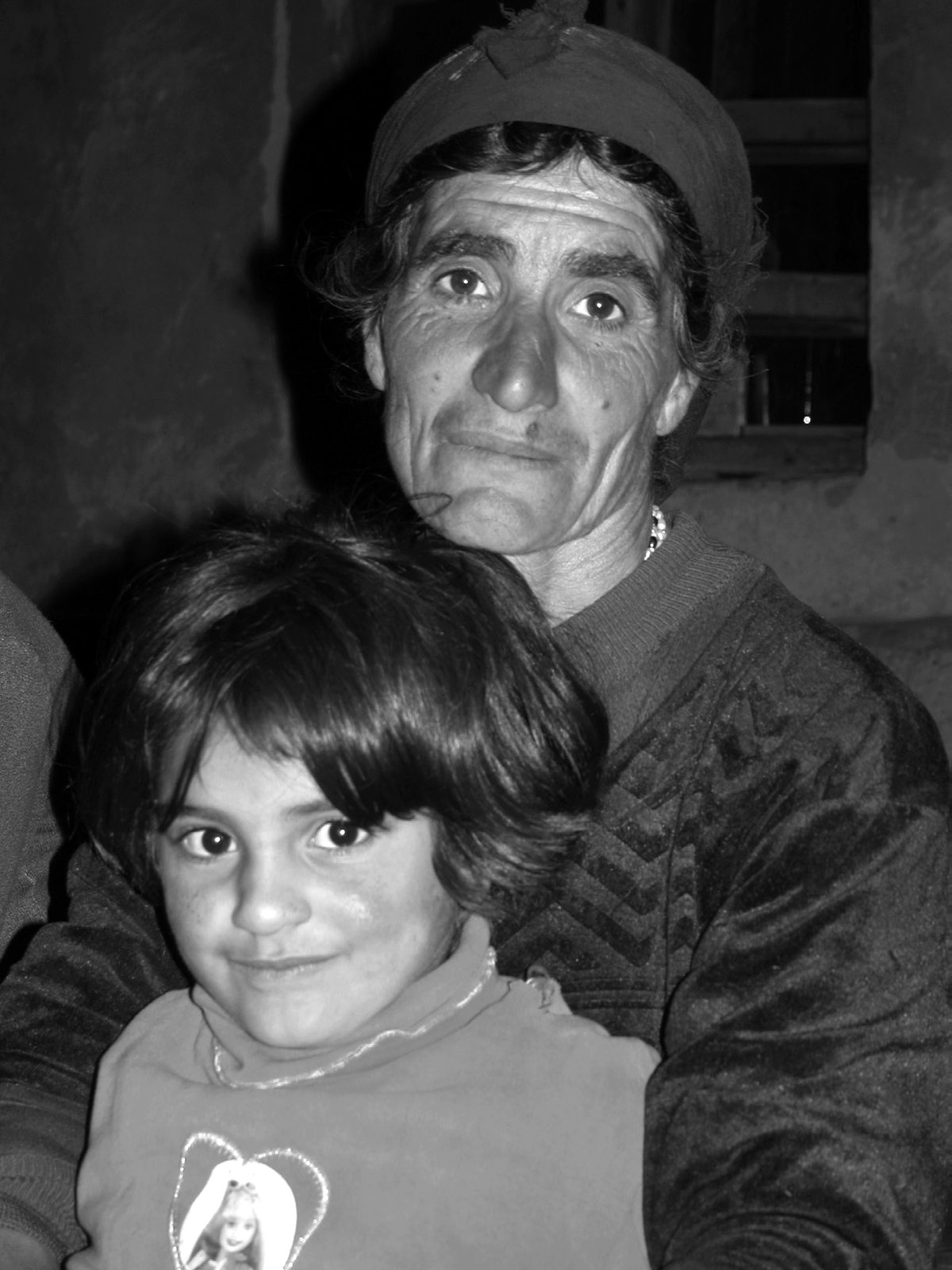
The Ezidi woman has always played a great role: as mother and wife, but also as a fighter at the side of her father, brother, husband and son. Ezidi women did not wear a veil and went about with their faces uncovered. Travelers of earlier centuries often noted that Ezidi women had greater freedoms and rights than women in their surroundings.
The peacock in the house
Almost every Ezidi family owns an object with the image of a peacock – a figurine, a carpet or a picture. There is also jewelry with a peacock motif: earrings, rings and bracelets. The peacock is the sign of the archangel Tawûsî Melek.
Marriage rules
Among the Ezidis, marriage is bound to fixed rules. They are part of the three basic rules and ensure that the people and its castes are preserved over generations. The following information is based mainly on Khanna Omarkhali (2005).
The principles
- Only among Ezidis: A marriage with people of other faiths is considered one of the three mortal sins. Since no one can become an Ezidi, marriages with members of other peoples are thus also excluded.
- Only within the caste: Şêx, P’îr and Mirîd marry only among themselves. Everyone is born into their caste; both parents must be Ezidis and from the same caste, a change is impossible.
- Punishment: According to Omarkhali, whoever violates these rules is excluded from the community.
- Descent: Belonging to the people and to the caste comes from both parents; belonging to the clan, by contrast, only from the father, to sons and daughters alike.
Further rules within the castes
Within the castes there are additional marriage prohibitions:
| Group | Rule |
|---|---|
| Şêx | Marriages only within one of the three lines Adanî, Şemsanî and Qatanî, not between them |
| Şêxê Reş / Cindîyar (Şêşims line) | Marriages only within the Cindîyar family, not even with the rest of the Şêşims line |
| P’îr | Marriages between the P’îr clans permitted, but not with the house of Hesmeman; its members marry only among themselves |
| Mirîd | Marriages between all Mirîd clans permitted; exception: women of the Yeknavî clan, from which the Qewal (singers of the hymns) come, marry only Yeknavî men, while Yeknavî men may marry any Mirîd woman |
E’zîz T’amoyan, too, emphasizes in his memorial volume that the subgroups of the Şêx may not intermarry and that this prohibition has been in force for centuries up to the present day.
Knowledge of the ancestors
According to Omarkhali, most Ezidis can list the names of at least ten generations of their ancestors and know exactly which tribe and which clan they belong to. This knowledge partly determines a person’s position and relationships in the community. Over centuries of insecure living conditions, it also served the self-preservation of the people.
On the terms for house, clan and tribe (mal, ber, berek, qebîl, êl) see Terms of the tribal order and Tribes of the Serhed.
Additions according to Tagay and Ortaç (2016)
Marriage rules
- Only those who descend from two Ezidi parents are Ezidis; there is no conversion. Whoever marries a non-Ezidi is excluded from the community (p. 73) – in agreement with Omarkhali (above).
- Tagay and Ortaç understand endogamy as a historical protection of the community against persecution. In Europe it is sometimes viewed critically (right to free choice of partner), while at the same time there is concern that the community would perish without it; according to Kızılhan (2014), the majority of Ezidis in the diaspora are still in favor of retaining it (pp. 73–74).
- In the diaspora, Şêx and P’îr find it particularly difficult to find a partner from their own group. Increasingly there are calls to at least lift the marriage barriers between the three Şêx groups and the four P’îr groups (p. 149).
The position of women
- According to the authors, the religious texts contain no prescriptions on the division of roles between man and woman, apart from rules of decency; there is, they say, no religiously justified unequal treatment (p. 142).
- Nevertheless, women in the countries of origin did not have equal status. The authors attribute this to the patriarchal character of all communities in the region, to the isolated location of the villages and to the lack of schooling (p. 142) – that is their interpretation.
- In Turkey girls were often not sent to school, out of fear of harassment or abduction by Muslim neighbors; most women of the first generation in Germany therefore could not read and write (p. 96).
- In Germany: Women of the third and fourth generation increasingly reject the traditional roles. Families who already came as guest workers in the 1970s have moved closer to equal rights; among newly arrived refugees from Iraq and Syria the patriarchal character is still considerably stronger (pp. 142–143).
Family and generations in the diaspora
- According to the authors, the family is part of a collectively shaped order – extended family, tribe, community – in which obedience and harmony are highly valued (pp. 103–107).
- In the diaspora the standing of the father as head of the family is waning; the third and fourth generation question rules and rites (pp. 107–108).
- The conflict between the generations is sharpest over marriage: young Ezidis are less and less willing to marry partners chosen by their parents (p. 109).
More on this in the article Ezidis in Germany.
Differing account
Above (according to Perminov and Omarkhali), the strong position of the Ezidi woman is emphasized. Tagay and Ortaç, by contrast, state that women in the countries of origin did not have equal status, even if the religion does not prescribe unequal treatment. Both views stand side by side.
Additions according to Layard, Drower and Tezcür
- Spiritual offices of women (1846): According to Layard, the hereditary spiritual offices also pass to women, who then enjoy the same respect. The wives of the Şêx wear the same insignia of office as the men and perform the same services at the sanctuary. At the feast in Lalîş the women went unveiled (see The feast in Lalîş 1846).
- Women’s work (1940): According to Drower, the women in Başîqa ground grain, worked in the fields, baked, cooked, milked, churned butter, wove, dyed, bleached, sewed and washed. The washing places at the springs were their meeting points.
- Education: Mîra Wansa is regarded as the first Ezidi woman with a school education.
- After 2014: According to Tezcür, Kaya and Sevdeen, women from Dohuk and Şêxan (for example from Şarya) became active in aid organizations; according to their interviews, openness to education and paid work for women also grew in the families from Şengal, which are considered more conservative.
Kinship terms according to the primer
The Ezidi primer for the 1st grade (T’amoyan, 2014) teaches 36 kinship terms. A selection:
| Word | Meaning |
|---|---|
| met’e | father’s sister |
| ap | father’s brother |
| xatî | mother’s sister |
| xal | mother’s brother |
| birazî / xarzî | child of the brother / of the sister (from the father’s perspective) |
| kalik, pîrik | grandfather, grandmother |
| nevî, nevîç’ir’k | grandchild, great-grandchild |
| xezûr, xasî | father-in-law, mother-in-law |
| jinap (amojn), jinxal (xalojn) | wife of the father’s brother, wife of the mother’s brother |
| kur’ape, qîzape | son, daughter of the father’s brother |
| bûk | daughter-in-law (son’s wife) |
| jinbira | brother’s wife (from the perspective of the husband’s siblings) |
| t’î | husband’s brother (from the wife’s perspective) |
| bûra, balt’ûz | brother, sister of the wife (from the husband’s perspective) |
| zir’bav, dêmar’î (jinbav) | stepfather, stepmother |
| biramak, xûşkmak | half-brother, half-sister on the mother’s side |
| malbavan | parental home of the wife |
| zêyî | married daughter (from the perspective of her parental home) |
| xinamî | the parents of the bride and groom in relation to each other |
| berdêlî | women from an exchange marriage (two men have each married the other’s sister) |
| hevalze’va | men who have married sisters |
Resolutions of 1923
At the assembly of the Ezidis on the Aragaz in August 1923, according to a newspaper report, a minimum marriage age of 15 years for girls and 18 for boys and civil registration were resolved; bride price and bride abduction were to be abolished (see The assembly of the Ezidis on the Aragaz 1923).
Sources
- H’esenê Şêx-Me’mûdê (Hasan T’amoyan), E’zîzê E’mer (E’zîz T’amoyan): Elîfba êzdîkî (primer, grade 1). Yerevan: Spîka 2014 (approved by the Ministry of Education of Armenia), p. p-084
- E’zîzê E’mer, H’esenê Şêx-Me’mûdê: E’debyet û zimanê êzdîkî, grade 6. Yerevan: Spîka 2014, p. p-042–043
- A. V. Perminov: Езиды – древний народ Адаби (The Ezidis – the ancient people Adabi). Sharya 2016, p. 106–107
- Birgül Açıkyıldız: The Yezidis. The History of a Community, Culture and Religion. London 2010, p. 29 (ill.)
- Khanna Omarkhali (Ханна Омархали): Йезидизм. Из глубины тысячелетий (From the depths of the millennia). Saint Petersburg 2005, p. 78–85, 96–101, 162–164
- E’zîz T’amoyan: The heroic deed of the Ezidi people – Ezidis in the Karabakh war (Armenian, memorial publication, Yerevan, c. 2000–2007), p. 53
- Şefik Tagay, Serhat Ortaç: Die Eziden und das Ezidentum. Geschichte und Gegenwart einer vom Untergang bedrohten Religion. Hamburg (Landeszentrale für politische Bildung) 2016, p. 73–74, 96, 103–109, 142–145, 149
- Austen Henry Layard: Nineveh and Its Remains, Vol. 1. London 1849, p. pp. 295, 302 (PDF 348, 355)
- E. S. Drower: Peacock Angel. Being some Account of Votaries of a Secret Cult and their Sanctuaries. London 1941, p. pp. 3–4 (PDF 14–15)
- Güneş Murat Tezcür (ed.): Kurds and Yezidis in the Middle East. Shifting Identities, Borders, and the Experience of Minority Communities. London: I.B. Tauris 2021, p. 89–90 (Tezcür et al.)
Found a mistake?
Is something wrong – a fact, a spelling, a source, an image? Let us know: we check every report and correct the article.
Other spellings: Tawuse Melek · Melek Taus · Taus-i Melek · Malak Tawus · Sheikh · Scheich · Shex · Pîr · Murid · Qawwal · Kawal · Kewal · Serhat · Serhad · Lalish · Lalisch · Lalesh · Bashiqa · Baschika · Duhok