
The religious poetry of the Ezidis was passed on for centuries only orally. It was carried by two groups: the Qewal, professional singers and musicians from Başîqa and Bahzanê, and the Qewlbêj, experts from the religious families and from the people, who perform the texts at burials, festivals and assemblies. This article describes who they are, how they learn and how they perform – the content of the texts belongs to the section Religion. The main source is the book by Khanna Omarkhali on the oral tradition (Russian 2023).
The Qewal
Origin
The Qewal come from the lay estate (Mirîd). According to Omarkhali they traditionally come from two tribes, Hekarî and Dumilî; today some also belong to the Mamûsî tribe. Their center is the Arabic-speaking places Başîqa and Bahzanê near Mosul. Guest speaks of two families in these places and reports that the Qewal have recently been allowed to marry other Mirîd too, because their estate is dying out.
The Qewal perform above all the Arabic-language chants and the great assemblies with recitation and music (Sema). At their head stands a chief (see Qewal Yûsif and Religious offices).
The Qewal schools
According to oral tradition, there were Qewal schools in Başîqa and Bahzanê until about the mid-1920s: children from Qewal families learned the texts and how to play the Def (frame drum) and Şibab (flute) in the evenings in small groups with a Qewal. According to Guest, a branch of the Şêx lineage of Şêx Hesen in Bahzanê trained the Qewal.
Seating order at the Sema
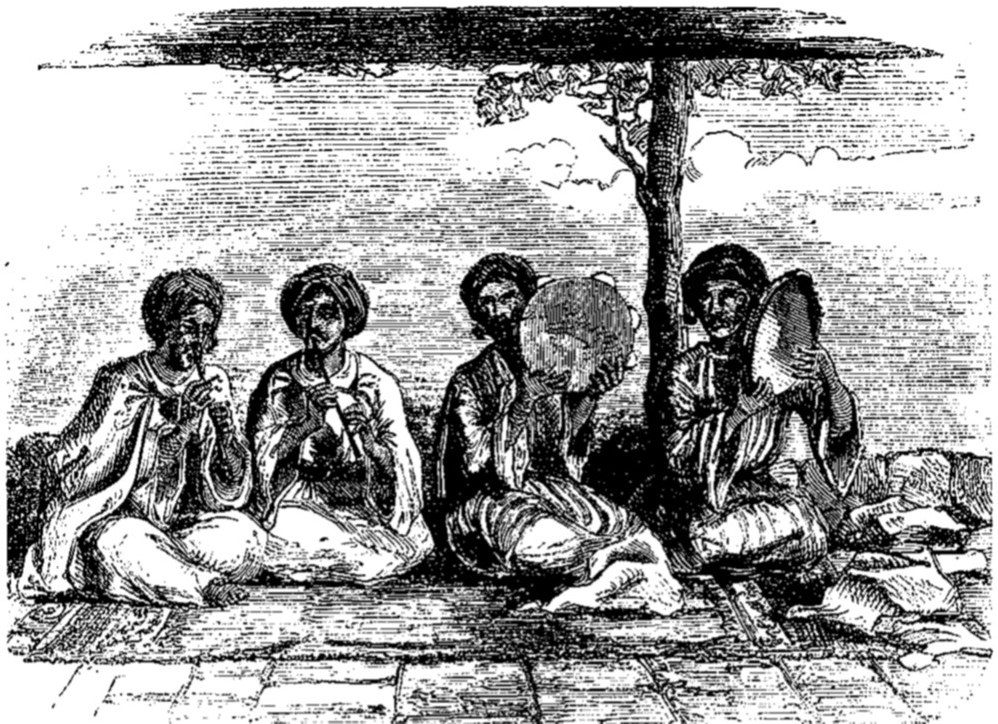
At the Sema five Qewal sit, all others stand. Two play the Şibab, three the Def; the drummers sing at the same time. The flute players sit on the right and come from the Hekarî tribe, the drummers sit on the left and come from the Dumilî tribe (see Instruments, dance and songs).
Tawûs gêran – the tour
The special position of the Qewal rests on the Tawûs gêran (“carrying the peacock around”): they traveled with a Sencaq, the holy peacock image, through the Ezidi communities. In the villages they opened the Sencaq, performed texts, taught those interested, brought news from other communities and collected the dues for Lalîş. The tour takes place in summer and autumn.
Each Sencaq was assigned to a region. Omarkhali names seven:
| Sencaq | Region |
|---|---|
| Tawûsa Enzel (Êzî) | Şêxan |
| Tawûsa Şingalê | Şengal |
| Tawûsa Helebê | Aleppo |
| Tawûsa Xalitiya | area of Diyarbakır |
| Tawûsa Zozana | Hakkari |
| Tawûsa Miskoviya (“Moscow”) | Armenia and Georgia |
| Tawûsa Tewrêzê | Iran (Tabriz) |
Today only the Sencaq of Şêxan and Şengal are carried around. In 2005–2008 the Qewal also visited the Ezidis of Syria. According to Guest, they have meanwhile also visited Ezidis in West Germany. According to Omarkhali, some Qewal did not want to go to Şengal, because the Feqîr there often knew more and even corrected their performance.
Journeys to the Caucasus
- In 1846, according to Layard, two horsemen returned from a journey to the Ezidis in Russian territory (Transcaucasia) with a large donation; an earlier embassy had been murdered on the way by the chief of Bitlis. Layard himself does not expressly call them Qewal in Nineveh and Its Remains (vol. 1, 1849); that they were Qewal follows other accounts (see Campaigns 1836–1847).
- Before the First World War Qewal came for the last time to the Ezidis in the Russian Empire: eight from Başîqa and Bahzanê and one from Ba’dre. Because of the war they could not return for 16 to 17 years. According to a document of April 21, 1930, four of them died in “Russia” and five returned home. In the old cemetery of Sangyar (formerly Aparan district, Armenia), Omarkhali found two Qewal graves, according to old villagers among them that of Qewal Hesen.
The Qewlbêj and their path of learning
Learning from a master
A future Qewlbêj learns from a master who is called seyda or hosta. Often this is the father, grandfather, uncle or another close relative; sometimes the pupil stays for weeks or months in the master's house. There he helps in the household and accompanies the master to festivals and rites. He takes no notes – everything is learned by repeated listening.
- Method: The text is learned stanza by stanza, word by word, a piece every day, regularly repeated and its meaning discussed. The melody follows only afterwards, sometimes months later and with another teacher.
- Example: Şêx Emad b. Şêx Ose (b. 1897) walked daily from Kuruaraz to Karkhun, three kilometers away, to Feqîr Duko and learned two to three stanzas a day.
- Conclusion: At the end the father presents the master with a gift (in the Caucasus xelat). The bond remains for life; the pupil names his master when he performs.
- Words for “to learn”: in Armenia hildan (“to take, to lift”), in Iraq girtin (“to grasp”) and ji ber kirin (“to learn by heart”).
Family and age
Children show interest at five to seven years of age; in Iraq learning begins at about six. Omarkhali saw six- and seven-year-olds in Armenia and Russia perform long texts before the family. Grandparents are regarded as the most important “bridge” for knowledge about family and community. From 15 or 16 years a boy may perform at assemblies; there is no graduation ceremony.
A Qewlbêj cannot come “from outside”: he must have listened in an Ezidi environment from childhood. Guests were often teachers – whoever visited a house as an expert taught the children and himself learned from the host.
Grades
One begins with short prayers, then learns Beyt and only last Qewl. In Iraq one asks “Tu gehîştî kêderê?” – “How far have you come?” Certain texts are given only to someone who already masters at least 70 others. Each expert masters only certain texts; in an area people know who can do what. Reputation grows with the extent and depth of the repertoire – a Feqîr in Şengal knew 107 Qewl and many other texts at the age of 70.
Omarkhali distinguishes four grades of experts: professionals (Qewal, Qewlbêj, the Feqîr of Şengal), knowledgeable performers at great occasions, people who know some texts and carry out the main rites, and the large group that knows some texts and the traditions. A good expert never calls himself an expert. In the Caucasus it is said of a gifted Qewlbêj that knowledge “reached him on the pillow” (ser be’lgî gihîştiye), that is, in his sleep.
Contests
At the end of the 19th and in the 20th century experts put questions to one another before an audience. Famous in Armenia was the twenty-year rivalry between P’îr Ûsib and P’îr Memed, who sent each other questions through messengers. If one asked either of them who was the better, he pointed to the other.
Women
The performance and interpretation of the Qewl is the business of men. Women, however, often know the daily prayers and some Qewl that they do not perform in public; many learned them from the next room. Women perform Beyt at women's gatherings and also at mourning ceremonies. In Armenia older women may sit with the men and join in the conversation.
Manner of performance
- By heart: Performance is only from memory; notes during performance are out of the question.
- Silence: Silence shows respect. The listeners mostly do not look at the performer; the knowledgeable close their eyes and nod slightly. Even children are quiet.
- Posture: sitting calmly, no vigorous gestures, a slight swaying. For the Qewl the performer in Iraq is barefoot and has his head covered; for the Beyt this is not necessary. The Qewl is performed with restraint, the Beyt with more feeling.
- Interruptions: One may pause, drink or greet guests, but not leave out a stanza. If the performer coughs, another Qewlbêj present immediately continues.
- Explaining: Between the stanzas the performer tells what the text means and addresses the listeners. In Armenia and Georgia the explanation was – except at burials – the main part of the performance; afterwards questions could be asked.
- Occasions: Texts are performed above all at mourning ceremonies, at great festivals and on their eves, and at the first visit to a family after a death (see Burial and mourning). At weddings no Qewl and Beyt are performed.
Melodies
Almost every religious text has its own melody, called kubrî in Iraq and kubir in Armenia and Georgia. The experts distinguish melodies that are bilind (“high”), giran (“heavy”, i.e. slow) or bi lez (“fast”). Between Iraq, Syria, Turkey, Armenia and Georgia there are slight to strong differences.
- The performance ranges from simple speaking through fast recitation and chant to melodic singing.
- According to Omarkhali's findings, about 40 Qewl have no melody, about 40 have a melody of their own, unique to them; some share a melody. All Beyt and Qesîde are performed with melody.
- Some texts change melody between beginning, middle and end, often because several parts have grown together.
- The melody aids memory, distinguishes the texts and makes the performance more solemn.
- If an expert forgets a stanza, he speaks the text quietly without melody and then continues with melody.
Omarkhali describes about 100 melodies and published about 70 recordings. Songs of the Şêx and P’îr of Armenia were collected by N. Cewarî (Oldenburg 2009). According to Omarkhali, the Ezidis in Georgia are increasingly adopting melodies from Iraq.
Well-known experts in the South Caucasus (20th century)
Omarkhali reproduces a list of well-known experts from Armenia and Georgia, which she checked with several informants; according to her the life dates are not always exact. Only deceased persons are listed here:
| Name | Life dates | Origin, activity |
|---|---|---|
| P’îr Ûsib b. P’îr Elî | around 1870 – 1939/40 | Şamiram; Hesmaman lineage; one of the best experts in the Serhed |
| P’îr Memed b. P’îr Ozman | 1871–1933 | Pamp (Aparan); his house-shaped grave is a place of pilgrimage |
| Feqîr Duko | b. 1880 | Karkhun (Etchmiadzin); many pupils |
| P’îr Derbas b. P’îr Merad | 1880–1961 | Kamışlu (today Zartonk) |
| Şêx Tafûr b. Şêx Memûd | 1885–1976 | from Digor (Kars); died in Tiflis, buried in Mirak |
| Şêx Hemze b. Şêx Sefer | 1885–1978 | from the Kars region; Şamiram; many pupils |
| Şêx Etar b. Şêx Hemîd | 1890–1971 | from Sinak; 1918 to Armenia, last in Tolik |
| Şêx Emad b. Şêx Ose | b. 1897 | from Qaraqoyê (Surmelî); 1918 to Kakheti, then Karkhun |
| P’îr Kakê b. P’îr Hemed | 1898/99–1973 | from Ûtê (Van); 1918 to Engeserk |
| Şêx Efendî b. Şêx Hemze | 1901–1980 | Kurubexaz (Aparan); died in Tiflis |
| P’îr Dodo b. P’îr Xidir | 1905–1976 | from the Kars region; Norakert; died in Tiflis |
| Şêx Ereb b. Şêx Ewas | around 1927 – 1995 | Abovyan |
| Şêx Dewrêşê Kelaş | 1928–1973 | Şamiram; one of the most knowledgeable Şêx of Armenia |
| P’îr Tosin b. P’îr Karo | 1929 – March 1, 2015 | Baroj (Talin); knowledge purely oral |
For Şêx Rostam b. Şêx Şamil (b. 1927/28) Omarkhali gives “1990s” as the year of death; elsewhere she mentions a Şêx Rostam who died in 2006 and was buried in Tutayev (Russia). Whether this is the same person remains open.
In Iraq Feqîr Hecî (1923–2019) was one of the most important experts.
Change and decline
- After 1991: With the end of the Soviet Union, according to Omarkhali, the tradition in the Caucasus also disintegrated. Many adults had to seek work in Russia or Ukraine; most thirty-year-olds could no longer take over the knowledge in full.
- Books and recordings: Young people today often learn from printed collections and from cassettes or mobile phones (see From oral to written).
- Qewal: Already before 2014 young people from Qewal families were taking up the difficult profession ever more rarely. The flight from Başîqa and Bahzanê in 2014 threatens the tradition in its known form.
- Lament: Many informants say that there are no longer experts of the rank of the old ones.
Qewal in 1846 and 1940 according to eyewitnesses
- Layard (1846): The Qewal are sent by the Baba Şêx from village to village. Only they play the flute and frame drum, which are regarded as semi-sacred; they kiss the drum before and after playing and pass it on to be kissed. They learn singing from childhood. Their clothing was mostly white with a black turban and black cap. At the festival in Lalîş about 30 Qewal played (see The festival in Lalîş 1846).
- Drower (1940): The Qewal lived above all in Başîqa and Bahzanê, married only within their estate and did not cut their hair and beards. They passed on their chants orally from father to son. The chief Qewal in Başîqa was Qewal Sîvo. Formerly the Qewal traveled with the Sencaq as far as Russia and India; in 1940 war and passport regulations prevented these journeys (see Sersal in Başîqa 1940).
Sources
- Khanna Omarkhali: The religious textual tradition of the Ezidis – from the oral to the written. Saint Petersburg 2023 (Russian translation of the English original, Wiesbaden 2017), p. 77–79, 123–145, 149–156, 240–242
- John S. Guest: The Yezidis. A Study in Survival. London/New York 1987, p. 52, 54, 113
- Khanna Omarkhali (Ханна Омархали): Йезидизм. Из глубины тысячелетий (From the depths of the millennia). Saint Petersburg 2005, p. 24, 87, 147–148
- Dimitri Pirbari (P’îr Dîma), A. Ščedrovickij: Тайна жемчужины (The secret of the pearl). Moscow/Tbilisi 2016, p. p-027, p-083
- Austen Henry Layard: Nineveh and Its Remains, Vol. 1. London 1849, p. p. 278–279, 291, 303–304 (PDF 331–332, 344, 356–357)
- E. S. Drower: Peacock Angel. Being some Account of Votaries of a Secret Cult and their Sanctuaries. London 1941, p. p. 16, 24, 99–100 (PDF 27, 37, 124–125)
Found a mistake?
Is something wrong – a fact, a spelling, a source, an image? Let us know: we check every report and correct the article.
Other spellings: Qewlbej · Tawus geran · Kubri · Hekari · Dumili · Qawwal · Kawal · Kewal · Bashiqa · Baschika · Qawl · Qaul · Kewl · Murid · Mossul · Mûsil · Sheikh · Scheich · Shex · Tawûsî Melek