
The Ezidis (self-designation Êzdî) understand themselves as a distinct people with their own descent, their own religion, their own language and their own culture. For them, these four aspects belong inseparably together: one is an Ezidi by birth, not by confession. EZDIKI.COM follows this self-understanding.
An ethno-religious people
Among the Ezidis, people and religious community coincide. One is born an Ezidi – father and mother must be Ezidis. Conversion to the religion Şerfedîn is not possible, and whoever voluntarily abandons the faith of the ancestors no longer belongs to the people according to the Ezidi view. Such apostates are called Brûk.
For people who were forced to adopt another faith, however, tradition knows a way back: the rite Cerb (see Return to the community).
Characteristics of the people
- Descent: According to Ezidi tradition, the Ezidis descend from Adab, who does not descend from Adam and Eve but was specially created – at a time when there were already 72 other peoples on earth. The old name of the people is therefore Adabi (so also Şêx Mak’sîm 2017). There is also another version according to which the Ezidis descend from Adam alone – both versions are given under Traditions of origin.
- Marriage only within the people: Marriage with members of other peoples and religions is forbidden; in addition, the three castes marry only among themselves (see Three basic rules and five duties).
- Own religion: Şerfedîn, with the belief in one God and seven archangels under Tawûsî Melek, with the sanctuary Lalîş.
- Own language: Êzdîkî, the language of everyday life and of songs; according to tradition, the prayers preserve an older, sacred layer of language.
- Own social order: the three castes Şêx, P’îr and Mirîd and the tribes (eşîr).
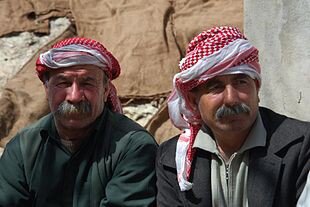
- Own culture: festivals, fasting periods, wedding and mourning customs, traditional dress, cuisine, songs and the Govend dance.
- Common history: the memory of the 74 Ferman – persecutions and genocides that the people have survived over centuries.
Language alone does not make a people
The everyday language of the Ezidis resembles the language of some of their neighbors. From this it is often concluded that the Ezidis are merely a religious group of another people. The Ezidi view contradicts this: a common or similar language does not mean common ethnic belonging. A frequently cited comparison is the Copts in Egypt, who speak the same language as their neighbors and are nevertheless a distinct people with their own history.
Recognition as a distinct ethnic group
In the Russian census, the Ezidis are counted as a separate group: in 2002 there were about 31,300, in 2010 about 40,600 people. The censuses in Armenia and Georgia also list the Ezidis as a distinct ethnic group.
Classification
Many older and some present-day publications assign the Ezidis to another people or describe them only as a religious community. EZDIKI.COM does not adopt these classifications. Why certain terms are not used here is explained in the article Names and terms.
Êzdî and Ezdîxan – self-designations
According to Khanna Omarkhali (2005), the Ezidis call themselves Êzdî. The totality of all Ezidis, wherever they live, is called Ezdîxan (also Ezdîxane). The word appears, for example, in blessings: one asks God to stand by first the “72 peoples” and then the whole of Ezdîxan. According to Omarkhali, every Ezidi understands himself as part of this community. The Ezidis themselves call their religion Şerfedîn. The names Êzdîtî or Ezdiyatî (“the Ezidi way”), which Omarkhali (2005) cites, are mainly the names under which other peoples know the religion.
To the question “Who are you?”, Ezidis, according to Omarkhali, usually simply answer: “Ezidi”.
Ezidi only by birth
Both sources of this section emphasize the same basic principle:
- According to Omarkhali, the religion knows no mission; conversion from outside is excluded. One can be an Ezidi only by birth, and belonging is passed on by both parents. The main characteristics by which the Ezidis distinguish themselves from others are religious affiliation and common descent. All Ezidis, wherever they live, speak the same language.
- E’zîz T’amoyan writes that, according to the “national law” of the Ezidis, one is born an Ezidi; no member of another people can become an Ezidi. He describes the Ezidis as one of the ancient peoples of the world.
According to Omarkhali, the strict marriage rules (see Family and the position of women) preserve this unity of descent and faith. Most Ezidis can list ten or more generations of their ancestors.
“Ezidi” as nationality in the passport
According to Omarkhali, the Ezidis in Armenia and Georgia – descendants of the survivors of the massacres in the Ottoman Empire – often understand themselves as a distinct people. In the passports of Ezidis in Armenia and partly in Georgia, “Ezidi” was entered in the nationality field.
The census of 1989
E’zîz T’amoyan, chairman of the National Union of Ezidis of Armenia, describes the path to it: in the first Soviet censuses the Ezidis were still listed separately. From the 1930s the name was abolished and the Ezidis were assigned to another ethnic group. With the “national awakening” from February 1988, Ezidis collected signatures; T’amoyan brought 15,000 signatures to Moscow. In the 1989 census, after 60 to 70 years, the Ezidis were once again able to register as Ezidis; in Armenia 51,900 were counted. T’amoyan calls this recognition the “first great victory” of the national awakening. In detail: Recognition as a distinct nationality.
On the cover of his memorial volume and in the masthead of the National Union’s newspaper stands the motto: “My nationality is Ezidi, my language Êzdîkî, my religion Şerfedîn.”
In Iraq after 2014
In Iraq, too, the self-understanding as a distinct people has strengthened after the genocide of 2014. According to Shammo (2026), many Ezidis there claim their own religious and ethnic identity and emphasize that their language is a distinct Ezidi language. The recognition of the genocide was understood by many as recognition of the Ezidis as a distinct people. Shammo also confirms: one is an Ezidi only by birth to Ezidi parents. In detail: Self-understanding after 2014. Which actors ascribed a different ethnic belonging to the Ezidis during this period is shown in the article External ascriptions and appropriation.
Early eyewitnesses: Layard (1846) and Drower (1940)
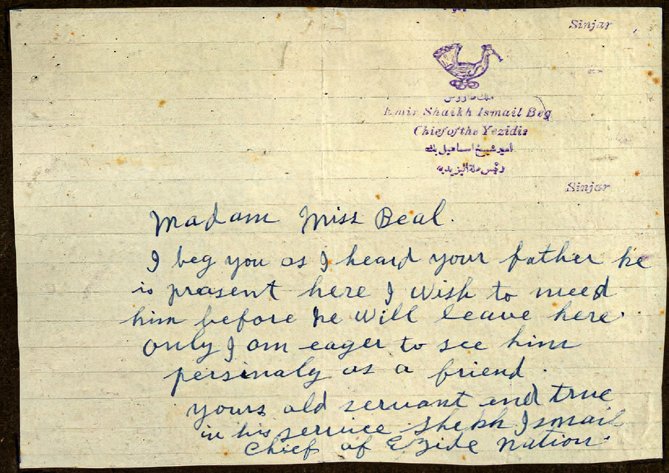
- In 1846, Layard divided the population of the plain east of the Tigris into Turkmens, Kurds, Arabs and Ezidis – thus the Ezidis as a separate group. Among themselves, the Ezidis named themselves after their district or tribe; the inhabitants at the foot of the mountains were called Dasinî. Layard knew of no case in which an adult Ezidi had given up his faith; even children who had been carried off into harems and outwardly made into Muslims often secretly held on to the Ezidi faith and remained in contact with Ezidi clergy.
- In 1940, Drower spoke of the Baba Şêx as the religious head “of the nation”, of an “honorable and proud people”, and of Lalîş as the center of one of the most severely persecuted peoples. Throughout her account she distinguished between the Ezidis and their Muslim neighbors.
- For evidence from research after 2014, see Self-understanding after 2014.
Sources
- International Journal of Yezidi Studies, Vol. 2. Tbilisi 2025, p. 28 (ill.)
- A. V. Perminov: Езиды – древний народ Адаби (The Ezidis – the ancient people Adabi). Sharya 2016, p. 1–3, 23–24, 56–59, 74–77, 86–88, 94–95, 111
- Khanna Omarkhali (Ханна Омархали): Йезидизм. Из глубины тысячелетий (From the depths of the millennia). Saint Petersburg 2005, p. 13, 31, 67, 78–85, 131–132
- E’zîz T’amoyan: The heroic deed of the Ezidi people – Ezidis in the Karabakh war (Armenian, memorial publication, Yerevan, c. 2000–2007), p. 1, 51–55
- Qader Saleem Shammo: The Yezidis in Kurdish Nationalist and Islamic Discourses after the 2014 Genocide (Yezidi Studies 4). Berlin 2026, p. p. 17, 67, 122–123, 181, 192
- Austen Henry Layard: Nineveh and Its Remains, Vol. 1. London 1849, p. p. 38, 277–278, 306 (PDF 79, 330–331, 359)
- E. S. Drower: Peacock Angel. Being some Account of Votaries of a Secret Cult and their Sanctuaries. London 1941, p. p. 7, 133, 171 (PDF 18, 166, 210)
Found a mistake?
Is something wrong – a fact, a spelling, a source, an image? Let us know: we check every report and correct the article.
Other spellings: Ezdi · Ezidi · Sheikh · Scheich · Shex · Tawuse Melek · Melek Taus · Taus-i Melek · Malak Tawus · Lalish · Lalisch · Lalesh · Ezidiki · Ezdeki · Pîr · Murid · Firman · Fermans · Sinjar · Sindschar