
Lalîş (full name Lalişa Nûranî, "radiant Lalîş") is the central sanctuary of the Ezidis. Here lies the tomb of Şêx Adî, here the holy spring Kaniya Sipî rises, and here leads the pilgrimage that every Ezidi should if possible undertake once in his life. Almost all the great festivals and rituals of the religion Şerfedîn are connected with Lalîş.
According to tradition, in Lalîş "every tree and every stone" has its own holiness and history. The valley is therefore more than a temple: it is a whole holy landscape of buildings, springs, caves, trees, mountains and memorial sites. The articles of this category go through it place by place.
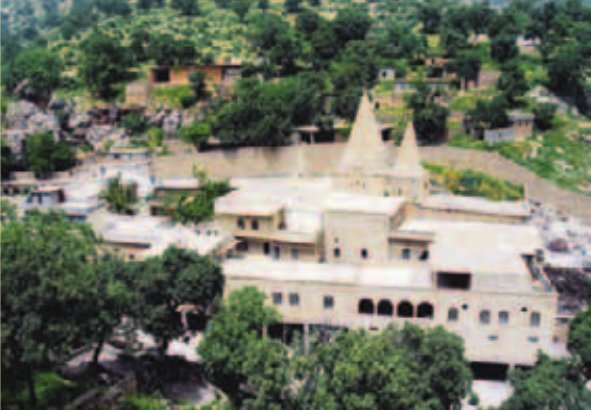
Location
Lalîş lies in a narrow, green valley, the Geliyê Lalişê, in the district of Şêxan in Duhok province in northern Iraq – according to the photo book Lalişa Nûranî, 11 km north of Êsivn (Eyn Sifnî) and 53 km southeast of Duhok. On three sides it is surrounded by mountains: the Erefat to the north, the Hizret to the west and the Mişet to the south (Mountains and greeting places).
According to Açıkyıldız, apart from the servants of the sanctuary no one lives permanently in the valley; it is said that "only God lives here".

What Lalîş means to the Ezidis
- Place of creation: according to tradition, at the site of Lalîş the leaven (havên) was thrown into the primordial sea so that the earth became solid; Lalîş itself came down from heaven. Several versions of this tradition are in the article Name and tradition.
- Place of paradise: according to mythology, the garden of paradise lay in the valley of Lalîş.
- Place of judgment: after death the soul comes to Lalîş; in front of the gate Dergê Mîr it is judged, then it crosses the bridge Pira Selatê (The path of the soul through Lalîş).
- Direction of prayer: Kreyenbroek calls Lalîş the earthly image of a heavenly Lalîş; according to a Qewl, the Kaniya Sipî was made the direction of prayer (qible).
- Tomb of Şêx Adî: the renewer of the religion in the 12th century (Şêx Adî) lived here with his companions and is buried here.
According to Şêx Mak’sîm (Grundpfeiler der Religion ScherfeDin), Lalîş is the first building on earth, a "house for the worship of the one God"; every Ezidi should visit it and be consecrated in the Kaniya Sipî.
Tour: the complex in words
Because of its many buildings and their different functions, the photo book Lalişa Nûranî calls Lalîş a temple complex. Whoever comes through the valley from the east meets the places roughly in this order:
- Pira Selatê – the small stone bridge over the stream. Here the holy ground begins; one takes off one's shoes. → Pira Selatê
- Xana Êzîd, the old pilgrims' hostel, about 1 km from the bridge. → Kitchen, hostels and service buildings
- Kaniya Sipî – the "White Spring" under its own dome, place of the consecration mor kirin. → Kaniya Sipî
- Above it on the slope the sanctuary of Şêşims with dome, tomb and sun sign. → Sanctuary of Şêşims
- Sûka Merîfetê, the "market of knowledge": the forecourt with arcades in front of the gate. → Sûka Merîfetê
- Dergê Mîr, the "gate of the ruler", the entrance to the temple courtyard. → Dergê Mîr
- Celsa Şîxadî, the paved courtyard in which the Sema is danced. → Celsa Şîxadî and the courtyards
- Dergê Şîxadî (Derê Qapîyê), the decorated portal with the black snake. → Dergê Şîxadî
- The main building: hall with wishing columns, basin of Nasirdîn, sarcophagus of Şêx Adî under the highest dome, gate of paradise. → The main building and the tomb of Şêx Adî
- Behind and beneath the main building: the room of Hesin Dena with oil jars and wishing stone, the spring Zimzim and the cave Çilexane. → Hesin Dena and the wishing stones, Kaniya Zimzim, Caves
- The courtyard Gaykuj, where Kaniya Sipî and Zimzim flow together and the holy food is cooked. → Gaykuj
- All around: lanes, buildings of the saints, caves, trees and hundreds of wick places (Nîşangeh). → Lanes and buildings, Nîşangeh and wicks, Holy trees, Other springs
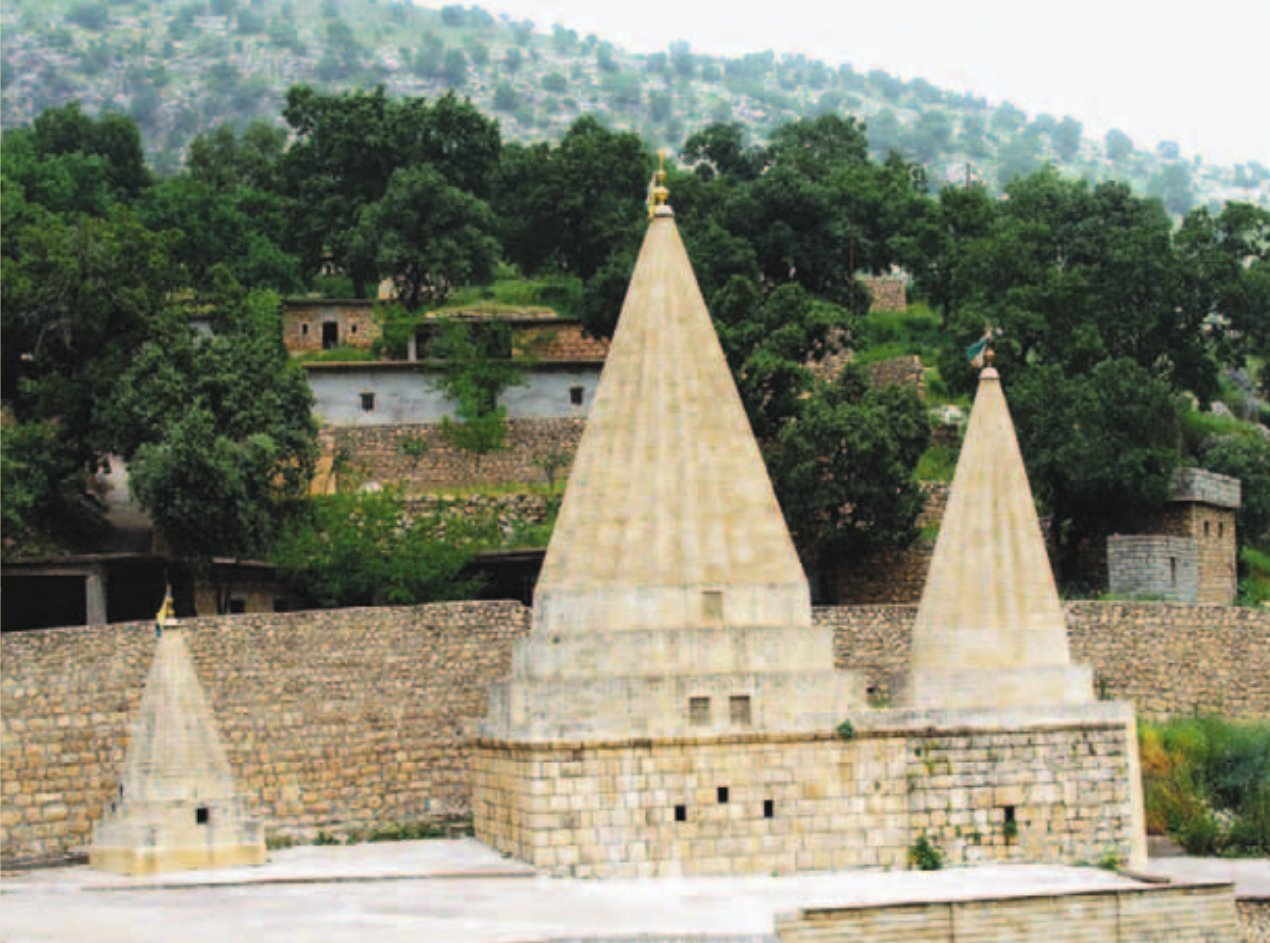
Above everything stand the white, ribbed conical domes (qub), the hallmark of Ezidi sanctuaries → The domes of Lalîş. On the walls there are old signs: snake, peacock, sun wheels, stars, combs and staffs → Symbols on the walls.
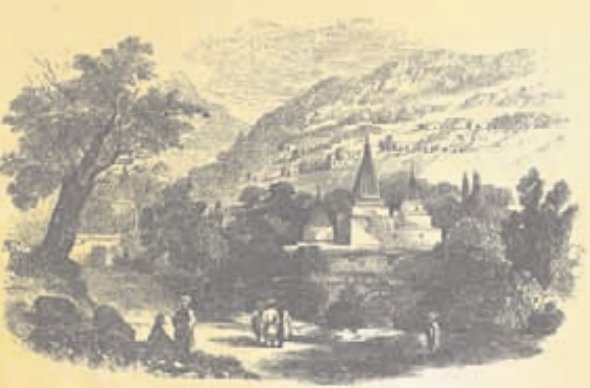
Life and festivals
The Bavê Çawîş, the Kebanî and the Feqra serve permanently in the valley, as well as Feqîr, Feraş and Xilmetkar (Offices in Lalîş). Every evening hundreds of oil wicks are lit. At the great festivals – above all the seven-day Cejna Cimaiyê in autumn and the Çarşema Sor in spring – the valley fills with pilgrims → Lalîş in the festival year. Whoever visits Lalîş keeps to certain rules → Rules for pilgrims. From Lalîş one takes along the Berat, small balls of holy earth → Berat.
History and surroundings
Lalîş was destroyed and rebuilt several times; there are various traditions about the origin of the building → History of the sanctuary. In the villages around – Bozan ("little Lalîş"), Behzan, Başîk, Baedrê, Êsivn – stand further sanctuaries → Surroundings: Bozan and the villages.
Building descriptions according to Guest, Bachmann, Edmonds, Drower and Açıkyıldız (dimensions, building phases, ground plan) as well as eyewitness reports from the 19th and 20th centuries are in the article Lalîş in the section People & Culture.
On the sources
The main source of this category is the trilingual photo book Lalişa Nûranî / Святой Лалыш / Holy Lalish (Grigoriev, Ivasko, Pirbari, 2008). Its most detailed text, in the language of the Ezidis, was written by P’îr Dîma (Dimitri Pirbari); for the description of the holy places the authors, by their own account, rely on Bedelê Feqîr Hecî and Heso Hurmî. The Êzdîkî version is in many places more detailed than the English and Russian ones; where the versions contradict each other, the articles say so.
Sources
- S. A. Grigoriev, L. V. Ivasko, D. V. Pirbari (P’îr Dîma): Lalişa Nûranî / Святой Лалыш / Holy Lalish. Yekaterinburg: Basko 2008, p. pp. 20–37, 38–43, 182–191, 202–206
- Philip G. Kreyenbroek, Khalil Jindy Rashow: God and Sheikh Adi Are Perfect. Sacred Poems and Religious Narratives from the Yezidi Tradition. Wiesbaden: Harrassowitz 2005, p. pp. 4, 14, 21, 37–39
- Birgül Açıkyıldız: The Yezidis. The History of a Community, Culture and Religion. London 2010, p. pp. 129–130, 143–148
- Şêx Mak’sîm (Maksim Ezdi): Grundpfeiler der Religion ScherfeDin, 2017 (on EZDIKI.COM in the Religion section and in the library), p. pp. 21–24, 36
Found a mistake?
Is something wrong – a fact, a spelling, a source, an image? Let us know: we check every report and correct the article.
Other spellings: Lalisa Nurani · Lalischa Nurani · Lalisha Nurani · Lalis · Lalisch · Lales · Lalesch · Lalesh · Perisgeha Lalise · Perisgeha Lalische · Perisgeha Lalishe · Sheikh Adi · Scheich Adi · Shaikh Adi · Şêxadî · Shikhadi · Shekhan · Scheichan · Shaikhan · Dohuk