
The Kaniya Zimzim (also Zemzem) flows in a deep cave beneath the main building of Lalîş. It is reached by a staircase that leads down behind the door Dergê Zimzimê (Lalişa Nûranî). Next to the Kaniya Sipî it is the second great holy spring of the sanctuary.

What the pilgrims do
According to the photo book Lalişa Nûranî, one rolls up one's trouser legs, steps into the water, offers the Sela for all relatives and moistens the eyes with the water.
In the cave there is a spot plastered with gypsum that looks like the cloak (kepen) of a shepherd, with a stone beneath it. Whoever has back pain sits down there and leans his back against the wall – according to the English version, three times.
At the festival of Erefat the pilgrims wash in the Zemzem after the run from Mount Erefat (Kreyenbroek). Together with the Kaniya Sipî it is the place of the Sela, the obligatory ritual of every pilgrim (Rules for pilgrims).
Whether everyone may go down, the sources describe differently: Lalişa Nûranî depicts the pilgrims' bath. Drower, by contrast, reports in 1940 that only the Baba Şêx, the Bavê Çawîş, the servant (Kannas) and the Feqraya had access to the Zemzem crypt. According to Açıkyıldız, it is inaccessible to non-Ezidis.
The legend of the forty Şêx
The photo book tells the origin of the spring as follows:
Forty Şêx from Baghdad came to Lalîş to test the miraculous power of Şîxadî (Şêx Adî). According to the English version, they were led by Ahmad ar-Rifâ’î and Abû l-Wafâʾ al-Hulwânî and wanted to drive Şîxadî away; as its source it names a holy hymn. The cave was too narrow for all of them. Şîxadî had them lean their backs against the wall and say: "Ya bi qewata Xwedê û Şîxadî" ("By the power of God and Şîxadî") – and the cave became wide. For the ritual ablution before prayer they asked for water. Şîxadî struck the rock with his staff (wekaz), and the water came forth.
The custom of leaning one's back against the wall of the cave in case of back pain recalls this.
Where does the water come from?
- According to the religious scholars cited by Lalişa Nûranî, Şîxadî fetched the water from the Kaaba; the English version says: from the Zemzem well in Mecca.
- According to Kreyenbroek, too, the spring is held to come from the spring of the same name in Mecca.
- Pirbari refers to the Qewlê Şêxadî û Mêra: in it Sufi preachers become Ezidis through Şêxadî's miracles, Lalîş is considered equal to Mecca, and the Zimzim water is brought to Lalîş; Şêxadî calls the water in Arabic with "come". In his glossary Pirbari calls the Zimzim an old, pre-Islamic spring at the Kaaba.
On the Qewl itself see Qewl.
The course of the water
The Zimzim water flows through the cave Çilexane (Caves) and unites with the Kaniya Sipî in the courtyard Gaykuj; from there it flows out of the temple precinct under the Pira Selatê (Lalişa Nûranî, Engl. version). According to Açıkyıldız, the spring rises in the middle of a room, flows 3.5 m on the surface, disappears and emerges again in a lower room.
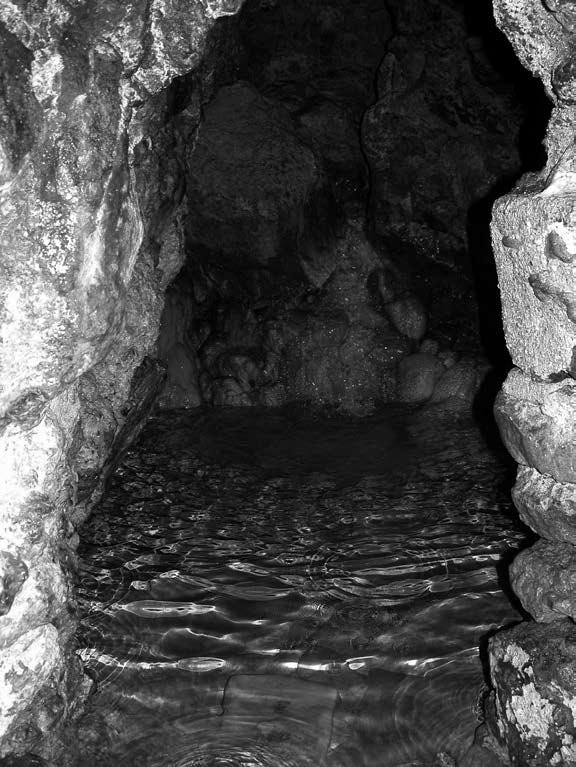
Gertrude Bell saw a small cellar east of the chapel of Şêx Hesen with a spring that supposedly comes from the well of Zemzem in Mecca; W. A. Wigram entered a large natural cave with rivulets in 1907 (according to Edmonds). In the list of wicks of Lalîş there are separate "Fitîlên Zimzimê", wicks of the Zimzim.
Sources
- S. A. Grigoriev, L. V. Ivasko, D. V. Pirbari (P’îr Dîma): Lalişa Nûranî / Святой Лалыш / Holy Lalish. Yekaterinburg: Basko 2008, p. pp. 31, 34–37, 72, 188, 203
- Philip G. Kreyenbroek, Khalil Jindy Rashow: God and Sheikh Adi Are Perfect. Sacred Poems and Religious Narratives from the Yezidi Tradition. Wiesbaden: Harrassowitz 2005, p. pp. 14, 16, 38
- Dimitri Pirbari (P’îr Dîma), A. Ščedrovickij: Тайна жемчужины (The secret of the pearl). Moscow/Tbilisi 2016, p. pp. 25, 224, 250
- Birgül Açıkyıldız: The Yezidis. The History of a Community, Culture and Religion. London 2010, p. pp. 147 (ill.), 152
- E. S. Drower: Peacock Angel. Being some Account of Votaries of a Secret Cult and their Sanctuaries. London 1941, p. pp. 151–201 (PDF 184–242)
- C. J. Edmonds: A Pilgrimage to Lalish. London (Royal Asiatic Society) 1967, p. p-070–071
Found a mistake?
Is something wrong – a fact, a spelling, a source, an image? Let us know: we check every report and correct the article.
Other spellings: Kaniya Zimzime · Sikevta Zimzime · Schikevta Zimzime · Shikevta Zimzime · Derge Zimzime · Derg Zimzime · Derg Zimzimê · Sheikh · Scheich · Shex · Lalish · Lalisch · Lalesh · Baba Sheikh · Baba Scheich · Bave Şêx · Sheikh Adi · Scheich Adi · Shaikh Adi · Shikhadi