
The valley of Lalîş is surrounded by mountains on three sides. They, too, are holy (Açıkyıldız): on them lie caves, memorial places and holy trees, and in tradition they have their place on the path of the soul. Whoever in former times came on foot over the mountains to Lalîş greeted the sanctuary at a greeting place (Silavgeh).
The mountains
In the Ezidi schoolbook Bedelê Feqîr Hecî names three mountains: the Erefat to the north (on it the Mişrûgiya), the Hizret to the west and the Mişet to the south. Kreyenbroek names the same three. The photo book Lalişa Nûranî describes them only in the text in Êzdîkî:
Erefat
The Çiyayê Erefatê lies north of the sanctuary. On it lie the caves of Omer Xala and Hesin Çinarî and the wishing column Stûna Miraza (Caves, Wishing stones). On it stands a holy tree to which one ties ribbons (Holy trees). The list of wicks names a separate wick "Çiyayê Erefatê".
At the festival of Erefat, according to Kreyenbroek, the dignitaries climb the mountain with the faithful. The Mîr Hec ("prince of the pilgrimage") throws pieces of bread; whoever catches one runs down to the Kaniya Sipî, and the first receives a prize. Afterward one washes in the Zemzem. → Other festivals
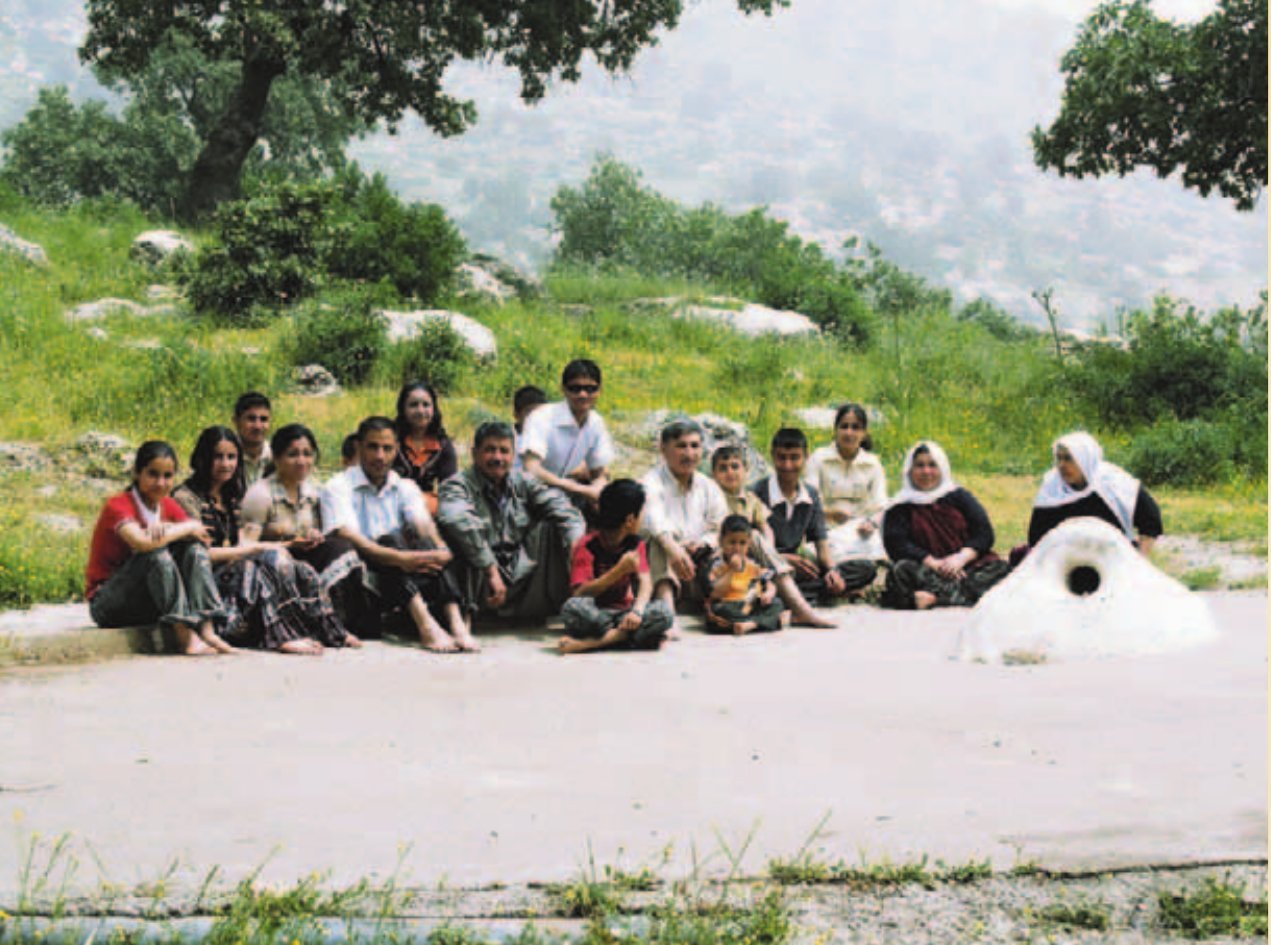

Mişrûgiya
The Çiyayê Mişrûgîya lies above the Erefat. According to the photo book, the name means "those who are better than us" – meaning the spirits (cin). Here lies the cave of the spirits, and here rises the spring Kaniya Berbaykê (Other springs). The list of wicks names wicks of the Mişrûgiya.
Geliyê Qewalan and Newala Waweylê
Between Mişrûgiya and Erefat lies the valley Geliyê Qewalan, above it the gorge Newala Waweylê. Into it, according to belief, the Zebanî throw the bad souls (The path of the soul).
Hizret
The Çiyayê Hizretê lies west of the sanctuary; on it lies the cave of Mîr Birahîm. According to Edmonds, the Hizret is about 4,000 feet high; an informant called it Cûdî (see Lalîş in People & Culture). In the list of wicks of Lalîş there is a wick "Nûh û Cûdî" ("Noah and Cûdî") in the Dîwan of Şêx Mend.
Mişet
At the Çiyayê Mişetê in the south rises the Kaniya Sipî. In former times the pilgrims coming from Baedrê descended into the valley over the Mişet (Lalişa Nûranî, Engl. version). On the slope lies the greeting place of Mehmed Reşan.
The greeting places (Silavgeh)
A Silavgeh ("place of greeting", also dika silavê) is a place from which one sees something holy from afar and greets it. Whoever comes from the plain to Lalîş on the mountain path and reaches the greeting place sees the valley and the holy signs and is obliged to greet them (Lalişa Nûranî).
How many greeting places there are, the language versions of the photo book state differently:
- Text in Êzdîkî: two – the Silavgeha Şîxadî (of Şêx Adî) and that of Mehmed Reşan (Mehmereşan) on the slope of the Mişet.
- English version: three – in addition the Silavgeh of Sitiya Ês.
In the schoolbook Bedelê Feqîr Hecî names greeting places for Şîxadî and Mehmed Reşan on the Mişet as well as in the lane of Sitiya Ês – this corresponds to the count of the English version.
Silavgeha Şîxadî
According to the text in Êzdîkî, the greeting place of Şîxadî is like a platform (doşek) on which people lay stones. In former times it was whitewashed every two years at the festival of the whitening of the domes (cemaya sipîkirina quba). According to the English version, it is a large, upright, whitewashed stone; in former times the pilgrims fell down at the sight of the tips of the domes and kissed the earth.
Kreyenbroek describes the Silavgeh on the way from Baedrê: there the pilgrims first see the towers, fire guns and kiss a stone. In 1944 Edmonds experienced how the two white conical towers suddenly came into view after a ride through the hills.

Sources
- S. A. Grigoriev, L. V. Ivasko, D. V. Pirbari (P’îr Dîma): Lalişa Nûranî / Святой Лалыш / Holy Lalish. Yekaterinburg: Basko 2008, p. pp. 28–37, 85, 157, 202–203
- Philip G. Kreyenbroek, Khalil Jindy Rashow: God and Sheikh Adi Are Perfect. Sacred Poems and Religious Narratives from the Yezidi Tradition. Wiesbaden: Harrassowitz 2005, p. pp. 10 (n. 17), 14, 16, 38–39, 286
- Birgül Açıkyıldız: The Yezidis. The History of a Community, Culture and Religion. London 2010, p. p. 129
- E’zîzê E’mer, H’esenê Şêx-Me’mûdê: E’debyet û zimanê êzdîkî, grade 8. Yerevan: Spîka 2011, p. p-019–024
- C. J. Edmonds: A Pilgrimage to Lalish. London (Royal Asiatic Society) 1967, p. p-021
Found a mistake?
Is something wrong – a fact, a spelling, a source, an image? Let us know: we check every report and correct the article.
Other spellings: Ciyayen Lalise · Tschiyayen Lalische · Chiyayen Lalishe · Miset · Mischet · Mishet · Misrugiya · Mischrugiya · Mishrugiya · Geliye Qewalan · Geliy Qewalan · Newala Waweyle · Lalish · Lalisch · Lalesh · Faqir · Fakir · Ezidiki · Ezdeki · Emir