
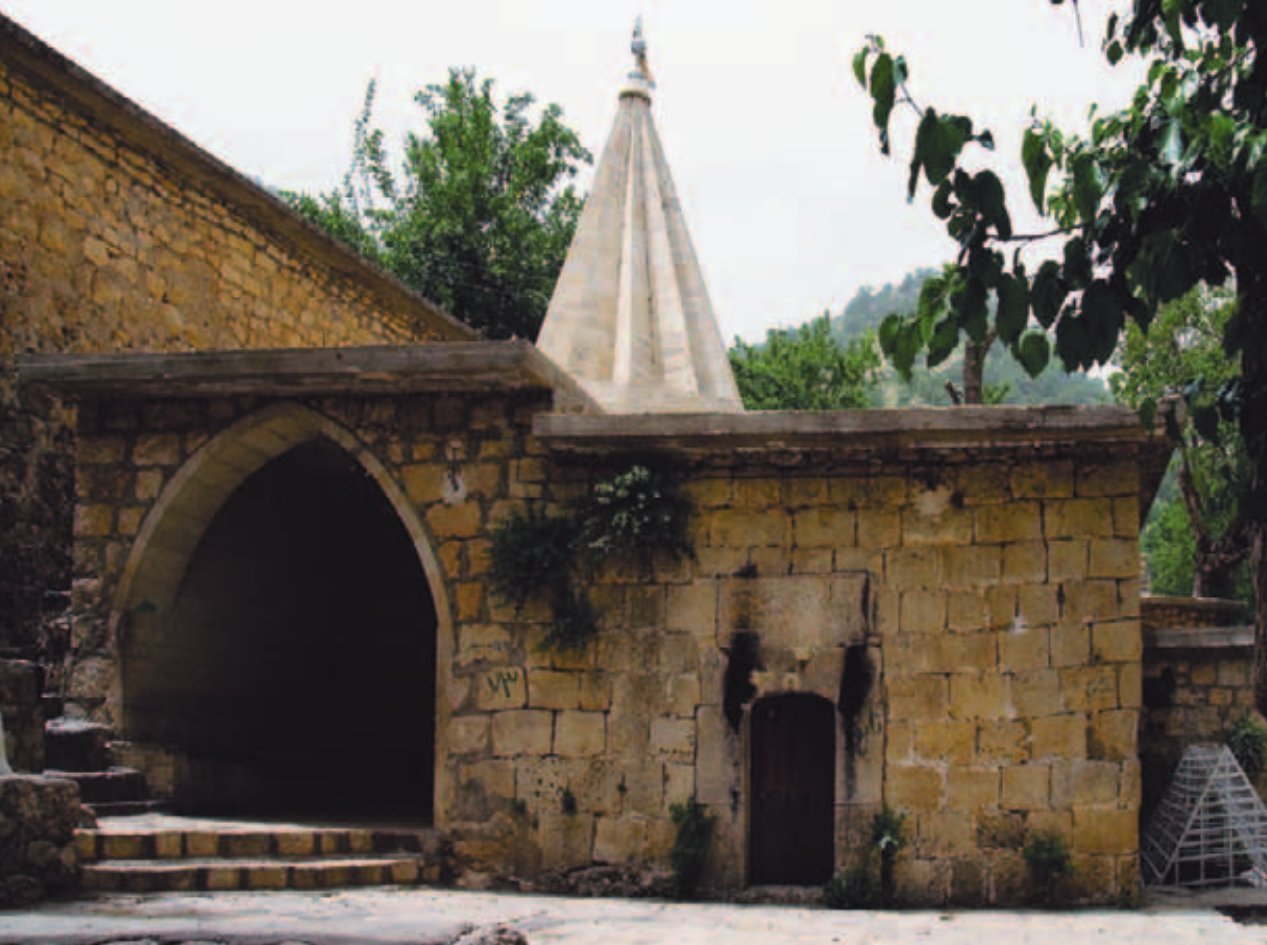
The Kaniya Sipî ("White Spring") is the holiest spring of the Ezidis. It rises at Mount Mişet in the middle of the valley of Lalîş; above it stands a conical dome of its own (Lalişa Nûranî). Every Ezidi is consecrated with its water (mor kirin, literally "to seal").
The spring in tradition
- Place of creation: according to tradition, at the site of the Kaniya Sipî the leaven (havên) fell into the primordial sea so that the earth became solid. Hence it is said: the Kaniya Sipî is the Havên of Lalîş, and Lalîş is the Havên of the earth (Lalişa Nûranî; similarly Kreyenbroek and Pirbari, see Name and tradition).
- Pure in the Flood: when in the Flood (ava reş, tofan) all water became murky, only the Kaniya Sipî stayed clear (Lalişa Nûranî).
- Direction of prayer: according to the Qewls, at creation the Kaniya Sipî was made the direction of prayer (Kreyenbroek). A Qewl quoted by Pirbari says: Şerfedîn is our religion, the Kaniya Sipî our Qible. Pirbari also calls it a "castle" whose key is the Xerqe.
Mor kirin – the consecration
After birth every Ezidi must be "sealed" with the water of the Kaniya Sipî, that is, made pure and helal; the English version of Lalişa Nûranî says: to wash away the impurity of birth. Whoever cannot come to Lalîş is, according to Kreyenbroek, consecrated with water that the Qewal bring along on their tour with the Sencaq, or even with ordinary water. On this tour the Qewal pour water of the Kaniya Sipî on people's heads and say it is the "cup of Êzîd". The rite itself is described in the article Mor kirin.
Separate for girls and boys
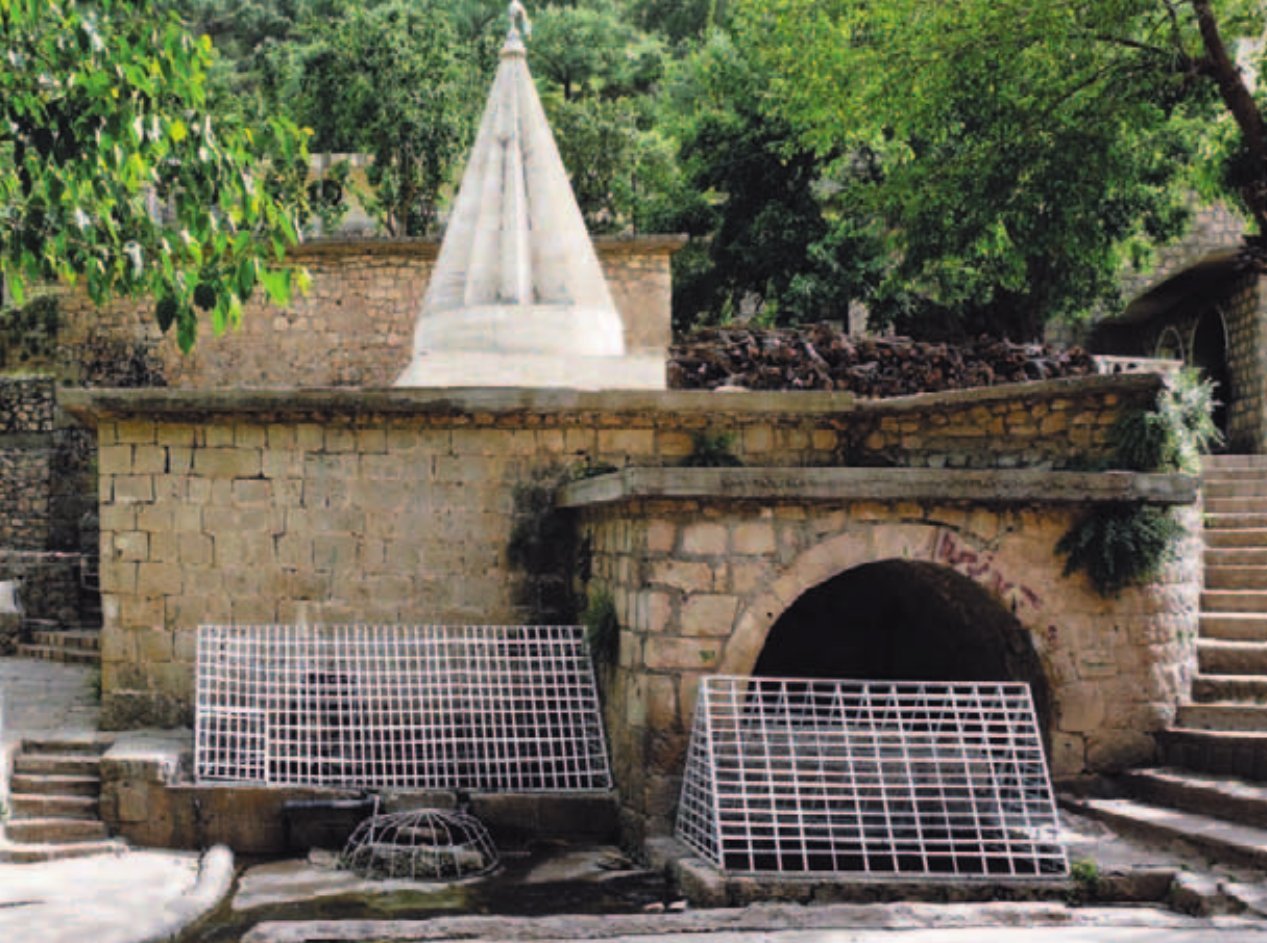
In former times girls and boys were consecrated separately. To this day there are two basins: Kaniya keçika (girls' spring, on the right) and Kaniya kurika (boys' spring, on the left) (Lalişa Nûranî). In 1944 Edmonds saw large spotted newts in the boys' basin, which were called horî after the virgins of paradise. According to Açıkyıldız, the spring house is the only Ezidi baptismal building; it has three rooms – for girls, for boys and for older people – and only the room Kaniya Sipî bears the ribbed dome.
Brothers and sisters
Married couples may not go together to the Kaniya Sipî and the Zimzim, for there all men and women become brother and sister. According to the English version, man and woman may not dance together there, otherwise they become spiritual siblings; men and women have separate entrances (Lalişa Nûranî).
What happens at the spring
- Sela: over the water pilgrims offer the Sela for their relatives – they sprinkle themselves and speak petitions for them (Rules for pilgrims).
- Sourdough and yogurt: every year at the beginning of spring the Ezidis make their sourdough and their yogurt culture (mast) "helal" with the water of the Kaniya Sipî (Lalişa Nûranî).
- Round dance: at the spring a special religious round dance is danced, the Dîlana derê Kaniya Sipî, to Def and Şibab; according to the English version it is a good deed to take part in it.
- Sema by day: at the Kaniya Sipî the Sema is also danced in the daytime during the Cejna Cimaiyê.
- Festival consecration: at the autumn festival the bier Berê Şibakê and the colored cloths (perî) are consecrated with its water (Lalîş in the festival year).
- Berat: the balls of holy earth are kneaded with its water (Berat).
Who serves at the spring
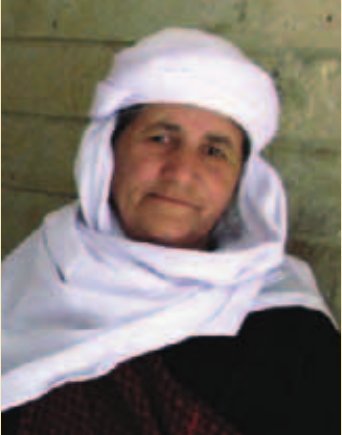
The keeper of the spring is called Micêwir (feminine Micêwra). According to Kreyenbroek, the Micêwirê Kaniya Spî is highly respected. Who holds this office, the sources say differently:
- According to Şêx Mak’sîm, only a Şêx from the family of the Şêxê Şemsa may serve at the Kaniya Sipî.
- According to Omarkhali, the Micêwirê Kaniya Sipî is a P’îr.
- According to Edmonds, in 1944 P’îr Derwêş from the Micêwir branch of the family P’îr Buwal explained that the baptizer at the White Spring was always a Micêwir; at that time it was his nephew.
- The photo book Lalişa Nûranî shows Dayê Esmer as Micêwra of the Kaniya Sipî.
Round about
Next to the spring lies the seating place Celsa Kaniya Sipî (Courtyards). At its door stands the tree Dara Xewê; behind the dome stood the now withered Dara Nezerê (Holy trees). Opposite the door lies the wick place of Seydil Kewn, at the girls' spring that of Dawidê bin Derman; two wicks burn for the guardians of the Kaniya Sipî (Lalişa Nûranî, pp. 78, 90, 202–203).
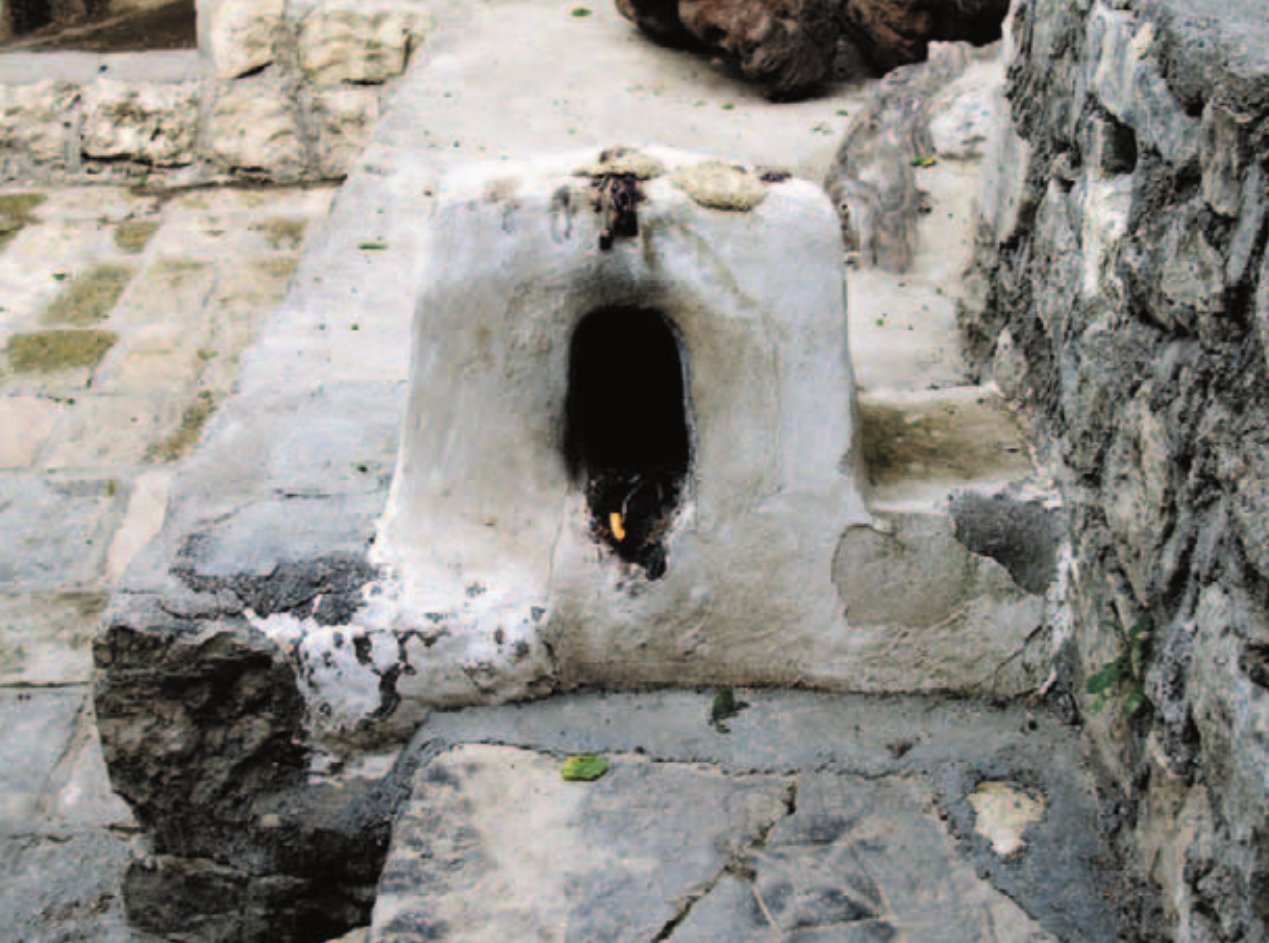
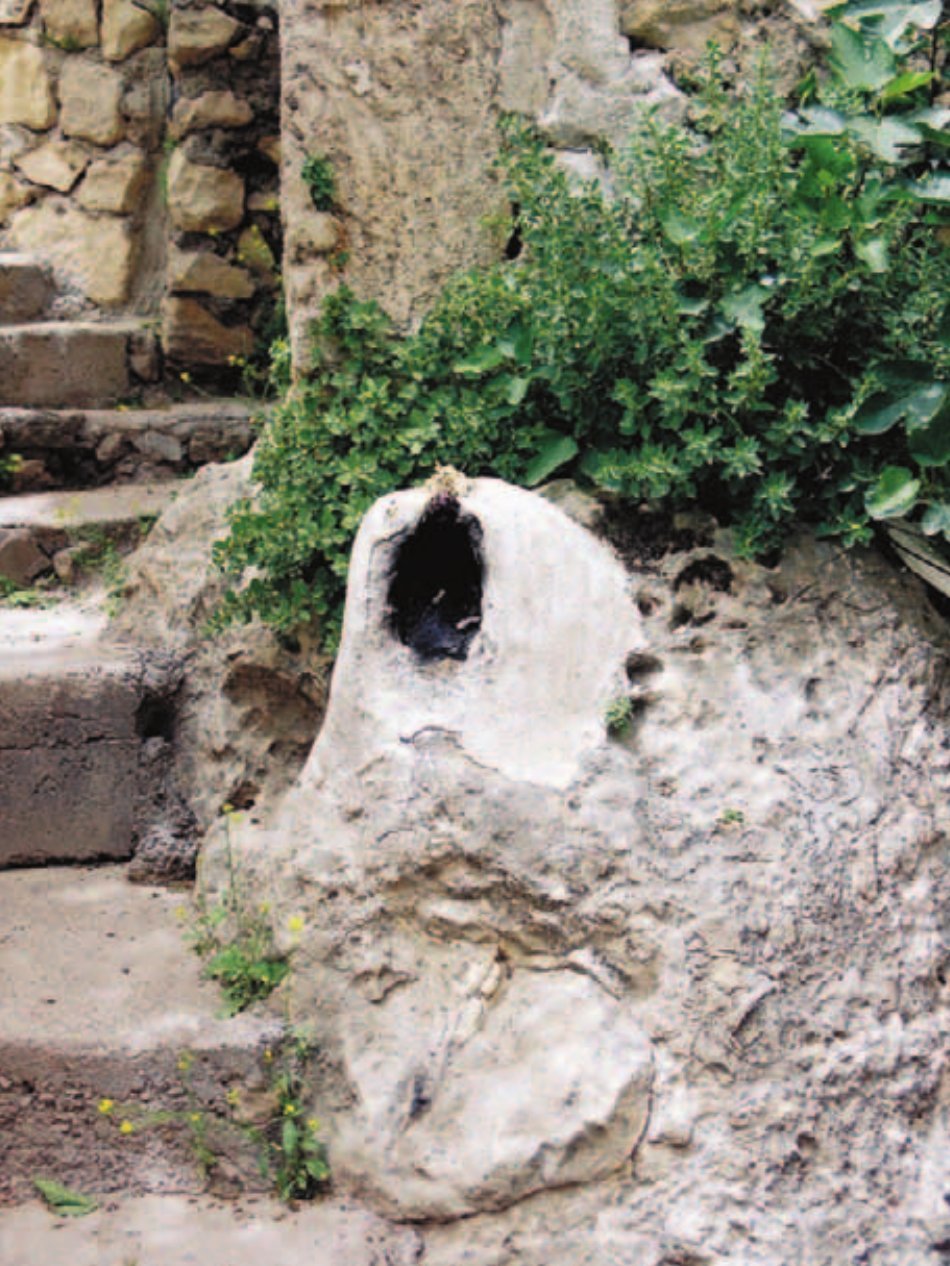
The water of the Kaniya Sipî flows into the courtyard Gaykuj, unites there with the Zimzim and leaves the holy precinct under the Pira Selatê; after that its holiness ends (Gaykuj, Other springs).
Sources
- S. A. Grigoriev, L. V. Ivasko, D. V. Pirbari (P’îr Dîma): Lalişa Nûranî / Святой Лалыш / Holy Lalish. Yekaterinburg: Basko 2008, p. pp. 20–21, 26–29, 33–37, 50–54, 78, 90, 202–203
- Philip G. Kreyenbroek, Khalil Jindy Rashow: God and Sheikh Adi Are Perfect. Sacred Poems and Religious Narratives from the Yezidi Tradition. Wiesbaden: Harrassowitz 2005, p. pp. 11, 14–16, 18, 27–30
- Dimitri Pirbari (P’îr Dîma), A. Ščedrovickij: Тайна жемчужины (The secret of the pearl). Moscow/Tbilisi 2016, p. pp. 41, 78, 130, 247
- Şêx Mak’sîm (Maksim Ezdi): Grundpfeiler der Religion ScherfeDin, 2017 (on EZDIKI.COM in the Religion section and in the library), p. pp. 36, 175
- Khanna Omarkhali: The religious textual tradition of the Ezidis – from the oral to the written. Saint Petersburg 2023 (Russian translation of the English original, Wiesbaden 2017), p. pp. 14 (n. 11), 139 (n. 49)
- C. J. Edmonds: A Pilgrimage to Lalish. London (Royal Asiatic Society) 1967, p. p-023, p-032, p-060
- Birgül Açıkyıldız: The Yezidis. The History of a Community, Culture and Religion. London 2010, p. pp. 129, 190–191
Found a mistake?
Is something wrong – a fact, a spelling, a source, an image? Let us know: we check every report and correct the article.
Other spellings: Kaniya Spi · Kani Sipi · Weiß Quelle · Kaniya kecika · Kaniya ketschika · Kaniya kechika · Lalish · Lalisch · Lalesh · Qawl · Qaul · Kewl · Xirqe · Kherqe · Khirqa · Qawwal · Kawal · Kewal · Sanjaq · Sandschak