
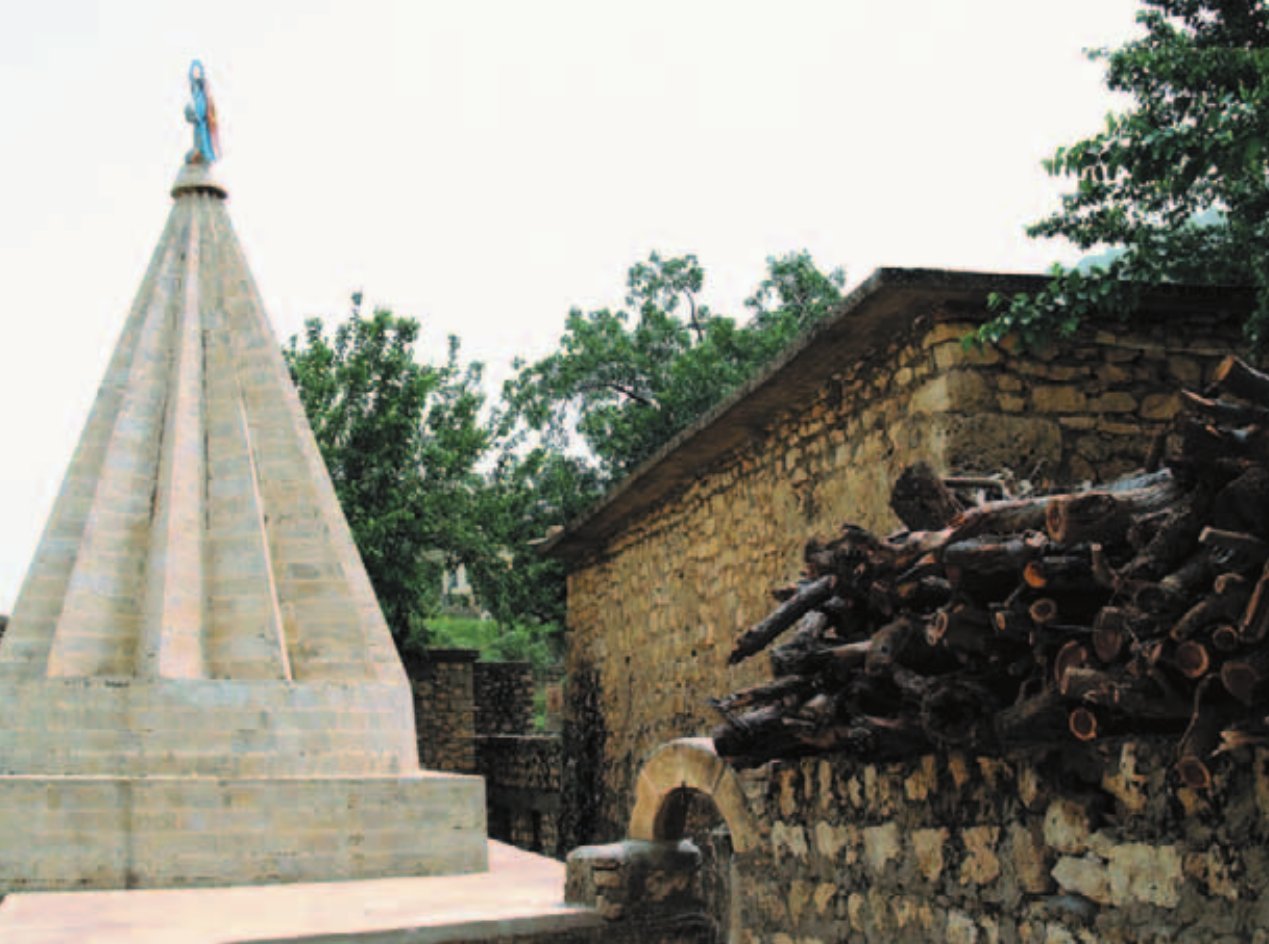
Gaykuj is the name of a large courtyard in the main building of Lalîş. The name is composed of ga ("bull") and kuj ("kill"): it is the place where the sacrificial bulls were slaughtered (Lalişa Nûranî). Here, moreover, the two holiest springs flow together, here the holy food was cooked, and here the black Xerqe of the Feqîr is dyed.
The springs flow together
In the Gaykuj the waters of the Kaniya Sipî and the Kaniya Zimzim unite. Small basins with water of the Kaniya Sipî are called Merzêd Behrê, "boundaries of the sea" (Lalişa Nûranî). According to the English version, the united water then flows under the Pira Selatê out of the temple precinct. → Kaniya Sipî, Kaniya Zimzim
The tomb of Adam
In front of the basins lies a hidden tomb. According to Ezidi belief it is the tomb of Adam (Lalişa Nûranî). This fits the tradition that the garden of paradise lay in the valley of Lalîş (Name and tradition).
Birka Gaykujê – sacrifice and Simat
In former times bulls and sheep were slaughtered here on festival days and distributed as Xêr (gift for the deceased) and Qurban (sacrifice). In large cauldrons over fireplaces Simat and Şîlan were cooked, the holy communal food (Lalişa Nûranî). According to the English version, the Simat consists of meat and Savar (bulgur) and is distributed to pilgrims and the poor; every spring the servants carry firewood here on their backs. Edmonds describes the Gaykuj in 1944 as an open-air kitchen with stacks of firewood and cauldrons; above it, as a veranda, lies the hall of Şerfedîn.
The bull of Şêşims
During the Cejna Cimaiyê the bull, the gayê Qebaxê, is led through this courtyard to the Sêdera Şêşims and slaughtered there (Lalişa Nûranî, p. 30). There are different statements about the day: according to Lalişa Nûranî it is the fourth day of the festival, according to Kreyenbroek the fifth. → Sanctuary of Şêşims, Cejna Cimaiyê
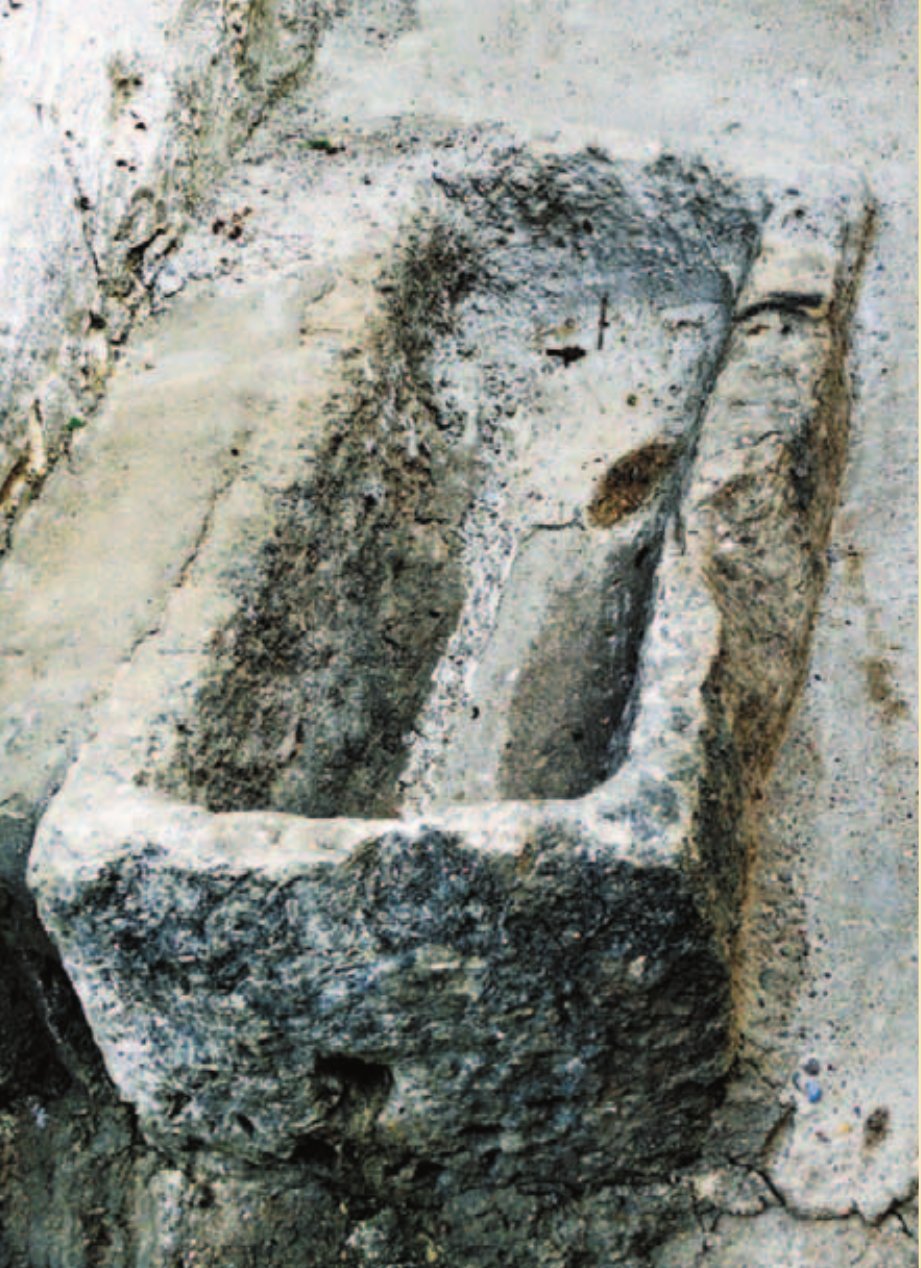
For smaller sacrifices there is a separate stone trough in Lalîş, the Hewda Melek Fexredîn, at which sacrificial lambs are slaughtered in honor of the saint (Lalişa Nûranî, p. 99).
Kela Xerqe – where the Xerqe is dyed
In the Gaykuj there is also the Kela Xerqe (Kele Xerqe). Here twigs and leaves of the Zergûz tree are boiled; in the brew woolen yarn is dyed black, and from it the Xerqe is knitted, the black garment of the Feqîr (Lalişa Nûranî). According to the English version, the Xerqe boils for two days and turns black or dark brown; Zergûz is a kind of walnut tree that bears no fruit. The list of wicks also names a wick of its own for the Kele Xerqe.
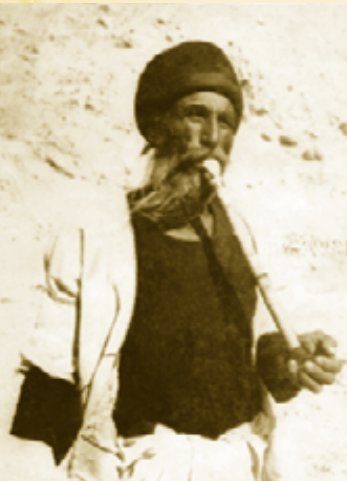
On the Xerqe as a holy garment see Holy clothing, on the tree Holy trees.
Sources
- S. A. Grigoriev, L. V. Ivasko, D. V. Pirbari (P’îr Dîma): Lalişa Nûranî / Святой Лалыш / Holy Lalish. Yekaterinburg: Basko 2008, p. pp. 26–35, 204–206
- Philip G. Kreyenbroek, Khalil Jindy Rashow: God and Sheikh Adi Are Perfect. Sacred Poems and Religious Narratives from the Yezidi Tradition. Wiesbaden: Harrassowitz 2005, p. pp. 16–17, 38
- C. J. Edmonds: A Pilgrimage to Lalish. London (Royal Asiatic Society) 1967, p. p-028
Found a mistake?
Is something wrong – a fact, a spelling, a source, an image? Let us know: we check every report and correct the article.
Other spellings: Birka Gaykuje · Merzed Behre · Kela Cherqe · Kela Kherqe · Kele Cherqe · Kele Kherqe · Kel Xerqe · Kel Cherqe · Silan · Schilan · Shilan · Xirqe · Kherqe · Khirqa · Lalish · Lalisch · Lalesh · Faqir · Fakir · Sinjar