
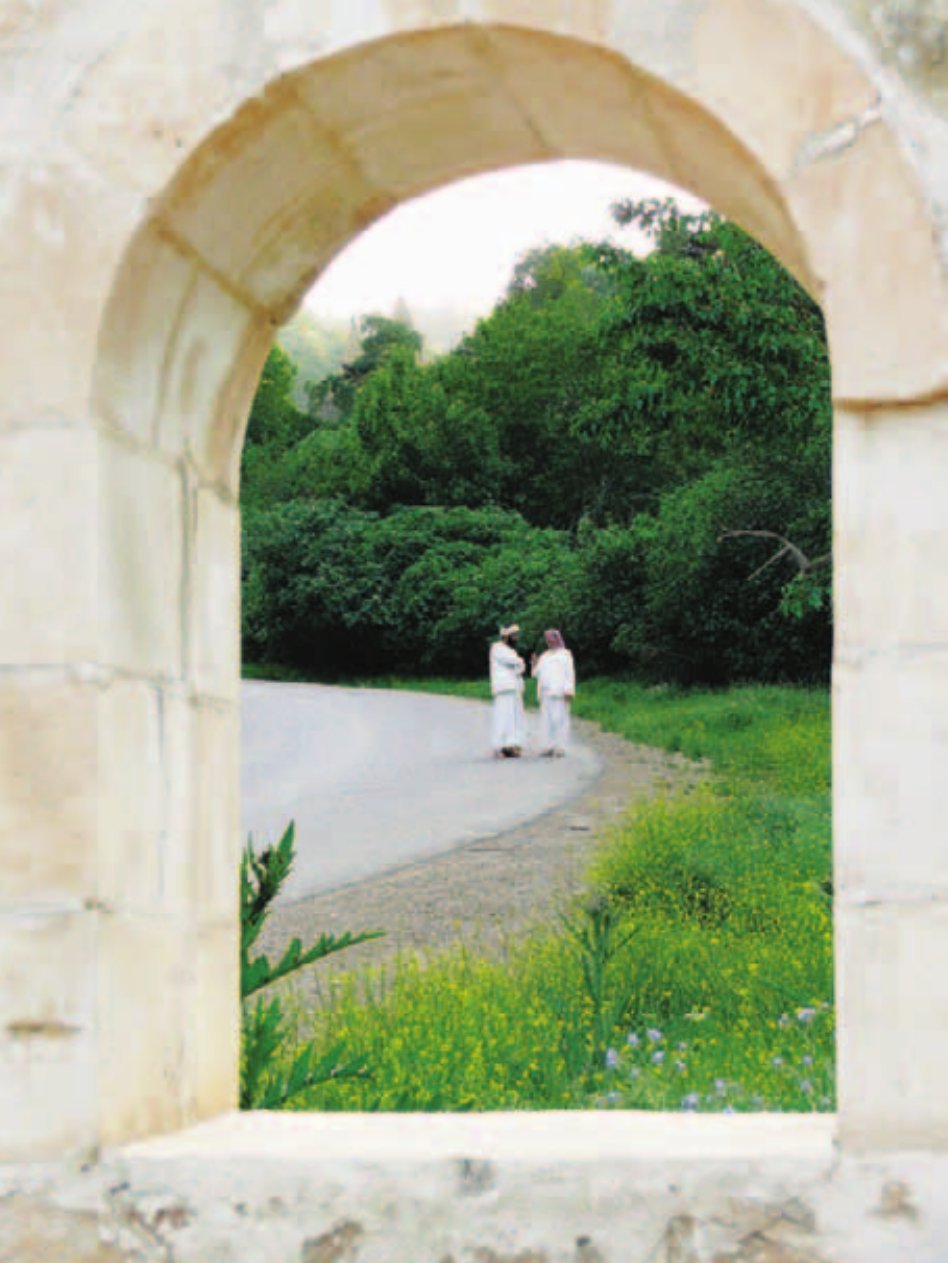
The Pira Selatê (also Pira Silatê, Pira Sirat) is a small stone bridge over the stream that flows out of the valley of Lalîş. It marks the boundary of the holy precinct: here the pilgrims take off their shoes. At the same time it stands for the bridge of the hereafter that every soul must cross after death.
The bridge in belief
According to belief, after death the soul is brought to the Pira Selatê. If it is good and God is satisfied with it, the bridge becomes wide; if it is bad, the bridge becomes hair-thin, and the soul falls down (Lalişa Nûranî). The bridge in Lalîş is the earthly image of this bridge (Kreyenbroek).
Who helps the soul on the bridge, the sources agree: the brother of the hereafter.
- According to Şêx Mak’sîm, the Birê Axiretê (a Şêx or P’îr) leads the soul across the bridge, which he calls P’ra Serhatê.
- According to Pirbari, the Ezidi crosses the bridge with the help of the birayê axretê.
- In the Qewlê Seremergê, translated by Kreyenbroek, the Zebanî bring the soul to the bridge Sirat; on one side lies paradise, on one darkness, on the third hell; the friends and brothers of the hereafter help their sinful brothers.
The whole path of the soul is described in The path of the soul through Lalîş; see also Brother and sister of the hereafter.
Customs at the bridge
- Before the Pira Selatê one takes off one's shoes and enters the holy ground barefoot (Lalişa Nûranî).
- Pilgrims must cross the bridge three times running (bi rev) (Lalişa Nûranî).
- In 1944 Edmonds saw arrivals run across the bridge, back and across once more, then descend to the stream and wash. They kissed a capstone or touched it with the right hand and brought the hand to their lips; some afterward stuck an olive twig in their turban. The bridge and a niche in a rock beside it belonged to the seventy holy stations that the pilgrims visited during the seven festival days. On the way home, too, most stopped at the bridge.
- Edmonds calls it the "Old Bridge" or "Bridge of Prayer".
Location and form
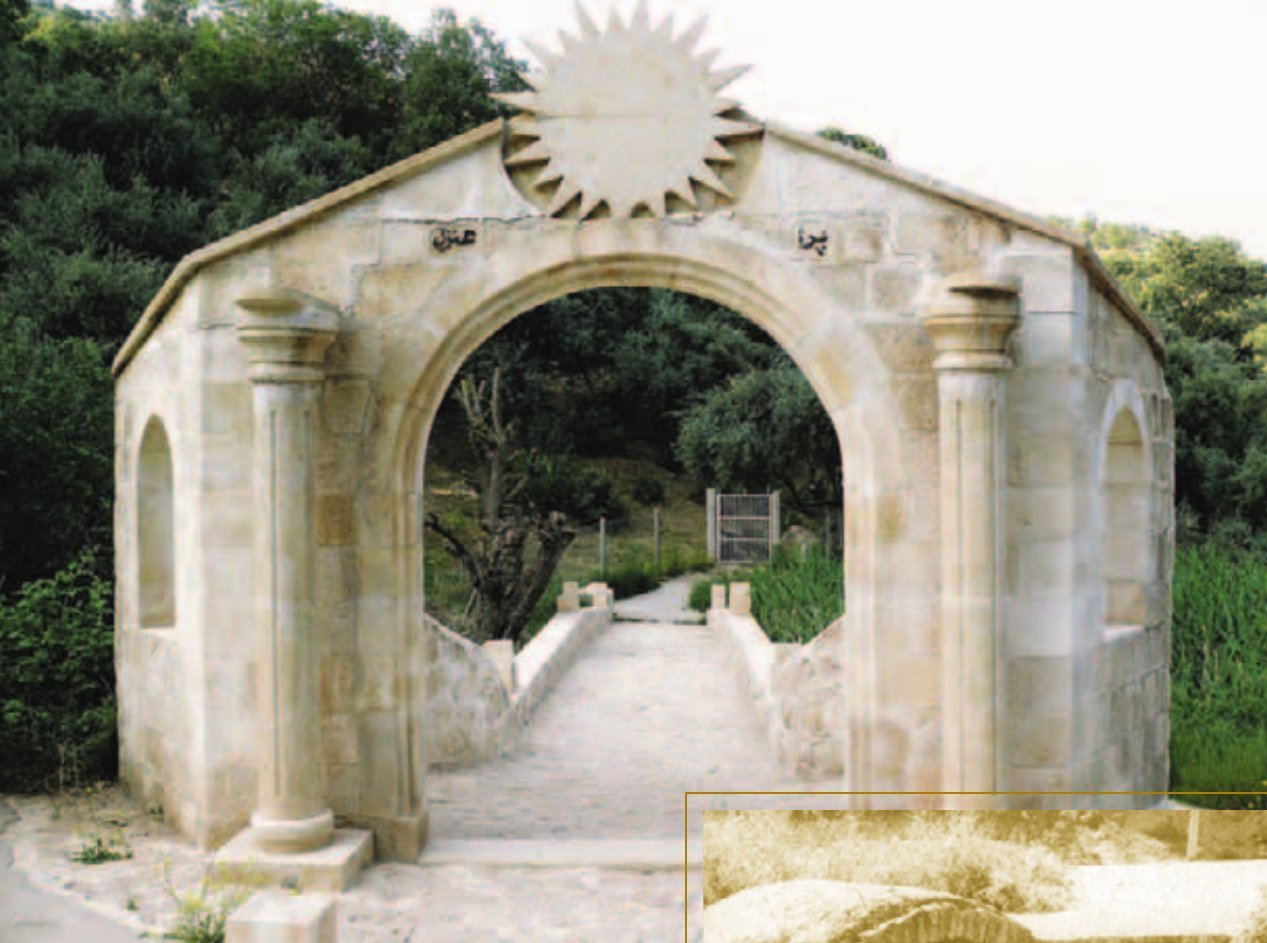
The bridge lies over the water that flows out of the valley, about 1 km from the Xana Êzîd. According to the text in Êzdîkî it is 10 m long, 3 m wide and 2 m high (Lalişa Nûranî). Beneath it the united water of Kaniya Sipî and Zimzim flows out of the temple precinct; nearby lie the Kaniya Şivana and the tree Dara Zergûz. After the bridge the holiness of the water ends (Other springs).

Rebuildings
The bridge was renewed several times. The text in Êzdîkî regrets that "a few years ago" it was built differently and the old form was lost. According to the captions it was built in 1980 on the old model and renewed in 2004, now with an archway and a sun symbol above it.
Sources
- S. A. Grigoriev, L. V. Ivasko, D. V. Pirbari (P’îr Dîma): Lalişa Nûranî / Святой Лалыш / Holy Lalish. Yekaterinburg: Basko 2008, p. pp. 20–23, 28–30, 36–37, 106–107
- Philip G. Kreyenbroek, Khalil Jindy Rashow: God and Sheikh Adi Are Perfect. Sacred Poems and Religious Narratives from the Yezidi Tradition. Wiesbaden: Harrassowitz 2005, p. pp. 14, 38–39, 349
- Dimitri Pirbari (P’îr Dîma), A. Ščedrovickij: Тайна жемчужины (The secret of the pearl). Moscow/Tbilisi 2016, p. pp. 87, 253
- Şêx Mak’sîm (Maksim Ezdi): Grundpfeiler der Religion ScherfeDin, 2017 (on EZDIKI.COM in the Religion section and in the library), p. pp. 75–77
- C. J. Edmonds: A Pilgrimage to Lalish. London (Royal Asiatic Society) 1967, p. p-022, p-036
- Birgül Açıkyıldız: The Yezidis. The History of a Community, Culture and Religion. London 2010, p. pp. 129–130 (text and ill.)
Found a mistake?
Is something wrong – a fact, a spelling, a source, an image? Let us know: we check every report and correct the article.
Other spellings: Pira Silate · Pira Serhate · Brüdschke des Gebets · Brüjke des Gebets · Brück des Gebets · Brüdschk des Gebets · Lalish · Lalisch · Lalesh · Sheikh · Scheich · Shex · Pîr · Serhed · Serhat · Serhad · Qewl · Qawl · Qaul · Kewl