
In the Ezidi view the body is made of earth and becomes earth again; only the soul is eternal. To prepare the last journey for one's parents, so that their soul passes over the Pira Silatê – the bridge between this world and the hereafter – is regarded as the most important duty of every child.
The Ferz of the deceased
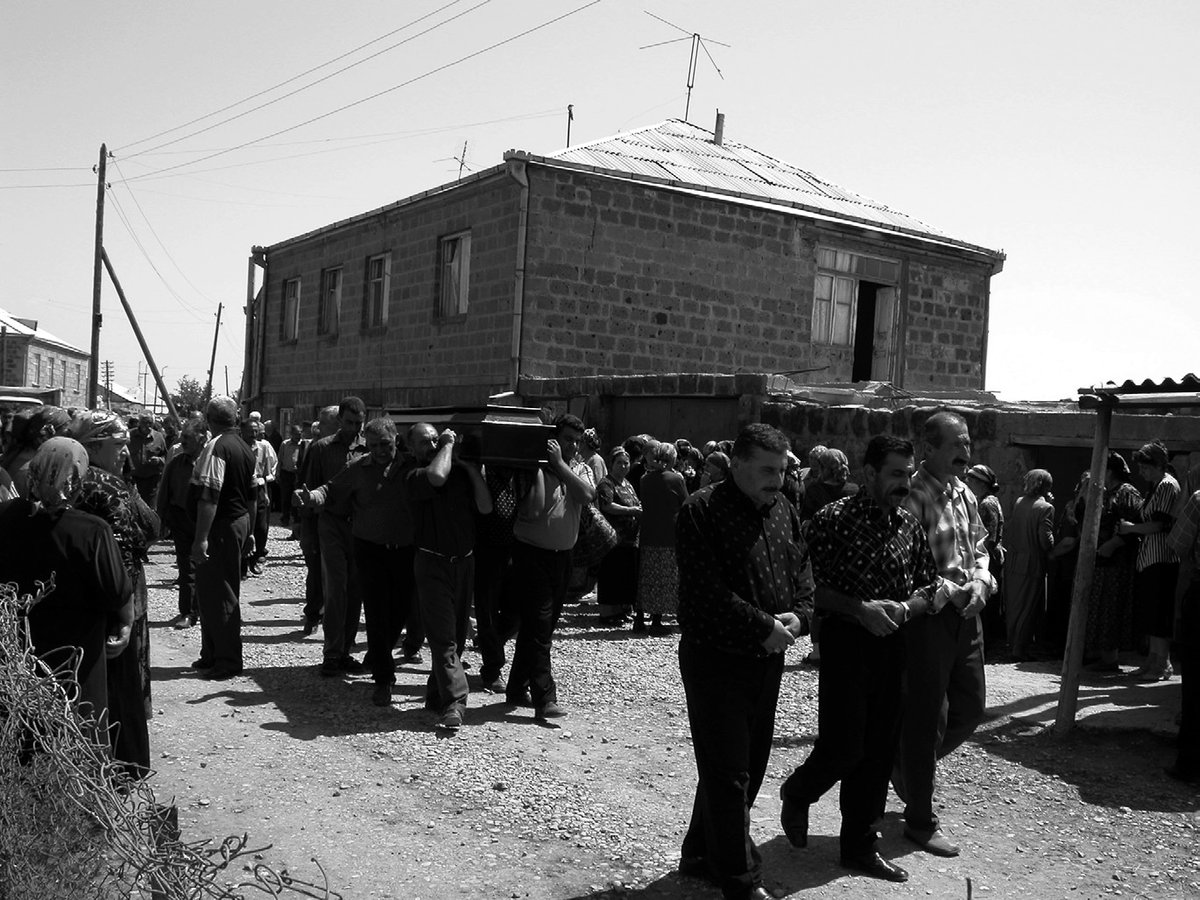
At the burial the Ferz of the deceased must be present: his rightful Şêx and P’îr, who have gone through the Dest Danîn. They perform all the rites. On the day of death a sacrifice is made in honor of the archangel Nasirdîn, the angel of death. For three days the Ferz pray three times daily – morning, noon and evening.
Morkirin – the washing of the dead
On the third day, early in the morning when the morning star (Stêra Sibê) rises, the Şêx and P’îr wash the deceased with a bowl of water in three passes: from the head to the navel, from the navel to the feet and from the head to the feet. In doing so the prayer Morkirin is spoken.
Kefen – the shroud
Afterwards the dead person is wrapped in a white shroud (Kefen). According to Perminov's book, by tradition it is 11.5 or 13.5 meters long. From then on the deceased may no longer be touched.
Originally the burial took place on the same day. In the Soviet period the time was extended to three days, because the relatives lived widely scattered.
Girîvan – the knot
Before the coffin is closed, the Birê Axretê (Şêx or P’îr) performs the rite Girîvan: at the head end a part of the Kefen is knotted three times and untied again – the third time the knot remains.
The way to the grave
On the way to the cemetery seven loaves are carried in front – in honor of the seven archangels and baked from seven ingredients. The Ferz pray until the grave is completely covered with earth. Then two stones (today mostly bricks) are laid on the grave three times and taken off again; the third time they remain: the Kêlik.
Xêr – the funeral meal
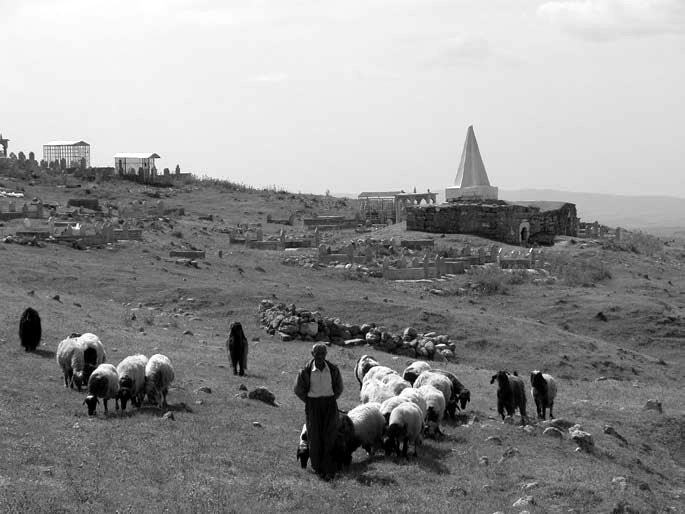
The burial is followed by the funeral meal (Xêr). For three days a small fire is lit on the grave. On the seventh day there is again a Xêr – the mourning period lasts seven days. On the first anniversary the memorial meal Xêra Serê Salê is obligatory.
At the funeral meal and the annual commemoration above all Xaşlama (boiled beef from a freshly slaughtered bull) and Birinc (seasoned rice) are served.
Blue is regarded as the color of mourning.
Burial according to Rudenko (1972)
The orientalist M. B. Rudenko recorded the burial customs of the Ezidis in Georgia and Armenia in detail in 1972. Her description supplements the information above in many details.
At the hour of death
When death is near, the closest relatives gather and remain silent until the end. The Şêx or P’îr of the dying person is fetched at once – his brother of the hereafter. He sits at the head, speaks quietly with him and speaks the prayers for the dying. A proverb known only among the Ezidis says that the Şêx and P’îr are the knife that cuts the thread of the soul. In a hard death struggle (du ruh bûn, “having two souls”) a sack turned inside out is carefully laid on the dying person.
Laying out
The dead person is dressed in clean clothes and laid out on a hard bed with the head toward the east, toward the rising sun. Arms and legs are crossed – for men the right side lies on top, for women the left. Relatives comb him; beard and mustache are shaved, except for gray-haired old men and clergy. Weeping and the lament for the dead begin at once. Women scratch their faces, tear their hair and beat their heads and breasts. With sunset every lament ends.
Washing and shroud
There is no special group of washers of the dead. Three or five persons – always an odd number – from the family of the brother of the hereafter do the washing; a man washes a man, a woman a woman. The dead person lies on a broad board, often a door taken off its hinges. One pours, one turns, one washes, without soap and with lukewarm water: the first jug on the head, the second on chest and belly, the third on the feet. The jug is then broken and the shards are thrown into running water.
For the shroud 11 to 15 meters of white cotton cloth are taken, which is not cut but torn by hand. Someone from the family of the brother of the hereafter sews it with a new needle, which is thrown away afterwards. From the same cloth are made the “shirt of the Day of Judgment” (kirasê qiyametê) and an unsewn short vest. The shroud is not sewn shut at the head end but drawn together with a band; the brother of the hereafter ties the knot. After that laypeople may no longer touch the dead person.
The way to the cemetery
The wooden bier with four handles (darbest, tabût; today a coffin) is lifted and set down three times, then carried out. In doing so the relatives touch the foot of the dead person and lay their hand on their heart. The dead person is carried head first so that he sees who accompanies him. According to a P’îr, formerly at the death of the master of the house a relative carried seven round loaves in front, which were distributed to the poor at the cemetery – this corresponds to the seven loaves in Perminov. Then follow the Şêx and P’îr, the bier and all those close to the deceased, including the women.
The grave
The grave is dug on the day of burial, about two meters deep. Any neighbor may dig, but he must be an Ezidi; no payment is taken for any service at the burial. Two flat stones are laid over the head of the dead person. According to popular belief, the dead person wants to get up to follow those leaving, bumps against the stones and so realizes that he has died.
At the grave the brother of the hereafter opens the band so that the relatives can take leave; the dead person is not kissed. Then he is lowered into the grave without ropes. Two clergy – Şêx and P’îr – speak a secret prayer of committal to the earth. Everyone throws a handful of earth into the grave; the shovel is not passed from hand to hand but first laid on the ground. There are no grave goods. At the head and foot two tall stones are set up, which are exchanged three times before finally being set – the Kêlik (see above). Mother, wife, daughter and sister cut off their braids and hang them on these stones.
Before leaving, a fire is lit on the grave; at home a lamp burns at the place where the dead person lay, and the women sweep and wash this spot. Formerly, at the death of a particularly respected person, according to a P’îr, Qewal also came with frame drum (def) and flute (şibab) and sang a religious song.
After the burial
For three days no fire is made and no cooking is done in the house of mourning; neighbors bring food. Condolences, the memorial meals on the 7th and 40th day and after one year, the day of remembrance roja mezela and the end of mourning are described in the article Days of remembrance for the dead. At the death of a brave man his horse was led in a circle on the day of burial – the Kotel.
A funeral in the Kars region (1915)
S. M. Polatov describes the funeral of the Sîpkî elder Usoyê Polat in the village of Susiz in June 1915. Instead of the colorful silk scarves, the men wound black cloths around their caps. Arriving guests tied a black mourning banner to a tree at the entrance of the village; a Dengbêj received each group with a lament. For three days the funeral procession moved across the meadow to the singing of laments. On the third evening the Şêx and P’îr washed the dead man and dressed him. On the coffin – then a rarity, from a neighboring Armenian village – lay 38 cut-off women's braids. Four men carried it, the Şêx and P’îr in front with chants. At the grave elders gave speeches; afterwards the guests were distributed among the houses and entertained in the open air. Members of many Ezidi tribes and Armenians of the neighboring villages had come.
Differences between the sources
- Timing: According to Rudenko, the whole burial must be carried out on one day. Perminov likewise names the day of death as the original date, but describes the washing on the morning of the third day; he attributes the extension to three days to the Soviet period. Polatov already describes a three-day mourning before the burial in 1915.
- Washing: Perminov describes the washing in three passes with a bowl, Rudenko with an odd number of jugs.
- Shroud: 11.5 or 13.5 meters in Perminov, 11 to 15 meters in Rudenko.
- Fire on the grave: according to Perminov for three days, according to Rudenko once before leaving the grave.
- Mourning period: seven days according to Perminov; according to Rudenko, women wear a black headscarf for a year and men do not shave for 40 days.
Additions according to Omarkhali (2005)
Khanna Omarkhali gives further details and names in her dictionary of Ezidi terms:
- Who must be present: At the burial the Şêx, the brother of the hereafter, the P’îr and also the Merebî (teacher) of the deceased must be present. They wash the dead person to certain hymns. Relatives may help with the washing, but the first three jugs are poured by a Şêx or P’îr. According to Omarkhali, no burial is possible without a P’îr.
- Clothing of the dead: Under the shroud the dead person wears the white cotton shirt Kirasê qiyametê (“shirt of the Day of Judgment”), whose cloth may not be cut, only torn with the hands, and over it the short sleeveless vest Qerqere of white calico. This corresponds to the “shirt” and the “unsewn vest” in Rudenko.
- Çardar (“four poles”, also darbest): the wooden bier with four handles on which the dead person is carried to the cemetery.
- Kevirê selîmê: the flat, rectangular stone laid in the grave over the head of the dead person. According to popular belief, the soul follows the funeral procession and does not yet know what has happened; when everyone leaves, the dead person wants to get up, bumps his head against the stone and realizes that he has died.
- Prayer of committal to the earth (duaya t’esmîlê erd): it is spoken at the funeral.
- Fire: On the first evening after the burial a fire of dry twigs is always lit on the grave.
- Şîvxelk: the memorial meal on the evening of the day of burial.
On the later memorial meals see Days of remembrance for the dead, on the tombs in animal shape Gravestones and tombs.
Mourning songs only at the burial
The brothers Ordîxanê and Celîlê Celîl observed in their collecting work that mourning songs (stranê şînê) are sung only at burials; outside the ritual nobody performs them. To record them, respected older people had to persuade a female lament singer specially. In 1975 they recorded in Tiflis 96 mourning songs of the well-known lament singer Hizreta Heso. Their archive also holds a tape recording of the laments at the burial of the storyteller E’tarê Şero, who died in Yerevan in 1974. At the burial of respected, meritorious men – not of women, children and young people – a particular Qewl (the “Qewlê bore-borê”) is performed at the family's request by two to three singers alternately. On the kinds and performance of the laments see Lament for the dead.
Performance at the funeral and at the grave according to Omarkhali (2023)
In her book on the oral tradition, Khanna Omarkhali describes who performs at burial and mourning and how – the content of the texts belongs to the section Religion.
- At the funeral (ser miriya) two, rarely three persons perform at the same time; in Armenia usually a Şêx and a P’îr. Those present are silent, no questions are asked.
- At the grave (ser mezela) in Armenia and Georgia two or three clergy always perform a particular Qewl together (the Qewlê Bore-borê, see above).
- In funeral processions in Armenia and Georgia Beyt were also performed until the 1970s; today only the most important Qewl. Which texts are chosen depends on whether a man or a woman has died.
- In Iraq the men do not go to the grave again after the funeral. After the funeral the men hold, in the presence of the women, an assembly of their own with recitation (Sema Miriya); its form depends on which Şêx house the deceased belonged to.
- At the first visit to a family after a death, Qewl are likewise performed.
- In the diaspora, knowledgeable laypeople exceptionally also take over the performance at burials; traditionally laypeople do not carry out rites.
At a funeral ceremony at home in a village near Nizhny Novgorod (Russia), Omarkhali observed that the performing P’îr sat in the middle and the men on chairs along the walls.
Times of lament
According to Omarkhali, laments for the dead are performed at fixed times: before going to the cemetery, at the cemetery, after the funeral, afterwards in the house, on the third and the 40th day and after one year (see Lament for the dead and Days of remembrance for the dead).
Cemeteries in the diaspora
According to Omarkhali, there are today separate Ezidi cemeteries in cities of Russia, Ukraine and Germany with large Ezidi communities.
Burial in Şengal and Syria according to Lescot (1936)
Roger Lescot describes the burial among the Ezidis of Şengal; in the Afrîn area and the Djebel Sim'ân in Syria it was, according to him, the same.
- Washing: The Şêx and P’îr come at once to the house of mourning and wash the dead person. According to Lescot's informants, they put a little earth from the sanctuary of Şêx Adî into his mouth; Lescot himself reports this only with reservation.
- Shroud: Women dress the dead person and sew him into a white shroud, among the Feqîran into black wool. At the feet a small opening remains. The Şêx tears the cloth above the head and knots the strip – this corresponds to the knot (Girîvan) in the descriptions from the Caucasus.
- Funeral procession: The dead person is carried on a bier; wives and daughters follow and sing laments.
- Grave: Burial takes place near the village, by the local sanctuary (ziyaret) or in the open field, in a pit 1–1.5 m deep, with the head to the west and the face to the east. The dead person is covered with flat stones and small pebbles, then wet earth on top. On top stands a row of upright stones 20–30 cm high, at the short sides two elongated slabs. Lescot published drawings of a grave in Şengal and of one in the Djebel Sim'ân. Since the First World War the wealthy in Syria had more elaborate graves built, for example Derwîş axa.
- Gifts and meals: At the grave bread and figs are laid down for the poor and travelers. After a week the family holds a meal. After 40 days an animal is sacrificed at the grave and the meat distributed to passers-by; likewise at the festival of the dead.
- Festival of the dead (Îda Dalîyê): It moves through the year and lies for three years each in April, in the first month of summer, at the beginning of autumn and in December. It lasts 5–10 days; gifts are laid on the graves, and whoever has lost a relative during the year gives the poor a meal. The first fruits of every harvest are intended for the dead.
Discrepancies
- Depth of the grave: about two meters according to Rudenko (Caucasus), 1–1.5 m according to Lescot (Şengal).
- Shroud: According to Rudenko it is drawn together at the head end with a band; according to Lescot the Şêx tears it above the head and knots the strip. Among the Feqîran in Şengal it is, according to Lescot, of black wool.
- Memorial meals: Lescot names the meal after one week and the sacrifice after 40 days – this agrees with the information from the Caucasus (7th and 40th day).
Funeral customs in the Erivan Governorate according to Yeghiazarov (1884)
S. A. Yeghiazarov describes the funeral customs of the Ezidis in the Erivan Governorate around 1884; in addition he reproduces the report of the district chief of Etchmiadzin (from 1874).
- Grave: The dead person lies in the grave chamber with the face to the east and the hands on the chest (p. 193); according to the report from Etchmiadzin the hands are laid crosswise on the chest (p. 228–229).
- Gravestones: According to Yeghiazarov, the Ezidis there set no gravestones; their cemeteries looked outwardly like those of their neighbors (p. 193).
- The Şêx's fee: For the burial the Şêx received money and the clothing of the dead person (p. 229, Etchmiadzin report).
- Memorial meals: In the first year there were three memorial meals: on the 3rd or 7th day after the funeral, after three months and after one year. The annual meal was the most solemn (p. 193).
- The share of the dead: A wealthy Ezidi “carried out the share of the dead”: for a whole year, morning, noon and evening, one portion of food and two loaves each (p. 193).
Discrepancies
- Gravestones: Yeghiazarov writes in 1884 that the Ezidis set no gravestones. The other sources of this article, by contrast, describe the two tall stones Kêlik at the head and foot, and there are distinctive Ezidi tombs (see Gravestones and tombs). Whether Yeghiazarov meant only dressed gravestones or the custom differed by region and period, the source does not say.
- Days of remembrance: Yeghiazarov names the 3rd or 7th day, three months and one year; the later sources the 7th and 40th day and one year (see Days of remembrance for the dead). Yeghiazarov does not mention the 40th day.
- Position of the dead: Yeghiazarov for the Caucasus and Lescot for Şengal agree in naming the face to the east.
Burial in Şêxan around 1940 according to Drower
A Şêx in Lalîş described the procedure to E. S. Drower in 1940 (Peacock Angel, 1941):
- The Şêx and P’îr wash the dead person with soap and warm water and lay earth from Lalîş (berat) on his eyes. The women dress him.
- The shroud consists of nine dra‘ (ells) of calico. The Şêx and P’îr sew it into a sack and tie it with a torn-off strip of the same cloth.
- The dead person is carried on a bier.
- For women the grave is so deep that it reaches the gravedigger's neck, for men his chest. Small walls are set at the sides, a niche behind the head. The dead person is laid on his side, facing east; stones are placed over him, then earth.
- Signs of mourning: Widows laid their cut-off braids on their husband's grave.
- Graves mostly had rough stones at the head and foot; some were walled and bore a marble slab with an Arabic inscription and date of death. All were oriented to the east. On images on gravestones see Gravestones.
On the remembrance of the dead on the eve of the New Year festival – lament of the women at the graves to the music of the Qewal, bulgur and colored eggs on the graves – see Sersal in Başîqa 1940. In 1945 Edmonds heard flutes and drums at a funeral in Başîqa (see Başîqa and Bahzanê).
Burial in Lalîş according to Layard (1846)
According to Layard, in 1846 only the supreme Şêx (Baba Şêx) and the chiefs were buried in Lalîş.
Rules according to Hesenê Şêx Kelaşê (1995)
The Şêx Hesenê Şêx Kelaşê from Şamîran describes the path of a dead person as he learned it:
- One's own T’irêq: Washing (morkirin) and shroud (kefen) are the business of one's own Şêx and P’îr, with whom the deceased was bound in his lifetime by Xerqe and Kulik. Service by other T’irêq, he says, is worthless for both and a sin (Qewlê Bawu-Bek’re Omera 17–18).
- Şehdetî first: Before the washing the T’irêq himself speaks the Şehdetî. Whoever cannot do so “cannot make himself pure – how then the dead?”
- Face: Until the washing the face of the dead person should remain covered; only close relatives may see it briefly. After the wrapping it is no longer uncovered, otherwise the dead person is regarded as unwashed.
- Kefen is obligatory (Qewlê Seremergê 32), washing is done with warm water (Seremergê 33).
- The procession to the grave: Only the T’irêq walk in front of the bier and speak Qewl; all others walk behind, for “one should not hurry into his house ahead of the dead” (Seremergê 38).
- In the grave the brother of the hereafter opens the knot at the head (Seremergê 44). Two stones (serkêlik) are what make the grave a grave (Seremergê 41). Earth is thrown against the wall of the grave; at the end a fire is lit on the grave – as a reminder that man is made of earth.
- During the Qewl no one should smoke, sit or put his hands behind his back, and no digging is done. At the end one T’irêq stays at the grave with a relative and speaks three times the prayer of committal to the earth (Du’a teslîmkirina e’rdê, addressed to “Dewrêş E’rd” = Şêxûbekir).
- Mourning: According to his teaching, the black clothing of the women and the not-shaving of the men end with the first Xêr; long, heavy mourning is a sin and a burden for the soul. At night the mourners may sleep. Young women who wear black for a long time after the manner of neighboring peoples are, in his view, imitating a fashion.
Source: Hesenê Şêx Kelaşê, Rê-rizma mileta Êzdî angorî qirarê dîn, Şamîran 1995. The author supports almost every rule with a stanza from a Qewl or Beyt.
Sources
- Һ'әсәне Шех К'әләше (Hesenê Şêx Kelaşê, Hesen Hesenyan): Р'е-р'ьзма мьләте Эзди ангори qьраре дин (Rê-rizma mileta Êzdî angorî qirarê dîn). Şamîran 1995 (scan and new text edition in the EZDIKI.COM library), p. 12–24, 28–30
- A. V. Perminov: Езиды – древний народ Адаби (The Ezidis – the ancient people Adabi). Sharya 2016, p. 103–105, 108
- M. B. Rudenko: Обрядовая поэзия – Похоронные причитания (Ritual poetry – funeral laments). Moscow 1982, p. 58–69, 124–127, 138–140
- S. M. Polatov: Дети Солнца (Children of the Sun). Rybinsk 2011, p. 27, 153–156
- Khanna Omarkhali (Ханна Омархали): Йезидизм. Из глубины тысячелетий (From the depths of the millennia). Saint Petersburg 2005, p. 105, 121, 125, 127, 129, 136–137, 143–144, 155
- Ordîxanê Celîl, Celîlê Celîl: Zargotina K’urda, Part 1. Moscow 1978, p. 16, 23, 36, 44
- Ordîxanê Celîl, Celîlê Celîl: Zargotina K’urda, Part 2. Moscow 1978, p. 488–489
- Khanna Omarkhali: The religious textual tradition of the Ezidis – from the oral to the written. Saint Petersburg 2023 (Russian translation of the English original, Wiesbaden 2017), p. 66, 125, 129, 144–147, 151, 493
- Roger Lescot: Enquête sur les Yezidis de Syrie et du Djebel Sindjār (Study of the Ezidis of Syria and of the Şengal mountains). Beirut 1938, p. 72, 154–156, plate XV
- S. A. Yegiazarov (Егиазаров): Краткий этнографический очерк курдов Эриванской губернии – containing the ethnographic-legal outline on the Ezidis. Tbilisi 1884, p. p. 193, 228–229 (PDF p-097, p-114)
- E. S. Drower: Peacock Angel. Being some Account of Votaries of a Secret Cult and their Sanctuaries. London 1941, p. p. 36–37, 185–186 (PDF 51–52, 226–227)
- Austen Henry Layard: Nineveh and Its Remains, Vol. 1. London 1849, p. p. 293 (PDF 346)
- Birgül Açıkyıldız: The Yezidis. The History of a Community, Culture and Religion. London 2010, p. 114, 180 (ill.)
Found a mistake?
Is something wrong – a fact, a spelling, a source, an image? Let us know: we check every report and correct the article.
Other spellings: Sin · Schin · Shin · Girivan · Kelik · Xer · Cher · Kher · Pira Silate · Sheikh · Scheich · Shex · Pîr · Qawwal · Kawal · Kewal · Qers · Dengbedsch · Tbilisi · Tbilissi