
In October 1944 the British official Cecil J. Edmonds, then adviser at the Iraqi Ministry of the Interior, took part in the last four days of the autumn festival Cejna Cimayê in Lalîş. He kept a diary and published his account in 1967. This article reproduces only what Edmonds himself saw or what participants told him. His own interpretations and judgments about the religion are not adopted; what was prayed and what significance the acts have belongs to the section Religion.
For comparison: almost a hundred years earlier A. H. Layard described the same festival – see The festival in Lalîş 1849. The course of the bull sacrifice today is described in Qebax – the bull sacrifice.
Date and occasion of the visit
- According to Edmonds, the festival is celebrated every year from September 23 to 30 according to the old (Julian) calendar, which corresponds to October 6 to 13. The same date appears in the Iraqi holiday decree of 1960 (see The Şêxan Memorial 1930/31).
- He had been told that the last four of the seven days were the most impressive. He therefore came on the morning of October 10, 1944 and stayed until the 13th.
- As European eyewitnesses before him he knew only Layard (1846 and 1849) and two short picture reports in the British soldiers' magazine Parade (1943 and 1946), each of which describes only one day.
Journey and reception
- In the village of Bingalî, about four miles north-northwest of E’yn Sifnî (seat of the Şêxan district), a delegation received him: Şêx Hecî from the family of the Baba Şêx and the heads of the Mahirkan tribe from Şengal and of the Dumilî and Tirk tribes from Şêxan.
- From there they went on horseback northward through hills, along a brook with brambles and willows, past irrigated summer fields, then westward until the two white ribbed conical towers of the sanctuary came into view.
- Edmonds' tent stood in an olive grove by the single-arched stone bridge called the “Old Bridge” or “Bridge of Prayer” (the Pira Silatê). It marks the boundary of the sacred precinct, in which all Ezidis go barefoot.
Who came
- According to the participants, attendance in 1944 was smaller than usual. Reasons: wartime rationing – there was too little white calico for new festive clothes – and the recent death of Mîr Seîd Beg.
- A topic of conversation was the reorganization of the revenues of the sanctuary; the debts of the late Mîr were put at about 40,000 pounds.
- The guest was visited by the new Mîr Tehsîn Beg, according to Edmonds a boy of “about twelve”, with members of the Mîr family, and then by the Baba Şêx with his Koçek. On the terrace of Şêx Hesen the Mîr greeted him together with his grandmother Mayan Xatûn.
- The order and course of the festival were directed as Mîr Hec by a member of the Mîr family, in 1944 Selîm Beg, son of Çolo.
- Pilgrims came mostly in small groups of three or four, men and women, boys and girls. Rifle shots from the mountain announced latecomers.
Custom at the bridge
Newcomers ran across the bridge, back and across once more, then went down to the brook and washed. Many kissed a capstone of the bridge or touched it with the right hand and raised the hand to their lips; some then put an olive twig in their turban. According to Edmonds, the bridge and a niche in a large rock beside it belong to the seventy holy stations that the pilgrims visit once or several times during the seven days.
Clothing
| Group | Clothing in 1944 according to Edmonds |
|---|---|
| Baba Şêx and Koçek | white flowing robes, white turban and cloak; woven sash (stole) in orange or orange-and-black worn diagonally over shoulder and chest |
| Baba Çawîş | entirely orange stole |
| Feraş (manager of the kitchen) | black Feqîr clothing |
| Men from Şengal | tall conical felt caps (gim), long white robes |
| Men from Şêxan | white trousers, colorful Zouave jackets, turbans mostly red-and-white checked, some entirely white, a few Arab headcloths |
| Women from Şêxan | white skirt, colorful Zouave jacket, shawl (mêzer) of white hand-spun wool over one shoulder; small turban of dark silk with a crown of silver coins set in a spiral and strings of coins; necklaces of large beads (mostly amber and red), gold and silver jewelry on the chest; some with gilded jewelry over the right temple and with kohl around the eyes |
| Married women | narrow white cloth (leçek), bound into the turban and laid around the neck or mouth |
| Women of the Xuwêrkî (Şengal) | entirely white clothing, large white turbans |
Many men also wore a white band over the turban. It is handed out by the administrator of the sanctuary of Şêx Şems for the visit to the two holy springs – Kanîya Spî (it feeds the baptism house) and Zemzem (in the sanctuary). It is dipped into the water, worn all the way home and kept with the family treasures. More on costume: Traditional clothing.
The dance
- On a paved square by the springs (Edmonds calls it the “court of the fountains”) men and women danced together to double flute and drum (tumbilk). The dancers formed a circling, swaying line, holding each other's hands with interlocked fingers, arms stretched and pressed back, shoulder to shoulder. Edmonds took the figure to be the widespread dance Milanê.
- In the evening the dance continued in the dark, lit only by the spectators' candles; the line moved counterclockwise up the stairs and down again. The music played for an hour without a break. Young men tried to strike up a song but did not get far without a lead singer.
- On the afternoon of October 11 two small boys in the middle of the circle performed pantomimes, a “cockfight” and wrestling bouts in time to the music; afterwards young men danced more wildly.
- On October 12 Edmonds saw on the terrace of the baptism house the Govend, which he describes as a solemn religious dance with only a few dancers; it lasted only a short time. On dance in general see Instruments and dance.
October 10: the round of the Baba Şêx
The Baba Şêx, the Koçek and the Çawîş went in solemn procession to one of the stations: a stone in the side wall of the dancing square blackened with soot from oil lamps. The Baba Şêx received visitors in the “reception room of Fexredîn” in the northwest corner of the forecourt, sitting on the floor, with a long-stemmed pipe. The talk was of quarrels with neighbors, lawyers in Mosul and the local administration.
October 11: the Qebax
At about 11 a.m. the Qebax took place on the market square. Only the three tribes Mamûsî, Qaîdî and Tirk took part; according to Edmonds the Qaîdî and Tirk are mostly Mirîd of Ebû Bekr, the Mamûsî Mirîd of Îsmaîl, although the ceremony is connected with Şêx Şems.
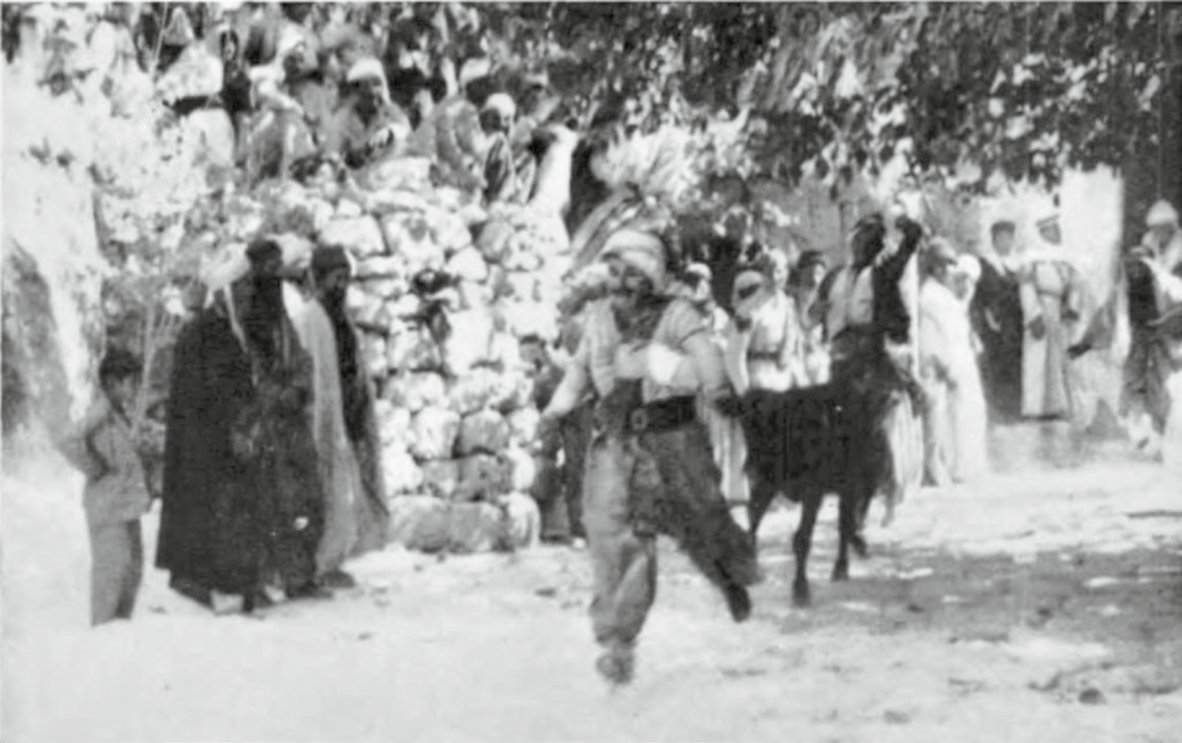
- Young men with rifles climbed the ridge, fired three volleys, ran down and fired another.
- Two “false alarms” followed: groups with rifles and freshly cut switches ran across the square.
- Then the bull burst forth through the arched gate, pursued by the crowd. In 1944 it did not run to the tomb of Şêx Şems but down the pilgrims' path; after a long chase it was led back on a rope. Throughout the valley the women trilled.
- Young men carried a white cloth (pêlat, “offering”) as a canopy; others crowded to touch it or get under it.
- The administrator slaughtered the bull with the words “Destûr Ellah” at the foot of the stairs to the tomb of Şêx Şems.
- The meat was distributed in the hostel of Ebû Bekr as Simat – boiled meat with wheat – to those who had taken part in the chase.
Edmonds emphasizes that in 1944 the bull was neither garlanded nor white, thereby contradicting authors who had written so without their own observation.
After the Qebax and the dances the administrator (micêwir) of each hostel distributed the festive meal simat. In the afternoon the Feraş came with three female servants dressed in white and a pan of olive oil and placed a burning wick in the niche that the Baba Şêx had visited the day before.
October 12: auction, baptism house and feasts
Walk over the Arafat
In the morning Edmonds went with Şêx Hecî over the hill Arafat. At the hostel of Ebû Bekr they met a grandson of Hemo Şero from Şengal. They saw the hostels of Xatûna Fexra and Şêx Îsmaîl, a cave with the wishing pillar ustûna miraza (whoever can embrace it will have a wish fulfilled) and the hostel of P’îr Hecalî with two chained lions on the lintel.
The auction at the tomb of Şêx Şems
- In 1944 the towers were freshly painted with white gypsum. The pounding of the gypsum the day before was done to the music of flutes.
- In a procession with flute and drum the Baba Şêx carried the large gilded double balls for the top of the tower to the tomb of Şêx Şems; all bystanders kissed them.
- Then an auction was held for the right to have the balls hauled up the spiral scaffolding and set in place in one's name: two brothers bid 6 dinars (6 pounds). The first application of the white gypsum brought 4 dinars in a second auction.
- Two female servants of the sanctuary and the young Mîr wore a dab of the consecrated gypsum on their foreheads, called tobirk (from Arabic tabarruk, “blessing”). The same ceremony had already taken place in the morning at the towers of Şêx Adî and Şêx Hesen.
The baptism house
Below the tomb of Şêx Şems lies the baptism house over the Kanîya Spî, a massive stone building on a terrace with a ribbed conical tower. To the south a small anteroom leads into the girls' baptism room (kanîya keçka), to the north a door into the brighter boys' room (kanîya kurka) with a basin of about 5 × 4 feet. In it live large spotted newts, called horî after the maidens of paradise. The overflowing water runs into two troughs at which anyone may water animals and wash pots.
In the reception room men and boys knelt before the Baba Şêx, kissed his right knee or a small heap of coins and added coins to it.
Three feasts
| Time | Meal | Course according to Edmonds |
|---|---|---|
| about 10:30 a.m. | Simat of Şêx Adî in the forecourt | The Baba Çawîş led in ten to twelve servants with wooden bowls of stew from the Gaykuj kitchen; those eating, including the Baba Şêx, stood along the walls; the Feraş gave the signal; people ate invoking Şêx Adî |
| immediately afterwards | Simat of the Mîr on the “terrace of the goats” | in memory of the Mîr's ancestors, especially his grandfather Elî Beg and his father Seîd Beg; Mayan Xatûn supervised three women cooking in three large cauldrons |
| about two hours after 11:30 a.m. | Simat of the Çilmêran | only for the villagers of E’yn Sifnî; only meat without wheat; the pieces were thrown into the crowd |
On the Simat of the Çilmêran tradition relates: Şêx Şems is said to have quarreled with Şêx Adî and stayed away for seven years. When the men of E’yn Sifnî were waiting for their food under a large mulberry tree by the Çilmêran, news came that Şems was already at the Bridge of Prayer. They snatched the half-cooked meat from the kitchen, threw it to the others and ran, eating, to the bridge to greet him.
It was part of the custom that the young men of E’yn Sifnî kept strangers away with sticks. In 1944 an intruder was beaten, drew a dagger and was taken away by the police. On this day the Mîr family was, by its own account, occupied with “certain ceremonies” that are not public.
October 13: return home
Already in the afternoon of the 12th and from early morning on October 13 the pilgrims went home. Most stopped at the bridge for a last pious act.
The valley and its mountains
Edmonds names the mountains around the valley, which is only about two miles long:
| Position | Name | Remark |
|---|---|---|
| West | Hizrat | about 4,000 feet (approx. 1,200 m); one informant called it Cûdî |
| North | Ziyaret | ridge with the elevation Arafat above the sanctuary |
| South | Mişat | – |
Further observations on the complex (market square, forecourt, reliefs, halls, hostels) are given in the article Lalîş.
Discrepancies with other sources
| Point | Other sources | Edmonds (1944) |
|---|---|---|
| Date of the festival | September 23 – October 1 O.S. (Omarkhali, in the article Pilgrimage to Lalîş) | September 23–30 O.S. = October 6–13; likewise Rodziewicz and the decree of 1960 |
| Color of the bull | “white bull” (Omarkhali, Guest), white oxen (Layard 1849) | in 1944 neither white nor garlanded |
| Chasing the bull | today forbidden by the Mîr (Rodziewicz) | in 1944 a long chase through the valley |
| Slaughterer | today a butcher of the Qiranî tribe (Rodziewicz) | in 1944 the administrator |
| Age of Tehsîn Beg | 13 years (Guest) | “about twelve” |
| Govend | in general a round dance | here a solemn dance of a few dancers on the terrace of the baptism house, separate from the mixed dance on the square |
Which statements are correct in each case cannot be decided from the sources; customs may also have changed between 1849, 1944 and today.
Sources
- C. J. Edmonds: A Pilgrimage to Lalish. London (Royal Asiatic Society) 1967, p. p-020–036, p-045, p-052, p-059
- International Journal of Yezidi Studies, Vol. 1. Tbilisi 2024, p. 169 (ill.)
Found a mistake?
Is something wrong – a fact, a spelling, a source, an image? Let us know: we check every report and correct the article.
Other spellings: Cejna Cimaye 1944 · Dschejna Dschimaye 1944 · Jejna Jimaye 1944 · Fest in Sex Adi 1944 · Lalish · Lalisch · Lalesh · Shekhan · Scheichan · Shaikhan · Sheikh · Scheich · Shex · Baba Sheikh · Baba Scheich · Bave Şêx · Sinjar · Sindschar · Shingal · Shengal