
Mîr Tahsîn Beg, son of Seîd Beg and grandson of Alî Beg, was Mîr of Şêxan and head of the Ezidis throughout the world. He took office in 1944 and held it until his death in 2019.
Accession in 1944 (according to Guest)
After the death of his father Seîd Beg on July 28, 1944, his grandmother Mayan Xatûn had the then 13-year-old Tahsîn Beg installed as Mîr. According to Guest, the deciding factor was his noble descent: his mother Xoxê Xatûn was a daughter of Prince Naîf Beg of the Çol family, while the mothers of his brothers came from the Basmariya family or from Şêx families. Suwaru Beg was regarded as a rival candidate. Until her death in 1957 Mayan Xatûn conducted affairs as regent.
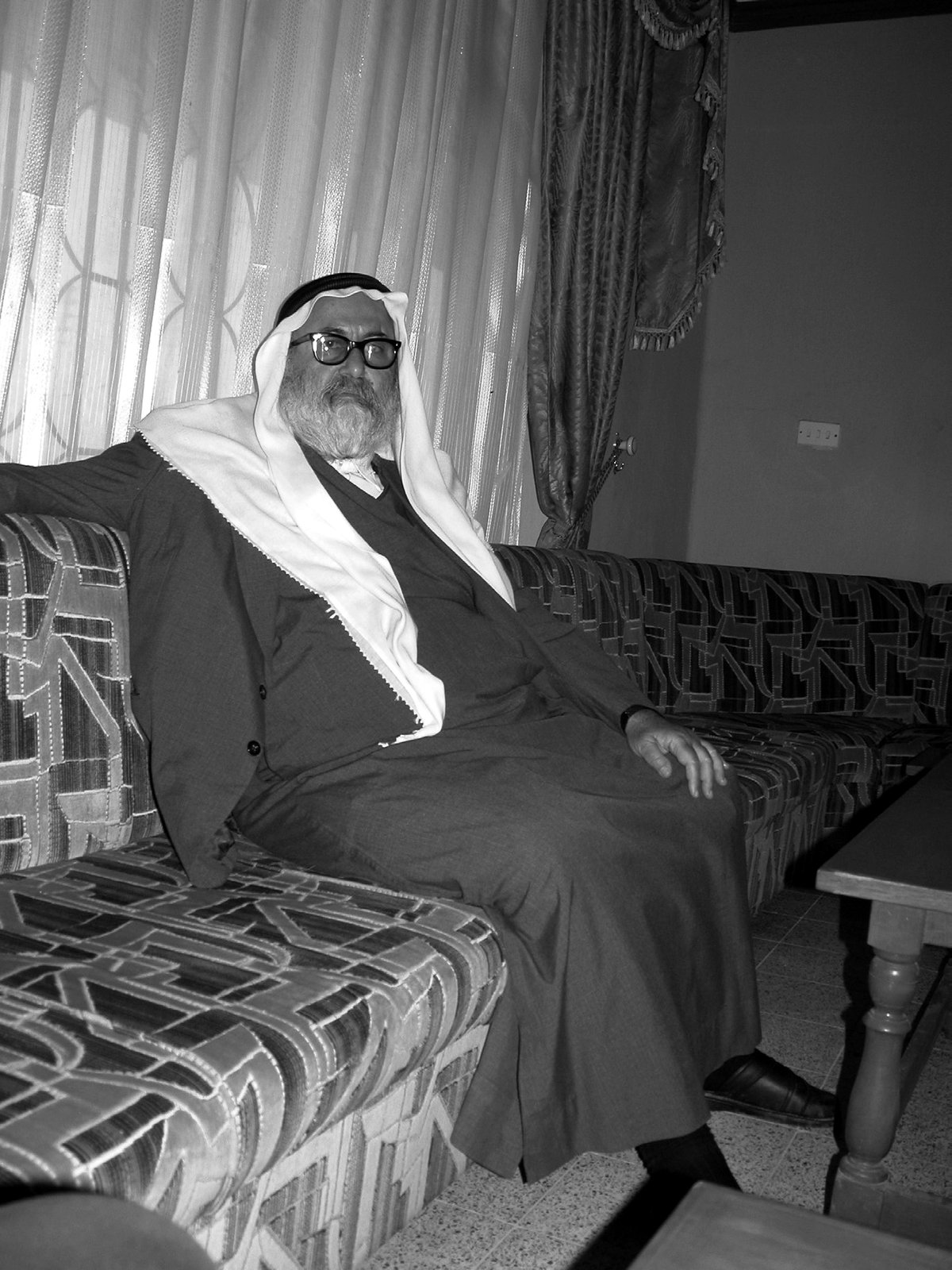
In 1981 an Ezidi in Baghdad saw Mîr Tahsîn Beg with his brothers Xeyrullah Beg and Faruk Beg and their mother Xoxê Xatûn. On the history of the family see The Mîr family Çol.
Visit to Armenia in 2012
In September 2012 Mîr Tahsîn Beg traveled to Armenia with a large delegation from Lalîş. In his own words, a Mîr had last been in Armenia in 1909 (Îsmayîl Beg); he understood his journey as a pilgrimage in his footsteps. It was thus the first visit by a Mîr in a good hundred years.
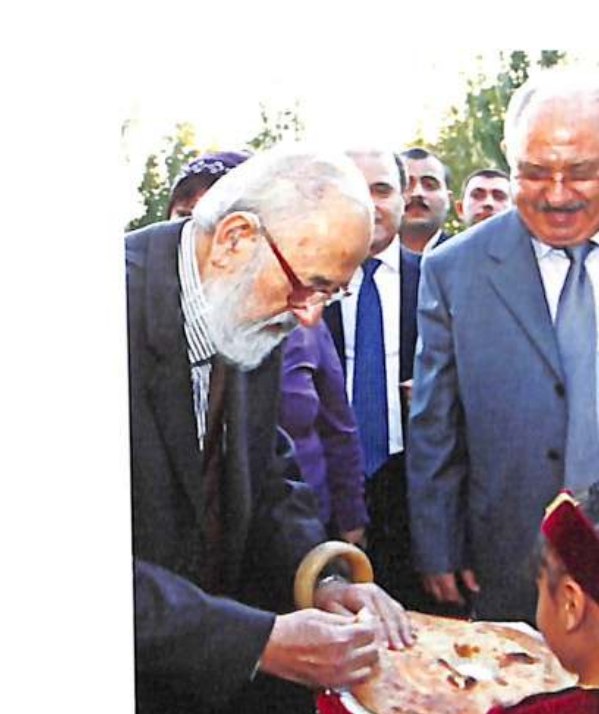
- The occasion was the consecration of the sanctuary of Aknalich on September 29, 2012. He declared this day the annual “Day of the Sanctuary”.
- Program: The first stop was the Tsitsernakaberd memorial in Yerevan. On September 28 he met Catholicos Karekin II in Etchmiadzin. He visited the Sardarapat memorial complex and Ezidi villages in the Ararat plain and in Aragatsotn, among them Sangyar, where he was received with zurna, drum, bread and salt.
- Political talks: He met Prime Minister Tigran Sargsyan, Deputy Speaker of Parliament Eduard Sharmazanov, Minister of Culture Hasmik Poghosyan, Deputy Foreign Minister Sergey Manasaryan and the Mayor of Yerevan, Taron Margaryan. He spoke about concerns of the Ezidi villages, advocated open borders and expressed the wish for an Ezidi deputy in parliament.
- Delegation: It included, among others, his son Mîr Hazim, his then 13-year-old grandson Amir, Bavê Şêx, Bavê Çawîş and the head of the Qewal, Bavê Gawan.

Visit to Armenia in 2015
In April 2015 he came for the second time, for the 100th anniversary of the genocide of 1915. He laid a wreath at Tsitsernakaberd and on April 22, 2015 was in Aknalich for the memorial ceremony and the laying of the foundation stone of a new, larger temple. He promised to consecrate this temple after its completion “if health permits”. Again he regretted that the Ezidis had no deputy of their own in the National Assembly. In a speech he related the family tradition that his father Seîd Beg had given refuge to Armenian refugees in 1915.
Year of birth
According to Guest he was 13 years old on taking office in July 1944, and would thus have been born around 1931. Bavê Şêx said in 2015 that Mîr Tahsîn Beg was born in 1933. The statements differ.
Year of birth and death according to Omarkhali
Khanna Omarkhali gives the life dates differently in her two books:
| Source | Birth | Further information |
|---|---|---|
| Omarkhali 2005 | 1931 in Baadrê, about 65 km north of Mosul | son of Seîd Beg, grandson of Elî Beg |
| Omarkhali 2023 | 1933 | of the house of Qatanî (Şêxûbekir); Mîr at 13; died on January 28, 2019 |
The year 1931 agrees with Guest (13 years old on taking office in 1944), the year 1933 with the statement of Bavê Şêx of 2015. The statement of 2023 that he became Mîr at 13, however, arithmetically fits only 1931. The exact year of birth therefore remains open.
Omarkhali gives the Mîr's line of ancestors as: Seîd Beg – Elî Beg – Mirza Beg – Hesen Beg – Qasim Beg (see The Mîr family Çol). On the offices that exist in Lalîş alongside the Mîr see Religious offices.
Succession
According to Shammo (2026), Mîr Tahsîn Beg died on January 28, 2019 in Germany. After a months-long dispute in the princely family, his son Hazim Tahsîn Beg was elected Mîr in July 2019 (see Succession of Mîr and Baba Şêx 2019/2020).
Additions according to Tezcür (ed., 2021)
- According to Majid Hassan Ali, after 1958 Tahsîn Beg was the first Mîr to establish official contact with the Kurdish movement. In the 1970s he fled to Great Britain and returned in 1981 after a pardon.
- In 2008, according to Tezcür, Kaya and Sevdeen, he expressed concern about the transfer of Ezidi property to non-Ezidis in Şêxan.
- In 2017 he called for participation in the independence referendum of the Kurdistan Region. His son Breen Tahsîn publicly criticized the KDP (Tezcür et al.; Ayhan).
- He died in January 2019; his successor was his son Hazim Tahsîn (see above).
Sources
- Birgül Açıkyıldız: The Yezidis. The History of a Community, Culture and Religion. London 2010, p. 104
- A. V. Perminov: Езиды – древний народ Адаби (The Ezidis – the ancient people Adabi). Sharya 2016, p. 114
- John S. Guest: The Yezidis. A Study in Survival. London/New York 1987, p. 234, 247
- Mirza Sloyan (Mirzoyê Çolo Siloyan): Дорога, ведущая в храм. Три года спустя (The road leading to the temple. Three years later). Yerevan 2015, p. 56–70, 83, 314–345
- Khanna Omarkhali (Ханна Омархали): Йезидизм. Из глубины тысячелетий (From the depths of the millennia). Saint Petersburg 2005, p. 86
- Khanna Omarkhali: The religious textual tradition of the Ezidis – from the oral to the written. Saint Petersburg 2023 (Russian translation of the English original, Wiesbaden 2017), p. 513–514
- Qader Saleem Shammo: The Yezidis in Kurdish Nationalist and Islamic Discourses after the 2014 Genocide (Yezidi Studies 4). Berlin 2026, p. p. 33
- Güneş Murat Tezcür (ed.): Kurds and Yezidis in the Middle East. Shifting Identities, Borders, and the Experience of Minority Communities. London: I.B. Tauris 2021, p. 50 (Ali), 93–94 (Tezcür et al.), 179 (Ayhan)
Found a mistake?
Is something wrong – a fact, a spelling, a source, an image? Let us know: we check every report and correct the article.
Other spellings: Mir Tahsin Beg · Mir Tahsin Bek · Mir Tahsin Bey · Mîr Tahsîn Bek · Mîr Tahsîn Bey · Mir Tahsîn Beg · Mir Tahsîn Bek · Mir Tahsîn Bey · Emir · Shekhan · Scheichan · Shaikhan · Sheikh · Scheich · Shex · Lalish · Lalisch · Lalesh · Jerewan · Eriwan