
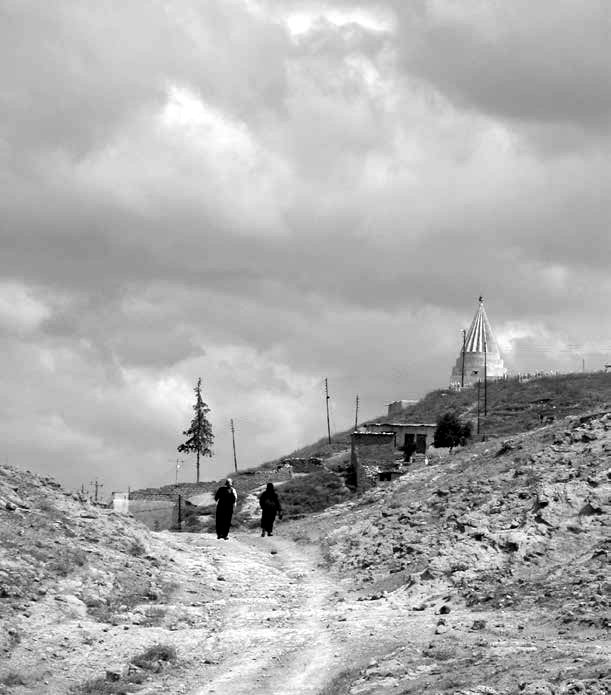
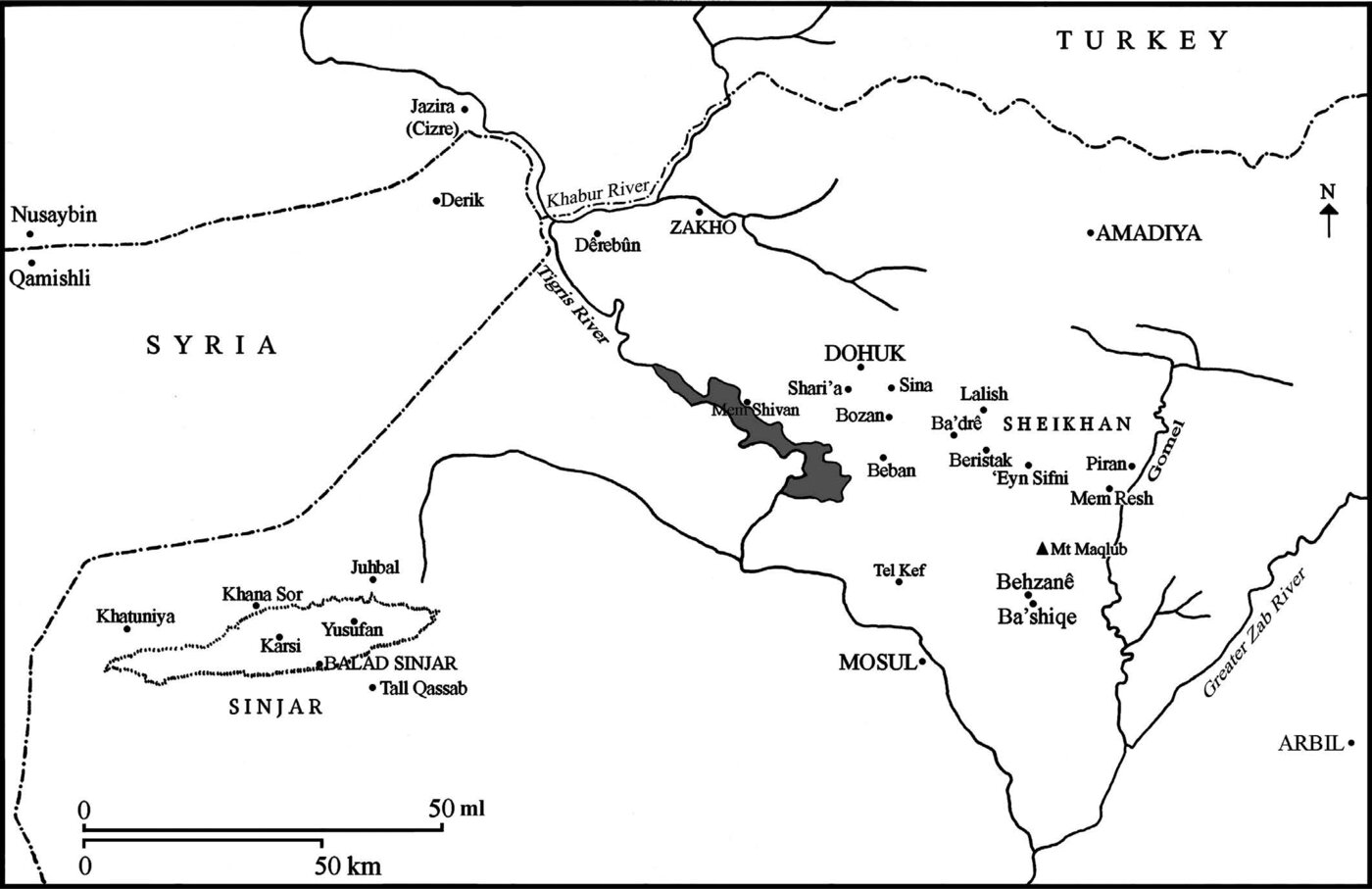
Şêxan is a region north of Mosul. Here lies the sanctuary of Lalîş, and here the hereditary Mîr of the Ezidis has his seat. The main town is Ain Sifni.
The Mîrs of Şêxan in the sources
- Şêx Mirza rose against the Ottomans in 1647–1648 and was executed in Van.
- Bedah Beg led an uprising in 1770–1771 that was crushed.
- Çolo Beg lost against the pasha of Amadiya in 1786–1787; a later Çolo Beg, son of Hasan Beg, was executed around 1790 by the Kurdish ruler of Amadiya.
- Alî Beg was captured and killed in 1832 by Bedirxan Beg, the hereditary Kurdish ruler of Botan.
- Mîr Tahsîn Beg was head of the Ezidis from 1944.
Persecutions
Şêxan was severely devastated in 1799–1800 (destruction of 25 villages), 1832 and 1892. Around 2012 Şêxan was, alongside Şengal, the main area of settlement of the Ezidis in Iraq.
Name and the Dasinî tribe (according to Guest)
In the 16th century the leading Ezidi tribe, the Dasinî, inhabited the foothills north and east of Mosul as far as Lalîş; its territory then extended southeast to between the Great and the Little Zab. According to John S. Guest, the region has borne the name Şêxan for about 200 years. Around 1508 the prince of Amadiya took the Ezidi fortress of Dohuk. In 1656 Evliya Çelebi counted 500 Ezidi houses in the village of Manar near Akrê, whose men all carried muskets.
Places
- Bacidrê (Baadri): traditional seat of the Mîr. In 1841 visitors found there a simple house of rubble stone and clay with a thatched roof; in the 1930s a new stone palace was built. In the Mîr’s castle the Sencaq are kept when they are not on their travels.
- Êsiyan (Ain Sifni): village near Bacidrê, in the 19th century seat of the Baba Şêx.
- Başîqa and Bahzanê: villages on Mount Maqlub, home of the Qewal families; Ezidis, Jacobites and Syrian Catholics lived side by side here. At New Year the largest celebrations with horse races take place here. In 1892 many sanctuaries of the two places were destroyed.
- Bozan: one of the most important burial places of the Ezidis, near Alqosh and the monastery of Rabban Hormizd.
Layard’s observations 1849–1850
The British archaeologist A. H. Layard, who excavated near Mosul in 1849–1850, visited Şêxan several times. He records:
- Bahzanê (in Layard Baazani) was a large village, “inhabited chiefly by Ezidis”. The revenues of the place had been leased by a Muslim gentleman from Mosul, Abd-ur-rahman Çelebi; in his house Layard met Mîr Huseyn Beg, Şêx Nasir and many Qewal.
- Başîqa and Bahzanê were separated only by a deep, mostly dry watercourse and both lay directly at the foot of the Cebel Maqlub.
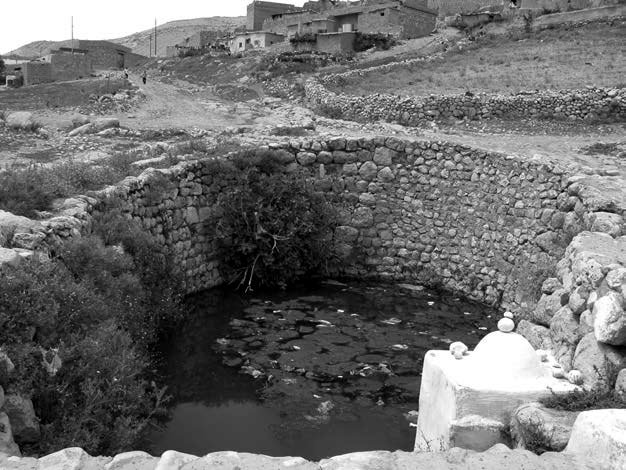
- Near Bahzanê, at the entrance to a ravine of the Cebel Maqlub, a spring rises from a grotto. According to a widespread tradition it is the cave of the Seven Sleepers; the Ezidis had made it into a Ziyaret (place of pilgrimage).
- In 1849 Başîqa and Bahzanê suffered from a stay of several days by the pasha of Mosul, Kamil Pasha, and therefore stayed away from the feast in Lalîş (see The feast in Lalîş 1849).
- In 1850 Layard witnessed in Başîqa the wedding of a niece of Qewal Yûsif (see Wedding).
- In Êsiyan Şêx Nasir had built a dwelling house shortly before 1850; Layard spent the night there with him, Huseyn Beg and many Qewal. In Bacidrê he was the guest of Huseyn Beg.
- The Ezidi district of Şêxan bordered on the district of Mizûrî with the Kurdish mountain villages of Xinnis and Bavian; according to Layard the Arab population ended with the plains.
Differing information on 1832
According to John S. Guest, Mîr Alî (Elî) Beg was killed in 1832 not by Bedirxan Beg but by the Kurdish prince Mîr Mihemed of Rewandiz (Emirate of Soran); see The massacre of 1832. An overview of all the Mîrs is given in The Mîr family Çol.
Şêxan in 1846 according to Layard
On his first visit in summer and autumn 1846 (Layard, Nineveh and Its Remains, vol. 1, 1849), Layard describes:
- Êsiyan: white houses and conical tomb buildings on the slope; strikingly clean compared with the Muslim and Christian places of the area; hospitality from the village headman. During the feast in Lalîş the village was almost empty. From Êsiyan to Lalîş one rode for two hours through a valley with oleander.
- Bacidrê: seat of Şêx Nasir and Mîr Huseyn Beg, at the foot of the range of hills about five miles north of Êsiyan. The houses were clean and well built, some in flower gardens, with watercourses from the springs on the slope. On the hill above the village lay the ruins of the castle of Mîr Elî Beg. In the Mîr’s reception room a spring-fed stream flowed right through the middle of the room.
- Sêmêl: the Ezidi chief of Sêmêl had a mud castle on the village mound and was well armed; the people of Sêmêl owned a large building of their own in Lalîş for the feast days.
- Layard names Bahzanê, Başîqa and Sêmêl as the main places of the Ezidis in the plain. North of Lalîş adjoined the territory of the Kurdish Mizûrî tribe.
On the feast of 1846 see The feast in Lalîş 1846.
Şêxan around 1940 according to Drower
- On the way from Başîqa to Êsiyan lay the places Fadhiliya and Nowera. In 1940 Êsiyan had a mixed population of Muslims, Christians and Ezidis, was the seat of the district governor (Qaimaqam) and had a school; the Baba Şêx lived there.
- In Bacidrê the castle (Qesr) of the Mîr stood on the hill, surrounded by holy trees.
- The village of Lalişa below the sanctuary of Lalîş was inhabited by Muslims.
- The pilgrims from Başîqa formerly needed two days by mule to Lalîş.
After 1991 (according to Tezcür, ed., 2021)
After 1991 Şêxan was divided: the south remained under the control of Baghdad, the north with Lalîş and Bacidrê came under the control of the Kurdish parties. According to Tutku Ayhan, the KDP settled Sunni Kurds in Şêxan. In 2007 the house of the Mîr and Ezidi centers in Şêxan were set on fire by Muslim Kurds (see Ezidis in Iraq in the 20th and 21st centuries). Majid Hassan Ali names as a geographical distinction within the Ezidis of Iraq the Şingalî (from Şengal) and the Welatî.
Village list in the 6th-grade schoolbook
The Ezidi 6th-grade schoolbook (T’amoyan et al., 2014) names Ezidi places in northern Iraq; the spelling follows the book and is partly distorted:
- Mosul region: Welatê Şêx (Şêxan, Êsfin), Kendala, Mamr’eşan, Miqbûlê, Çaravna, Başîk and Behzan (Başîqa and Bahzanê), Bakasir, Bae’dir (Bacidrê), Asîya, Cap’ara, Şêx Îdîrê, Sîna, K’alê Badir, Zarîa, Xanik.
- Around Dihok: Êlk’ûz, Baban, Zêxika, Horiza, K’arşaf, Bosa, Doxatê, Srêşka, Xoşaba, Mifarî, Neseirê, Çarehî, Gulbara, Tafîan, Xatarê, Daka Mezin, Daka Biç’ûk, Meşefê, Çangana, Babirlê.
According to the book, under Saddam Hussein Ezidi villages were resettled, Arabs were settled and Ezidis were officially listed as Arabs or Turkmen (see Ezidis in Iraq in the 20th and 21st centuries). As heroes it names Êzdî Mîrze, Mîr Ceferê De’sinî and Çol Beg. The statements “800,000 inhabitants” of these villages and “100,000 Ezidis killed in one night” in Xanesor in 1915 are without any evidence and are not adopted here.
Sources
- Birgül Açıkyıldız: The Yezidis. The History of a Community, Culture and Religion. London 2010, p. 36, 70, 133–134 (ill.)
- E’zîzê E’mer, H’esenê Şêx-Me’mûdê: E’debyet û zimanê êzdîkî, grade 6. Yerevan: Spîka 2014, p. p-039–040
- A. V. Perminov: Езиды – древний народ Адаби (The Ezidis – the ancient people Adabi). Sharya 2016, p. 62–65, 68, 73, 114
- John S. Guest: The Yezidis. A Study in Survival. London/New York 1987, p. 54, 60–66, 75, 78, 83, 101, 109, 123–124, 174, 182
- Austen Henry Layard: Discoveries among the Ruins of Nineveh and Babylon (abridged edition). New York 1853, p. 72–74, 111, 171–173, 181
- Austen Henry Layard: Nineveh and Its Remains, Vol. 1. London 1849, p. pp. 151–152, 271–279, 287–288, 306 (PDF 202–203, 324–332, 340–341, 359)
- E. S. Drower: Peacock Angel. Being some Account of Votaries of a Secret Cult and their Sanctuaries. London 1941, p. pp. 15, 18, 88, 138–143, 187 (PDF 26, 31, 111, 171–176, 228)
- Güneş Murat Tezcür (ed.): Kurds and Yezidis in the Middle East. Shifting Identities, Borders, and the Experience of Minority Communities. London: I.B. Tauris 2021, p. 46, 51, 54 (Ali), 177, 183 (Ayhan)
Found a mistake?
Is something wrong – a fact, a spelling, a source, an image? Let us know: we check every report and correct the article.
Other spellings: Sexan · Schechan · Shekhan · Scheichan · Shaikhan · Mossul · Mûsil · Lalish · Lalisch · Lalesh · Emir · Sheikh · Scheich · Shex · Sinjar · Sindschar · Shingal · Shengal · Singal · Duhok