
In the autumn of 1849 the British archaeologist Austen Henry Layard took part for the second time in the annual assembly festival in Lalîş; the first time had been in 1846 (see Pilgrimage to Lalîş). In his book of 1853 he describes above all what he had not yet seen in 1846. This article reproduces the course of events as Layard observed them. What was prayed and sung and what significance the acts have belongs to the section Religion; Layard's own interpretations are not adopted.
Invitation and journey
- Shortly after Layard's arrival in Mosul, Qewal Yûsif came with some Qewal from Bacidrê and invited him in the name of Mîr Huseyn Beg and Baba Şêx Şêx Nasir to the annual festival “at Şêx Adî”.
- On the first day Layard rode with his companions, the British vice-consul Christian Rassam and his interpreter, to Bacidrê. On the way Huseyn Beg came to meet him with many Ezidi horsemen and entertained him overnight. Şêx Nasir had already gone ahead to prepare the celebrations.
- The next morning they went on to Lalîş. In front of the valley they were received by Şêx Nasir, P’îr Sino, the Qewal, other clergy and the chiefs. The Qewal greeted the guests with Def and Şibab (frame drum and flute). Layard stayed in the same building in the sacred grove as in 1846.
Layard gives no exact date. He had set out from Bitlis on the 20th (of September) and was back in Mosul on October 12 after the festival and some excursions; the letters decided upon at the festival bear, according to Guest, the date October 1, 1849.
Who came and who was missing
In 1849, according to Layard, fewer pilgrims came than in 1846. He gives the reasons:
| Group | Reason for staying away |
|---|---|
| People from Şengal | Bedouins on the roads; only a few well-armed men dared the journey |
| Ebdê Axa of Sêmêl and his people | defense of their villages against Arab plunderers |
| Nomads (Koçer) and tribes of Dêrabûn | the same fear of the Bedouins |
| Inhabitants of Xerzan and Redwan | hard pressed by forced conscription into the Ottoman army |
| Inhabitants of Başîqa and Bahzanê | so tormented by a stay of the Pasha of Mosul that they were in no mood for celebrating |
On the last point Layard relates how the Pasha, Kamil Pasha, withdrew to Başîqa and there had first the donkeys banished, then the roosters slaughtered and then the crying children locked in the cellars with their mothers. Only when the village headman (Kehya) asked him, as a great vizier, to take action himself against the “infidel flies”, the only ones that did not obey the Sultan, did the Pasha laugh and leave.
On the places see Redwan and Xerzan around 1849, Şengal and Şêxan.
The first evening
About an hour after sunset Qewal Yûsif led Layard and Hormuzd Rassam – only the two of them were allowed to be present – to a window from which they overlooked the inner courtyard of the sanctuary.
- The lamp: In the middle of the courtyard stood an iron lamp with four wicks, a simple bowl on an iron rod stuck into the ground. A Feqîr held a torch and a large oil vessel, kept refilling the oil and in doing so loudly invoked Şêx Adî.
- The music: The Qewal stood against a wall and began a slow chant, accompanied by flutes and frame drums.
- The procession: The Şêx and chiefs moved in pairs around the lamp, now pausing, now walking on, and sang. At the head went Şêx Cindî, whom Layard describes as the Pêşnimêj (“prayer leader”) of the Ezidis. He was followed by two old Şêx, then Huseyn Beg and Şêx Nasir, after them the rest. All wore long robes “of the purest white”.
- The dance: Within the circle the Feqîr in their black robes danced in time to the music, with raised arms swinging to and fro. Gradually the chant grew faster, the drums beat more frequently, the Feqîr moved more vigorously, and the women uttered the joyful trill (tahlîl).
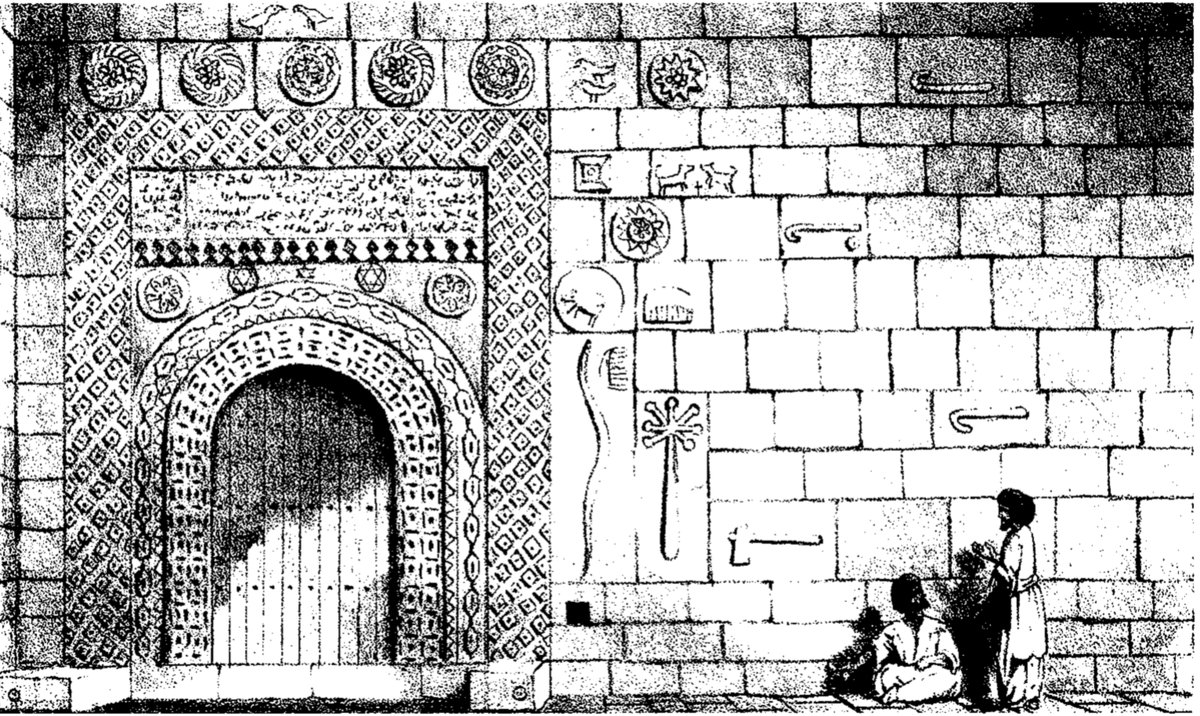
- Conclusion: Those who had walked in the procession kissed in passing the right side of the entrance to the sanctuary, on which a snake is depicted – according to Şêx Nasir and Qewal Yûsif, not the image itself. Then Huseyn Beg stood on the step of this entrance and received the homage of the Şêx and elders: each touched his hand and raised it to his lips. Finally all gave one another the kiss of peace.
Access: During the prayers clergy stood at the entrance of the sanctuary and let no one in except a few women and girls. The wives and daughters of the Şêx and Qewal had free access and evidently took part in the ceremonies.
Layard describes the clothing of Şêx Cindî thus: a tall, shaggy black cap, whose hair fell far into his face, and a long robe with horizontal stripes in black and dark red. He had a long jet-black beard; in Layard's company it was said that no one had ever seen him smile.
The assembly: report from Istanbul
After the ceremonies Huseyn Beg and Şêx Nasir led Layard into the inner courtyard. Carpets were laid out at the entrance of the sanctuary for him and the two heads; the Şêx, Qewal and respected men sat down along the walls. The vice-consul and his interpreter were now also admitted.
- Qewal Yûsif had to report in detail on his embassy to Istanbul – almost in the same words as in every village on the way.
- Layard urged those assembled to make use of the new rights and opportunities.
- It was decided to send letters of thanks, sealed by all the chiefs, to the Grand Vizier Reşid Pasha (for receiving the delegation) and to the British ambassador Stratford Canning (for his advocacy). The content and signatories of these letters according to Guest are given in The Mîrs of Şêxan 1832–1913.
Discrepancy between the sources: According to Layard (p. 17), Huseyn Beg and Şêx Nasir, “the heads of the whole community”, sent the delegation to the Sultan when they heard that Layard was in Istanbul; the occasion was the harsh forced conscription. According to John S. Guest, the British vice-consul Christian Rassam sent Qewal Yûsif to Istanbul. The two statements do not exclude each other, but the sources set different emphases.
The morning: the cover and the Herîse
- Shortly after sunrise the Şêx and Qewal spoke a short prayer in the courtyard, this time without the ceremonies of the previous evening. Some kissed the threshold and the holy places in the sanctuary.
- Then they took the green cover from the tomb of Şêx Adî and carried it, accompanied by the Qewal with flutes and drums, around the outer courtyard. The people crowded close, raised a corner to their lips and gave a small gift of money.
- Afterwards the chiefs and clergy sat down in the inner courtyard. The Koçek – according to Layard Feqîr and Şêx in the special service of the sanctuary – brought from the kitchens of the sanctuary large steaming dishes of Herîse (in Layard Karisa): crushed wheat, minced meat, milk and curdled milk, cooked into a thick porridge and covered with melted butter. While the guests ate in groups, the Koçek called out loudly that they should accept the hospitality of Şêx Adî.
- After the meal a collection was made for the upkeep of the sanctuary and the tomb.
Layard remarks that Herîse is a popular dish in Syria and Mesopotamia, which families cook at great festivals or on particular days when they have vowed it in illness or on journeys (see Ezidi cuisine).
Noon: dance and fun at the spring
Toward noon the guests sat down at the spring in the valley. Men and women danced, boys climbed into the trees to watch. Sugar, dates and raisins were thrown among the children. When a troop of Kurdish traders from the mountains arrived at the festival with donkeys and grapes for sale, the men made a game of burying traders, donkeys and grapes under a heap of people. The traders at first resisted, but were reconciled when they were amply compensated for their losses. According to Layard the whole valley laughed.
Layard gives no separate report of a market for 1849. On trade in the courtyard and the former market Suq al-Ma’rifa see Lalîş.
Afternoon: visit of the women
In the afternoon the wives and daughters of the chiefs and Qewal visited Layard. He describes their festive clothing exactly (see Traditional clothing):
- Girls braided flowers into their hair or placed a myrtle wreath around the black turban; they wore many necklaces of coins, amber, coral, agate and glass beads, some a black cap entirely set with gold and silver coins.
- A kind of checked apron in gray or yellowish, tied over one shoulder, fell over the silk gown.
- Unmarried women wore the neck uncovered, married women covered it with a white cloth.
- The women of the Qewal families always wore black turbans and black caps.
To the amusement of the bystanders Qewal Yûsif walked up and down arm in arm with his young wife in front of the guests to show how the “Frankish” husbands in Istanbul honored their wives.
The second night
During the night the ceremonies in the sanctuary were repeated. Layard was allowed to sleep in the room above the inner courtyard. When everyone had gone to rest, a cleric whom Layard calls “Mulla” recited a long narrative in a low chant before the burning lamp. Around him the Şêx and Qewal slept on the stone floor, wrapped in their white cloaks.
After the festival
- The next morning Layard, with Christian Rassam and the painter Frederick Cooper, visited the rock reliefs of Bavian, about six miles from the valley.
- Qewal Yûsif later showed him a booklet of verses, accompanied by Şêx Nasir's scribe – according to Layard the only Ezidi who could read it. Qewal Yûsif reported that before the great massacre by the Beg of Rewandiz the Ezidis had possessed many books, which were lost in the panic or destroyed by Kurds (see The massacre of 1832).
- On October 12, 1849 Layard was back in Mosul.
Offices and persons at the festival
| Person or office | Role at the festival of 1849 |
|---|---|
| Mîr Huseyn Beg | host; received homage on the threshold of the sanctuary |
| Baba Şêx Şêx Nasir | host; prepared the celebrations |
| P’îr Sino | received the guests in front of the valley |
| Şêx Cindî (Pêşnimêj) | led the evening procession |
| Qewal (headed by Qewal Yûsif) | music with Def and Şibab; singing; report from Istanbul |
| Feqîr | tending of the lamp; dance around the lamp |
| Koçek | hospitality with Herîse from the kitchens of the sanctuary |
| Wives and daughters of the Şêx and Qewal | free access to the sanctuary during the prayers |
On the offices in general see Religious offices, on the instruments Instruments and dance.
About the source
Layard wrote as a British archaeologist and diplomat who was personally attached to the Ezidis and had campaigned for them in 1849. He describes exactly, but interprets the ceremonies from a Christian European point of view; these interpretations are not reproduced here. Quotations follow the abridged New York edition of 1853. The well-known engravings of the dance in Lalîş appear only in the large London edition.
Sources
- Austen Henry Layard: Discoveries among the Ruins of Nineveh and Babylon (abridged edition). New York 1853, p. 17, 72–80, 82
- John S. Guest: The Yezidis. A Study in Survival. London/New York 1987, p. 119–120
Found a mistake?
Is something wrong – a fact, a spelling, a source, an image? Let us know: we check every report and correct the article.
Other spellings: Cejna Cimaye 1849 · Dschejna Dschimaye 1849 · Jejna Jimaye 1849 · Fest in Sex Adi · Lalish · Lalisch · Lalesh · Mossul · Mûsil · Qawwal · Kawal · Kewal · Emir · Baba Sheikh · Baba Scheich · Bave Şêx · Sheikh · Scheich · Shex · Sheikh Adi