
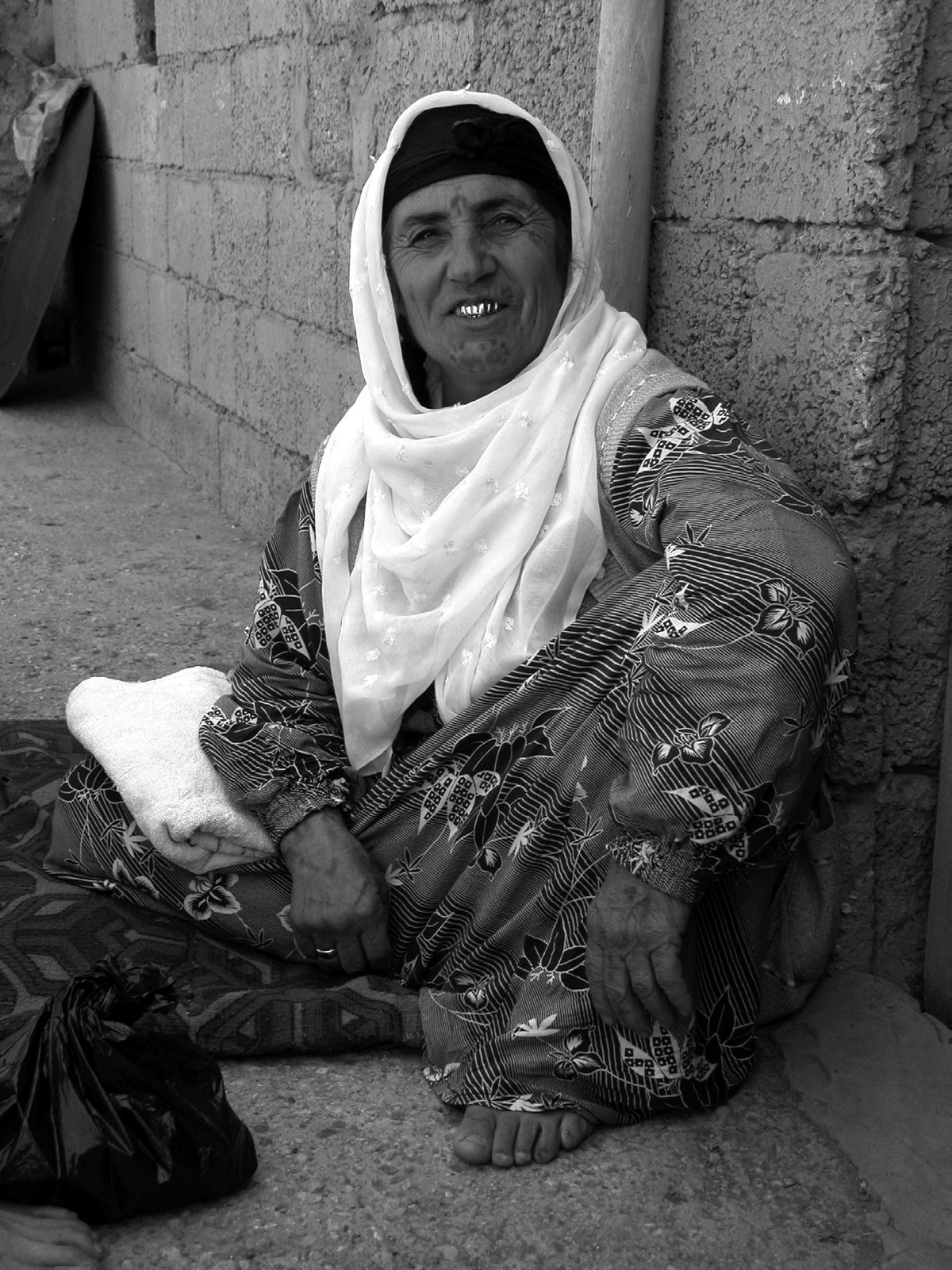
Tattoos on the hands, arms and legs were widespread among Ezidi women in the plain of Mosul around 1940. The most detailed description comes from the British orientalist E. S. Drower, who lived in Başîqa and Bahzanê in April 1940 and spoke with women about their tattoos (Peacock Angel, 1941). The information applies to these two places and this period; whether and how tattooing was done in other settlement areas is not clear from the source.
Who tattooed
- The female tattooist was called deqqaqe. Tattooing was done by women for women.
- In Bahzanê a Qewal who looked after a spring sanctuary said that his wife was a tattooist by profession.
- In Başîqa a married daughter of the village midwife was a tattooist; she explained her method of working to Drower.
- When Drower wanted to look at the women's tattoos, they laughingly sent the men away from the door.
The dye and the pricking
The paste consisted of three ingredients:
- sheep's bile,
- soot – exclusively from an olive oil lamp,
- fresh breast milk of a woman nursing a girl. With the milk of a mother of boys, the tattooist said, the pricks would fester.
The mixture was to be doughy. The pattern was drawn on the skin with the paste and then pricked in with a needle or two needles tied together until blood came. The spot at first swelled up; after healing the pattern appeared deep blue.
Why people had themselves tattooed
The women said they had themselves tattooed for adornment (zîne) and for beauty (hilwe). According to Drower, individual signs were placed on painful spots to keep the pain away.
Parts of the body
Unlike women in the south of Iraq, according to Drower, the Ezidi women seldom tattooed the whole body, but only:
- the back of the hand and the wrist,
- the forearm,
- the chest,
- the ankle and the lower leg.
The girls Drower met at a spring in Bahzanê had tattooed hands and arms.
Patterns
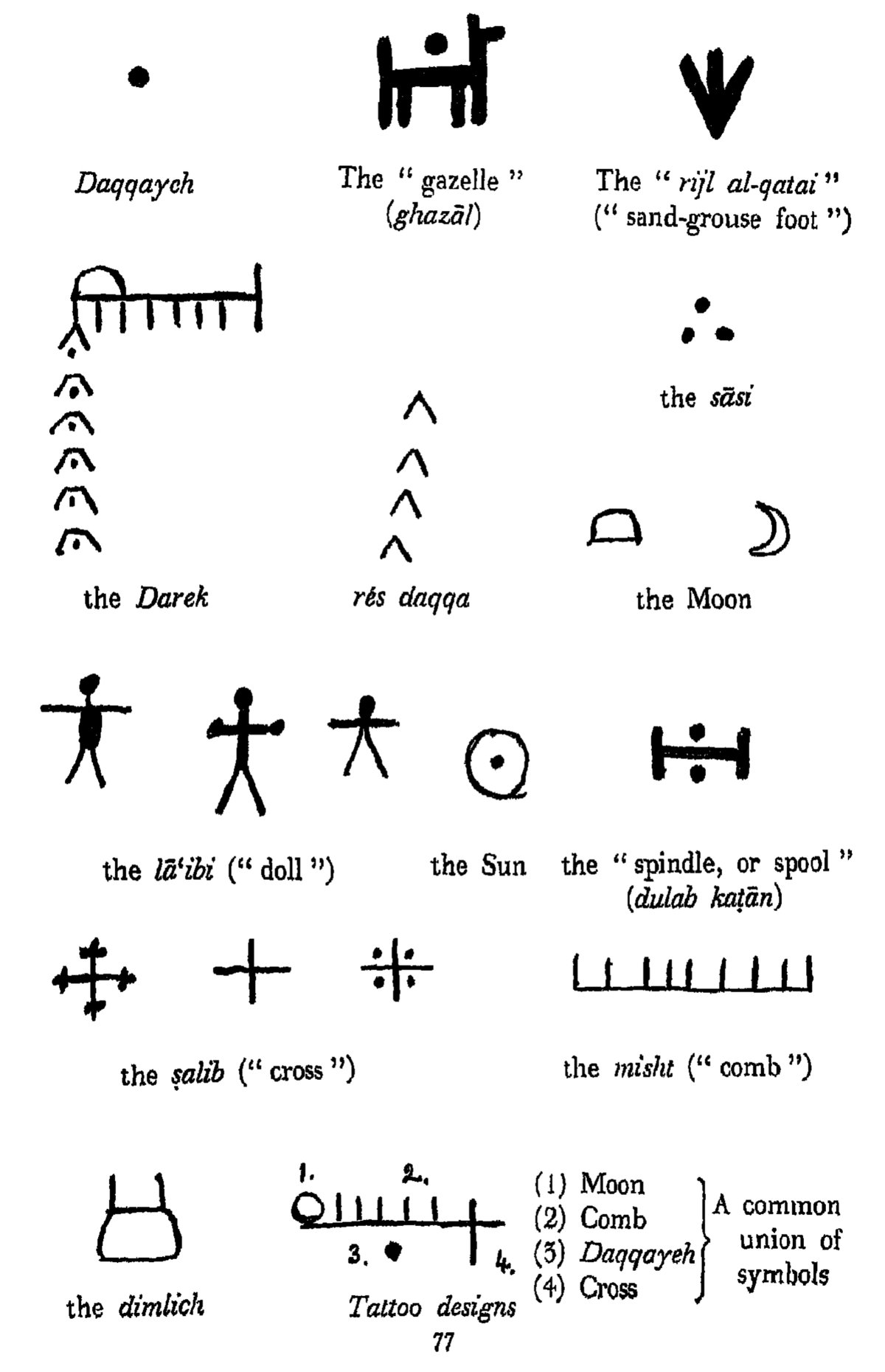
Drower had the most popular patterns named to her and copied them. The names are Arabic, since Arabic was the everyday language in Başîqa and Bahzanê (see Arabic-speaking Ezidis):
| Name | Meaning | Description |
|---|---|---|
| mişt | comb | often combined with a circle (qemr, “full moon”) or ending in a cross |
| Cross | – | also with leaf-shaped ends or with a dot in each arm |
| Gazelle | – | a dot (deqqaye) above the animal's back |
| ricl el-qeta | sandgrouse foot | like the track of a bird in the sand |
| Moon | – | full or as a crescent |
| la‘ibe | doll | simple human figure with outstretched arms and spread legs |
| dolab katin | bobbin, spindle | – |
| rês deqqa | – | an inverted V |
| dimlic | – | a shape like a bag hanging from two cords |
Drower found it remarkable that the women pronounced the word mişt (“comb”) without hesitation. She had heard that the Ezidis avoided this word because of its sound; this was not confirmed here.
Connection with clothing and jewelry
Like the coin cap, silver jewelry and dyed cloak, tattoos were part of the appearance of the women. On costume see Traditional clothing and Sersal in Başîqa 1940.
About the source
Drower observed for herself and asked the women; her own supposition that some signs are to be understood above all as magical is her interpretation. A sheet with her drawings of the patterns appears in her book; for legal reasons it is not reproduced here.
Sources
- Birgül Açıkyıldız: The Yezidis. The History of a Community, Culture and Religion. London 2010, p. 42 (ill.)
- E. S. Drower: Peacock Angel. Being some Account of Votaries of a Secret Cult and their Sanctuaries. London 1941, p. p. 29, 43, 50, 74–76 (PDF 44, 60, 67, 95–98)
Found a mistake?
Is something wrong – a fact, a spelling, a source, an image? Let us know: we check every report and correct the article.
Other spellings: Hautsdschhmudschk · Hautsjhmujk · Mossul · Mûsil · Bashiqa · Baschika · Qawwal · Kawal · Kewal · Eziden