
Ezidi cuisine is based on what livestock breeding and agriculture produce: milk, wheat, meat and herbs.
Dishes
- Girar – dish of curdled milk, wheat and herbs
- Avsîr – soup with eggs
- Kufte – balls of minced beef cooked in tomato sauce
- Ser dav – boiled wheat with butter and yogurt
- Xaşlama – boiled beef; together with seasoned rice (Birinc) the main dish at the funeral meal and at the annual commemoration
- Çeqilmast – refreshing drink of curdled milk and water
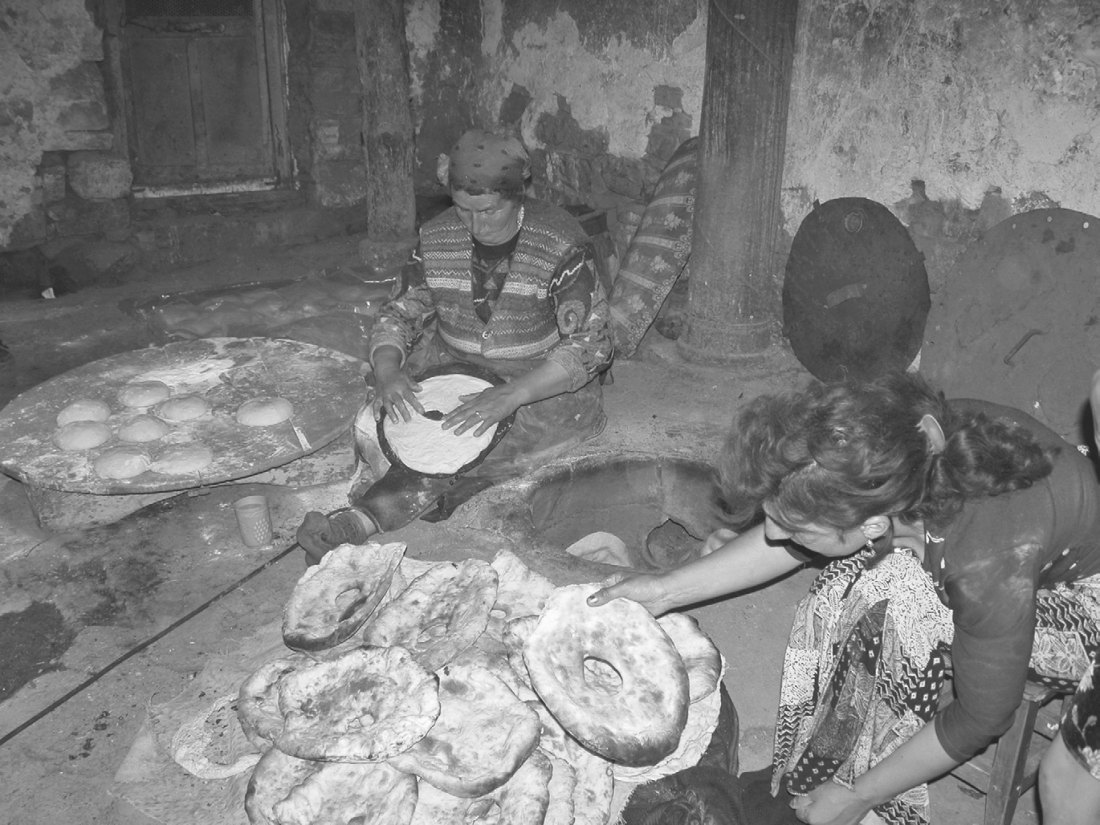
Nanê germ – the warm bread
When a family member was in danger and the danger has passed, fresh bread is baked or bought – Nanê germ, “warm bread” – and brought to one's P’îr or Şêx as a thank offering.
Food prohibitions
According to tradition, pork and cabbage are forbidden.
Cuisine and provisions in Başîqa around 1940 according to Drower
E. S. Drower lived in April 1940 in Başîqa in the house of an Ezidi family (Peacock Angel, 1941). She describes:
- Bread (nan): unleavened wheat flour with salt and a little sesame flour. The dough is rolled out paper-thin on a round three-legged stone slab (furşe) with a rolling pin (şabak) and a thin rod, and slapped onto the inner wall of the oven with a leather cushion.
- Kleiçe, the festive pastry for the New Year: filled with dates, raisins, nuts and sugar, seasoned with pepper, cubeb and cinnamon, with clarified butter; brushed with egg yolk and baked in the clay oven, which is heated with straw and dung (cf. Kiloça Serê Salê).
- Provisions: bulgur, lentils and beans in clay vessels under the ground; dried vine leaves for dolma; cheese; sesame, eaten with honey or syrup; home-boiled olive oil soap of two kinds.
- Festive dishes: Herîse (wheat porridge with meat), meat with flatbread, bulgur; for guests thin bread with cream or butter and sugar.
- Drinks: tea as a sweet syrup with a lot of sugar, also “three-color tea” with sugar, lemon leaves and tea; coffee bitter in cups without handles. Tea and coffee are prepared by the host or his son, not by the women (see Homestead and guest room).
- Wild plants: wild vegetables such as kenger and mallow (xubbaz); mahlab seeds as a spice. The wood of the mahlab tree is regarded as holy and is not burned; the Muxtar's staff is made from it.
- Harvest customs: at the beginning of the harvest and at the last sheaf a sheep was sacrificed.
Food rules according to Layard and Drower
The information on forbidden foods differs in the sources; Drower already noted that the opinions of her informants varied.
| Food | Layard (1846, according to Şêx and Qewal in Şêxan) | Drower (1940, according to Qewal Selman, Bahzanê) |
|---|---|---|
| Pork | forbidden | forbidden |
| Lettuce | forbidden | forbidden |
| Okra (bamya) | forbidden | forbidden |
| Cabbage | – | forbidden (cauliflower allowed) |
| Broad beans | – | forbidden (but eaten in Şengal) |
| Gazelle, birds | – | allowed |
| Wine | allowed | – |
| Meat | only from ritually slaughtered animals; but people ate with Christians | – |
According to Layard, the color blue was furthermore used neither in clothing nor in the house.
Sources
- Roger Lescot: Enquête sur les Yezidis de Syrie et du Djebel Sindjār (Study of the Ezidis of Syria and of the Şengal mountains). Beirut 1938, p. plate VII (p-196)
- Birgül Açıkyıldız: The Yezidis. The History of a Community, Culture and Religion. London 2010, p. illustrations
- A. V. Perminov: Езиды – древний народ Адаби (The Ezidis – the ancient people Adabi). Sharya 2016, p. 96, 108–109
- Austen Henry Layard: Nineveh and Its Remains, Vol. 1. London 1849, p. p. 300–301 (PDF 353–354)
- E. S. Drower: Peacock Angel. Being some Account of Votaries of a Secret Cult and their Sanctuaries. London 1941, p. p. 35, 42, 45, 49, 52, 85–86, 111–115, 122–123 (PDF 50, 57, 62, 66, 69, 108–109, 136–142, 151–152)
Found a mistake?
Is something wrong – a fact, a spelling, a source, an image? Let us know: we check every report and correct the article.
Other spellings: Xaslama · Chaschlama · Khashlama · Birindsch · Birinj · Nane germ · Nan germ · Ceqilmast · Tscheqilmast · Cheqilmast · Pîr · Sheikh · Scheich · Shex · Sinjar · Sindschar · Shingal · Shengal · Singal · Bashiqa